

The Art of Bitter Laughter: Decoding Haehak and Korean Satire Like an Insider
Phase 1: Empathy (Story-Immersive Opening)
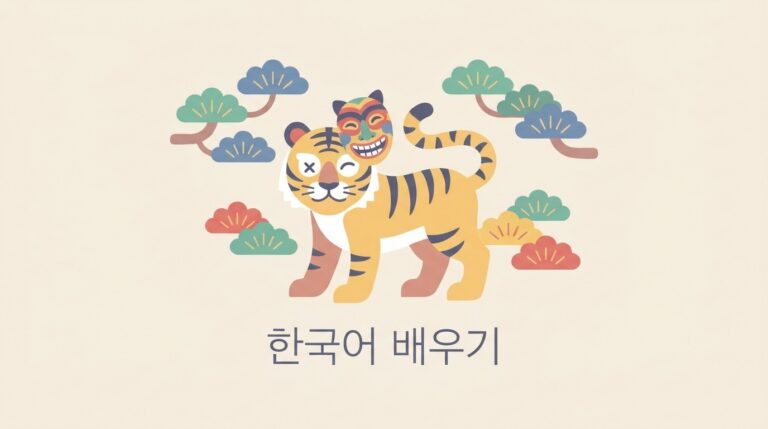
안녕하세요! 매일한글 에디터입니다. Have you ever watched a critically acclaimed Korean drama or film—think Parasite or an episode of Extraordinary Attorney Woo—and found yourself baffled when the Korean audience burst into uproarious laughter during an objectively tragic, heartbreaking moment? Or perhaps you’ve visited the National Folk Museum of Korea, stood before a Joseon-era folk painting (Minhwa), and wondered why the majestic, ferocious tiger looks cross-eyed, round-bellied, and goofy, being openly mocked by a tiny magpie perched on a pine branch.
At the C1 level, your grasp of syntax and vocabulary is solid, yet you might still hit an invisible cultural wall: the nuance of laughter born from sorrow. In western comedic frameworks, sharp wit often leans on sarcasm, dry cynicism, or dark humor. But Korean culture has cultivated something uniquely resilient over centuries of colonial oppression, class disparity, and national adversity: 해학 (Haehak)—the sublime folk art of disarming authority and easing existential hardship through gentle, self-deprecating, and cathartic laughter.
Without mastering this comedic subtext, high-level Korean feels strangely clinical. You might recognize every word in a modern workplace banter or a cutting socio-political critique, yet miss the subtle, winking social critique beneath. This guide was built directly from feedback gathered across hundreds of advanced learners who wanted to bridge that exact gap. Today, we step beyond textbook grammar into the beating heart of traditional Korean wit and its modern rebirth.
Phase 2: Core Expressions Deep Dive
1. 웃음으로 승화시키다 (Useumeuro seunghwasikida)
- Pronunciation: [Useumeuro seunghwasikida] (Think: “Oot-seum-eu-ro seung-hwa-shee-kee-da”)
- Meaning: Literally “to sublimate [pain/adversity] into laughter”; practically, turning agonizing struggle into communal humor and healing resilience.
- K-Culture Moment: Seen frequently in historical dramas or variety essay commentaries when describing how commoners during the Joseon Dynasty used Talchum (mask dances) to parody corrupt aristocrats (Yangban) rather than succumbing to despair.
- Editor’s Insight: 승화시키다 is an elevated, literary verb borrowing from chemistry (sublimation) and philosophy. When paired with 웃음 (laughter), it moves beyond mere distraction; it signifies psychological alchemy. You acknowledge the tragedy, refuse to be crushed by it, and elevate it into art.
- Situation Spectrum: Casual: ⚠️ | Semi-formal: ✅ | Formal: ✅
- 🤔 Think About It: Does your native culture have a concept that treats humor not merely as escapism, but as a moral victory over suffering?
2. 뼈 있는 농담 (Ppyeo inneun nongdam)
- Pronunciation: [Ppyeo inneun nongdam] (Think: “Ppyeo in-neun nong-dahm”)
- Meaning: Literally “a joke with a bone in it”; practically, a sharp, barbed truth disguised as a lighthearted quip.
- K-Culture Moment: Used constantly in corporate K-dramas when a junior colleague slyly exposes an executive’s incompetence under the guise of respectful dinner banter.
- Editor’s Insight: Traditional mask dances functioned entirely as 뼈 있는 농담. The commoners bowed low to the Yangban characters while slipping in puns that exposed their greed. If someone hits you with a comment that makes the whole room chuckle while leaving the target blushing, this is the exact phrase to use.
- Situation Spectrum: Casual: ✅ | Semi-formal: ✅ | Formal: ⚠️
- 🤔 Think About It: How does polite indirectness in Korean society allow jokes to carry heavier social critiques than straightforward complaints?
3. 눙치다 (Nungchida)
- Pronunciation: [Nungchida] (Think: “Noong-chee-da”)
- Meaning: Literally to smooth down or temper; practically, to defuse anger, awkward tension, or harsh confrontation with sly, genial humor.
- K-Culture Moment: Master interviewers and talk show hosts use this verb to describe guests who effortlessly deflect aggressive rumors with playful self-mockery.
- Editor’s Insight: This is a bona fide C1-level pure Korean word (순우리말). It embodies the spirit of Haehak. Instead of confronting hostility head-on with anger, one simply rolls with the punch, shrugs playfully, and neutralizes the venom.
- Situation Spectrum: Casual: ✅ | Semi-formal: ✅ | Formal: ⚠️
- 🤔 Think About It: Why does Korean culture value de-escalating conflicts through witty deflection more than direct ideological confrontation?
Phase 3: Textbook Korean vs. Real Korean
Situation 1: Describing a bittersweet, tragicomic life event
- 📖 교과서 한국어 (Textbook): 상황이 매우 슬프지만 한편으로는 웃음이 납니다. (Sanghwangi maeu seulpeujiman hanpyeoneoneun useumi namnida. – The situation is very sad, but on the other hand, it evokes laughter.)
- 🗣️ 진짜 한국어 (Real Native): 이거 완전 웃프잖아요. 해학 그 자체예요! (Igeo wanjeon utpeujanayo. Haehak geu jacheyeyo! – Isn’t this totally bittersweet? It’s the very definition of Haehak!)
- 💡 왜 다를까? (Why the difference?): Advanced natives blend the portmanteau 웃프다 (웃기다 + 슬프다) with high-concept cultural vocabulary to capture subtle emotional duality without sounding dry.
Situation 2: Calling out a trenchant social critique delivered through comedy
- 📖 교과서 한국어 (Textbook): 사회의 모순을 날카롭게 비판하는 유머였습니다. (Sahoeeui mosuneul nalkaropge bipanhaneun yumeoyeosseumnida. – It was humor that sharply criticized the contradictions of society.)
- 🗣️ 진짜 한국어 (Real Native): 농담 속에 뼈가 제대로 박혀 있네요. 탈춤 한 판 본 기분이에요. (Nongdam soge ppyeoga jedaero bakhyeo itneyo. Talchum han pan bon gibunieyo. – That joke had some serious bone in it. Feels like I just watched a round of traditional mask dance.)
- 💡 왜 다를까? (Why the difference?): Native Korean speakers frequently draw cultural allegories to folk performances (Talchum) to praise layered, socially conscious wit.
Phase 4: K-Culture Deep Dive & Non-Verbal Manners
4-1. Nunchi & Gestures: Delivering Satire Without Crossing the Line
In traditional Talchum, performers wore fixed wooden masks; they conveyed emotional duality solely through body tilts, exaggerated shoulder bounces (어깨춤), and vocal cadences. In modern social interactions, delivering Haehak requires exquisite Nunchi (눈치).
* The Self-Defacing Half-Smile: When using 뼈 있는 농담, never maintain an unblinking, aggressive stare. Soften your gaze, tilt your head slightly to a 15-degree angle, and pair the barb with a self-effacing half-smile. This signals: “I am critiquing the absurdity of the situation, not attacking your humanity.”
* The Shared Smirk (눙치기 제스처): When diffusing tension, a gentle outward wave of the hand accompanied by a relaxed breath shows that you are letting the tension dissolve into the room rather than holding onto resentment.
4-2. Cultural Code Analysis: From Joseon Minhwa to Bong Joon-ho
Consider the iconic Joseon folk painting Kkachi Horangi (까치호랑이 – Magpie and Tiger). The tiger represents the overbearing, pompous ruling class; yet folk painters never painted tigers as terrifying monsters. They gave them crossed eyes, goofy grins, and clumsy paws, while the small magpie (representing the common folk) looks down from the branch with a witty smirk.
Fast forward to modern Korean cinema. Directors like Bong Joon-ho (Parasite, The Host) are celebrated globally precisely because they inherit this aesthetic DNA. In Parasite, the lower-class Kim family makes jokes about stink bugs and WiFi theft while living in a flooded semi-basement. That is not nihilism; it is pure Haehak—human dignity maintained through laughter when structural forces deny that dignity.
Phase 5: Real-Life Roleplay Scenario
Setting: An avant-garde contemporary art gallery in Insa-dong. You are touring an exhibition titled “Neo-Minhwa: Masks of the 21st Century” with Min-jun (민준), an art director friend known for his razor-sharp cultural observations.
Characters:
* You: An advanced learner exploring traditional aesthetics.
* Min-jun (민준): A witty curator who loves connecting Joseon aesthetics to modern society.
- 민준: 이 민화 속 호랑이 표정 좀 보세요. 권력자라면서 콧물까지 흘리고 있잖아요.
(I minhwa sok horangi pyojeong jom boseyo. Gwonryeokjaramyeonseo konmulkkaji heulligo itjanayo.)
“Look at this tiger’s face in the folk painting. Supposed to be an almighty ruler, yet he’s practically dripping snot.”
🎭 [Pointing at the canvas with a wry grin] -
You: 그러게요. 위엄을 세우기는커녕 동네 바보처럼 그려놨네요.
(Geureogeyo. Wieomeul seugineunkeonyeong dongne babocheoreom geuryeonwatneyo.)
“Right? Far from projecting majesty, they painted him looking like the village fool.”
🎭 [Leaning in close, chuckling softly] -
민준: 바로 그게 조선 민중의 ‘해학’이죠. 칼을 들고 싸우기엔 힘이 없으니, 웃음거리로 만들어 권위를 무너뜨린 거예요.
(Baro geuge Joseon minjungeui ‘haehak’ijyo. Kaleul deulgo ssaugien himi eopseuni, useumgeoriro mandeureo gwonwireul muneotteurin geoyeyo.)
“That is precisely the common people’s ‘Haehak’. Lacking swords to fight, they stripped authority of its power by turning it into a laughingstock.”
🎭 [Folding arms, nodding thoughtfully] -
You: 요즘 직장인들이 터무니없는 야근을 ‘웃픈 밈’으로 소비하는 것도 같은 맥락일까요?
(Yojeum jikjangindeuri teomunieopneun yageuneul ‘utpeun mim’euro sobihaneun geotdo gateun maengnak-ilkkayo?)
“Would you say modern office workers consuming absurd overtime as ‘bittersweet memes’ shares the same context?”
🎭 [Raising an eyebrow playfully] -
민준: 정확해요! 고단한 현실을 웃음으로 승화시키지 않으면 당장 미쳐버릴 것 같으니까요.
(Jeonghwakhaeyo! Godanhan hyeonsireul useumeuro seunghwasikiji aneumyeon dangjang michyeobeoril geot gateunikkayo.)
“Spot on! Because if you don’t sublimate this exhausting reality into laughter, you’d go mad on the spot.”
🎭 [Snapping fingers in agreement] -
You: 탈춤에서 하인 말뚝이가 양반들을 대놓고 조롱하던 장면이 딱 겹치네요.
(Talchum-eseo hain Malttugiga yangbandeureul daenoko joronghadeon jangmyeoni ttak gyeopchineyo.)
“It overlaps perfectly with how Malttugi the servant openly mocked the aristocrats in traditional mask dances.”
🎭 [Mimicking a subtle mask dance shoulder bounce] -
민준: 맞아요. 뼈 있는 농담으로 양반들을 쥐락펴락했죠. 우리도 오늘 퇴근하고 막걸리 한잔하면서 상사 뒷담화로 신명 나게 놀아볼까요?
(Majayo. Ppyeo inneun nongdameuro yangbandeureul jwirakpyeorakhaetjyo. Urido oneul toegeunhago makgeolli hanjanhamyeonseo sangsa dwitdamhwaro sinmyeong nage norabolkkayo?)
“Exactly. He played the aristocrats like a fiddle with jokes full of bones. Shall we grab some makgeolli after work and release some festive energy venting about our bosses?”
🎭 [Winking conspiratorially] -
You: 좋습니다! 오늘 밤은 제대로 한을 풀고 훌훌 털어버리죠.
(Joeuseumnida! Oneul bameun jedaero haneul pulgo hulhul teoreobeorijo.)
“Sounds brilliant! Tonight let’s untie all our sorrow and shake it clean off.”
🎭 [Clapping hands with bright laughter]
🔀 Interactive Branching Moment
After Min-jun asks to vent over Makgeolli, how do you respond to showcase native-level cultural nuance?
- Option A: 좋습니다! 양반 풍자하듯 오늘 아주 시원하게 눙치면서 뼈 때려보죠.
(Let’s do it! Just like satirizing the Yangban, let’s deftly deflect and throw some bone-hitting truths tonight.) - Option B: 상사 욕을 하는 건 도덕적으로 옳지 않으니 전시회 이야기만 합시다.
(Talking behind our boss’s back is morally wrong, so let us only talk about the exhibition.) - Option C: 저 상사한테 불만 진짜 많은데, 회사 단체 메신저에 다 써버릴까요?
(I have so many complaints about our boss; should I write them all in the company group chat?)
Feedback:
* Option A (Best): 🌟 Perfect C1 response! You weave together 풍자 (satire), 눙치다 (to deflect with humor), and 뼈 때리다 (bone-hitting truth) while honoring the cathartic ritual of after-work drinks.
* Option B (Bad): ❌ Too literal and stiff. It completely rejects the communal function of Haehak and kills the friendly social atmosphere.
* Option C (Risk): ⚠️ Extreme danger. This confuses Haehak (subtle, witty catharsis) with destructive direct insubordination. You will face HR tomorrow morning!
Phase 6: 10-Second Emotion Shadowing Drill
Read these sentences aloud, paying strict attention to the pauses (/) and emotional milestones.
[😏 Bittersweet & Satirical]
슬픔을 속으로 삭이기보다는 / 웃음으로 승화시키는 게 / 우리 민중의 진짜 저력이죠.
(Seulpeumeul sogeuro sagigibodaneun / useumeuro seunghwasikineun ge / uri minjungeui jinjja jeoryeogijyo.)
“Rather than swallowing our grief inside / sublimating it into laughter / is the true inner strength of our people.”-
[😂 Wry & Piercing]
방금 그 농담, / 허허실실 웃고 넘기기엔 / 뼈가 너무 제대로 박혀 있는데요?
(Banggeum geu nongdam, / heoheosilsil utgo neomgigien / ppyeoga neomu jedaero bakhyeo itneundeyo?)
“That joke just now / to just casually laugh it off / had a bit too much bone embedded in it, don’t you think?” -
[😌 Calm & Defusing]
쓸데없이 각 세우지 말고, / 그냥 능청스럽게 눙치고 지나가세요.
(Sseuldeeopsi gak seuji malgo, / geunyang neungcheongseureopge nungchigo jinagaseyo.)
“Don’t pointlessly raise your defenses; / just deflect it smoothly with a sly smile and let it pass.”
Phase 7: K-Culture Mini Dictionary
- 해학 (Haehak) | Benevolent Humor / Cathartic Wit
Unlike cold sarcasm, 해학 laughs with love. It acknowledges the target’s human flaws and suffering, using warm absurdity to heal collective trauma rather than inflict humiliation. - 풍자 (Pungja) | Sharp Socio-Political Satire
The tactical sibling of Haehak. Where Haehak is warm and universal, 풍자 targets specific corrupt institutions, hypocritical elites, or social taboos through pointed allegories and wordplay. - 신명 (Sinmyeong) | Communal Ecstatic Joy / Catharsis
The emotional high achieved at the end of a traditional mask dance or percussion performance (Samulnori). It is the feeling of heavy sorrow (한) dissolving into infectious collective celebration. - 한 (Han) | Collective Lingering Sorrow and Resilience
The deep-seated historical melancholy woven through Korean art, music, and literature. Importantly, Han is never static; Haehak is the cultural motor used to untie (풀다) this accumulated pain.
Phase 8: Traveler’s Survival Kit
Top 3 Survival Expressions for Heritage Explorers
-
이 작품에 담긴 해학적인 요소를 설명해 주실 수 있나요?
(I jakpume damgin haehakjeogin yosoreul seolmyeonghae jusil su 있nayo?)
“Could you explain the elements of Haehak embedded in this artwork?”
Pro Tip: Use this at museum docent desks or traditional gallery tours. Curators will immediately treat you like a connoisseur. -
탈춤 공연에서 관객도 추임새를 넣어도 되나요?
(Talchum gong-yeon-eseo gwan-gaek-do chu-im-sae-reul neo-eo-do doe-na-yo?)
“Are audience members allowed to interject vocal shouts (Chuimsae) during the mask dance performance?”
Pro Tip: The answer is always yes! Shouting “얼씨구!” (Eolssigu!) or “좋다!” (Jota!) bridges the gap between spectator and performer. -
전통 민화를 현대적으로 재해석한 굿즈는 어디에 있나요?
(Jeontong minhwareul hyeondaejeogeuro jaehaeseokan gutjeuneun eodie 있nayo?)
“Where can I find merchandise that modernly reinterprets traditional folk paintings?”
Pro Tip: Museum gift shops in Korea (especially the National Museum of Korea, nicknamed ‘Muji of Joseon’) produce world-class design souvenirs.
Editor’s Travel Note: Heritage in Real Life
When visiting Seoul, don’t just admire the royal palaces like Gyeongbokgung. Head over to the National Folk Museum of Korea official guide app to explore commoner aesthetics. If you travel during autumn, take the KTX to Gyeongsangbuk-do for the Andong Mask Dance Festival. Purchase your tickets in advance using a local travel app, and remember: tipping performers is not customary in Korea, but active, rhythmic clapping and shouting affirmative vocal sounds (추임새) is the ultimate sign of cultural respect!
Phase 9: A Step Deeper (Reflective Essay)
In Western classical theatre, tragedy and comedy are segregated by distinct masks: Melpomene weeps, while Thalia laughs. Traditional Korean aesthetics, however, refuse this clean emotional dichotomy. In the Joseon mindset, joy and sorrow are merely two sides of a spinning coin.
When a culture experiences recurring foreign invasions, strict hierarchical caste systems, and rapid socioeconomic modernization within a single generation, pure optimism can feel naive, while relentless despair is fatal. Haehak became the psychological survival mechanism of the Korean people. By rendering the oppressor ridiculous and turning one’s own misery into self-mocking puns, the speaker reclaims agency. You cannot control your circumstances, but you can always dictate whether you meet them with tears or a brilliant, subversive grin.
💬 Your Turn: How does your native culture process collective trauma or authority? Do you rely on dark cynicism, quiet stoicism, or shared laughter? Share your perspectives in the comments below!
Phase 10: FAQ & Common Mistakes
Q: What is the exact difference between ‘해학’ (Haehak) and ‘풍자’ (Pungja)?
A: 풍자 (Satire) requires an explicit target of criticism—typically authority figures, hypocritical institutions, or systemic corruption—and aims to expose reality. 해학 (Benevolent Humor), on the other hand, embraces human fallibility with warmth. It laughs at weaknesses (including one’s own) to comfort and heal rather than condemn.
Q: Can I use the phrase ‘웃프다’ in a formal business presentation?
A: No. 웃프다 is modern colloquial slang. In formal presentations or professional writing, replace it with sophisticated C1 expressions like “비극과 희극이 교차하다” (Tragedy and comedy intersect) or “고난을 유머로 승화시키다” (Sublimating hardship into humor).
Q: Why do traditional Korean mask dances break the ‘fourth wall’ so often?
A: Unlike Western proscenium theatre, Korean Talchum is communal. The boundary between stage and spectator (마당) is fluid. The performers openly address the audience, ask their opinions, and invite them to join the dance to transform individual grievances (한) into collective festive liberation (신명).
🚨 Common Mistakes (흔한 실수) Warning Board
- Mistake: Using aggressive sarcasm and calling it 해학.
Correct Action: Korean Haehak lacks malice. If your joke insults someone’s personal dignity without underlying warmth, it is simply 비아냥 (mockery/sneering). - Mistake: Saying “뼈 때리지 마세요” to an elder or executive boss.
Correct Action: While trendy, 뼈 때리다 (hitting the bone / dropping hard truth) implies informal critique. Use “정곡을 찌르셨네요” (You hit the nail on the head) in professional contexts. - Mistake: Assuming folk painting tigers are meant to look scary.
Correct Action: Appreciate the deliberate caricature. Describing a Minhwa tiger as “scary” shows a lack of understanding; praise its goofy, rounded form as intentional 해학.
Phase 11: Action Mission & Community Engagement
- 🥉 Bronze Mission (Solo Shadowing): Practice saying “슬픔을 웃음으로 승화시키는 게 진정한 해학이죠” three times with an effortless, knowing smile in front of the mirror.
- 🥈 Silver Mission (Social Media): Find a K-drama meme or comic strip online depicting exhausting daily life. Post it to your Instagram story with the caption: “이것이 바로 K-해학의 현주소! 완전 웃프다 😂” and tag your language study buddies.
- 🥇 Gold Mission (Real Life Application): The next time a Korean friend or colleague makes a gently barbed, witty observation during drinks, nod admiringly and say: “방금 농담 속에 뼈가 아주 제대로 박혀 있었어요!”
🎮 K-Culture Mission: Watch Bong Joon-ho’s film Parasite or a contemporary performance by the Ambiguous Dance Company. Identify at least two moments where serious tension is broken by deliberate, clumsy physical humor. Note down how the characters use humor to survive pressure.
Phase 12: Interactive Quiz Challenge
1. Situational Judgment
Your Korean friend just spent three hours waiting in the rain for a famous pop-up store, only to find out it sold out right in front of them. They take a selfie of their drenched hair and post it with a funny duck face. What is the most culturally empathetic, high-level comment you can leave?
* A) 비를 맞았으니 감기에 걸릴 확률이 높습니다. 병원에 가세요.
* B) 절망적인 상황을 유쾌한 해학으로 승화시켰네요! 완전 웃퍼요.
* C) 왜 그렇게 비효율적으로 줄을 서서 시간 낭비를 하셨나요?
2. Fill-in-the-Blank
조선 시대 탈춤에서 말뚝이는 양반들의 위선을 꼬집기 위해 날카로운 ( ) 있는 농담을 던졌습니다.
* Hint: Meaning literally “a joke with bone in it.”
3. True / False Cultural Check
- Traditional folk paintings (Minhwa) depicted tigers with crossed eyes and silly smiles because the Joseon painters lacked the technical skill to draw realistic anatomy. (True / False)
🔍 Click here to reveal the answers and explanations!
1. Answer: B
Explanation: Option B perfectly appreciates their attempt to turn bad luck into laughter (Haehak) using authentic advanced vocabulary (승화시키다, 웃프다). Option A is overly medical and clinical, while Option C is tactless and critical.
2. Answer: 뼈
Explanation: The complete idiom is 뼈 있는 농담 (a joke with a bone in it), describing sharp satire nestled inside comedic packaging.
3. Answer: False
Explanation: Joseon court painters possessed extraordinary realistic techniques (as seen in royal portraits). The simplified, comical rendering in folk paintings was a conscious aesthetic choice designed to satirize corrupt aristocrats and render fear harmless through laughter.
🎬 Watch Our Daily Videos! (Daily Hangul Official Instagram)
Review the expressions you learned in this article with our fun daily short videos! Check out native pronunciation and real-life nuances in action.
- Instagram @dailyhangul_en







