

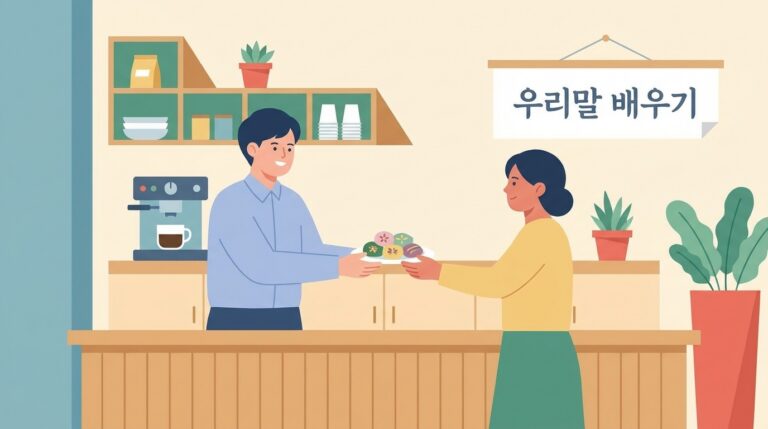
Master Korean Workplace Diplomacy: The Genius Strategy of Feeding Your Enemy
Phase 1: Empathy & K-Culture Opening
안녕하세요! 매일한글 에디터입니다. (Hello! I am your Daily Hangul editor.)
Picture this: You are sitting in an open-plan office in Teheran-ro, Gangnam. The quarterly strategy review just concluded, and your colleague—let’s call him Manager Kim—spent twenty grueling minutes nitpicking your proposal with barely concealed passive aggression. Your heart is pounding. Every instinct from your native culture screams: confront him directly, refute every bullet point, or ice him out completely.
Just as your jaw clenches, a seasoned Korean mentor gently places a hand on your desk, slides over a box of artisan songpyeon (rice cakes), and whispers with an enigmatic half-smile:
“미운 놈 떡 하나 더 준다고 하잖아요. 가서 제일 큰 놈으로 건네고 오세요.”
(“They say give an extra rice cake to the one you dislike. Go hand him the biggest one.”)
To a Western ear, this advice sounds like spineless surrender or baffling absurdity. Why reward hostility with indulgence? Yet, in the complex, high-context chess game of Korean social hierarchy, this ancient proverb is not submission—it is the ultimate, paradoxical masterstroke of psychological diplomacy (고단수 처세술, godansu cheosesul). By mastering this single native concept, you cease being an outsider puzzled by confusing office politics and step into the echelon of C2-level cultural fluency, where conflicts are disarmed before they even spark.
Phase 2: Core Expressions Deep Dive
1. 미운 놈 떡 하나 더 준다 (Miun nom tteok hana deo junda)
- Pronunciation: [Mee-oon nom ddeok ha-na deo joon-da] (Think “me-un”, “nom” like a quick “numb”, “tteok” with a tense crisp ‘tt’, “deo” like the first syllable of ‘dirty’, and “joon-da”.)
- Meaning:
- Literal: “Give one more rice cake to the detestable fellow.”
- Nuance: Disarm an antagonist through deliberate, unexpected generosity, simultaneously claiming the moral high ground and rendering further hostility unviable.
- K-Culture Moment: Seen frequently in K-Dramas like Misaeng: Incomplete Life or Queen of Tears, where an underdog executive smiles, buys an adversary an upscale ginseng tonic, and completely disorients their scheming opponent.
- Editor’s Insight: The word ‘놈’ (nom) is a blunt, slightly pejorative marker for a person, grounding this proverb in earthy, peasant wit rather than sterile Confucian etiquette. The ‘떡’ (tteok) represents something valuable, delicious, and scarce. You are not yielding; you are overwhelming malice with strategic largesse.
- Situation Spectrum: Casual: ✅ | Semi-formal: ✅ | Formal: ⚠️ (In boardrooms, soften ‘놈’ to ‘사람’ or use ‘적대적인 상대에게 호의를 베풀다’)
- 🤔 Think About It: Does your native tongue have a proverb like “Kill them with kindness”? How does offering food specifically alter the dynamic of social retribution?
2. 고단수 처세술 (Godansu cheosesul)
- Pronunciation: [Go-dan-soo cheo-se-sool] (Pronounce like “go” + “dahn” + “sue”, followed by “chuh-seh-sool”.)
- Meaning:
- Literal: “High-Dan (master rank) worldly survival art.”
- Nuance: Sophisticated, multi-layered strategic interpersonal maneuvering that solves tension gracefully.
- K-Culture Moment: In historical sageuk dramas like Under the Queen’s Umbrella, court officials describe a queen’s subtle alignment of hostile factions as 고단수 처세술.
- Editor’s Insight: Originating from Baduk (Go) rankings, ‘고단수’ implies thinking five moves ahead while your rival is only reacting to the current stone on the board.
- Situation Spectrum: Casual: ⚠️ | Semi-formal: ✅ | Formal: ✅
- 🤔 Think About It: Why does Korean culture value indirect diplomatic agility (처세술) above brute force confrontation?
3. 원한을 풀다 (Wonhaneul pulda)
- Pronunciation: [Won-han-eul pool-da] (Pronounce as “won” + “hahn” + “ool” + “pool-dah”.)
- Meaning:
- Literal: “To untie deep-seated grievance/grudge.”
- Nuance: Actively dissipating systemic animosity so that lingering negative karma dissolves.
- K-Culture Moment: The thematic climax of nuanced revenge dramas, where true power lies not in annihilating an enemy, but in causing them to self-reflect and release the vendetta (한, han).
- Editor’s Insight: In Korean philosophy, grudge is not “smashed” or “broken”; it is a tangled knot (풀다, to untie). Tangible generosity is the lubricant that loosens that knot.
- Situation Spectrum: Casual: ✅ | Semi-formal: ✅ | Formal: ✅
- 🤔 Think About It: How does the conceptual metaphor of “untying” a conflict differ from “winning” an argument?
Phase 3: Textbook Korean vs. Real Korean
Situation 1: Deciding to treat an abrasive co-worker to coffee
- 📖 교과서 한국어 (Textbook):
“저는 사이가 안 좋은 동료에게 친절하게 대하기로 결심했습니다.”
(Jeoneun saiga an joeun dongryoege chinjeolhage daehagiro gyeolsimhaesseumnida. – I have resolved to treat my coworker with whom I have bad relations kindly.) - 🗣️ 진짜 한국어 (Real-World C2):
“속은 쓰리지만, 미운 놈 떡 하나 더 주는 셈 치고 커피 한 잔 사 들고 갔죠.”
(Sogeun sseurijiman, miun nom tteok hana deo juneun sem chigo keopi han jan sa deulgo gatjyo. – It irked me inside, but taking the stance of giving an extra rice cake to the detestable guy, I bought and brought him a coffee.) - 💡 왜 다를까? (Why the difference?):
Advanced native speakers rarely proclaim naive moral benevolence. Using the construction~는 셈 치고(acting as if / considering it as) combined with the proverb demonstrates emotional honesty alongside strategic maturity.
Situation 2: Analyzing someone’s brilliant response to sabotage
- 📖 교과서 한국어 (Textbook):
“그분의 행동은 매우 지혜로운 대인관계 전략이었습니다.”
(Geubunui haengdongeun maeu jihyeroun daeingwangye jeollyagieosseumnida. – That person’s behavior was a very wise interpersonal strategy.) - 🗣️ 진짜 한국어 (Real-World C2):
“감정적으로 맞받아치지 않고 판을 뒤집다니, 진짜 고단수 처세술이네요.”
(Gamjeongjeogeuro matbadachiji anko paneul dwijipdani, jinjja godansu cheosesulineyo. – Rather than firing back emotionally, flipping the entire board like that—what high-tier tactical diplomacy!) - 💡 왜 다를까? (Why the difference?):
C2 mastery replaces stiff Latinate adjectives with kinetic game-theory idioms like맞받아치다(retaliate blow for blow) and판을 뒤집다(flip the playing field).
Phase 4: K-Culture Deep Dive & Non-Verbal Manners
4-1. 눈치 (Nunchi) & The Gift Delivery Gesture
When executing the “extra rice cake” maneuver, non-verbal performance is everything. If you hand your adversary a gift with a sarcastic smirk, the gesture becomes a blatant insult (기만).
- Hand Position: Always deliver the beverage or document with both hands (두 손으로 건네기), supporting your right elbow or forearm lightly with your left hand. This formal deferential posture physically lowers your aggression.
- Gaze (시선 처리): Keep your gaze softly focused at neck or chin level, avoiding the piercing, unblinking eye contact that signals western dominance. It communicates calmness and magnanimity.
- Micro-Expression: Maintain a composed, neutral half-smile. You are neither seeking their approval nor gloating; you are demonstrating emotional invulnerability.
4-2. Cultural Code Analysis: The Psychology of “Che-myeon” (Face)
Why does this proverb work so effectively in modern Korea? Korean society operates on communal optics (체면, chaemyeon). When someone mistreats you publicly and you retaliate, you create a zero-sum dogfight where observers feel uncomfortable. However, when you repay hostility with a prestigious favor, you trap the aggressor in a psychological cul-de-sac: if they accept, they owe you social debt; if they continue their aggression, the entire office identifies them as an unreasonable villain. You win without firing a shot.
Phase 5: Real-Life Roleplay Scenario
- Location: The corporate breakroom of a bustling venture firm in Pangyo.
- Context: Senior Strategist Julian has faced relentless, petty obstructionism from Assistant Director Choi (최 과장). Instead of escalating, Julian applies high-level Korean tact with Colleague Min-ji (민지 대리).
Julian: 민지 대리님, 최 과장님이 오늘 회의 때 제 기획안에 사사건건 태클 거셨잖아요. 솔직히 표정 관리하기 힘들었어요.
(Min-ji daerinim, Choi gwajangnimi oneul hoeui ttae je gihoek-ane sasageon-geon taekeul geosyeotjanhayo. Soljikhi pyojeong gwallihagi himdeureosseoyo.)
🎭 Julian sighs deeply, looking weary while stirring his espresso.
“Assistant Director Min-ji, Assistant Director Choi picked apart every single detail of my proposal today. Honestly, keeping my poker face was brutal.”
Min-ji: 아휴, 봤어요. 옆에서 보는 제가 다 조마조마하더라고요. 최 과장님, 본인 프로젝트 밀리니까 줄리안 님 견제하는 거예요.
(Ahyu, bwasseoyo. Yeop-eseo boneun jega da jomajomahadeoragoyo. Choi gwajangnim, bonin peurojekteu millinikka Julian nim gyeonjehaneun geoyeyo.)
🎭 Min-ji glances toward the doorway and lowers her voice.
“Ugh, I saw it. Sitting next to you, even my heart was in my throat. Manager Choi is threatened by you because his own project is falling behind.”
Julian: 맞서서 싸우자니 팀 분위기만 망칠 것 같고, 가만히 있자니 만만하게 볼 것 같고… 참 난감하네요.
(Matseoseo ssaujani tim bun-wigiman mangchil geot gatgo, gamanhi itjani manmanhage bol geot gatgo… Cham nan-gamhaneyo.)
🎭 Julian taps his finger against the counter thoughtfully.
“Fighting back head-on will poison the team vibe, but doing nothing makes me look like an easy target… It’s truly a dilemma.”
Min-ji: 이럴 때 선배들이 늘 하던 말이 있죠. ‘미운 놈 떡 하나 더 준다’고요.
(Ireol ttae seonbaedeuri neul hadeon mari itjyo. ‘Miun nom tteok hana deo junda’goyo.)
🎭 Min-ji gives a knowing, mischievous smile.
“This is when senior colleagues always drop that old line: ‘Give an extra rice cake to the one you hate.'”
Julian: 그 말씀은… 오히려 최 과장님한테 호의를 베풀라는 뜻인가요?
(Geu malsseumeun… Ohiryeo Choi gwajangnimhante houireul bepullaneun tteusingayo?)
🎭 Julian raises an eyebrow, fascinated.
“Does that mean… I should actually extend generosity toward Manager Choi?”
Min-ji: 그렇죠! 다음 주 데이터 분석 때 최 과장님 파트 필요한 레퍼런스 먼저 챙겨드려 보세요. 완전히 허를 찌르는 거죠.
(Geureochyo! Daeum ju deiteo bunseok ttae Choi gwajangnim pateu piryohan repeoreonseu meonje chaeng-gyeodeuryeo boseyo. Wanjeonhi heoreul jjireuneun geojyo.)
🎭 Min-ji nods enthusiastically, crossing her arms.
“Exactly! Next week during the data analysis phase, assemble the reference materials he desperately needs and hand them over first. Catch him totally off guard.”
Julian: 하하, 그의 경계심을 무장해제시키는 고단수 처세술이군요.
(Haha, geuui gyeonggyesimeul mujanghaejesikineun godansu cheosesul-igunyo.)
🎭 Julian breaks into a genuine, enlightened smile.
“Haha, a high-tier strategy to disarm his vigilance completely.”
Min-ji: 맞아요. 적을 내 편으로 만드는 제일 우아한 방법이에요!
(Majayo. Jeogeul nae pyeon-euro mandeuneun jeil uahan bangbeobieyo!)
🎭 Min-ji clinks her paper cup against Julian’s mug.
“Spot on. It’s the most elegant way to turn a rival into an ally!”
🔀 Interactive Decision Point
Manager Choi walks past the breakroom looking exhausted, muttering about an impending client presentation deadline. What do you do?
- Choice A: Prepare a cup of premium black tea with a neatly organized folder of your industry research, saying: “과장님, 오늘 발표 준비 힘드실 텐데 참고 자료 좀 정리해 뒀습니다.” (Manager Choi, you must be exhausted preparing for today’s presentation; I organized some reference materials for you.)
- Choice B: Walk straight up to him and demand: “과장님, 회의 때 왜 자꾸 제 의견만 물고 늘어지세요?” (Manager Choi, why do you keep nitpicking only my opinions in meetings?)
- Choice C: Look away, pretend not to see him, and post an anonymous rant on the workplace community Blind app.
Feedback Evaluation:
- Choice A (Best – The Masterclass Move): You implement the proverb flawlessly. By addressing his vulnerability with professional benevolence, you deny him a target for future aggression and assert your undeniable dominance.
- Choice B (Bad – Catastrophic Confrontation): Violates Korean corporate collectivism. Choi will dig in his heels to protect his che-myeon (reputation), painting you as an abrasive troublemaker.
- Choice C (Risk – Passive Resentment): It vents immediate anger but shifts zero social dynamics. The hostility remains unaddressed and will ambush you again.
Phase 6: 10-Second Emotion Shadowing Drill
Sharpen your cadence, pause timing, and emotional color by shadowing these sentences aloud.
[😏 여유롭고 고단수다운 태도로 / With calm, strategic poise]
미운 놈 / 떡 하나 더 준다는데, / 커피나 한 잔 사 들고 가야겠다.
(Miun nom / tteok hana deo jundaneunde, / keopina han jan sa deulgo gayagetda.)
“They say give an extra rice cake to the detestable one, so I might as well grab him a coffee.”-
[😮 깨달음을 얻고 감탄하며 / With enlightened admiration]
상대의 공격을 / 호의로 맞받아치다니, / 진짜 소름 돋는 처세술이네요.
(Sangdaeui gonggyeokeul / houiro matbadachidani, / jinjja soreum donneun cheosesulineyo.)
“To counter an opponent’s attack with benevolence—that is genuinely goosebump-inducing tactical finesse.” -
[😌 원한을 풀며 평온하게 / Releasing resentment with serenity]
속 좁게 굴지 말고 / 대범하게 넘깁시다. / 그게 결국 이기는 길이에요.
(Sok jopge gulji malgo / daebeomhage neomgipsida. / Geuge gyeolguk igineun girieyo.)
“Let’s not act petty; let’s brush past it with magnanimity. In the end, that is how you win.”
Phase 7: K-Culture Mini Dictionary
-
처세술 (Cheosesul / The Art of Social Survival)
Definition: The pragmatic philosophy of navigating human hierarchies, resolving rivalry, and protecting one’s standing in society.
Everyday Usage: Highly praised in Korean corporate and political life as the dividing line between raw technical talent and genuine leadership. -
눈치싸움 (Nunchi-ssaum / Psychological War of Wits)
Definition: A subtle, unspoken battle where parties evaluate each other’s intent, power, and boundaries without overt conflict.
Everyday Usage: Occurs everywhere from office bonus negotiations to securing the best seats in a crowded Hongdae restaurant. -
체면 (Chaemyeon / Social Face and Honor)
Definition: One’s dignified public image within a collective hierarchy.
Everyday Usage: Causing someone to lose their chaemyeon creates permanent enemies; saving someone’s chaemyeon wins enduring loyalty. -
대인배 (Dae-in-bae / A Person of Vast Generosity)
Definition: The antonym of 소인배 (a petty person). An individual whose psychological bandwidth accommodates rivals with grace.
Everyday Usage: When you overlook an insult and offer help, peers will admiringly call you a true 대인배.
Phase 8: Survival Kit for Travelers & Expats
Top 3 Practical Survival Expressions
- “떡 하나 더 드리는 셈 치고 양보할게요.”
(Tteok hana deo deurineun sem chigo yangbohalgeyo.)
Pro Tip: Use this when negotiating a slightly prickly interaction with a taxi driver or landlord. It frames your concession not as weakness, but as generous forbearance. - “제가 한 턱 낼 테니 앙금은 털어버리시죠.”
(Jega han teok nael teni anggeumeun teoreobeorisijyo.)
Pro Tip: Use during hoesik (team dinner) to resolve a minor workplace misunderstanding over grilled pork belly and soju. - “둥글게 둥글게 가시죠.”
(Dunggeulge dunggeulge gasijyo.)
Pro Tip: “Let’s proceed smoothly without sharp edges.” The quintessential phrase for de-escalating bureaucratized gridlock.
Editor’s Travel Note
When navigating Korea as an expat or traveler, friction often occurs not from malice, but from language misunderstandings at local markets or governmental offices. Instead of showing irritation, offer a polite bow, an energetic greeting, or a small snack to the counter clerk. You will see stern bureaucratic expressions melt instantly. For navigating Seoul’s labyrinthine streets without losing your cool, check the live transit data by 네이버 지도 앱 다운로드.
Phase 9: “One Step Deeper” (Sociolinguistic Insight)
In Western debate traditions rooted in Greco-Roman rhetoric, truth and justice emerge through dialectical combat: thesis meets antithesis, sparks fly, and the victor takes the field. Korean linguistic wisdom operates on an ecological paradigm of coexistence. Traditional agrarian society required villages to share labor (품앗이, pumasi); you could not simply eliminate your obnoxious neighbor because you would still need them to harvest rice next autumn.
Thus, “미운 놈 떡 하나 더 준다” is not moral pacifism. It is high-context preservation of the communal web. Giving the rice cake denies the adversary justification for hostility, protects the village ecosystem, and preserves individual dignity. In an increasingly polarized modern world, this Korean paradoxical insight is nothing short of revolutionary.
💬 Your Turn: Have you ever defused an aggressive situation by surprising your opponent with kindness? Share your experience in the comments below!
Phase 10: FAQ & Common Mistakes
Q: Isn’t giving a ‘rice cake’ to an adversary simply enabling toxic behavior?
A: Not in the Korean contextual framework. The proverb emphasizes overwhelming hostility with an unexpected, visible favor that shifts the social balance of power. It exposes the aggressor’s pettiness to the entire group while leaving you untouchable. It is an assertive containment strategy, not submissive toleration.
Q: Can I use the word ‘놈’ (nom) directly in front of the person I dislike?
A: Absolutely not! ‘놈’ is a vulgar/casual reference for a male or generic person. Saying “너 미운 놈이니까 이거 먹어” (You’re a detestable guy so eat this) will trigger an immediate brawl. The proverb is used when speaking to a third party or meditating internally on your strategy.
Q: Does this proverb apply exclusively to business situations?
A: No. It is widely applied to family relations (especially between mothers-in-law and daughters-in-law), friend circles, and neighborly disputes over apartment noise (층간소음).
🚨 Common Mistakes Warning Board
- Mistake: Delivering the extra kindness with an ironic, sarcastic tone.
Correct Action: Execute the favor with pristine, deadpan professional courtesy. Sarcasm turns wisdom into mockery. - Mistake: Assuming the proverb means you must become close friends with the rival.
Correct Action: The goal is neutralization, not intimacy. You provide the figurative rice cake to build a moat of peace, not an open doorway. - Mistake: Using the raw proverb verbatim with high-ranking executives.
Correct Action: Say “오히려 더 잘 챙겨드려서 포용하겠습니다” (I will take even better care of them to embrace them) when speaking to C-suite leadership.
Phase 11: Action Missions & Cultural Challenge
- 🥉 Bronze Mission (Solo Shadowing): Stand in front of a mirror, channel your inner K-Drama corporate strategist, and recite the core phrase with an amused, calm half-smile: “미운 놈 떡 하나 더 주는 셈 치지, 뭐.” (Recording your tone on your phone helps refine your rhythm).
- 🥈 Silver Mission (SNS Expression Share): Tweet or post an Instagram story about a frustrating day, captioning it: “오늘도 속으로 ‘미운 놈 떡 하나 더 준다’ 백 번 외침! 🍡” (Chanted ‘give an extra rice cake to the detestable guy’ a hundred times internally today!). Tag
#DailyHangul. - 🥇 Gold Mission (Real-Life Deployment): Identify one person who has been slightly cold or uncooperative to you recently. Bring them a small, thoughtful coffee or treat with a polite word. Observe their reaction and note down the shift in social tension.
- 🎮 K-Culture Mission: Watch Episode 3 of Misaeng or any workplace K-Drama. Spot the scene where a protagonist defuses a senior colleague’s harsh berating with unexpected politeness rather than rebellion.
Phase 12: Interactive Quiz Challenge
1. Situational Judgment
Your project partner has consistently turned in substandard work and blamed your communication for the project delay. According to the philosophy of “미운 놈 떡 하나 더 준다”, what is the most strategically sophisticated action?
* A) Delete their name from the contributors list.
* B) Send a group email with screenshots demonstrating their errors.
* C) Publicly thank them for their contribution, hand them detailed formatted templates to make their job effortless, and copy the team lead.
* D) Refuse to speak to them until they apologize.
2. Fill-in-the-Blank
Complete the sentence using the appropriate C2 phrase:
“팀장님이 내 제안서를 또 반려했지만, 감정적으로 굴지 않고 __________________ 셈 치고 간식을 사다 드렸다.”
3. True / False Cultural Insight
True or False? The proverb “미운 놈 떡 하나 더 준다” indicates that Korean culture encourages complete passivity and subservience in the face of injustice.
👉 Click to reveal Answers & Explanations
- Correct Answer: C
Explanation: Option C is the absolute epitome of high-level 처세술. By providing templates and public praise, you simultaneously expose the work disparity to leadership while robbing them of any excuse to complain. -
Correct Answer: 미운 놈 떡 하나 더 주는
Full Sentence: “팀장님이 내 제안서를 또 반려했지만, 감정적으로 굴지 않고 미운 놈 떡 하나 더 주는 셈 치고 간식을 사다 드렸다.” (My team leader rejected my proposal again, but rather than getting emotional, taking the stance of giving an extra rice cake to the detestable one, I bought and brought him a snack.) -
Correct Answer: False
Explanation: Far from passivity, this proverb represents dynamic psychological statecraft designed to disarm an opponent and seize moral superiority within high-context social hierarchies.
🎬 Watch Our Daily Videos! (Daily Hangul Official Instagram)
Review the expressions you learned in this article with our fun daily short videos! Check out native pronunciation and real-life nuances in action.
- Instagram @dailyhangul_en







