

Phase 1: Empathy & Storytelling Opening
안녕하세요! 매일한글 에디터입니다. (Hello! This is your Daily Hangul editor.)
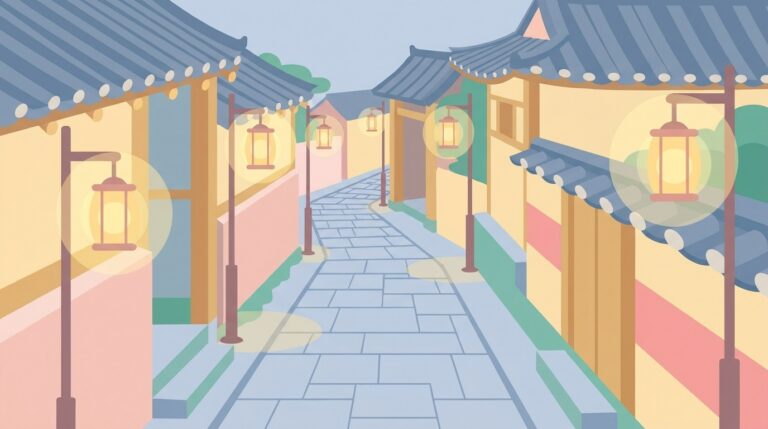
Picture this: You are wandering through the picturesque, labyrinthine streets of Ikseon-dong or the retro alleyways of Hipjiro (Euljiro) in Seoul. You smell freshly toasted hotteok, and you can hear laughter trickling out from hidden cafes. You pull out your smartphone to locate that viral retro bakery you spotted in a K-drama. Suddenly, your GPS arrow spins erratically between tall heritage walls and concrete buildings. Your blue dot is completely lost inside a maze of narrow alleyways.
You spot a kind-looking local resident watering flowerpots outside a small shop. You gather your courage, show the bakery name on your screen, and they smile warmly, pointing past a tiny corner and saying: “오른쪽 골목으로 들어가세요!”
Did your brain just freeze at “골목” (gol-mok)? You’re definitely not alone. Over 80% of beginner Korean learners tell us that directional vocabulary is where textbook drills fall apart. In real-life Korea, navigation rarely relies on broad avenue names; it thrives inside vibrant, charming alleyways. Learning this exact phrase won’t just save your feet from endless wandering—it opens the doorway to authentic neighborhood spots that tourists usually walk right past. Based on real feedback from dozens of our A1 travelers, this guide is your personal compass to navigating Korean streets with confidence.
Phase 2: Top 3 Core Expressions In-Depth Analysis
1. 오른쪽 골목으로 들어가세요 (O-reun-jjok gol-mog-eu-ro deul-eo-ga-se-yo)
- Pronunciation: [O-reun-jjok gol-mo-geu-ro deu-reo-ga-se-yo] (Sound analogy: Think of saying orange without the “ange” for o-reun, a crisp choke sound for jjok, goal-moke for gol-mok, and through for euro).
- Meaning: Literal: “Enter toward the right alley.” / Real Nuance: “Take that alleyway right on your right side and walk in.”
- K-Culture Moment: Seen frequently in Reply 1988 when neighbors guide guests through the cozy, interconnected street corners of Ssangmun-dong.
- Editor’s Insight: The particle ~(으)로 (~[eu]ro) signals direction (“towards”), while ~세요 (~se-yo) softens an instruction into a polite, warm request. It sounds helpful rather than commanding.
- Situation Spectrum: Casual: ⚠️ (Use ‘들어가’ with close peers) | Semi-formal: ✅ (Perfect for strangers and store clerks) | Formal: ✅
- 🤔 Think About It: In English, we usually say “take a right at the alley.” Korean emphasizes the physical action of entering inside (들어가다). How does imagining yourself stepping into a space change how you visualize directions?
2. 여기서 직진하세요 (Yeo-gi-seo jik-jin-ha-se-yo)
- Pronunciation: [Yeo-gi-seo jik-jin-ha-se-yo] (Sound analogy: Yeo-gi sounds like “yummy” with a ‘g’, and jik-jin sounds like “chic-jean”).
- Meaning: Literal: “Go straight from here.” / Real Nuance: “Keep walking straight ahead from this spot without turning.”
- K-Culture Moment: Every scene in Itaewon Class where characters hustle along the main road before turning into bustling nightlife alleys.
- Editor’s Insight: “직진” (jik-jin) is a Sino-Korean word meaning direct advance. Paired with “여기서” (from here), it gives you an immediate starting anchor.
- Situation Spectrum: Casual: ⚠️ | Semi-formal: ✅ | Formal: ✅
- 🤔 Think About It: Notice how Korean anchors the perspective at “여기” (here) first. It keeps both speaker and listener grounded in the present location before projecting forward.
3. 왼쪽으로 돌아가세요 (Oen-jjok-eu-ro dol-a-ga-se-yo)
- Pronunciation: [Oen-jjo-geu-ro do-ra-ga-se-yo] (Sound analogy: Oen sounds like “when”, followed by choke-euro and dough-rah-ga-se-yo).
- Meaning: Literal: “Turn and go to the left.” / Real Nuance: “Make a left turn up ahead.”
- K-Culture Moment: Classic rom-com trope where the lead character tells a taxi driver or walking companion to turn left around the corner near their rooftop apartment.
- Editor’s Insight: “돌아가다” literally means to turn around or circle around. In pedestrian navigation, it simply means taking the turn around a physical street corner.
- Situation Spectrum: Casual: ⚠️ | Semi-formal: ✅ | Formal: ✅
- 🤔 Think About It: English uses the sharp verb “turn,” whereas Korean uses “돌다” (to round/curve), painting a softer spatial transition around city corners.
Phase 3: Textbook Korean vs. Real Korean
Situation 1: Telling someone to turn right at an intersection
- 📖 Textbook Korean: 우회전하십시오. (U-hoe-jeon-ha-sip-si-o.)
- 🗣️ Real Korean: 오른쪽으로 꺾으세요. (O-reun-jjok-eu-ro kkeokk-eu-se-yo.) / 오른쪽으로 가시면 돼요. (O-reun-jjok-eu-ro ga-si-myeon dwae-yo.)
- 💡 Why is it different? “우회전하십시오” sounds like an automated GPS voice or a driving test manual. Real people on foot prefer bodily descriptive terms like “꺾으세요” (bend/turn) or the reassuring “~시면 돼요” (you just need to go).
Situation 2: Confirming if a shop is inside the alley
- 📖 Textbook Korean: 상점이 골목길 내부에 존재합니까? (Sang-jeom-i gol-mok-gil nae-bu-e jon-jae-ham-ni-kka?)
- 🗣️ Real Korean: 골목 안쪽에 있어요? (Gol-mok an-jjog-e iss-eo-yo?)
- 💡 Why is it different? Bookish vocabulary like “존재하다” (to exist) sounds robotic. Everyday Korean relies on simple existentials like “있어요” (is there / exists) paired with intuitive position words like “안쪽” (inner side).
Phase 4: K-Culture Deep Dive & Non-Verbal Manners
4-1. Nunchi & Street Gestures
When asking for directions in Korea, your posture speaks before your mouth does. Pointing directly with a single index finger at a person or right into someone’s face is considered rude. Instead, locals use an open hand with fingers gently together, palm angled slightly upward, to point toward directions or street signs.
Additionally, practicing Nunchi (눈치) means observing whether the person is in a rush. If someone is power-walking toward the subway during rush hour, don’t stop them. Look for a shop owner standing by their entrance or someone waiting leisurely at a bus stop. A quick polite head nod (목례, mok-rye) at 15 degrees before speaking instantly establishes mutual respect.
4-2. The Soul of the Korean “Golmok” (골목)
In Western urban layouts, alleys are sometimes viewed as service corridors or back entrances. In Korea, 골목 (Golmok) is the heartbeat of culture! From historical hanok alleys in Bukchon to Euljiro’s printing-shop alleys transformed into trendy speakeasies, alleys house the best restaurants (골목 맛집, golmok matjip). Renowned food shows like Baek Jong-won’s Alley Restaurant showcase how these narrow passages carry generations of culinary mastery and community bonding. Navigating alleys isn’t getting lost—it’s arriving where real Korean life happens.
Phase 5: Real-World Roleplay Scenario
- Setting: A quiet intersection near Ikseon-dong. Red brick walls meet traditional tiled eaves.
- Characters:
- You (Traveler): Holding your phone, looking for “Cafe Moonlight”.
- Min-su (Local Dry Cleaner Owner): Sweeping the porch outside his laundry shop, humming a retro trot song.
- You: 저기요, 죄송한데 길 좀 여쭤봐도 될까요? (Jeo-gi-yo, joe-song-han-de gil jom yeo-jjwo-bwa-do doel-kka-yo?)
🎭 [Approaching gently with a slight bow]
“Excuse me, sorry to bother you, but may I ask for directions?” -
Min-su: 네, 어디 찾으세요? (Ne, eo-di chaj-eu-se-yo?)
🎭 [Pauses sweeping, smiling warmly with relaxed shoulders]
“Yes! Where are you looking for?” -
You: 달빛 카페 가고 싶은데요. (Dal-bit ka-pe ga-go sip-eun-de-yo.)
🎭 [Showing the Korean name written on your phone screen]
“I want to go to Cafe Moonlight.” -
Min-su: 아, 달빛 카페요? 여기서 직진하세요. (A, dal-bit ka-pe-yo? Yeo-gi-seo jik-jin-ha-se-yo.)
🎭 [Points with an open palm straight down the stone road]
“Ah, Cafe Moonlight? Go straight ahead from here.” -
You: 직진이요? 얼마나 가요? (Jik-jin-i-yo? Eol-ma-na ga-yo?)
🎭 [Tilting head inquisitively, repeating key word]
“Straight? How far do I go?” -
Min-su: 한 50미터 가면 편의점 나와요. 거기서 오른쪽 골목으로 들어가세요. (Han o-sip-mi-teo ga-myeon pyeon-ui-jeom na-wa-yo. Geo-gi-seo o-reun-jjok gol-mog-eu-ro deul-eo-ga-se-yo.)
🎭 [Gestures turning right into a side street]
“Walk about 50 meters and a convenience store will appear. From there, go into the alley on the right.” -
You: 편의점 끼고 오른쪽 골목으로 들어가면 되나요? (Pyeon-ui-jeom kki-go o-reun-jjok gol-mog-eu-ro deul-eo-ga-myeon doe-na-yo?)
🎭 [Nodding in comprehension, confirming with hands]
“I just go into the right alley right past the convenience store?” -
Min-su: 맞아요! 골목 안쪽에 바로 보여요. (Maj-a-yo! Gol-mok an-jjog-e ba-ro bo-yeo-yo.)
🎭 [Nods reassuringly with a bright smile]
“That’s right! You’ll see it right inside the alley.”
🔀 Interactive Decision Point
Min-su just finished explaining. What is your best response?
- Option A: “감사합니다! 좋은 하루 보내세요!” (Gam-sa-ham-ni-da! Jo-eun ha-ru bo-nae-se-yo!) [Bow politely]
- Option B: “오케이, 땡큐!” (O-kei, ttaeng-kyu!) [Turn around instantly and start jogging]
- Option C: “골목 무서운데 같이 가요.” (Gol-mok mu-seo-un-de gat-i ga-yo.) [Grab his arm]
Feedback:
* Option A (Best): 🌟 Excellent! Courteous, natural, and leaves the local with a delightful impression of foreign travelers.
* Option B (Bad): ⚠️ While understood, abrupt casual English can make the elder feel unappreciated after carefully explaining directions.
* Option C (Risk): 🚫 Overstepping personal boundaries! In Korea, asking an elderly stranger working at their shop to abandon their work and walk with you causes deep social awkwardness (b 부담).
Phase 6: 10-Second Emotion Shadowing Drill
Practice these aloud! Match the slash / pauses to catch the natural cadence:
[😊 Polite & Inquiring]
저기요, / 길 좀 여쭤봐도 될까요? (Jeo-gi-yo, / gil jom yeo-jjwo-bwa-do doel-kka-yo?)-
[🧭 Confident Direction]
여기서 직진해서 / 오른쪽 골목으로 들어가세요. (Yeo-gi-seo jik-jin-hae-seo / o-reun-jjok gol-mog-eu-ro deul-eo-ga-se-yo.) -
[🙏 Grateful & Bright]
아, 오른쪽 골목이요! / 정말 감사합니다! (A, o-reun-jjok gol-mog-i-yo! / Jeong-mal gam-sa-ham-ni-da!)
Phase 7: K-Culture Mini Dictionary
-
골목 (Gol-mok) | Noun | Alleyway / Backstreet
Usage: The lifeblood of culinary tourism in Korea. Phrases like 골목 상권 (alley commercial district) represent trendy neighborhood hubs. -
오른쪽 (O-reun-jjok) | Noun | Right side
Usage: Rooted historically in the word “옳다” (to be correct/right). Pair with direction markers: “오른쪽으로” (to the right). -
길치 (Gil-chi) | Slang/Noun | Directionally challenged person
Usage: Combines “길” (road) and “-치” (someone clumsy at a skill). Used playfully: “저 완전 길치예요!” (I have zero sense of direction!). -
직진 (Jik-jin) | Noun | Going straight / Forward advance
Usage: Heard during walking navigation and taxi rides. You can simply say “직진해 주세요” (Please go straight) to a cab driver.
Phase 8: Traveler’s Survival Kit
Survival Expressions TOP 3
- 여기 어디예요? (Yeo-gi eo-di-ye-yo?)
Meaning: Where is this place?
Pro Tip: Pinpoint your physical spot on paper maps or show a photo when completely turned around. - 여기서 멀어요? (Yeo-gi-seo meol-eo-yo?)
Meaning: Is it far from here?
Pro Tip: Helps you decide instantly whether to walk into the alleys or hail a taxi. - 지도 좀 봐주실 수 있어요? (Ji-do jom bwa-ju-sil su iss-eo-yo?)
Meaning: Could you take a look at my map?
Pro Tip: Hand over your phone with both hands for maximum Korean politeness.
Editor’s Travel Note
Never rely solely on global map apps inside Seoul’s denser districts. Google Maps navigation for walking is notoriously restricted in Korea due to national security map data laws. Make sure you complete your [네이버 지도 앱 다운로드 (Download Naver Map App)] or KakaoMap before boarding your flight. When navigating alley networks, GPS signals bounce off high building walls. Rely on physical landmarks: look for convenience stores (CU, GS25, 7-Eleven) at alley entrances—they are Korea’s unofficial navigational lighthouses!
Phase 9: “One Step Deeper” (Reflective Prompt)
In many sprawling Western metropolises, alleys are utilitarian and sometimes avoided after dark. In South Korea, however, the golmok is an extension of the living room. Low residential walls allow neighbors to exchange side dishes, and small business owners greet regular passersby daily. When someone instructs you to “오른쪽 골목으로 들어가세요,” they aren’t sending you off into an obscure, dangerous void. They are welcoming you into the most intimate, safe, and lively layer of Korean social life.
💬 Your Turn: Have you ever stumbled into an unexpected culinary gem or quaint cafe by taking a wrong turn down a Korean street? Tell us about your favorite alley adventure in the comments below!
Phase 10: FAQ & Common Mistakes
Q: What is the difference between 오른쪽 (o-reun-jjok) and 우측 (u-cheuk)?
A: “오른쪽” is native Korean used in everyday spoken conversation and casual pedestrian directions. “우측” is Sino-Korean (Hanja), primarily seen on formal signs, subway platforms, elevators (“우측 통행” – keep right), or heard in automated GPS announcements.
Q: Do I need to use “-으로” (-euro) or “-로” (-ro)?
A: If the preceding noun ends in a consonant (batchim) other than ㄹ, use “-으로” (e.g., 골목 + 으로 = 골목으로). If the word ends in a vowel or the consonant ㄹ, use “-로” (e.g., 오른쪽 + 으로 = 오른쪽으로; 위 + 로 = 위로).
Q: Can I say “오른쪽에 가세요” instead of “오른쪽으로 가세요”?
A: “-에” marks a fixed destination or location of existence, whereas “-(으)로” indicates dynamic movement toward a direction. While locals will guess your meaning, “오른쪽으로 가세요” (head towards the right) is grammatically precise and natural.
🚨 Common Mistakes Alert
- Mistake: Confusing “오른쪽” (right) and “왼쪽” (left).
Correct Action: Remember the mnemonic: Orange is on the right (오른쪽), while West is on the left (왼쪽). - Mistake: Saying “직진으로 가세요”.
Correct Action: Drop “-으로” with Sino-Korean movement verbs. Say “직진하세요” or “앞으로 가세요”. - Mistake: Expecting street numbers on houses to match European or US grids.
Correct Action: Korean addresses use road names (도로명), but locals orient by prominent stores, subway exits, and alleys.
Phase 11: Action Mission & Engagement
- 🥉 Bronze Mission (Solo Shadowing): Stand in front of your mirror. Point with an open palm to your right and declare aloud 3 times: “오른쪽 골목으로 들어가세요!”
- 🥈 Silver Mission (SNS Story Challenge): Take a photo of an aesthetic alley in your city or from a K-drama pause screen. Caption it: “여기가 바로 한국 골목 감성! (This is true Korean alley vibe!)” and tag @DailyHangul.
- 🥇 Gold Mission (Real-world Practice): Next time you visit Korea (or a local K-town), ask a clerk for directions using: “저기요, [Place Name] 어디예요?” and follow their hand gestures without looking at your phone!
🎮 K-Culture Mission: Watch Episode 1 of any slice-of-life K-drama (like Hospital Playlist or Welcome to Samdal-ri). Spot at least one scene where characters walk side by side down an alleyway and listen for direction verbs!
Phase 12: Interactive Quiz Challenge
1. Situation Decision:
You need to tell a tourist to take the alley on the left. Which sentence is the most natural A1 level Korean?
* A) 왼쪽 문을 닫으세요.
* B) 왼쪽 골목으로 들어가세요.
* C) 직진해서 뒤로 가세요.
2. Fill-in-the-Blank:
“From here, please go straight.”
→ 여기서 (____)하세요.
* (Hint: 2-syllable word meaning straight advance).
3. True or False:
In Korea, it is polite to point directly at street signs using your single index finger when speaking to elders. (True / False)
👉 Click to reveal answers & explanations!
- Answer: B) 왼쪽 골목으로 들어가세요.
Explanation: 왼쪽 (left) + 골목으로 (into the alley) + 들어가세요 (please enter). Option A means “close the left door,” and Option C means “go straight then go backwards.” -
Answer: 직진 (Jik-jin)
Explanation: 직진 (直進) directly translates to going straight ahead without deviating. -
Answer: False
Explanation: Pointing sharply with a single finger can feel confrontational in Korean etiquette. Always use an open palm with your fingers gathered together when gesturing directions.
🎬 Watch Our Daily Videos! (Daily Hangul Official Instagram)
Review the expressions you learned in this article with our fun daily short videos! Check out native pronunciation and real-life nuances in action.
- Instagram @dailyhangul_en







