

Phase 1: Empathy (Immersive Storytelling Opening)
안녕하세요! 매일한글 에디터입니다. (Hello! This is your Daily Hangul editor.)
Picture this: You are watching a high-stakes K-Drama like Queen of Tears or Reborn Rich. The boardroom is dead silent. Elite chairpersons, international investors, and government dignitaries sit in tailored suits. Suddenly, due to an unavoidable diplomatic shift or a grand logistical reshuffle, the gala venue must be moved at the eleventh hour. The lead executive doesn’t just blurt out, “이해해 주세요! (Ihaehae juseyo! – Please understand!)” or a casual “죄송합니다 (Joesonghapnida – I am sorry).” That would instantly shatter the refined atmosphere and compromise institutional prestige.
Instead, an impeccably embossed formal letter arrives on heavy textured paper, concluding with the mesmerizing, dignified sentence: “너른 마음으로 널리 혜량하여 주시기 바랍니다 (Neoreun ma-eumeuro neolli hyeryanghayeo jusigi baramnida – We ask that you kindly understand with gracious benevolence).”
If you have reached the C1 level in Korean, you already know how to order food, debate current events, and compose standard business emails. But when you cross the threshold into official protocol (의전 / Uijeon), diplomatic banquets, congratulatory addresses (축전), and solemn missives, standard textbook phrases will no longer suffice. In high-level Korean society, asking an elder, a distinguished guest, or an esteemed client to “overlook an inconvenience” requires you to elevate their dignity while demonstrating profound humility.
Over the past ten years coaching global executives, cultural diplomats, and advanced K-Drama script buffs, I have seen brilliant learners freeze when formal protocols demand this exquisite tier of Sino-Korean etiquette. This comprehensive masterclass will elevate your formal Korean to an executive C1 standard, giving you the polish, linguistic authority, and cultural finesse to navigate Korea’s most formal ceremonial spaces with absolute confidence.
Phase 2: Deep Dive into 3 Core Protocol Expressions
1. 널리 혜량하여 주시기 바랍니다 (Neolli hyeryanghayeo jusigi baramnida)
- Pronunciation: [Neol-li hye-ryang-ha-yeo ju-si-gi ba-ram-ni-da] (Think: “Nuhl-lee hyeh-ryang-ha-yuh joo-see-gee bah-rahm-nee-dah”)
- Meaning:
- Literal: Please generously consider and forgive with gracious benevolence.
- Actual Nuance: “We respectfully implore your gracious understanding and benevolent tolerance regarding this matter.”
- K-Culture Moment: Seen in premier historical period dramas (사극 / Sageuk) or modern corporate boardroom thrillers when an invitation to a state summit or presidential banquet includes a polite scheduling amendment.
- Editor’s Insight: The word 혜량 (惠諒) combines 혜 (惠 – favor/benevolence) and 량 (諒 – inspect/understand with empathy). Unlike the common word 양해 (諒解 – mutual understanding), 혜량 explicitly treats the listener’s understanding as an act of magnanimous grace. You never grant 혜량 to someone else; you only ask for or receive 혜량 from a person of higher status or an honored audience.
- Situation Spectrum:
- Casual (Friends/Peers): 🚫 (Sounds absurdly archaic or sarcastic)
- Semi-formal (Internal colleagues): ⚠️ (Overly stiff unless addressing the corporate chairman)
- Formal (Official Invitations, Diplomatic Letters, VIP Disclaimers): ✅ (The gold standard)
- 🤔 Think About It: In English, we often say “We apologize for the inconvenience.” Why does high-level Korean shift the focus to praising the recipient’s personal capacity for mercy rather than simply labeling the situation an “inconvenience”?
2. 너그러운 아량으로 굽어살펴 주시기 바랍니다 (Neogeureoun aryang-euro gubeosalpyeo jusigi baramnida)
- Pronunciation: [Neo-geu-reo-un a-ryang-eu-ro gu-beo-sal-pyeo ju-si-gi ba-ram-ni-da] (Pronounce ‘gubeosalpyeo’ gently, like “goo-buh-sahl-pyuh”)
- Meaning:
- Literal: Please look down upon us with kind magnanimity and care.
- Actual Nuance: “We humbly beseech your generous magnanimity and warm forbearance.”
- K-Culture Moment: Delivered when an ambassador or cultural foundation head offers a congratulatory message (축전) while acknowledging unforeseen limitations in hosting capacity.
- Editor’s Insight: 아량 (雅量) refers to a broad, noble mind capable of embracing faults. The archaic-literary verb 굽어살피다 (Gubeosalpida – to look down with benevolent gaze) is a humble honorific construction where you place the listener in an elevated moral position. It communicates total reverence.
- Situation Spectrum:
- Casual: 🚫
- Semi-formal: ⚠️
- Formal (State ceremonies, Congratulatory tributes): ✅
- 🤔 Think About It: Notice the spatial metaphor here: the respondent is metaphorically “above” looking down with compassionate eyes. How does this reflect the vertical respect embedded in traditional Korean Confucian protocol?
3. 심려를 끼쳐드려 송구하오나, 혜안으로 품어주시길 앙망합니다 (Simryeoreul kkichyeodeuryeo songguhona, hye-an-euro pumeojusigil angmanghapnida)
- Pronunciation: [Sim-ryeo-reul kki-chyeo-deu-ryeo song-gu-ha-o-na, hye-an-eu-ro pu-meo-ju-si-gil ang-mang-ham-ni-da]
- Meaning:
- Literal: We cause you concern and are deeply humbled, yet we look up and hope you embrace this with wise discernment.
- Actual Nuance: “We are profoundly contrite for causing any concern, and we earnestly look to your esteemed wisdom and embracing grace.”
- K-Culture Moment: The climactic moment in a corporate drama when a chairman resigns or a high-ranking official appeals to a foundation’s board of trustees.
- Editor’s Insight: 앙망하다 (仰望하다 – to revere and look upward with earnest hope) is an ultra-formal protocol verb used in formal petition letters (상소문) and top-tier formal addresses. Pair it with 혜안 (慧眼 – discerning wisdom) to honor the recipient’s intellect.
- Situation Spectrum:
- Casual: 🚫
- Semi-formal: 🚫
- Formal (Elite epistolary writing, Official corporate statements): ✅
- 🤔 Think About It: How does utilizing a verb meaning “to look upward with longing” (앙망) transform an institutional apology into an artistic demonstration of loyalty and respect?
Phase 3: Textbook Korean vs Real Korean
Let’s compare standard high-intermediate phrases with legitimate C1 diplomatic/ceremonial phrasing:
Scenario 1: Informing VIP guests about a sudden schedule or seat adjustment on an official invitation
- 📖 교과서 한국어 (Textbook Korean):
- 일정이 바뀌었으니 이해해 주시기 바랍니다. (Iljeong-i bakkwieosseuni ihaehae jusigi baramnida – The schedule has changed, so please understand.)
- 🗣️ 진짜 한국어 (Authentic C1 Protocol):
- 부득이한 사정으로 일정이 다소 변경되었사오니, 귀빈 여러분의 너른 혜량을 부탁드립니다. (Budeugi-han sajeong-euro iljeong-i daso byeongyeong-doe-eot-sa-oni, gwibin yeoreobun-ui neoreun hyeryang-eul butakdeurimnida – Due to unavoidable circumstances, the itinerary has been slightly modified; we humbly request our distinguished guests’ generous consideration.)
- 💡 왜 다를까? (Why the difference?): Saying “이해해 주세요” commands the listener to perform the mental task of understanding. In formal protocol, one never demands understanding from an esteemed guest; instead, one highlights the inevitability (부득이한 사정) and invites their gracious favor (혜량).
Scenario 2: Seeking patience when seats or reservations are overbooked in an executive symposium
- 📖 교과서 한국어 (Textbook Korean):
- 자리가 부족해도 너그럽게 봐주세요. (Jariga bujokhaedo neogeureopge bwajuseyo – Even if seats are lacking, please overlook it kindly.)
- 🗣️ 진짜 한국어 (Authentic C1 Protocol):
- 협소한 장소로 인하여 다소 불편함이 발생할 수 있사오니, 하해와 같은 아량으로 혜량하여 주시기 바랍니다. (Hyeopsohan jangso-ro inhayeo daso bulpyeonhami balsaenghal su itsaoni, hahaewa gateun aryang-euro hyeryanghayeo jusigi baramnida – As the venue is constrained, minor inconveniences may arise; we earnestly ask you to look upon this with sea-like magnanimity.)
- 💡 왜 다를까? (Why the difference?): “봐주세요” is an informal, colloquial idiom suitable only between close friends. In royal and diplomatic communications, metaphoric descriptors such as 하해와 같은 (Ha-haewa gateun – vast as the rivers and seas) express maximum honorific courtesy.
Phase 4: K-Culture Deep Dive & Non-Verbal Manners
4-1. 눈치 (Nunchi) & Protocol Body Language
When delivering formal announcements or letters of explanation in Korean society:
1. The Gongsu Posture (공수 자세): When speaking or presenting an official statement, clasp your hands together slightly below your navel. For men, the left hand rests gently over the right; for women, the right hand over the left (except during funerary rites where this is reversed).
2. The 45-Degree Diplomatic Bow: If you utter “널리 혜량하여 주시기 바랍니다” in person at a podium or dais, pause for one breath, lower your upper torso smoothly to a 45-degree angle, hold the bow for 2-3 seconds, and rise slowly. Do not rush back up—that projects nervousness rather than dignified solemnity.
3. Tone and Pitch Control: Lower your vocal pitch by a half-octave. Maintain an even, resonant chest voice (중저음). Avoid rising inflections at the end of clauses, which can sound indecisive.
4-2. Cultural Code Analysis: The Aesthetic of Hanji & Red Wax Seals
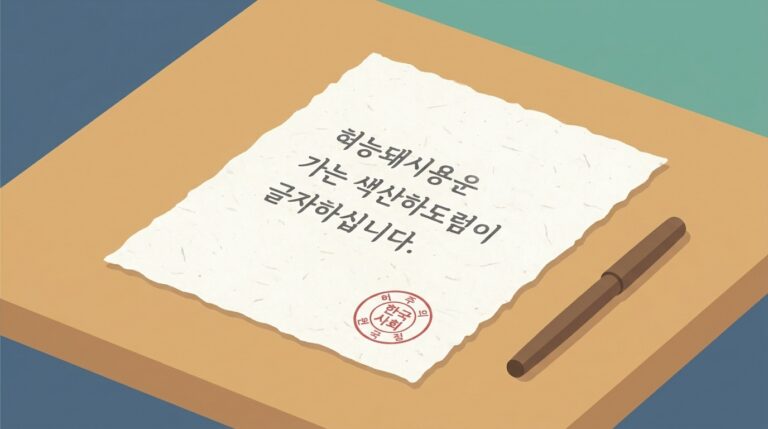
In Korea’s elite corporate circles and cultural institutions (e.g., the National Museum of Korea, prestigious presidential advisory councils, or top conglomerate foundations), digital invitations are often considered secondary. For high-ranking honorees (귀빈 / Gwibin), physical invitations printed on artisanal Korean mulberry paper (한지 / Hanji) and sealed with traditional seals are delivered by hand.
The phrase “널리 혜량하여 주시기 바랍니다” almost always sits in the closing paragraph of these missives. It serves a crucial cultural function known as 체면 (Chaemyeon – Face saving). By pre-emptively offering apologies for any conceivable lapse in etiquette, the host demonstrates peerless modesty (겸양의 미덕), ensuring that whatever hiccups might occur during the banquet, the guest’s honor remains impeccably safeguarded.
Phase 5: Real-World Roleplay Scenario
Setting: You are Elena, the Chief Protocol Officer for an International Cultural Gala held in an iconic hanok estate in Seoul. Due to sudden autumn rain, the open courtyard banquet must be relocated to the indoor hall. You are briefing Director Park, the chief representative of the VIP delegation.
- Turn 1 (Elena):
- 박 이사님, 금일 갈라 행사에 왕림해 주셔서 깊이 감사드립니다.
- Bak isanim, geum-il galla haengsa-e wangrimhae jusyeoseo gipi gamsadeurimnida.
- (Director Park, we are deeply grateful for your esteemed presence at today’s gala.)
🎭 [두 손을 공손히 모으고 부드러운 미소로 맞이하며 / Clasping hands courteously and greeting with a warm, steady smile]
- Turn 2 (Director Park):
- 엘레나 의전관님, 초청해 주셔서 영광입니다. 그런데 뜰에 준비되던 만찬 세팅이 정리되고 있는 것 같군요?
- Ellena uijeongwannim, chocheonghae jusyeoseo yeong-gwang-imnida. Geureonde tteure junbídoedeon manchan seting-i jeongnidoego inneun geot gatgunyo?
- (Chief Protocol Officer Elena, it is an honor to be invited. But it seems the banquet arrangement in the courtyard is being packed away?)
🎭 [안경을 살짝 매만지며 마당을 둘러본다 / Gently adjusting glasses while glancing across the courtyard]
- Turn 3 (Elena):
- 네, 이사님. 기상 악화로 인하여 부득이 실내 대청마루로 연회장을 이전하게 되었습니다.
- Ne, isanim. Gisang ak-hwa-ro inhayeo budeugi silnae daecheongmaruro yeonhoejang-eul ijeonhage doe-eotsumnida.
- (Yes, Director. Due to worsening weather, we have inevitably relocated the banquet hall to the indoor grand hall.)
🎭 [눈을 마주치며 안정적이고 진중한 어조로 / Maintaining calm eye contact in a composed tone]
- Turn 4 (Director Park):
- 아, 고풍스러운 야경을 기대했는데 다소 아쉽게 되었네요. 귀빈들이 조금 답답해할 수도 있겠습니다.
- A, gopungseureoun yagyeong-eul gidaehaenneunde daso aswipge doe-eotneyo. Gwibindeuri jogeum dapdaphaehal sudo itgetseumnida.
- (Ah, I was anticipating the antique night view, so that is a bit regrettable. The guests might feel slightly constrained.)
🎭 [팔짱을 가볍게 끼며 염려스러운 표정을 짓는다 / Crossing arms lightly with a concerned expression]
- Turn 5 (Elena):
- 귀빈 여러분께 온전한 정취를 전해드리지 못해 송구할 따름입니다. 너른 마음으로 널리 혜량하여 주시기 바랍니다.
- Gwibin yeoreobunkke onjeonhan jeongchwireul jeonhaedeuriji mot-hae songguhal ttareumimnida. Neoreun ma-eumeuro neolli hyeryanghayeo jusigi baramnida.
- (We are truly contrite for not delivering the complete outdoor atmosphere to our distinguished guests. We ask that you kindly understand with gracious benevolence.)
🎭 [상체를 30도 가량 숙이며 정중하게 고개를 숙인다 / Bowing upper body smoothly at roughly 30 degrees]
- Turn 6 (Director Park):
- 하하, 의전관님이 이토록 극진히 예를 갖추어 말씀하시니 섭섭한 마음이 눈 녹듯 사라집니다.
- Haha, uijeongwannimi itorok geukjini yereul gatchueo malsseumhasini seopseophan ma-eumi nun nokdeut sarajimnida.
- (Haha, since the Chief Protocol Officer speaks with such consummate propriety, any disappointment melts away like snow.)
🎭 [빙그레 웃으며 고개를 끄덕인다 / Nodding approvingly with a broad smile]
- Turn 7 (Elena):
- 배려 깊은 말씀에 감사드립니다. 실내 공간에는 전통 국악 현악 삼중주를 특별히 준비해 두었습니다.
- Baeryeo gipeun malsseume gamsadeurimnida. Silnae gonggan-eneun jeontong gugak hyeon-ak samjungjureul teukbyeolhi junbihae dueotsumnida.
- (Thank you for your considerate words. We have specially arranged a traditional Korean string trio inside.)
🎭 [손바닥을 위로 펴서 실내 연회장 방향을 정중히 가리키며 / Gesturing gracefully toward the indoor hall with open palm up]
- Turn 8 (Director Park):
- 훌륭합니다. 어서 들어가 귀빈들과 담소를 나누어 보지요.
- Hullyunghapnida. Eoseo deureoga gwibindeulgwa damshoreul nanueo bojiyo.
- (Splendid. Let us proceed inside and converse with the guests.)
🎭 [만족스러운 걸음으로 대청마루로 향한다 / Walking toward the hall with an expression of complete satisfaction]
🔀 Interactive Decision Point
Suppose Director Park noticed that three diplomatic seats were slightly shifted closer to the speakers. How should Elena respond?
- Choice A: “자리 배치는 원래 계획대로 안 됐지만, 그냥 앉아 주시면 감사하겠습니다.” (Jari baechineun wonrae gyehoekdaero an dwaetjiman, geunyang anja jusimyeon gamsahagetseumnida.)
- Choice B: “갑작스러운 공간 조정으로 좌석이 다소 협소해졌사오니, 부디 혜량하여 주시기를 간곡히 청합니다.” (Gapjakseureoun gonggan jojeong-euro jwaseogi daso hyeopsohaejyeotsaoni, budi hyeryanghayeo jusigireul gang-gokhi cheonghamnida.)
- Choice C: “죄송하지만 비가 와서 어쩔 수 없었습니다. 이해 부탁드립니다.” (Joesonghajiman biga waseo eojjeol su eopseotseumnida. Ihae butakdeurimnida.)
Detailed Analysis:
* Choice A (Bad): “그냥 앉아 주시면… (Just sit down…)” sounds dismissing, borderline rude, and utterly destroys protocol decorum.
* Choice B (Best): Flawless C1 honorific execution. Identifies the issue politely, maintains honorific humility (-사오니), and applies 혜량 with sincerity.
* Choice C (Risk): While grammatically correct, “어쩔 수 없었습니다 (We couldn’t help it)” sounds defensive and shifts blame onto circumstances rather than upholding the guest’s dignity.
Phase 6: 10-Second Emotion Shadowing Drill
Practice reading these protocol master-sentences aloud. Pay attention to pauses marked by / and channel the emotional stage directions.
[🙇♂️ 극진한 예의와 진심을 담아 / With consummate reverence and sincerity]- 예기치 못한 사정으로 / 결례를 범하게 되었사오니, / 너른 마음으로 / 널리 혜량하여 주시기 바랍니다.
- (Yegichi mothan sajeong-euro / gyeolryereul beomhage doe-eotsaoni, / neoreun ma-eumeuro / neolli hyeryanghayeo jusigi baramnida.)
[🤝 정중하고 결연하게 품격을 세우며 / With solemn composure and unwavering protocol poise]- 귀빈 여러분의 / 너그러운 혜안과 아량에 기대어, / 부디 너그러이 혜량해 주시길 / 간곡히 앙망합니다.
- (Gwibin yeoreobun-ui / neogeureoun hye-an-gwa aryang-e gidaeeo, / budi neogeureoi hyeryanghae jusigil / gang-gokhi angmanghamnida.)
[📜 공식 초청장의 맺음말 낭독 톤으로 / In the serene, resonant cadence of reading a formal dispatch]- 미흡한 점이 있더라도 / 혜량하여 주신다면, / 더없는 영광으로 / 간직하겠나이다.
- (Miheubhan jeomi itdeorado / hyeryanghayeo jusindamyeon, / deoeomneun yeong-gwang-euro / ganjikhagetnaida.)
Phase 7: K-Culture Mini Dictionary
| No | Term (Hangul / Hanja / Romanization) | Translation | Real-world Context & Usage |
|---|---|---|---|
| 1 | 혜량 (惠諒 / Hyeryang) | Gracious consideration / Benevolent pardon | Used exclusively in high-level correspondence, ceremonial invitations, and VIP diplomatic requests when asking someone of high standing to forgive a shortfall. |
| 2 | 아량 (雅量 / Aryang) | Magnanimous broad-mindedness | Refers to an individual’s nobility of heart. Often paired with “바다와 같은 (vast as the sea)” or “너그러운 (generous)” when praising an elder or client’s patience. |
| 3 | 결례 (缺禮 / Gyeolye) | Breach of etiquette / Discourtesy | The formal equivalent of 실수 (mistake) or 잘못 (wrongdoing). Executives say “결례를 범하다 (to commit an etiquette breach)” instead of “실수했어요”. |
| 4 | 경구 (敬具 / Gyeonggu) | Sincerely yours / Respectfully submitted | Written at the very end of ultra-formal letters, placed below the date and sender’s signature, equivalent to the Japanese 敬具 or traditional English epistolary salutations. |
Phase 8: Protocol Survival Kit for Travelers & Executives
Survival Protocol TOP 3
- 부득이한 사정으로 불편을 드려 송구합니다.
- Budeugi-han sajeong-euro bulpyeon-eul deuryeo songguhamnida.
- Pro Tip: Use this in high-end hotels, first-class lounges, or Michelin-starred restaurants when you are delayed or need a sudden change of plans.
- 너그러운 양해를 부탁드립니다.
- Neogeureoun yanghaereul butakdeurimnida.
- Pro Tip: The best all-around phrase for modern corporate meetings and polite business correspondence before reaching the extreme formality of 혜량.
- 공사다망(公私多忙)하신 와중에도 자리를 빛내주셔서 감사합니다.
- Gongsadamang-hasin wajung-edo jarireul binnae-jusyeoseo gamsahamnida.
- Pro Tip: The quintessential opening line when an executive arrives at your corporate seminar or event. It means: “Thank you for gracing us with your presence despite your busy public and private schedule.”
Editor’s Travel & Etiquette Note
When traveling for business in Seoul, always keep your formal invitations or reservation confirmations neatly organized. If you ever need to send a VIP car service or reserve a private banquet room (한정식 룸) in Gwanghwamun or Gangnam, check navigation and reviews using the Naver Map App Download instead of Google Maps, which does not reflect local transit or executive venue nuances accurately in Korea. When paying at high-end establishments, always present corporate credit cards with both hands, lightly supporting your right wrist with your left hand.
Phase 9: “One Step Deeper” (Thinking Question)
In traditional Confucian morality, language is never just an exchange of data; it is an active architecture of social harmony. When you use the word 혜량 (惠諒), you engage in a psychological maneuver that scholars term 상대 격상, 자아 비하 (Elevating the other while humbling oneself). Rather than defending your mistake or coldly requesting logical comprehension (이해), you define the other person as an inherently benevolent sage whose moral depth can absorb life’s small imperfections.
This reveals how Korean high society values 정형화된 겸양 (codified humility). Politeness at the C1 level is not just about grammatical suffixes; it is an art form that transforms tension into mutual respect.
💬 Your Turn: How does your native language handle ultra-formal apologies or invitations? Do you have an equivalent phrase that praises the listener’s broad-mindedness, or does your culture favor direct, straightforward apologies? Share your thoughts below!
Phase 10: FAQ & Avoiding Misunderstandings
Q: Can I use “혜량하여 주시기 바랍니다” in a regular company Slack message or to my team manager?
A: Definitely not! Unless your team manager is the 80-year-old founder of a traditional conglomerate, using 혜량 in daily Slack messages will make you sound like you stepped right out of an 18th-century Joseon Dynasty palace drama. In standard workplace emails, stick to: “너른 양해 부탁드립니다 (Neoreun yanghae butakdeurimnida – We ask for your kind understanding)” or “너그럽게 양해해 주시면 감사하겠습니다.”
Q: What is the exact difference between 양해 (Yanghae) and 혜량 (Hyeryang)?
A: 양해 (諒解) literally means “discerning understanding.” It is reciprocal and widely used in contemporary business, public transport notices, and service emails. 혜량 (惠諒), on the other hand, adds the character 혜 (惠 – favor/grace). It implies that understanding this matter is an act of sovereign benevolence. Hence, 혜량 is reserved for ceremonial dispatches, VIP correspondences, and high protocol.
Q: Can I say “제가 당신을 혜량하겠습니다” (I will understand you)?
A: Never! This is a grave grammatical and protocol error. Because 혜량 implies benevolence bestowed from above, claiming that you will “혜량” an elder, client, or superior implies you consider yourself morally above them! You can only ask for 혜량 or receive it.
🚨 Common Mistakes Warning Board
- ❌ Mistake 1: Using 혜량 when speaking to your friends or juniors.
- Correct Action: Use “이해해 줘 (Ihaehae jwo)” or “봐줘 (Bwajwo)”.
- ❌ Mistake 2: Combining 혜량 with informal endings (e.g., 혜량해 줘요).
- Correct Action: Keep it in the highest honorific brackets: 혜량하여 주시기 바랍니다 or 혜량해 주시기를 앙망합니다.
- ❌ Mistake 3: Assuming 양해 and 혜량 are 100% interchangeable in official invitations.
- Correct Action: For VIP galas, memorial services, or state banquets, elevate 양해 to 혜량 to reflect the true ceremonial weight.
Phase 11: Action Missions & Practical Engagement
The 3-Tier Protocol Challenge
- 🥉 Bronze Mission (Solo Vocal Drill): Stand in front of a mirror, assume the 공수 (Gongsu) hand posture, and recite: “부득이한 사정으로 일정이 변경되었사오니, 널리 혜량하여 주시기 바랍니다” smoothly without looking at the screen.
- 🥈 Silver Mission (Writing Precision): Draft a mock formal letter excerpt (3 sentences) inviting an international artist to an art forum in Seoul, using at least two terms from our Mini Dictionary (혜량, 아량, 결례, 경구).
- 🥇 Gold Mission (Real-world Protocol Application): The next time you compose a high-level email or post an inquiry to an esteemed Korean institution, incorporate “너그러운 혜량을 부탁드립니다” and observe their impressed response!
🎮 K-Culture Discovery Mission: Watch an episode of a royal historical drama (사극) or a boardroom episode of Reborn Rich or Queen of Tears. Listen closely for the Sino-Korean root 량 (諒)—see if you catch 혜량, 양해, or 도량 (magnanimity) spoken during an official dispute!
Phase 12: Interactive Quiz Challenge
Test your mastery of high-level Korean protocol! Check your answers using the spoiler toggles below.
1. Situation Judgment
You are writing the closing disclaimer on a printed invitation for an international ministerial dinner. A printing typo caused the room number to be corrected with an elegant overlay sticker. Which sentence demonstrates the highest protocol elegance?
* (A) 방 번호가 틀렸으니 양해해 주길 바래.
* (B) 제작상의 미흡함으로 혼선을 드려 송구하오며, 널리 혜량하여 주시기 바랍니다.
* (C) 인쇄소 실수이니 그냥 이해해 주세요.
👉 Click to view Answer & Explanation
- Correct Answer: (B)
- Explanation: (A) uses informal banmal (바래), which is disrespectful. (C) blames the printer and uses colloquial phrasing (그냥 이해해 주세요). (B) takes full institutional responsibility with exemplary humility (송구하오며) and respectfully asks for gracious understanding (혜량하여 주시기 바랍니다).
2. Fill in the Blank
Complete this classic ceremonial sentence:
“결례를 범한 점 머리 숙여 사죄드리오며, 바다와 같은 너른 ( )으로 품어주시길 앙망합니다.”
* Hints: Choose the word meaning ‘magnanimous broad-mindedness’ (from Phase 7).
👉 Click to view Answer & Explanation
- Correct Answer: 아량 (Aryang)
- Explanation: 아량 (雅量) is frequently paired with “바다와 같은 너른 (broad as the ocean)” to denote exceptional magnanimity.
3. True or False Cultural Quiz
- Statement: It is completely natural for a department head to tell an intern: “내가 자네의 실수를 널리 혜량하겠네.” (True / False)
👉 Click to view Answer & Explanation
- Correct Answer: False
- Explanation: Even though the boss is higher in hierarchy, 혜량 carries a sacred epistolary reverence; native speakers do not casually declare “내가 혜량하겠다” in spoken modern speech. They would simply say “내가 이해하겠네” or “이번엔 너그럽게 넘어가겠네.”
🎬 Watch Our Daily Videos! (Daily Hangul Official Instagram)
Review the expressions you learned in this article with our fun daily short videos! Check out native pronunciation and real-life nuances in action.
- Instagram @dailyhangul_en







