

Playful Banter Among Friends: Fact-Bombing, Getting Triggered, and Annoyed Reactions
Phase 1: Empathy (Story Immersion Opening)
안녕하세요! I’m your Daily Hangul editor.
Imagine this scene: You are huddled around a plastic orange table at a bustling night food cart in Hongdae with your Korean friends. Steam rises from a spicy bowl of tteokbokki. Suddenly, your friend smirks, points at your tired eyes, and says, “Did you really stay up all night playing games after promising to wake up early?” The table erupts: someone yells “팩폭!” (Paek-pok!), another chuckles, and you freeze. Are they mad? Are you supposed to defend yourself? But before you can panic, your friend scoops up a crispy fried dumpling, pops it into your bowl, and says, “Here, eat up before you pass out.” That is the magic of Jjin-chin (찐친 – true bestie) chemistry: bickering like Tom and Jerry one second, and sharing comfort food the next.
Many intermediate learners get trapped in polite, formal Korean. But real Korean friendships thrive on playful teasing. If you only know textbook answers, you miss the warm intimacy hidden inside spicy banter. This guide is crafted directly from our classroom coaching sessions to help you react naturally, laugh off roasts, and bond like a true local.
Phase 2: Core 3 Expressions Deep Dive
1. 팩트 폭행 / 팩폭 (Paektu pokhaeng / Paekpok)
- Pronunciation: [Paek-pok] (Sounds like packing a snappy punch: Pack-poke)
- Meaning: Literal: “Fact violence / Assault with facts” | Real Nuance: “Brutal truth-bomb!” or dropping an undeniable reality check with surgical accuracy.
- K-Culture Moment: Seen constantly on variety shows like Running Man, where cast members roast each other’s terrible fashion choices while the screen flashes bold red text: “팩폭 주의” (Warning: Fact Bomb Ahead).
- Editor’s Insight: It sounds intense, but it is actually a compliment to your bond. Koreans only drop a ruthless paekpok on people they feel completely relaxed around.
- Situation Spectrum: Casual ✅ | Semi-formal ⚠️ | Formal 🚫
- 🤔 Think About It: In many Western contexts, brutal honesty can feel confrontational. Why does Korean culture treat mutual fact-roasting as a badge of deep trust?
2. 긁혔다 / 긁? (Geul-khyeot-da / Geul?)
- Pronunciation: [Geul-kyeot-da] (Think of the scratchy sound of scraping ice: Goolk-hyut-dah)
- Meaning: Literal: “Scratched” | Real Nuance: “Triggered!”, “Hit a sore spot, didn’t I?”, or “That struck a nerve!”
- K-Culture Moment: Popularized in Korean gaming communities and live chat streams. When a streamer pretends they don’t care about losing but their voice goes an octave higher, viewers flood the chat with just one syllable: “긁?” (Triggered?).
- Editor’s Insight: This is the ultimate playful reverse-card. When a friend teases you and you get overly defensive, they will grin and say, “너 긁혔지?” (You got triggered, right?).
- Situation Spectrum: Casual ✅ | Semi-formal 🚫 | Formal 🚫
- 🤔 Think About It: How does your native language playfully call out someone who is pretending not to be bothered?
3. 킹받네 (King-bat-ne)
- Pronunciation: [King-baht-neh] (The English word King combined with yeol-bat-ne / getting steamed up)
- Meaning: Literal: “King-annoyed” | Real Nuance: “Ugh, you are so irritatingly funny!” or “That smirk grinds my gears in the best way!”
- K-Culture Moment: Coined by legendary webtoon creator and streamer Calmdown Man (침착맨), this phrase conquered Korea and appears everywhere from YouTube shorts to K-pop backstage vlogs whenever someone makes an irresistibly punchable funny face.
- Editor’s Insight: Crucial distinction: you are not genuinely furious. You use king-bat-ne precisely when someone’s antics are amusingly exasperating.
- Situation Spectrum: Casual ✅ | Semi-formal ⚠️ | Formal 🚫
- 🤔 Think About It: Adding “King-” to slang words makes them theatrical rather than aggressive. How does exaggeration create humor in your culture?
Phase 3: Textbook Korean vs. Real Korean
Situation 1: When your friend reminds you of an embarrassing mistake you made
- 📖 교과서 한국어: 그 말씀이 사실이라서 저는 화가 납니다. (Geu malsseumi sasiriraseo jeoneun hwaga namnida. / Because what you said is true, I feel angry.)
- 🗣️ 진짜 한국어: 와, 뼈 때리지 마… 완전 팩폭이네. (Wa, pbyeo ttaeriji ma… wanjeon paekpogine. / Whoa, don’t hit my bones… that is a total fact bomb.)
- 💡 왜 다를까? Textbook Korean sounds like a courtroom statement. Real Koreans use playful metaphors like “hitting the bone” to keep the tone lightweight.
Situation 2: When your friend eats the last piece of fried chicken with a cheeky smile
- 📖 교과서 한국어: 당신의 행동은 정말 나를 짜증나게 합니다. (Dangsin-ui haengdongeun jeongmal nareul jjajeungnage hamnida. / Your behavior truly annoys me.)
- 🗣️ 진짜 한국어: 아, 저 얄미운 표정 진짜 킹받네! (A, jeo yalmiun pyojeong jinjja king-bat-ne! / Ah, that cheeky smirk is seriously so king-annoying!)
- 💡 왜 다를까? Jjajeung (짜증) can sound genuinely resentful, while king-bat-ne clarifies that you are joking along.
Phase 4: K-Culture Deep Dive & Non-Verbal Manners
4-1. Nunchi & Gestures: The Banter-and-Bribe Rule
Banter in Korea operates on quick emotional repair. If you deliver a stinging paekpok, you must never hold a cold, deadpan stare. Soften your shoulders, scrunch your nose playfully, or follow up with physical comfort. The golden rule among Korean besties is the Food Offering (정 – Jeong): immediately hand them a spoon, offer a piece of your snack, or slide the dish toward them. Offering a bite signals: I may tease you, but you are my person.
4-2. Culture Code: The “Tom and Jerry” Chemistry (톰과 제리 케미)
In K-Pop fandoms and K-Dramas, fans love the “Tom and Jerry” dynamic (like Jin and Jungkook of BTS). In Korean social psychology, strict politeness (존댓말 and bowing) is reserved for social distance. When two people constantly bicker over trivial things without taking offense, society recognizes them as 찐친 (Jjin-chin). Teasing is proof of safety.
Phase 5: Real-Life Roleplay Scenario
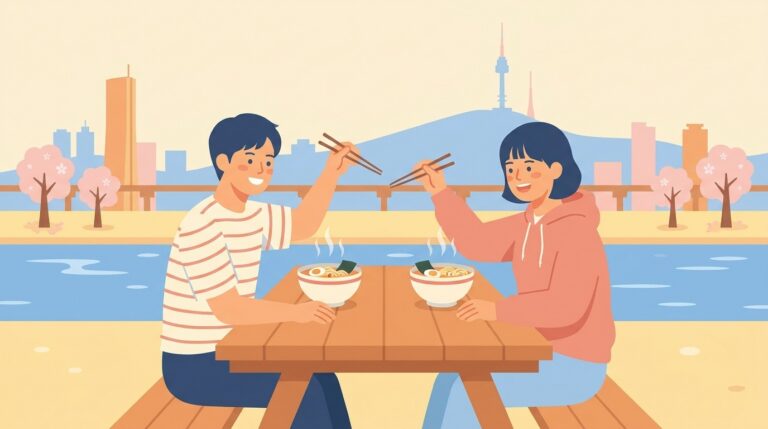
Setting: Sitting on a picnic mat by the Han River (Yeouido) at sunset. Your Korean friend Minjun (민준) has just brought instant ramen from the convenience store.
- Minjun: 🎭 (Peeking at your phone screen with a mischievous grin) 너 다음 주부터 다이어트한다더니 방금 라면 두 개 끓여온 거 실화냐? (Neo daeum jubeuteo daieoteuhandadeoni banggeum ramyeon du gae kkeulyeoon geo silhwanya? / Didn’t you say you’re going on a diet next week? Is cooking two ramens right now for real?)
- You: 🎭 (Clutching your chest in mock agony) 윽, 순살 팩폭 뭔데… 너무 아프다. (Euk, sunsal paekpok mwonde… neomu apeuda. / Ugh, what’s with the boneless fact bomb… that hurts!)
- Minjun: 🎭 (Wiggling his eyebrows teasingly) 뭐래, 찔려? 얼굴 빨개진 거 보니까 제대로 긁혔네! (Mweorae, jjillyeo? Eolgul ppalgaejin geo bonikka jedaero geul-khyeotne! / What? Feeling guilty? Looking at your red face, you got totally triggered!)
- You: 🎭 (Shaking your head in theatrical outrage) 아, 그 눈빛 진짜 킹받네! 그만 놀려라! (A, geu nunbit jinjja king-bat-ne! Geuman nollyeora! / Ah, that look in your eyes is so king-annoying! Stop teasing!)
- Minjun: 🎭 (Pushing the steaming ramen bowl toward you with chopsticks) 알았어, 미안! 대신 내가 계란 완벽한 반숙으로 풀었거든? (Arasseo, mian! Daesin naega gyeran wanbyeokhan bansugeuro pureotgeodeun? / Alright, my bad! To make up for it, I cooked the egg to a perfect soft-boil, okay?)
- You: 🎭 (Inhaling the savory smell with wide eyes) 헐, 반숙 계란? 이건 용서할 수밖에 없네. (Heol, bansuk gyeran? Igeon yongseohal subakke eoptne. / Whoa, soft-boiled egg? I have no choice but to forgive you.)
- Minjun: 🎭 (Grinning warmly) 빨리 첫 입 먹어봐. 아직도 긁혀 있어? (Ppalli cheot ip meogeobwa. Ajikdo geul-khyeo isseo? / Hurry and take the first bite. Still triggered?)
- You: 🎭 (Slurping a mouthful happily) 라면 한 입에 완치 완료! 역시 찐친밖에 없다. (Ramyeon han ibe wanchi wallyo! Yeoksi jjinchinbakke eoptda. / Completely healed with one bite! Truly, nobody beats a best friend.)
🔀 Interactive Decision Point
How would you respond if Minjun teased you about eating ramen?
* Option A: “왜 나한테 화를 내? 다시는 너랑 안 먹어.” (Why are you getting angry at me? I will never eat with you again.)
* Feedback: 🚫 Risk! This takes the teasing literally and instantly creates an awkward silence (갑분싸).
* Option B: “저는 칼로리를 신경 쓰지 않는 편입니다.” (I tend not to care about calories.)
* Feedback: ⚠️ Bad. Too formal and robotic; it kills the warm mood.
* Option C: “와, 팩폭 자제 좀! 킹받으니까 라면 얼른 넘겨.” (Whoa, easy on the fact bomb! You’re king-annoying me, so hand over that ramen fast.)
* Feedback: ✅ Best! Perfect blend of playful resistance and casual closeness.
Phase 6: 10-Second Emotion Shadowing Drill
Practice these lines with exaggerated pitch variations (use the / for natural pauses):
[😤 Playfully victimized / 억울한 척하며]
와… / 뼈 때리지 마세요 / 순살 되겠어요! (Wa… / pbyeo ttaeriji maseyo / sunsal doegetseoyo! / Whoa… / don’t hit my bones / I’ll turn into boneless chicken!)[😏 Cheeky & teasing / 능글맞게 놀리며]
어라? / 목소리 커지는 거 보니까 / 제대로 긁혔네? (Eora? / Moksori keojineun geo bonikka / jedaero geul-khyeotne? / Oh? / Seeing your voice get louder / you totally got triggered, huh?)[🤣 Suppressed laughter in faux fury / 웃참 실패하며]
아 그 표정 / 진짜 킹받네! / 웃지 마! (A geu pyojeong / jinjja king-bat-ne! / Utji ma! / Ah, that smirk / is so king-annoying! / Stop laughing!)
Phase 7: K-Culture Mini Dictionary
- 찐친 (Jjin-chin): Authentic best friend. A compound of 찐 (authentic/real) and 친구 (friend). Reserved for the inner circle who can see you at your worst.
- 뼈 때리다 (Pbyeo ttaerida): To hit the bone. Delivering a truth so accurate and sharp that it strikes deep beneath your emotional skin.
- 뇌절 (Noe-jeol): Brain short-circuit. Repeating a joke past the point of humor until it becomes awkward and annoying.
- 티키타카 (Tiki-taka): Seamless, rhythmic back-and-forth communication, borrowed from Spanish football passing style.
Phase 8: Traveler’s Survival Kit
Top 3 Survival Teasing Lines
- 한 입만! (Han ip-man!) – “Just one bite!” (The universal Korean phrase to test friendship limits over street food).
- 반칙이지! (Banchik-iji!) – “That’s cheating! / Totally unfair!” (Use when someone orders something tastier than yours).
- 나 안 삐졌거든? (Na an ppijyeot-geodeun?) – “I am not sulking, alright?” (Say this with a tiny smirk to show you’re not actually upset).
Editor’s Travel Note
When hunting for riverside ramen or night market tteokbokki, make sure you have the 카카오맵 지도 앱 길찾기 바로가기 installed. Google Maps often struggles with pedestrian shortcuts in Seoul. Also, keep small bills or check card convenience app payments ready: splitting the bill (N분의 1) is standard among friends, but taking turns buying rounds (1차는 내가, 2차는 네가) is the ultimate mark of Korean bonding.
Phase 9: “One Step Deeper” (Reflective Humanities Essay)
In a society structured by hierarchy, age brackets, and polite grammar, playful teasing serves as a sanctuary. When Koreans trade paekpok and laugh over being king-bat-ne, they are momentarily stepping outside rigid social expectations. The mutual roasting acts as proof of psychological safety: “We are close enough that I don’t need to guard my ego around you.” Food sharing completes this circle—the physical act of offering nourishment reminds both parties that the teasing is wrapped in Jeong (정, affection).
💬 Your Turn: Does your native culture use “mock insults” to show affection, or does intimacy require constant compliments? Drop your thoughts in the comments below!
Phase 10: FAQ & Avoiding Misunderstandings
Q: Can I use “킹받네” with my Korean boss or older colleagues?
A: Absolutely not! While king-bat-ne is cute among peers, using it with someone older or senior in rank will sound extremely disrespectful and unpolished. Keep it strictly to same-age friends or younger close buddies.
Q: What is the difference between “팩폭” and “뼈 때리다”?
A: 팩폭 (Fact bomb) focuses on the undeniable truth of the statement itself. 뼈 때리다 (Hitting the bone) highlights the emotional sting or painful impact of hearing that truth.
Q: How do I know if I crossed the line from fun banter to being rude?
A: Watch their body language! If your friend stops smiling, breaks eye contact, or checks their phone in silence, you have crossed into 갑분싸 (sudden awkward silence). Instantly apologize and use the golden reset: buy them a snack or drink!
🚨 Common Mistakes Warning Board
- Mistake 1: Spamming “긁?” when someone is genuinely sad or stressed about exams or family issues. (Correct Action: Switch to sincere empathy: “많이 힘들었겠다 / You must have had a tough time”).
- Mistake 2: Dropping honorifics (Banmal) without an explicit invitation just because you learned fun slang.
- Mistake 3: Committing Noe-jeol (뇌절) by repeating the same tease ten times in an hour.
Phase 11: Action Mission & Engagement
- 🥉 Bronze Level: Say “아 진짜 킹받네!” aloud in front of your mirror with an exaggerated pout and eye-roll.
- 🥈 Silver Level: Screenshot a funny meme or K-Drama expression on your social feed and caption it with #킹받네 #찐친케미.
- 🥇 Gold Level: Next time your Korean language exchange partner playfully points out your habit, reply with: “와, 팩폭… 라면 사주세요!” (Whoa, fact bomb… buy me ramen!).
- 🎮 K-Culture Mission: Watch an episode of a variety show like Going Seventeen or Earth Arcade and spot three times the caption editor writes 팩폭 or 킹받.
Phase 12: Interactive Quiz Challenge
Q1. Situational Judgment: Your Korean friend smirks and says you spent 30 minutes picking out your socks. What is the most natural, playful reply?
* (1) 당신의 지적에 깊이 반성합니다.
* (2) 아 표정 진짜 킹받네! 귀여워서 봐준다.
* (3) 경찰을 부르겠습니다.
Q2. Fill in the Blank: When someone hits you with an undeniable truth that stings playfully, Koreans call this a “fact assault”:
팩___ (Two syllables)
Q3. Cultural True or False: In Korea, if you bicker playfully with a friend, you should maintain physical distance and not share meals to avoid conflict.
* (True / False)
👉 Click here to reveal the answers and explanations!
- Q1 Answer: (2) – “아 표정 진짜 킹받네! 귀여워서 봐준다.” (That smirk is so king-annoying! I’ll forgive you because you’re cute). (1) is too formal and (3) calls the police!
- Q2 Answer: 팩폭 (Paek-pok – short for 팩트 폭행).
- Q3 Answer: False – Sharing food right after bickering is the quintessential Korean “Jeong” ritual that proves you are true besties (찐친)!
🎬 Watch Our Daily Videos! (Daily Hangul Official Instagram)
Review the expressions you learned in this article with our fun daily short videos! Check out native pronunciation and real-life nuances in action.
- Instagram @dailyhangul_en







