

Step Inside Seoul Flagship Stores: How to Speak High-End Korean Brand Architecture
Phase 1: Empathy (Immersive Story Opening)
안녕하세요! This is your Daily Hangul editor and cultural navigator.
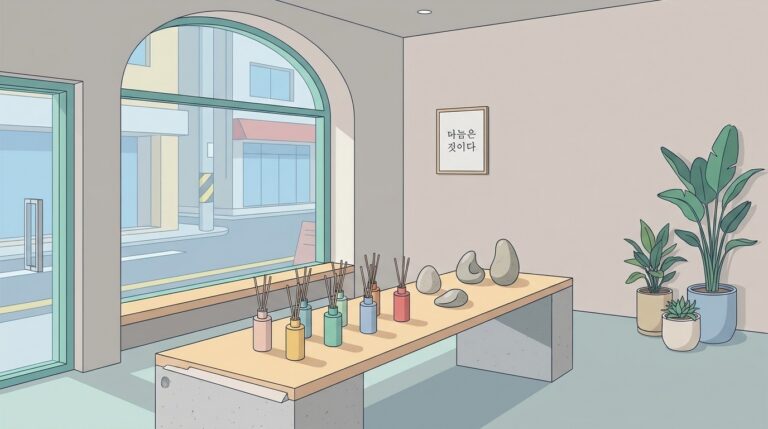
Imagine walking down the industrial-chic alleys of Seongsu-dong or the sophisticated avenues of Dosan Park in Seoul. You push open the heavy pivoting door of an ultra-contemporary building, leaving the bustling street behind. Inside, you are not greeted by rows of packaged products with barcode scanners. Instead, an earthy signature fragrance envelops you, a minimalist mechanical kinetic art installation moves rhythmically to ambient soundscapes, and an impeccably dressed curator offers you a lukewarm herbal infusion. You have stepped into a modern Korean flagship store—a physical manifestation of redefined brand architecture.
At this moment, your colleague or a Korean brand director turns to you and asks what you think of the new space. Many advanced learners freeze, defaulting to basic praise: “인테리어가 예뻐요” (The interior is pretty) or “가게가 커요” (The store is big). But as a C1-level communicator or branding professional, you want to convey the subtle interplay of spatial storytelling, multi-sensory curation, and brand heritage.
Learning to articulate these nuances in Korean is not just about vocabulary; it is about grasping how modern Korean commerce treats customer touchpoints as cultural experiences. Based on years of feedback from global marketers and cultural creatives working in Seoul, this guide equips you with the exact lexicon to discuss high-concept brand strategy effortlessly.
Phase 2: 3 Core Expressions Deep Dive
1. 감도 높은 (Gamdo nopeun)
- Pronunciation: Gam-do no-peun (Sounds like “calm dough” followed by “no pun”)
- Meaning: Literal: “High sensitivity/receptivity” | Real Nuance: “Aesthetically sophisticated,” “finely curated,” or possessing exceptional design taste.
- K-Culture Moment: Commonly heard in creative agencies, luxury fashion houses, and lifestyle documentaries when discussing brands like Tamburins, Gentle Monster, or Sulwhasoo’s Bukchon House.
- Editor’s Insight: While “세련된” means sophisticated or sleek, “감도 높은” specifically addresses artistic sensitivity and high sensory curation. It is the ultimate compliment for spaces where every texture, light, and corner has been deliberately calibrated.
- Situation Spectrum: Casual ⚠️ | Semi-formal ✅ | Formal ✅
- 🤔 Think About It: In English, we often say “chic” or “well-curated,” but Korean uses 감도 (receptivity/sensitivity). Why does Korean culture frame elevated taste around the capacity to perceive and express delicate feelings?
2. 오감으로 경험하다 (Ogameuro gyeongheomhada)
- Pronunciation: Oh-gam-eu-ro gyeong-heom-ha-da (Metaphor: Oh as in “open”, gam as in “gum”, heom as in “hum”)
- Meaning: Literal: “To experience with all five senses” | Real Nuance: “To experience an immersive, multi-sensory brand universe.”
- K-Culture Moment: Used by spatial designers explaining why a flagship store features a signature scent (olfactory), acoustic treatment (auditory), bespoke texture materials (tactile), a tea lounge (gustatory), and architectural lighting (visual).
- Editor’s Insight: Koreans consider experiential retail essential rather than optional. Using 오감으로 경험하다 moves you away from transactional shopping talk into the realm of spatial marketing.
- Situation Spectrum: Casual ⚠️ | Semi-formal ✅ | Formal ✅
- 🤔 Think About It: Does your home culture evaluate shopping spaces purely on convenience, or does it also demand sensory storytelling?
3. 브랜드 철학을 공간에 녹여내다 (Beuraendeu cheolhageul gonggan-e nogyeonaeda)
- Pronunciation: Beu-raen-deu cheol-ha-geul gong-gan-e no-gyeo-nae-da (Metaphor: nogyeo flows smoothly like “no-gear”)
- Meaning: Literal: “To melt down the brand philosophy into the space” | Real Nuance: “To seamlessly embody brand values within an architectural environment.”
- K-Culture Moment: Featured regularly in boardroom presentations and brand renewal press releases across K-Beauty and K-Food conglomerates.
- Editor’s Insight: The verb 녹여내다 (to melt/infuse) is vital. It implies that the brand identity is not pasted on as a logo; it is dissolved into the very walls, atmosphere, and customer journey.
- Situation Spectrum: Casual 🚫 | Semi-formal ✅ | Formal ✅
- 🤔 Think About It: Why does Korean professional discourse favor fluid, organic metaphors like “melting” (녹여내다) over mechanical terms like “implementing” (적용하다)?
Phase 3: Textbook Korean vs Real Korean
Situation A: Praising an immersive retail showroom
- 📖 교과서 한국어 (Textbook):
“이 매장은 인테리어가 매우 아름답고 분위기가 좋습니다.”
(I mae-jang-eun in-te-ri-eo-ga mae-u a-reum-dap-go bun-wi-gi-ga jo-seum-ni-da. / This store’s interior is very beautiful and the atmosphere is good.) - 🗣️ 진짜 한국어 (Real Native C1):
“공간의 감도가 정말 남다르네요. 브랜드의 세계관이 오감으로 와닿아요.”
(Gong-gan-ui gam-do-ga jeong-mal nam-da-reu-ne-yo. Beu-raen-deu-ui se-gye-gwan-i o-gam-eu-ro wa-da-a-yo. / The aesthetic sensitivity here is exceptional. The brand’s universe truly resonates through all five senses.) - 💡 왜 다를까?: Native Korean professionals in Seoul avoid generic descriptors like “아름답다” (beautiful) and instead praise 세계관 (brand universe) and 감도 (aesthetic density).
Situation B: Discussing a brand renewal campaign
- 📖 교과서 한국어 (Textbook):
“우리 회사는 디자인을 바꾸고 새로운 손님을 모으려고 합니다.”
(U-ri hoe-sa-neun di-ja-in-eul ba-kku-go sae-ro-un son-nim-eul mo-eu-ryeo-go ham-ni-da. / Our company plans to change the design and gather new customers.) - 🗣️ 진짜 한국어 (Real Native C1):
“브랜드 아키텍처를 재정립하면서, 프리미엄 리브랜딩의 일환으로 플래그십 공간을 기획했습니다.”
(Beu-raen-deu a-ki-tek-cheo-reul jae-jeong-nip-ha-myeon-seo, peu-ri-mi-eom ri-beu-raen-ding-ui il-hwan-eu-ro peul-lae-geu-sip gong-gan-eul gi-hwoek-haet-seum-ni-da. / While realigning our brand architecture, we curated a flagship space as part of our premium rebranding initiative.) - 💡 왜 다를까?: Contemporary corporate Korean uses industry-standard loanwords alongside precise Sino-Korean compound nouns (재정립, 일환, 기획) to project authority and strategic clarity.
Phase 4: K-Culture Deep Dive & Non-verbal Manners
4-1. Nunchi & Spatial Manners in High-End Seoul Stores
When exploring premium Korean flagship stores in districts like Hannam-dong or Cheongdam-dong, visual and physical etiquette is crucial:
* The Lowered Decibel Rule: These spaces are designed like art galleries. Loud conversations disrupt the curated acoustic design. Speak in quiet, measured tones.
* Curator Engagement: Staff in these stores are rarely sales clerks (직원); they act as brand docents (도슨트). Maintain gentle eye contact, nod respectfully as they introduce the spatial narrative, and accept test products with both hands (양손 사용).
* Appreciative Gazing: Instead of rushing straight to price tags, step back to observe installations. Korean spatial designers pride themselves on ” 여백의 미” (the beauty of empty space). Acknowledging negative space demonstrates high aesthetic discernment.
4-2. Cultural Code: The Rise of “Space Branding” (공간 브랜딩)
Why are Korean consumers obsessed with physical stores in the era of super-fast delivery apps like Coupang? In modern Korea, a store is no longer a place to buy things; it is a cultural verification ground. Young Koreans crave “디깅 소비” (digging consumption)—delving deeply into brands that mirror their personal identity and value systems. A flagship store is the physical altar of that lifestyle. When a brand nails its spatial curation, it earns virality not through ads, but through authentic user-generated cultural capital on Instagram and YouTube.
Phase 5: Real-World Roleplay Scenario
Setting: You are touring a newly opened luxury flagship store in Seongsu-dong with Min-seo, the Head of Spatial Branding at a premier Seoul design agency.
- 민서 (Min-seo): “팀장님, 이번에 새롭게 공개한 플래그십 스토어 어떠세요? 헤리티지를 현대적으로 재해석하는 데 공을 많이 들였거든요.”
(Tim-jang-nim, i-beon-e sae-rop-ge gong-gae-han peul-lae-geu-sip seu-to-eo eo-tteo-se-yo? He-ri-ti-ji-reul hyeon-dae-jeok-eu-ro jae-hae-seok-ha-neun de gong-eul man-i deu-ryeot-geon-yeo.)
(Director, what do you think of our newly unveiled flagship store? We dedicated tremendous effort to reinterpreting our heritage through a modern lens.)
🎭 Gesturing gracefully toward an ink-wash landscape painting displayed on a giant LED screen. -
당신 (You): “정말 인상적입니다. 브랜드 철학이 공간 구석구석에 아주 섬세하게 녹아있네요.”
(Jeong-mal in-sang-jeok-im-ni-da. Beu-raen-deu cheol-hak-i gong-gan gu-seok-gu-seok-e a-ju seom-se-ha-ge nog-a-it-ne-yo.)
(It is truly impressive. The brand philosophy is dissolved so delicately into every single corner of this space.)
🎭 Slowly sweeping your eyes across the stone counters and raw cedar fixtures. -
민서 (Min-seo): “알아봐 주셔서 감사해요. 특히 입구에서 느껴지는 시그니처 향과 사운드트랙도 맞춤으로 제작했습니다.”
(Al-a-bwa ju-syeo-seo gam-sa-hae-yo. Teuk-hi ip-gu-e-seo neu-kyeo-ji-neun si-geu-ni-cheo hyang-gwa sa-un-deu-teu-raek-do mat-chum-eu-ro je-jak-haet-seum-ni-da.)
(Thank you for recognizing that. In particular, we custom-produced the signature scent at the entrance and the ambient soundtrack.)
🎭 Pausing deliberately to let the subtle cedarwood fragrance register. -
당신 (You): “아, 어쩐지 입장할 때부터 오감이 자극받는 느낌이었습니다. 고객 경험의 감도를 한 단계 끌어올렸군요.”
(Ah, eo-jjeon-ji ip-jang-hal ttae-bu-teo o-gam-i ja-geuk-bat-neun neu-kkim-i-eot-seum-ni-da. Go-gaek gyeong-heom-ui gam-do-reul han dan-gye kkeul-eo-ol-lyeot-gun-yo.)
(Ah, no wonder I felt my five senses stimulated right upon entering. You have elevated the sensitivity of customer experience to another tier.)
🎭 Nodding with subtle, genuine admiration. -
민서 (Min-seo): “맞습니다. 단순한 판매 공간이 아니라, 브랜드의 가치를 체감할 수 있는 쉼터로 기획했거든요.”
(Mat-seum-ni-da. Dan-sun-han pan-mae gong-gan-i a-ni-ra, beu-raen-deu-ui ga-chi-reul che-gam-hal su it-neun swim-teo-ro gi-hwoek-haet-geon-yeo.)
(Exactly. We curated it not as a simple sales floor, but as a sanctuary where visitors can physically feel our brand values.)
🎭 Presenting a tactile sample of locally sourced Korean granite. -
당신 (You): “그 의도가 명확히 전달됩니다. 리브랜딩 캠페인의 전체적인 맥락과도 아주 자연스럽게 맞아떨어지네요.”
(Geu ui-do-ga myeong-hwak-hi jeon-dal-doem-ni-da. Ri-beu-raen-ding kaem-pe-in-ui jeon-che-jeok-in maek-rak-gwa-do a-ju ja-yeon-seu-reop-ge ma-ja-tteol-eo-ji-ne-yo.)
(That intention comes through crystal clear. It aligns seamlessly with the broader context of your rebranding campaign.)
🎭 Maintaining comfortable eye contact with an appreciative smile. -
민서 (Min-seo): “그렇게 말씀해 주시니 큰 힘이 됩니다. 2층에는 VIP 고객을 위한 프라이빗 살롱도 마련되어 있는데, 함께 둘러보시겠어요?”
(Geu-reoh-ge mal-ssuem-hae ju-si-ni keun him-i doem-ni-da. I-cheung-e-neun V-I-P go-gaek-eul wi-han peu-ra-i-bit sal-rong-do ma-ryeon-doe-eo it-neun-de, ham-kke dul-reo-bo-si-get-eo-yo?)
(Your words mean so much to us. On the second floor, we have arranged a private salon for VIP clientele. Would you care to look around together?)
🎭 Signaling politely toward the minimalist sculptural staircase. -
당신 (You): “네, 매우 기대됩니다. 앞장서 주시죠.”
(Ne, mae-u gi-dae-doem-ni-da. Ap-jang-seo ju-si-jyo.)
(Yes, I look forward to it very much. Please lead the way.)
🎭 Extending an open-palm gesture to indicate deference.
🔀 Interactive Decision Point
How would you conclude your assessment of the space when meeting the Vice President on the 2nd floor?
* Choice A: “물건 파는 곳치고는 너무 화려하고 복잡해서 정신이 좀 없네요.” (For a place selling goods, it’s too flashy and complicated, so it feels distracting.)
* Choice B: “브랜드 철학을 공간 속에 오감으로 온전히 풀어내어, 프리미엄 리브랜딩의 정점을 보여주는 훌륭한 쇼케이스입니다.” (By expressing the brand philosophy across all five senses within this space, it serves as a brilliant showcase marking the pinnacle of premium rebranding.)
* Choice C: “인테리어 비용이 엄청 많이 들었을 것 같은데, 매출은 잘 나오나요?” (It looks like the interior cost a fortune; are sales coming in well?)
Feedback Guide:
* Choice A (Bad): Shows a total misunderstanding of high-concept brand architecture. Dismissing experiential storytelling as “flashy and distracting” destroys professional rapport.
* Choice B (Best): Perfect C1 eloquence. Synthesizes strategic brand concepts (철학, 오감, 리브랜딩의 정점) and delights corporate leadership.
* Choice C (Risk): While commercially valid, bluntly asking about interior costs and direct sales at a flagship opening violates Korean social etiquette (눈치), making you seem transaction-obsessed rather than strategically minded.
Phase 6: 10-Second Emotional Shadowing Drill
Practice reading these lines aloud with the indicated pause points (/) and emotional tone indicators.
- [✨ Deep Admiration & Spatial Wonder]
“단순한 매장이 아니라, / 브랜드의 철학이 / 오감으로 살아 숨 쉬는 공간이네요.”
(Dan-sun-han mae-jang-i a-ni-ra, / beu-raen-deu-ui cheol-hak-i / o-gam-eu-ro sal-a sum swi-neun gong-gan-i-ne-yo.)
(It is not merely a store; / it is a space where the brand philosophy / breathes through all five senses.) -
[💼 Confident Executive Insight]
“감도 높은 공간 큐레이션을 통해, / 브랜드 아키텍처가 / 훨씬 명확해졌습니다.”
(Gam-do no-peun gong-gan kyu-re-i-syeon-eul tong-hae, / beu-raen-deu a-ki-tek-cheo-ga / hwol-ssin myeong-hwak-hae-jyeot-seum-ni-da.)
(Through this highly sensitive spatial curation, / your brand architecture / has become substantially clearer.) -
[🤝 Warm Professional Rapport]
“고객의 발길이 머무는 모든 접점에 / 세심하게 신경 쓰신 태가 납니다.”
(Go-gaek-ui bal-gil-i meo-mu-neun mo-deun jeop-jeom-e / se-sim-ha-ge sing-gyeong sseu-sin tae-ga nam-ni-da.)
(At every touchpoint where customers pause, / your meticulous attention to detail is unmistakably visible.)
Phase 7: K-Culture Mini Dictionary
-
공간 브랜딩 (Gonggan beuraending) | Spatial Branding
The comprehensive discipline of translating a brand’s narrative into physical dimensions—lighting, airflow, scent, acoustics, and materials. Essential in Korean marketing discourse. -
팝업 스토어 (Papeop seuto-eo) | Pop-up Store
In Korea, pop-ups are seasonal architectural phenomena. Brands overhaul buildings in Seongsu or Gangnam for mere weeks to launch exclusive collaborations and test sensory concepts. -
결 (Gyeol) | Inherent Grain / Texture / Aesthetic Cohesion
Literally the grain of wood or stone. In high-level branding, Koreans say “브랜드의 결이 다르다” (The brand’s grain/vibe is distinctly elevated) to denote effortless, organic refinement. -
헤리티지 (Heritiji) | Brand Heritage
A heavily utilized loanword in contemporary corporate Seoul. Traditional Korean pharmaceutical, cosmetic, and confectionery firms undergoing rebranding constantly reference their 헤리티지 to retain trustworthiness while modernizing.
Phase 8: Traveler’s Survival Kit
Top 3 On-Site Survival Phrases
- “공간 촬영이 가능한가요?” (Gong-gan chwal-yeong-i ga-neung-han-ga-yo?)
Can I take photos of the space?
Pro Tip: While flagship stores encourage social sharing, exclusive second-floor consultation lounges or art pieces often prohibit flash photography. - “도슨트 프로그램이나 공간 설명 안내서가 마련되어 있나요?” (Do-seun-teu peu-ro-geu-raem-i-na gong-gan seol-myeong an-nae-seo-ga ma-ryeon-doe-eo it-na-yo?)
Do you provide a docent tour or spatial guide pamphlet?
Pro Tip: Many flagship stores offer architectural design booklets in English and Korean that provide profound insight into the materials used. - “이곳의 시그니처 향과 음악은 별도로 구매할 수 있나요?” (I-got-ui si-geu-ni-cheo hyang-gwa eum-ak-eun byeol-do-ro gu-mae-hal su it-na-yo?)
Are the signature scent and music played here available for purchase?
Pro Tip: Korean lifestyle brands often sell diffusers, incenses, and vinyl editions curated specifically for their physical spaces.
Editor’s Travel Note
Before heading to Seongsu-dong, Euljiro, or Dosan Park, prepare your smartphone essentials. Standard global maps often malfunction in South Korea due to local spatial data security regulations. Use the Naver Map App store navigation download to pin high-concept flagship stores in advance and read real-time visitor reviews. For public transport, reload your physical climate transit pass or use mobile cards at turnstiles. Remember that flagship boutique purchases in Seoul qualify for immediate duty-free tax refunds on the spot—keep your physical passport handy.
Phase 9: One Step Deeper (Reflective Insight)
In Western commercial philosophy, physical brick-and-mortar stores are frequently analyzed through utility, foot-traffic efficiency, and conversion funnels. In contrast, modern Korean culture perceives 공간 (Space) as an organic continuum of relationship building (정, 情) and collective memory. A flagship store in Seoul is an experiential ecosystem where a company demonstrates humility, generosity, and cultural reverence toward its community. By gifting visitors sensory delight without demanding an immediate financial transaction, the brand cements deep psychological loyalty.
💬 Your Turn: What makes a flagship store memorable in your country? Does your culture prioritize functional efficiency, or do you also have spaces that stimulate all five senses? Share your thoughts below in Korean or English!
Phase 10: FAQ & Avoiding Misunderstandings
Q: Can I use “감도 높은” to describe everyday people or casual objects?
A: You should be selective. Calling a friend “감도 높은 사람” sounds overly analytical or poetic, like something written in a high-fashion magazine editorial. It is best reserved for artistic directors, refined designers, architectural spaces, publications, or aesthetic portfolios. For an individual’s casual good taste, “센스 있는 사람” (a sensible/tasteful person) is far more natural.
Q: What is the exact difference between “리브랜딩 (Rebranding)” and “새단장 (Renewal/Saedanjang)”?
A: 새단장 (literally “new makeup/decoration”) refers to physical cosmetic remodeling—repainting walls or changing a storefront banner. 리브랜딩 implies an ontological realignment: restructuring brand architecture, revising brand values, repositioning target demographics, and overhauling tone of voice across all customer touchpoints.
Q: Is it rude to touch display items in a flagship store if there are no signs?
A: In high-end Seoul flagship stores, raw architectural materials (like volcanic rocks, fabric rolls, or water installations) are often artistic metaphors rather than tactile testers. A good rule of thumb is “눈으로 감상하다” (appreciate with your eyes) first. If you wish to interact with an unlabelled element, politely ask the docent: “만져봐도 괜찮을까요?” (May I touch this?).
🚨 Common Mistakes Alert
- Mistake: Saying “이 건물 디자인은 너무 비쌉니다” (This building design is too expensive) to convey luxury.
Correct Action: Say “마감재와 디테일에 고급스러움이 묻어나네요” (The finishes and details exude luxury). - Mistake: Using “오감 (Five Senses)” as a standalone verb like “오감해요”.
Correct Action: Pair it with verbs of action or stimulation: “오감을 자극하다” (stimulate the five senses) or “오감으로 느끼다/경험하다” (feel/experience with all five senses). - Mistake: Confusing “플래그십 스토어” with a standard chain branch (지점).
Correct Action: Never refer to a brand’s flagship flagship as “성수 지점” (Seongsu branch); call it “성수 플래그십 스토어” or “성수 쇼룸” (showroom).
Phase 11: Action Missions
- 🥉 Bronze Level (Solo Practice): Record yourself shadowing the 3 sentences in Phase 6. Focus on pausing at the slashes (
/) and capturing an executive, appreciative tone. - 🥈 Silver Level (Social Sharing): Visit a design space, aesthetic café, or flagship store near you. Post a photo on Instagram or LinkedIn and caption it using the phrase: “공간의 감도가 돋보이는 곳. 브랜드 철학을 오감으로 경험하다.”
- 🥇 Gold Level (Real-World Application): Next time you speak with a Korean colleague, client, or language partner, describe your favorite brand’s physical presence using 감도 높은 and 녹여내다.
🎮 K-Culture Mission: Watch an episode of a modern corporate K-Drama (such as Search: WWW or Agency). Spot how marketing executives pitch spatial launches, and listen for the words 세계관, 접점, and 감도 in the wild.
Phase 12: Interactive Quiz Challenge
Test your mastery of Korean brand architecture and spatial terminology. Check your answers in the spoiler toggles below!
Question 1: Situation Judgment
You are attending the opening ceremony of an iconic K-Beauty flagship store in Gangnam. The CEO asks for your impressions of the multi-sensory perfume gallery. Which response demonstrates natural C1 competence?
* (A) “화장품 냄새가 좋고 조명이 밝아서 사진이 잘 나옵니다.”
* (B) “브랜드의 고유한 헤리티지를 오감으로 체험할 수 있도록 감도 높게 연출하셨네요.”
* (C) “인테리어에 돈을 많이 쓰셔서 앞으로 손익분기점 맞추기 힘드시겠습니다.”
👉 View Answer & Explanation
Correct Answer: (B)
Explanation: Option (B) weaves together 헤리티지 (heritage), 오감으로 체험하다 (experience through the senses), and 감도 높게 연출하다 (execute with high aesthetic sensitivity). Option (A) is too simplistic (A2-B1), and option (C) is a catastrophic breach of professional etiquette.
Question 2: Fill in the Blank
Complete this spatial branding sentence with the most natural verb phrase:
“이번 플래그십 스토어는 브랜드가 추구하는 지속 가능성의 가치를 공간 전체에 섬세하게 (________) 것이 특징입니다.”
* (A) 버려둔 (abandoned)
* (B) 녹여낸 (melted/infused)
* (C) 비싸게 만든 (made expensive)
👉 View Answer & Explanation
Correct Answer: (B) 녹여낸
Explanation: In Korean spatial branding, values and philosophies are metaphorically “infused/melted” into physical environments: 철학/가치를 공간에 녹여내다.
Question 3: Cultural True or False
Statement: Modern flagship stores in Seoul like Gentle Monster or Tamburins prioritize allocating at least 80% of their floor area to product display shelves and cash registers to maximize revenue.
* [True / False]
👉 View Answer & Explanation
Correct Answer: False
Explanation: Seoul’s landmark flagship stores frequently dedicate more than half their footprint to art installations, kinetic sculptures, rest zones, and experiential sensory displays. Direct retail selling is deprioritized in favor of building cultural equity and brand immersion.
🎬 Watch Our Daily Videos! (Daily Hangul Official Instagram)
Review the expressions you learned in this article with our fun daily short videos! Check out native pronunciation and real-life nuances in action.
- Instagram @dailyhangul_en







