

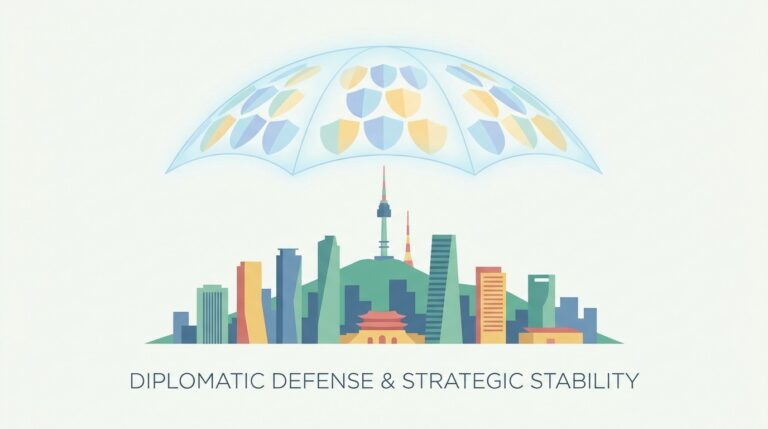
Decoding Extended Deterrence in Korean: How Seoul Navigates the Nuclear Umbrella
Phase 1: Empathy & Immersion
안녕하세요! 매일한글 에디터입니다. (Hello! I’m your Daily Hangul editor.)
Imagine this: You are sitting in an upscale cafe near the National Assembly in Yeouido, or perhaps attending an international security seminar in Gwanghwamun. The TV overhead is tuned to YTN news, flashing breaking reports on regional defense summits. Your Korean colleagues, usually enthusiastic about weekend hiking or the latest Netflix K-thriller like Steel Rain or Designated Survivor: 60 Days, suddenly drop their casual banter. Their tones deepen as they dissect national security: “과연 미국의 확장억제가 실효성이 있을까요?” (Does the US extended deterrence really remain effective?)
You want to chime in. You hold nuanced opinions on strategic stability, balance of power, and alliance commitments. Yet your tongue freezes. You know the English terms inside out—nuclear umbrellas, extended deterrence, counter-proliferation—but expressing these complex multilateral doctrines in natural, authoritative, C2-level Korean feels like defusing an unexploded ordnance.
You are not alone. Advanced learners often hit a glass ceiling when transitioning from conversational fluency to high-stakes political and analytical discourse. This guide transforms that frustration into effortless intellectual presence. Based on real feedback from foreign policy fellows, diplomats, and international researchers who mastered Korean with us, this lesson equips you to articulate state-level defense dynamics with native precision. Let’s step into the high-stakes world of Korean strategic vocabulary!
Phase 2: Core Expressions Deep Dive
1. 확장억제 (Hwakjang eokje)
- Pronunciation: [Hwak-jang eok-je] (Think of hwak like a brisk gust of wind, jang like a martial artist’s strike, eok like a muffled gasp, and je like the ‘ge’ in ‘gelatin’)
- Meaning: Literal: “Extended Deterrence” | Nuance: The solemn guarantee that an ally will employ its full spectrum of military capabilities—including nuclear, conventional, and missile defense—to deter attacks against a partner nation as if defending its own homeland.
- K-Culture Moment: Regularly featured in major press briefings between the ROK Minister of National Defense and the US Secretary of Defense during the annual Security Consultative Meeting (SCM).
- Editor’s Insight: In Korean diplomatic parlance, 확장억제 carries an existential weight. It is rarely uttered lightly; using this term signals that you are analyzing national survival rather than casual military news.
- Situation Spectrum: Casual 🚫 | Semi-formal ⚠️ | Formal ✅
- 🤔 Think About It: In your home country, is defense assistance discussed as an ethical obligation or a pragmatic transaction? How does the Korean term reflect an alliance bound by historical solidarity?
2. 핵우산 (Haek-usan)
- Pronunciation: [Haek-u-san] (Haek sounds like ‘hack’, u-san sounds like ‘oo-sahn’, the Korean word for umbrella)
- Meaning: Literal: “Nuclear Umbrella” | Nuance: The psychological and strategic canopy provided by a nuclear-armed power shielding a non-nuclear ally from atomic blackmail.
- K-Culture Moment: Often cited in political debates and editorial columns in The Chosun Ilbo or The Hankyoreh when discussing the credibility of external defense commitments.
- Editor’s Insight: While 확장억제 is the comprehensive strategic term, 핵우산 is the evocative, media-friendly metaphor that every Korean citizen instantly understands. It invokes both security and vulnerability.
- Situation Spectrum: Casual ⚠️ | Semi-formal ✅ | Formal ✅
- 🤔 Think About It: An “umbrella” shields you from rain, but can it shield you from a tempest? Notice how Koreans use this weather metaphor to question whether an ally would risk rain falling on their own soil.
3. 안보 딜레마 (Anbo dillema)
- Pronunciation: [An-bo dil-le-ma] (An-bo resembles ‘on-board’ without the rd, dil-le-ma matches the English loanword cadence)
- Meaning: Literal: “Security Dilemma” | Nuance: A structural paradox where actions taken by a state to heighten its defensive security inadvertently provoke adversaries to respond in kind, escalating overall tensions.
- K-Culture Moment: The analytical backbone of academic forums and documentary panels on the inter-Korean armistice on KBS and JTBC.
- Editor’s Insight: When speaking to senior Korean analysts, framing strategic friction as an “안보 딜레마” rather than simple “갈등” (conflict) instantly elevates your register to native policy-level sophistication.
- Situation Spectrum: Casual 🚫 | Semi-formal ✅ | Formal ✅
- 🤔 Think About It: How do linguistic framing tools like “dilemma” help soften direct blame while acknowledging systemic regional tensions?
Phase 3: Textbook Korean vs. Real Korean
Situation 1: Reaffirming Alliance Commitments
- 📖 교과서 한국어: 미국은 한국에게 핵우산을 제공하기로 약속했습니다. (Migukeun hangugege haekusaneul jegonghagiro yaksokhaesseumnida.) – “The United States promised to provide a nuclear umbrella to South Korea.”
- 🗣️ 진짜 한국어: 동맹국 본토 피격 시와 동일한 수위로 확장억제 공약을 강력히 재확인했습니다. (Dongmaengguk bonto pigyeok siwa dong-ilhan suwiro hwakjangeokje gong-yageul gangryeok-hi jaehwakin-haesseumnida.) – “They staunchly reaffirmed the extended deterrence commitment at an equivalent threshold to an attack on the homeland.”
- 💡 왜 다를까? Textbook Korean relies on basic verbs like 약속하다 (to promise), whereas real diplomatic Korean relies on formal Sino-Korean compounds (재확인, 피격, 수위) to project treaty-grade gravity.
Situation 2: Questioning Deterrence Credibility
- 📖 교과서 한국어: 만약 전쟁이 나면 미국이 진짜로 도와줄지 궁금합니다. (Mannyak jeonjaeng-i namyeon miguki jinjaro dowajulji gung-geumhamnida.) – “I wonder if the US will really help if war breaks out.”
- 🗣️ 진짜 한국어: 워싱턴이 불바다가 될 위험을 무릅쓰고 서울을 지켜줄 것인가에 대한 전략적 의구심이 상존하죠. (Wosingteoni bulbukdaga doel wiheomeul mureupsseugo seoureul jikyeojul geosinga-e daehan jeonryakjeok uigusimi sangjonhajyo.) – “Strategic skepticism persists over whether Washington would truly risk fire raining on its own cities to defend Seoul.”
- 💡 왜 다를까? Policy analysts convey complex skepticism using conditional metaphors (불바다가 될 위험을 무릅쓰고) and high-register nouns like 상존하다 (to persist perpetually) rather than personal doubts.
Phase 4: K-Culture Deep Dive & Non-Verbal Nuance
4-1. Nunchi (눈치) & Posture in Geopolitical Dialogue
In South Korea, discussing nuclear posture, conscription, and national defense is not an abstract academic parlor game; it touches personal histories of families separated by war, mandatory military service, and civil defense drills.
- The Subdued Nod (묵직한 끄덕임): When your conversational partner expresses concern over regional escalation, avoid brisk, enthusiastic nodding. Instead, deliver a measured, deliberate tilt of the head. It shows you recognize the gravity of the peninsula’s geopolitical fragility.
- Vocal Restraint: Maintain a steady, low baritone/alto pitch. In Korean debates, raising your pitch or volume during strategic discussions is perceived as emotional volatility rather than passion.
- Eye Contact: Hold unwavering, respectful eye contact when referencing alliance credibility, but soften your gaze downward for a fraction of a second when acknowledging historical devastation.
4-2. Cultural Code: The Blockbuster Geopolitics of K-Cinema
From classic box-office hits like Shiri and JSA (Joint Security Area) to modern cinematic treatises like The Man Standing Next and Steel Rain, Korean popular cinema has relentlessly explored the tension between great-power hegemony and domestic security autonomy. When you reference extended deterrence in Seoul, you are tapping into a cultural psyche shaped by centuries of peninsular geography—famously encapsulated in the proverb: “고래 싸움에 새우 등 터진다” (A shrimp’s back breaks in a fight between whales). Showing that you understand this underlying collective trauma elevates you from an observer to a true cultural insider.
Phase 5: Real-Life Roleplay Scenario
Setting: A panel breakout lounge at an International Geopolitics Forum in Yeouido, Seoul.
NPC: Dr. Han Min-seok (한민석 박사), a veteran strategic affairs analyst with a calm, penetrating gaze.
- Turn 1:
- 한민석 박사: 이번 정상회담에서 다뤄진 확장억제 방안, 어떻게 평가하십니까? (Ibeon jeongsanghoedam-eseo darwojin hwakjangeokje bang-an, eotteoke pyeong-gahasimnikka?)
- 🎭 Taking a slow sip of green tea, eyes focused intently on you.
- “How do you evaluate the extended deterrence measures addressed in this summit?”
- Turn 2:
- Learner: 선언적 확약 차원을 넘어 제도적 협의체를 명문화했다는 점에서 의미가 깊다고 봅니다. (Seoneonjeok hwakyak chaweoneul neomeo jedojeok hyeob-uiche-reul myeongmunhwahaetdaneun jeom-eseo uimiga giptago bomnida.)
- 🎭 Speaking with steady, articulate composure.
- “I see great significance in the fact that it codified institutional consultation mechanisms beyond mere declaratory rhetoric.”
- Turn 3:
- 한민석 박사: 일각에서는 여전히 ‘핵우산의 실효성’에 의문을 품고 자체 핵무장론까지 제기되는데 말이죠. (Ilgageseoneun yeojeonhi ‘haekusan-ui silhyoseong’-e uimuneul pumgo jache haekmujangron-kkaji jegidoeneunde marijyo.)
- 🎭 Resting hands on the table, leaning forward slightly.
- “Yet certain factions still harbor doubts regarding the ‘potency of the nuclear umbrella,’ even proposing sovereign nuclear armament.”
- Turn 4:
- Learner: 안보 딜레마를 고려할 때, 독자적 핵무장은 NPT 체제 균열과 역내 군비경쟁을 심화시킬 우려가 큽니다. (Anbo dillemareul goryeohal ttae, dokjajeok haekmujang-eun NPT cheje gyun-yeolgwa yeoknae gunbigyeongjaeng-eul simhwisikil uryeoga keumnida.)
- 🎭 Nodding once slowly to validate his point before offering your counterpoint.
- “Considering the security dilemma, autonomous nuclear armament risks fracturing the NPT regime and exacerbating regional arms races.”
- Turn 5:
- 한민석 박사: 그렇다면 동맹국의 전략자산 전개 빈도를 높이는 것만으로 충분한 억지력이 작동할까요? (Geureotamyeon dongmaengguk-ui jeonryakjasan jeongae bindoreul nop-ineun geonmaneuro chungbunhan eokjiryeogi jakdonghalkkayo?)
- 🎭 Looking with an intrigued eyebrow raised.
- “Then would simply increasing the operational frequency of allied strategic assets provide sufficient deterrence?”
- Turn 6:
- Learner: 가시적 전개뿐 아니라 전략기획 단계에서 공동 기획과 실행을 체계화하는 것이 관건입니다. (Gasijeok jeongaeppun anira jeonryakgihoek dangyeseo gongdong gihoekgwa silhaeng-eul chegyehwahaneun geosi gwangeon-imnida.)
- 🎭 Maintaining open palms on the table to demonstrate analytical clarity.
- “Beyond visible deployments, the crux lies in systematizing joint planning and execution at the strategic doctrine level.”
- Turn 7:
- 한민석 박사: 정확한 지적이십니다. 신뢰성이 담보되지 않은 억지는 환상에 불과하니까요. (Jeonghwak-han jijeogisimnida. Silroeseong-i dambodoeeji aneun eokjineun hwansang-e bulgwahanikkayo.)
- 🎭 Nodding with genuine professional satisfaction and an approving smile.
- “A spot-on observation. Deterrence without guaranteed credibility is nothing more than an illusion.”
- Turn 8:
- Learner: 결국 전략적 안정성을 유지하면서 동맹의 억지력 신뢰도를 제고하는 균형 감각이 요구됩니다. (Gyeolguk jeonryakjeok anjeongseong-eul yujihamyeonseo dongmaeng-ui eokjiryeok silroedoreul jegohaneun gyunhyeong gamgagi yogudoemnida.)
- 🎭 Concluding with a respectful, confident half-bow of the head.
- “Ultimately, a sense of balance is required that enhances alliance deterrence credibility while preserving strategic stability.”
🔀 Interactive Decision Point
How would you conclude this analytical discussion with Dr. Han?
- Option A: “차기 세미나에서 이 의제를 더 심도 있게 다뤄보고 싶습니다.” (Chagi seminaseo i uijereul deo simdo itge darwobogo sipseumnida.)
- Option B: “솔직히 미국이 한국 버릴 수도 있는 거 아닌가요?” (Soljikhi miguki hanguk beoril sudo inneun geo aningayo?)
- Option C: “핵무기 관련 얘기는 너무 복잡해서 잘 모르겠어요.” (Haekmugi gwallyeon yaegineun neomu bokjaphaeseo jal moreugesseoyo.)
Feedback:
* Option A (Best): Demonstrates flawless scholarly etiquette and forward-looking intellectual partnership. Dr. Han will enthusiastically invite you to co-panel!
* Option B (Risk): Too sensational and colloquially raw for a high-profile symposium setting. While real skepticism exists, framing it this bluntly violates diplomatic decorum.
* Option C (Bad): Undermines the entire sophisticated dialogue you just constructed. Never self-deprecate at the C2 level during formal discussions!
Phase 6: 10-Second Emotional Shadowing Drill
Practice these high-stakes sentences out loud, obeying the pauses (/) and emotional cues:
[진지하고 단호하게 - Serious and firm]
동맹국의 안보 위협은 / 곧 자국 본토에 대한 공격과 / 동일한 수위로 간주됩니다.
(Dongmaengguk-ui anbo wieob-eun / got jaguk bontoe daehan gonggyeokgwa / dong-ilhan suwiro ganjudoemnida.)-
[신중하고 분석적으로 - Prudent and analytical]
확장억제의 핵심은 / 선언적 레토릭이 아니라 / 행동으로 증명되는 / 억지력의 신뢰성입니다.
(Hwakjangeokje-ui haeksimeun / seoneonjeok retorik-i anira / haengdong-euro jeungmyeongdoeneun / eokjiryeok-ui silroeseong-imnida.) -
[냉철하고 통찰력 있게 - Composed and insightful]
안보 딜레마를 간과한 전력 증강은 / 역내 군비경쟁을 촉발하여 / 전략적 불안정을 초래할 수 있습니다.
(Anbo dillemareul gangwahan jeonryeok jeonggang-eun / yeoknae gunbigyeongjaeng-eul chokbalhayeo / jeonryakjeok buranjeong-eul choraehal su itseumnida.)
Phase 7: K-Culture Mini Dictionary
- 비확산 체제 (Bihwaksan cheje) | Non-Proliferation Regime
- Usage: Refers to multilateral agreements and institutions, primarily centered on the NPT, designed to prevent the spread of nuclear weapons. Essential for policy briefs and high-level op-eds.
- 전략적 모호성 (Jeonryakjeok mohoseong) | Strategic Ambiguity
- Usage: A statecraft tactic of deliberately leaving diplomatic/military responses undefined to keep adversaries guessing. Frequently applied to South Korea’s diplomacy between major powers.
- 상호확증파괴 (Sangho hwakjeung pagoe) | Mutually Assured Destruction (MAD)
- Usage: The military doctrine where full-scale nuclear use results in complete annihilation of both attacker and defender. Used in theoretical strategic discussions.
- 자주국방 (Jaju gukbang) | Self-Reliant National Defense
- Usage: A patriotic, political concept denoting a country’s ability to protect its sovereignty with its own military forces without relying exclusively on foreign alliances.
Phase 8: Traveler’s Survival Kit
Whether you are visiting think tanks in Seoul or presenting at academic conventions, keep these tools ready:
- Top 3 Survival Expressions:
- 동맹 간 신뢰 구축이 최우선 과제입니다. (Dongmaeng gan silroe guchuk-i choe-useon gwaje-imnida.)
- Building trust between allies is the top priority.
- Pro Tip: Use this to summarize any complex alliance impasse diplomatically.
- 핵 불확산 원칙을 확고히 견지해야 합니다. (Haek bulhwaksan wonchigeul hwakkohi gyeonjihaeya hamnida.)
- We must firmly adhere to the principles of nuclear non-proliferation.
- Pro Tip: An airtight response when questioned on rogue nuclear development.
- 전략자산의 적시 전개가 억지력의 척도입니다. (Jeonryakjasan-ui jeoksi jeonggaega eokjiryeok-ui cheokdo-imnida.)
- The timely deployment of strategic assets is the benchmark of deterrence.
- Pro Tip: Sounds deeply authentic in discussions regarding joint naval or air exercises.
- Editor’s Travel Note:
When visiting Seoul for geopolitical research, do not miss the War Memorial of Korea in Yongsan and the nearby foreign policy centers. To navigate Seoul’s specialized institutional landscape effortlessly, make sure to read our guide on Naver Map application download. Seoul taxis accept international cards, but the T-Money transit card remains indispensable for hopping between research centers in Yeouido, diplomatic enclaves in Gwanghwamun, and academic hubs in Sinchon.
Phase 9: “One Step Deeper” (Thought Essay)
Words carry the weight of geography. In landlocked or insular nations, defense can often be studied as an abstract chessboard. But in the Republic of Korea, where the Demilitarized Zone lies a mere hour’s drive from bustling Seoul coffee shops, “확장억제” (extended deterrence) represents an everyday, living shield. For millions of Koreans, the debate surrounding the “nuclear umbrella” is an ongoing contemplation of autonomy, alliance, and the precarious balance between peace and survival. Mastering this vocabulary does not merely make you sound eloquent; it bridges your worldview with the historical resilience of the Korean people.
💬 Your Turn: How does your native language describe alliances that guarantee mutual survival? Does your culture lean more toward strategic self-reliance (자주국방) or collective multilateral umbrellas? Leave your thoughts in the comments below!
Phase 10: FAQ & Common Mistakes
Q: Is ‘확장억제’ only used when talking about nuclear weapons?
A: While extended deterrence is fundamentally anchored in the nuclear umbrella, modern Korean defense doctrine explicitly defines it as a “전체적 군사 역량” (full spectrum of military capabilities), which includes conventional precision-strike assets, advanced missile defense, and cutting-edge cyber-space capabilities.
Q: Can I use ‘핵우산’ in casual daily speech with friends?
A: You certainly can, especially when commenting on the evening news! You might say: “뉴스 보니까 미국 핵우산 얘기 계속 나오네.” (Looking at the news, the American nuclear umbrella keeps coming up.) However, reserve 확장억제 for intellectual, academic, or formal discussions.
Q: How do I distinguish ‘자주국방’ from nationalism?
A: 자주국방 (Self-Reliant Defense) is an official ROK constitutional and strategic aspiration born out of historical vulnerability. While it can take on nationalistic tones in political rallies, in policy discourse it refers practically to indigenous defense technology, R&D, and sovereign command capabilities.
🚨 Common Mistakes Warning Board
- Mistake: Using 억제 (deterrence) when you mean 방어 (defense).
- Correct Action: Remember that 방어 (defense) is repelling an attack once it happens, while 억제 (deterrence) is preventing the attack from occurring in the first place through credible threat.
- Mistake: Translating “umbrella” literally as 우산 in diplomatic contexts without 핵.
- Correct Action: Always specify 핵우산 (nuclear umbrella); using just 우산 will make people think of wet weather gear!
- Mistake: Overusing colloquial connective particles like 근데요 or 그래서요 in academic defense discourse.
- Correct Action: Replace them with formal transitionals such as 아울러 (in addition), 반면 (on the other hand), or 따라서 (consequently).
Phase 11: Action Mission & Engagement
- 🥉 Bronze Level: Read the 3 emotional shadowing sentences in Phase 6 out loud five times while recording your voice. Focus on a confident, measured, analytical cadence.
- 🥈 Silver Level: Share your favorite sentence from Phase 6 on your social media or language exchange app, tagging
#DailyHanguland explaining the term 확장억제 in your own words. - 🥇 Gold Level: Watch a short clip from a Korean defense briefing (like a Ministry of National Defense spokesperson clip on YouTube) and write a two-sentence analytical summary in Korean incorporating 확장억제 and 안보 딜레마.
- 🎮 K-Culture Mission: Stream the geopolitical thriller Steel Rain (강철비) or Designated Survivor: 60 Days (60일, 지정생존자). Spot at least two scenes where characters debate alliance reliability or defense readiness!
Phase 12: Interactive Quiz Challenge
1. Scenario Judgment
You are presenting at a seminar in Seoul. A participant asks whether regional missile defenses might provoke neighboring countries. Which C2 response is most appropriate?
* A) 그건 그 나라들이 화를 잘 내서 그래요. (Geugeon geu naradeuri hwareul jal naeseo geuraeyo.)
* B) 방어적 조치가 역내 안보 딜레마를 자극할 가능성을 면밀히 검토해야 합니다. (Bang-eojeok jochiga yeoknae anbo dillemareul jageukhal ganeungseong-eul myeonmilhi geomtohaeya hamnida.)
* C) 그냥 핵우산만 펴면 다 해결될 문제입니다. (Geunyang haekusanman pyeomyeon da haegyeoldoel munje-imnida.)
2. Fill-in-the-Blank
동맹국이 공격받았을 때 본토와 동일하게 방어해 주는 공약을 ( _________ )(이)라고 합니다.
(Hint: 4 Korean syllables)
3. True / False Cultural Check
- Statement: In Korean strategic debate, 안보 딜레마 means that a country has completely given up its military alliance.
- (True / False)
🔍 Click here to reveal the answers and explanations!
- Answer: B.
- Explanation: Option B uses nuanced analytical vocabulary (안보 딜레마를 자극할 가능성, 면밀히 검토) suitable for an international forum. Option A is colloquial and crude, while Option C is unrealistically dismissive.
- Answer: 확장억제 (Hwak-jang-eok-je)
- Explanation: Extended deterrence is precisely the pledge to defend an ally under threat as one’s own territory.
- Answer: False.
- Explanation: 안보 딜레마 (Security Dilemma) refers to the paradoxical escalation where defensive measures taken by one nation provoke retaliatory military build-ups by others, not the abandonment of an alliance.
- Explanation: 안보 딜레마 (Security Dilemma) refers to the paradoxical escalation where defensive measures taken by one nation provoke retaliatory military build-ups by others, not the abandonment of an alliance.
🎬 Watch Our Daily Videos! (Daily Hangul Official Instagram)
Review the expressions you learned in this article with our fun daily short videos! Check out native pronunciation and real-life nuances in action.
- Instagram @dailyhangul_en







