

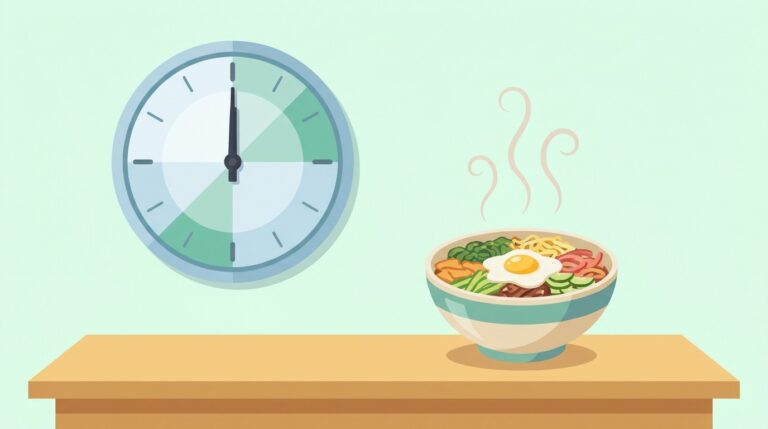
Master Korean Time: Telling 12:00 Noon Like a Local
Phase 1: Empathy (Story-Immersive Opening)
안녕하세요! 매일한글 에디터입니다.
Imagine this scene straight out of an office K-Drama: It is 11:59 AM in a bustling Gangnam tech firm. The clatter of mechanical keyboards suddenly dies down. Eyes stealthily shift to the digital clock in the corner of computer monitors. The moment the digits flip, someone perks up from their cubicle with an eager smile: “정오 열두 시예요! (Jeong-o yeoldu si-ye-yo! / It is 12:00 noon!)” Instantly, everyone grabs their wallet and phone—it’s officially lunchtime!
For many beginner learners (CEFR A1), telling time in Korean is one of the first major stumbling blocks. Do you use Native Korean numbers or Sino-Korean numbers? Is it sibi-si or yeoldu-si? Why do Koreans suddenly bring up the word jeong-o when the clock hits twelve? If you’ve ever felt frozen when asking a friend for the time or missed the cue for lunch because the numbers jumbled in your head, take a deep breath. You are not alone! Based on feedback from hundreds of our beginner students at Daily Hangul, mastering just this single noon checkpoint will unlock your confidence in reading the clock and setting daily plans naturally.
Phase 2: 3 Core Expressions In-Depth Analysis
1. 정오 열두 시예요 (Jeong-o yeoldu si-ye-yo)
- Pronunciation: [Jeong-o yeol-du shi-ye-yo] (Sounds like: “Jung-oh yull-doo she-yeh-yo”)
- Meaning: Literal: “It is noon, twelve o’clock” | Real Nuance: “It’s exactly twelve o’clock noon!”
- K-Culture Moment: You’ll hear this broadcast on midday radio shows or announced by office workers right before sprinting to the best local soup shop before the queue forms.
- Editor’s Insight: Notice that hours in Korean use Native Korean numbers (하나, 둘, 셋…), so 12 is 열두 (yeoldu), never 십이 (sibi)! Adding 정오 (jeong-o) adds clarity that you are specifically speaking of midday.
- Situation Spectrum: Casual: ⚠️ | Semi-formal: ✅ | Formal: ✅
- 🤔 Think About It: In English, we simply say “It’s noon.” Why do you think Korean often pairs the concept “noon (정오)” together with the hour “twelve o’clock (열두 시)”? It highlights precision and clarity in shared schedules!
2. 지금 몇 시예요? (Jigeum myeot si-ye-yo?)
- Pronunciation: [Ji-geum myeot shi-ye-yo] (Sounds like: “Jee-geum myut she-yeh-yo”)
- Meaning: Literal: “Now, what hour is it?” | Real Nuance: “What time is it right now?”
- K-Culture Moment: Protagonists in dramas frantically waking up after an all-nighter, tapping their phone screen and shouting this line to their roommate.
- Editor’s Insight: 지금 (jigeum) means “now” and 몇 (myeot) means “how many / which”. When combined with 시 (si / hour), the final consonant sound of 몇 links smoothly into 시, making it sound like [myeot-si].
- Situation Spectrum: Casual: ⚠️ (Use ‘지금 몇 시야?’ with close peers) | Semi-formal: ✅ | Formal: ✅
- 🤔 Think About It: Unlike English which asks “what time”, Korean asks “how many hours”. Notice how counting units are built directly into everyday questions.
3. 점심 먹을 시간이에요 (Jeomsim meogeul sigan-i-e-yo)
- Pronunciation: [Jeom-shim meo-geul shi-gan-i-e-yo] (Sounds like: “Jum-sheem muh-gool she-gahn-ee-eh-yo”)
- Meaning: Literal: “It is time to eat lunch.” | Real Nuance: “It’s lunchtime! / Time for a meal!”
- K-Culture Moment: Coworkers nudging each other around 11:55 AM, tapping their stomachs and making eye contact across desks.
- Editor’s Insight: 점심 (jeomsim) specifically refers to lunch or midday meal. In Korea, mealtime isn’t just sustenance—it’s the ultimate social ritual to bond and reset your day.
- Situation Spectrum: Casual: ⚠️ | Semi-formal: ✅ | Formal: ✅
- 🤔 Think About It: Food is a cornerstone of Korean greetings. Stating that it’s “time to eat” is an invitation to connect, not just a factual statement about the hour.
Phase 3: Textbook Korean vs Real Korean
Situation 1: Announcing that it is 12:00 sharp
- 📖 교과서 한국어: 현재 시각은 정오 십이 시 영 분입니다. (Hyeonjae sigag-eun jeong-o sibi-si yeong-bun-imnida. / The current time is noon, 12 hours and 0 minutes.)
- 🗣️ 진짜 한국어: 벌써 열두 시네! (Beolsseo yeoldu sine! / It’s already twelve!)
- 💡 왜 다를까?: Native speakers rarely mention minutes if it’s on the dot, and they use Native Korean numbers (열두, not 십이) followed by the exclamation ending -네 (-ne) to reflect spontaneous realization.
Situation 2: Asking what time to meet for lunch
- 📖 교과서 한국어: 몇 시에 만나는 것이 좋겠습니까? (Myeot si-e mannaneun geosi jokessumnikka? / At what time would it be preferable to meet?)
- 🗣️ 진짜 한국어: 우리 몇 시에 봐? (Uri myeot si-e bwa? / What time are we meeting?)
- 💡 왜 다를까?: In real-life peer conversation, Koreans prefer the verb 보다 (boda / to see) rather than the formal textbook verb 만나다 (mannada / to meet).
Phase 4: K-Culture Deep Dive & Non-Verbal Manners
4-1. Nunchi & Time Gestures
When lunch hits at 12:00 noon in Korea, timing requires quick Nunchi (눈치 / situational awareness). Notice how people tap the back of their wrist lightly where a watch would sit, accompanied by a slight head tilt toward the door. This gentle gesture signals, “Shall we get going before the restaurant line stretches down the street?” Making quick eye contact while standing up demonstrates team cohesion.
4-2. The 12:00 PM Korean Lunch Rush (점심시간 문화)
In Seoul’s bustling districts like Yeouido, Gangnam, and Gwanghwamun, the period between 12:00 PM and 1:00 PM is sacred. Most restaurants fill up within seven minutes past twelve. Arriving at 12:05 PM often means waiting in line for 30 minutes! Because of this, saying “정오 열두 시예요” is the universal starter pistol for securing a table at your favorite stew or noodle joint.
Phase 5: Real-Life Roleplay Scenario
Setting: You are studying Korean at a café in Hongdae with your Korean study-buddy, Minji. The bell of the grandfather clock nearby begins chiming.
- Turn 1 (Minji): 🎭 Checks her smartphone screen | 벌써 시간이 이렇게 됐네? (Beolsseo sigan-i ireoke dwaenne? / Wow, how did time fly like this?)
- Turn 2 (You): 🎭 Peeks at your watch | 지금 몇 시예요? (Jigeum myeot si-ye-yo? / What time is it now?)
- Turn 3 (Minji): 🎭 Points to the clock hands pointing straight up | 딱 정오 열두 시예요! (Ttak jeong-o yeoldu si-ye-yo! / It is sharp twelve o’clock noon!)
- Turn 4 (You): 🎭 Smiling with relief | 벌써 열두 시예요? 시간 진짜 빠르네요. (Beolsseo yeoldu si-ye-yo? Sigan jinjja ppareuneyo. / It’s already twelve? Time really flies.)
- Turn 5 (Minji): 🎭 Pats her stomach gently | 배고프지 않아요? 점심 먹을 시간이에요! (Baegopeuji anayo? Jeomsim meogeul sigan-i-e-yo! / Aren’t you hungry? It’s lunchtime!)
- Turn 6 (You): 🎭 Nods enthusiastically | 좋아요! 우리 뭐 먹으러 가요? (Joayo! Uri mwo meogeureo gayo? / Sounds great! What shall we go eat?)
- Turn 7 (Minji): 🎭 Packs up her notebook quickly | 근처에 맛있는 김치찌개 집 있어요. 빨리 가요! (Geuncheo-e masinneun gimchijjigae jip isseoyo. Ppalli gayo! / There’s a delicious Kimchi stew place nearby. Let’s hurry!)
- Turn 8 (You): 🎭 Slings backpack over shoulder | 네, 지금 바로 가요! (Ne, jigeum baro gayo! / Yes, let’s head out right now!)
🔀 Interactive Decision Point
Minji asks if you want to leave right at 12:00 sharp or finish the chapter for 10 more minutes. What do you say?
- Option A: “지금 정오 열두 시니까 바로 가요! (Jigeum jeong-o yeoldu sinikka baro gayo! / Since it’s 12 noon now, let’s go right away!)”
- Feedback: [BEST] Excellent! You used the time expression accurately and showed great nunchi to beat the lunch crowd rush.
- Option B: “십이 시예요. 천천히 공부해요. (Sibi si-ye-yo. Cheoncheonhi gongbuhaeyo. / It is twelve o’clock. Let’s study slowly.)”
- Feedback: [BAD] Careful! 십이 시 is grammatically awkward (Native Korean 열두 시 is required for hours), and ignoring the 12:00 lunch rush means a 40-minute wait outside!
- Option C: “몰라요. 배 안 고파요. (Mollayo. Bae an gopayo. / I don’t know. I’m not hungry.)”
- Feedback: [RISK] Grammatically understandable, but sounds abrupt and dismissive to your study partner who wants to bond over food.
Phase 6: 10-Second Emotional Shadowing Drill
Read these aloud, pausing at the slashes (/), mimicking the specified mood:
[😲 Surprised & Realizing]- 벌써 / 열두 시네! (Beolsseo / yeoldu sine! / It’s already / twelve o’clock!)
[🤔 Curious & Polite]- 지금 / 몇 시예요? (Jigeum / myeot si-ye-yo? / Right now / what time is it?)
[😊 Bright & Energetic]- 정오 / 열두 시예요! / 점심 먹으러 가요! (Jeong-o / yeoldu si-ye-yo! / Jeomsim meogeureo gayo! / It is noon / twelve o’clock! / Let’s go eat lunch!)
Phase 7: K-Culture Mini Dictionary
- 정오 (Jeong-o) | Noon / Midday
- Usage: Used in formal announcements, broadcasts, and scheduling to specify 12:00 PM without any ambiguity.
- 점심시간 (Jeomsimsigan) | Lunch hour / Lunchtime
- Usage: The golden hour (usually 12:00–1:00 PM) across Korean businesses, universities, and schools where daily social life happens.
- 정각 (Jeonggak) | Exactly on the hour / Sharp
- Usage: Essential for appointments. “12시 정각 (Yeoldu-si jeonggak)” means “12:00 on the dot”.
- 약속 (Yaksok) | Appointment / Engagement / Promise
- Usage: Covers everything from a casual coffee meetup to formal client appointments.
Phase 8: Traveler’s Survival Kit
Top 3 Survival Phrases for Time
- 지금 몇 시예요? (Jigeum myeot si-ye-yo?)
- Romanization: [Ji-geum myeot shi-ye-yo]
- Pro Tip: Ask anyone on the street or subway platform if your phone battery dies.
- 열두 시에 예약했어요. (Yeoldu si-e yeyakhaesseoyo.)
- Romanization: [Yeol-du shi-eh yeh-yak-haet-seo-yo]
- Pro Tip: Use this at restaurant host stands to confirm your 12:00 PM reservation.
- 몇 시에 문 열어요? (Myeot si-e mun yeoreoyo?)
- Romanization: [Myut shi-eh moon yuh-ruh-yo]
- Pro Tip: Perfect when you arrive outside a popular bakery or K-beauty shop before opening.
Editor’s Travel Note
Always sync your schedule using the Naver Map navigation app download rather than standard Western map apps when visiting Korea, as Naver Map provides live bus and subway arrival times down to the exact second. Subway doors close strictly on schedule, so knowing how to read the station clock is essential!
Phase 9: “One Step Deeper” (Reflective Question)
In many cultures, time is individualistic—lunch happens whenever you happen to feel a rumble in your stomach. In Korea, however, meal times are communal. Sharing lunch at noon (정오 열두 시) is an unspoken social agreement where teams pause work together, reinforce friendships, and ensure everyone is cared for. In this sense, announcing twelve o’clock isn’t just about reading a mechanical device; it’s an act of care that brings people together around a steaming table.
💬 Your Turn: What is lunch culture like in your country? Do people strictly stop work at 12:00 noon, or do you eat whenever you like at your desk? Tell us in the comments below!
Phase 10: FAQ & Common Mistakes
Q: Why do we say “열두 시 (Yeoldu-si)” instead of “십이 시 (Sibi-si)”?
A: Korean uses two number systems: Native Korean (하나, 둘, 셋…) and Sino-Korean (일, 이, 삼…). When counting hours on the clock (시), you must use Native Korean numbers! Sino-Korean numbers are only used for the minutes (분).
Q: Is “정오 (Jeong-o)” used for midnight as well?
A: No! 정오 (Jeong-o) means daytime noon (12:00 PM). Midnight (12:00 AM) is called 자정 (Jajeong). A handy memory hook: 오 (午) connects to midday sun, while 자 (子) connects to deep night.
Q: Can I just say “열두 시예요” without “정오”?
A: Absolutely! In everyday casual conversation, simply saying “열두 시예요 (Yeoldu si-ye-yo)” is completely natural. 정오 is added when you want to be extra clear or slightly more formal.
🚨 Common Mistakes Alert
- Mistake: Saying “십이 시예요 (Sibi si-ye-yo)” for 12 o’clock.
- Correct Action: Always use Native Korean numbers for hours: 열두 시예요 (Yeoldu si-ye-yo).
- Mistake: Forgetting the counter 시 (si) and just saying the number.
- Correct Action: Never drop 시 when stating the hour! Always pair the number with 시.
- Mistake: Confusing 정오 (noon) with 자정 (midnight).
- Correct Action: Remember: Sunlight = 정오 (Jeong-o), Starry night = 자정 (Jajeong).
Phase 11: Action Missions
- 🥉 Bronze Mission (Solo Practice): Set an alarm on your phone for 12:00 PM tomorrow. When it rings, look at the screen and say aloud 3 times: “정오 열두 시예요! (Jeong-o yeoldu si-ye-yo!)”
- 🥈 Silver Mission (Social Connection): Send a message to a language exchange partner or friend at noon asking: “지금 몇 시예요? 점심 먹었어요? (Jigeum myeot si-ye-yo? Jeomsim meogeosseoyo? / What time is it now? Did you eat lunch?)”
- 🥇 Gold Mission (Real-World Execution): Next time you enter a Korean restaurant or café around midday, greet the staff and ask: “지금 몇 시까지 점심 메뉴 돼요? (Jigeum myeot si-kkaji jeomsim menyu dwaeyo? / Until what time is the lunch menu available?)”
- 🎮 K-Culture Mission: Watch any episode of a workplace K-drama (like Misaeng or Business Proposal). Spot the exact moment the clock strikes 12:00 noon and notice how the characters react!
Phase 12: Interactive Quiz Challenge
Question 1: Situational Judgment
You are meeting a friend at 12:00 PM sharp. Which phrase correctly tells them that it is 12:00 noon right now?
* A) 지금 십이 시예요. (Jigeum sibi si-ye-yo.)
* B) 지금 정오 열두 시예요. (Jigeum jeong-o yeoldu si-ye-yo.)
* C) 지금 자정 열두 시예요. (Jigeum jajeong yeoldu si-ye-yo.)
👉 Click to view answer and explanation
Correct Answer: B
Explanation: Hours take Native Korean numbers (열두, not 십이), and noon is 정오 (자정 means midnight). Therefore, “지금 정오 열두 시예요” is the perfect answer!
Question 2: Fill-in-the-Blank
Complete the natural Korean lunchtime sentence:
“벌써 12시네요! 점심 _______ 시간이에요.” (It’s already 12! It’s time to eat lunch.)
👉 Click to view answer and explanation
Correct Answer: 먹을 (meogeul)
Explanation: 먹다 (meokda / to eat) combined with the future modifying ending -(으)ㄹ becomes 먹을 (meogeul), meaning “to eat (time to eat)”.
Question 3: True or False (K-Culture)
True or False: In urban Korean business districts, it is standard practice to delay leaving for lunch until 12:30 PM because restaurants are emptier then.
👉 Click to view answer and explanation
Correct Answer: False
Explanation: Most restaurants remain crowded straight through 12:00 to 1:00 PM. People rush out precisely at or slightly before 12:00 noon (정오 열두 시) to secure seating before lines wrap around the block!
🎬 Watch Our Daily Videos! (Daily Hangul Official Instagram)
Review the expressions you learned in this article with our fun daily short videos! Check out native pronunciation and real-life nuances in action.
- Instagram @dailyhangul_en







