

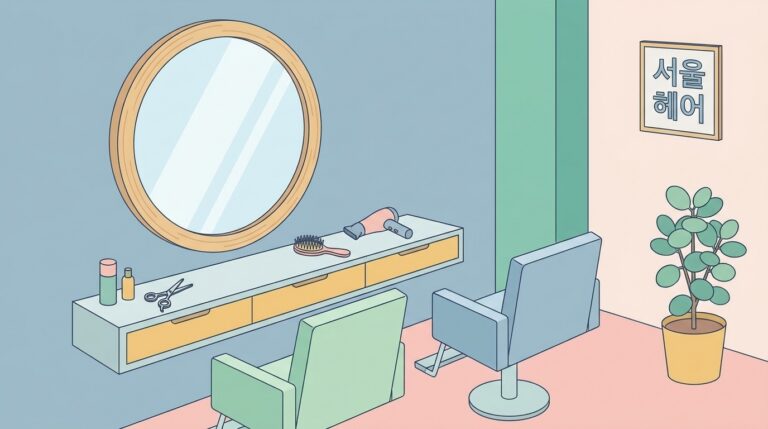
Phase 1: Empathy & K-Culture Scene Setting
안녕하세요! 매일한글 에디터입니다. (Annyeonghaseyo! It’s your Daily Hangul editor.) Have you ever walked into a chic hair salon in Hongdae or Seongsu, clutch in hand and phone ready with a screenshot of your favorite K-drama lead, only to freeze when the stylist greets you with a warm smile and asks, “어떤 스타일 원하세요? (What kind of style are you looking for?)”?
You might have memorized basic words like “다듬어 주세요 (Please trim it)” or “단발로 잘라 주세요 (Cut it into a bob).” But what happens when you don’t just want a haircut—you want a style that actually softens your jawline, balances your forehead, and suits your shoulders? In Korea, styling isn’t just about following trends; it is considered an essential part of 자기관리 (jagi-gwanli / self-care). Understanding how to articulate what brings out your best features and balances your proportions will transform your beauty and fashion experiences in Korea from stressful guessing games into empowering self-discoveries. This guide is crafted from real salon consultations and everyday fashion talks so you can speak like a local insider!
Phase 2: Core 3 Expressions In-Depth
1. 단점을 보완하다 (Danjeomeul bowanhada)
- Pronunciation: [Dahn-jeom-eul bo-wahn-ha-da] (Sounds like “dawn-jump” + “bow-one-ha-da”)
- Meaning: Literally “to supplement weaknesses,” used naturally as “to flatter or conceal less-confident features.”
- K-Culture Moment: You will hear beauty creators on YouTube say: “이 넥라인은 둥근 얼굴형의 단점을 보완해 줘요 (This neckline balances out round face shapes).”
- Editor’s Insight: Koreans rarely say “hide my ugly cheekbones.” Instead, using 보완하다 (to balance/complement) turns an insecurity into a sophisticated styling goal.
- Situation Spectrum:
- Casual: ✅
- Semi-formal: ✅
- Formal: ✅
- 🤔 Think About It: In English, we often say “slimming” or “flattering.” How does the Korean mindset of “complementing” rather than “hiding” change how you perceive self-care?
2. 장점을 살리다 (Jangjeomeul sallida)
- Pronunciation: [Jang-jeom-eul sal-li-da] (Sounds like “jahng-jum-eul sal-lee-da”)
- Meaning: Literally “to revive/give life to strengths,” naturally meaning “to highlight your best features.”
- K-Culture Moment: In K-Pop makeover shows, stylists often note: “턱선이 예쁘셔서 그 장점을 살리는 숏컷으로 갈게요 (Your jawline is gorgeous, so we’ll do a short cut that accentuates it).”
- Editor’s Insight: The verb 살리다 (to bring alive) gives energy to your look. It communicates that you want your natural charm front and center.
- Situation Spectrum:
- Casual: ✅
- Semi-formal: ✅
- Formal: ✅
- 🤔 Think About It: Contrast “accentuate” with “살리다 (bring to life).” The Korean phrasing treats your best feature as an active, living charm.
3. 넥라인이 어울리다 (Nengnaini eoullida)
- Pronunciation: [Nek-la-in-i eo-ul-li-da] (Sounds like “neck-line-ee uh-ool-lee-da”)
- Meaning: “The neckline suits / flatters (my body shape).”
- K-Culture Moment: While shopping in Dongdaemun or browsing Musinsa, a friend might comment: “스퀘어넥보다 브이넥 넥라인이 훨씬 어울려요 (A V-neck neckline suits you much better than a square neck).”
- Editor’s Insight: In Korean fashion, 어울리다 (to match/suit) is the highest compliment. It signifies harmony between the garment and your personal silhouette.
- Situation Spectrum:
- Casual: ✅
- Semi-formal: ✅
- Formal: ⚠️ (Use 격식에 맞다 for dress codes)
- 🤔 Think About It: Why do Koreans place so much emphasis on visual harmony (어울림) compared to purely bold individualism?
Phase 3: Textbook Korean vs. Real-Life Korean
Scenario 1: Consulting a Stylist at the Hair Salon
- 📖 교과서 한국어 (Textbook): 제 얼굴에 어울리는 머리로 잘라 주세요. (Je eolgure eoullineun meoriro jalla juseyo. / Please cut my hair in a style that suits my face.)
- 🗣️ 진짜 한국어 (Real-Life): 제 얼굴형 단점은 좀 보완하고, 이목구비 장점은 살리는 스타일로 추천해 주실 수 있나요? (Je eolgulhyeong danjeomeun jom bowanhago, imokgubi jangjeomeun sallineun seutaillo chucheonhae jusil su innayo? / Could you recommend a style that balances my face shape while accentuating my facial features?)
- 💡 왜 다를까? (Why is it different?): Textbook phrasing is too passive and generic. Modern Korean salon culture is collaborative; mentioning “얼굴형 보완 (face shape balancing)” gives the stylist permission to offer tailored professional advice.
Scenario 2: Trying on Tops at a Boutique
- 📖 교과서 한국어 (Textbook): 이 옷은 제 몸에 맞지 않습니다. (I oseun je mome matji anseumnida. / This clothing does not fit my body.)
- 🗣️ 진짜 한국어 (Real-Life): 이 라운드넥은 목이 좀 짧아 보여서, 목선이 트인 브이넥으로 입어볼게요! (I raundeuneegeun mogi jom jjalba boyeoseo, mokseoni teuin beuinegeuro ibeobolgeyo! / This round neck makes my neck look a bit short, so I’ll try an open V-neck instead!)
- 💡 왜 다를까? (Why is it different?): Native speakers don’t just say an item “doesn’t fit” (which sounds like an incorrect size); they specify visual lines like “목선이 트이다 (open neckline)” to explain why a cut flatters their frame.
Phase 4: K-Culture Deep Dive & Non-Verbal Manners
4-1. Nunchi & Salon Gestures
- Mirror Eye Contact: When sitting in the styling chair, avoid staring directly at the stylist’s face through the mirror while speaking. Look at your own hair, gesture to the specific area, and glance up warmly to catch their eyes in the reflection.
- Framing Hands: When explaining your facial shape, use both hands to lightly frame your cheekbones (광대) or jawline (턱선). This subtle body language instantly signals to the designer where you feel self-conscious without needing advanced medical terms.
4-2. The Rise of “Body Consulting” Culture
In Korean media, the standard of beauty has moved far beyond “one-size-fits-all” trends like high-waisted skinny jeans or blunt bangs. The viral trend of 퍼스널 진단 (Personal Consulting)—popularized by style analysis channels like RareLee and celebrated by K-pop idols—teaches that beauty is about geometric harmony. Koreans classify necklines (스퀘어넥, 유넥, 보트넥) and face silhouettes (하트형, 계란형, 각진형) meticulously. Knowing your personal lines isn’t considered vain; it is celebrated as intelligent self-management.
Phase 5: Real-Life Roleplay Scenario
Setting: Chic Hair Studio ‘Lumière’ in Seongsu-dong, Seoul.
Characters:
* Min-a: Intuitive and professional hair designer.
* You: A client wanting a customized cut that flatters your features.
- Min-a: 🎭 (Gently running fingers through your ends while looking into the mirror) 오늘 어떤 느낌으로 바꿔 드릴까요? 원하는 스타일 찾아오신 거 있으세요?
(Oneul eotteon neukkimeuro bakkwo deurilkkayo? Wonhaneun seutail chajaosin geo isseuseyo? / How would you like to transform your look today? Did you bring any reference styles?) -
You: 🎭 (Hesitantly pulling out your smartphone) 사진을 가져오긴 했는데… 제 얼굴형에 어울릴지 잘 모르겠어요.
(Sajineul gajyeooging haenneunde… Je eolgulhyeonge eoullilji jal moreugesseoyo. / I brought a photo, but… I’m not sure if it would flatter my face shape.) -
Min-a: 🎭 (Nodding attentively, smiling) 어디 볼까요? 와, 레이어드 컷이네요! 손님은 이목구비가 또렷하셔서 이 느낌 정말 잘 맞을 것 같아요.
(Eodi bolkkayo? Wa, reieodeu keosineyo! Sonnimeun imokgubiga ttoryeothasyeoseo i neukkim jeongmal jal majeul geot gatayo. / Let’s see! Wow, a layered cut! Your facial features are very distinct, so I think this vibe would suit you nicely.) -
You: 🎭 (Pointing lightly to your jawline) 근데 제가 옆광대랑 턱선이 살짝 부각되는 편이라서요. 단점을 좀 보완하고 싶어요.
(Geunde jega yeopgwangdaerang teokseoni saljjak bugakdoeneun pyeoniraseoyo. Danjeomeul jom bowanhago sipeoyo. / But my cheekbones and jawline tend to stand out. I’d like to complement those areas.) -
Min-a: 🎭 (Tracing two sections of hair along your cheeks) 아, 그럼 사이드뱅(옆머리)을 광대 라인에 맞춰서 자연스럽게 떨어뜨리면 광대가 싹 가려져요!
(A, geureom saideubaengeul gwangdae raine matchwoseo jayeonseureopge tteoreotteurimyeon gwangdaega ssak garyeojyeoyo! / Ah, then if we cut curtain bangs that fall naturally along the cheekbone line, it will soften the cheekbones completely!) -
You: 🎭 (Relieved) 오, 좋아요! 그리고 목선이 답답해 보이지 않게 가벼운 느낌이면 좋겠어요.
(O, joayo! Geurigo mokseoni dapdaphae boiji anke gabyeoun neukkimimyeon jokesseoyo. / Oh, I love that! And I’d like it to feel lightweight so my neckline doesn’t look stifled.) -
Min-a: 🎭 (Adjusting the cape with confidence) 쇄골 라인 쪽에 질감을 가볍게 쳐서 목선 장점을 확 살려드릴게요. 믿고 맡겨주세요!
(Swaegol rain jjoge jilgameul gabyeopge chyeoseo mokseon jangjeomeul hwak sallyeodeurilgeyo. Mitgo matgyeojuseyo! / I’ll add airy texture around your collarbones to accentuate your neckline. Leave it to me!) -
You: 🎭 (Clasping hands happily) 네, 원장님 추천대로 진행해 주세요!
(Ne, wonjangnim chucheondaero jinhaenghae juseyo! / Yes, please proceed with your professional recommendation!)
🔀 Interactive Branching Decision
At Turn 4, if you want to ask about bangs (앞머리), what should you say?
- Option A: 앞머리 풀뱅으로 꽉 채워서 이마 다 가려주세요! (Give me thick full bangs to hide my entire forehead!)
- Outcome (Bad): Thick blunt bangs on an angular face can make the lower jaw stand out even more, defeating the purpose of balancing your face shape.
- Option B: 제 얼굴 길이에 맞춰서 시스루뱅이나 사이드뱅으로 보완해 주실 수 있나요? (Could you balance it with see-through or curtain bangs that match my face length?)
- Outcome (Best): Perfect! Stylists love this because it asks for a customizable solution based on facial harmony.
- Option C: 그냥 아무렇게나 짧게 잘라주세요. (Just cut it short however you want.)
- Outcome (Risk): You leave no guidance, risking a generic haircut that may not complement your unique neckline or features.
Phase 6: 10-Second Emotion Shadowing Drill
Practice the rhythm markers (/) and embody the emotion tags!
- [😊 기대감과 공손함을 담아 / Hopeful & Polite]
제 얼굴형 단점은 / 보완하고, / 장점은 살리고 싶어요.
(Je eolgulhyeong danjeomeun / bowanhago, / jangjeomeun salligo sipeoyo. / I’d like to complement my face shape flaws / and bring out my strengths.) -
[🤔 진지하고 신중하게 / Inquiring & Thoughtful]
이 니트 넥라인이 / 제 목선을 / 길어 보이게 해 줄까요?
(I niteu nengnaini / je mokseoneul / gireo boige hae julkkayo? / Will this knit sweater’s neckline / make my neck line / appear longer?) -
[✨ 감탄하며 만족스럽게 / Impressed & Satisfied]
사이드뱅 하나로 / 얼굴형이 / 훨씬 갸름해 보여요!
(Saideubaeng hanaro / eolgulhyeongi / hwolssin gyareumhae boyeoyo! / With just curtain bangs, / my face shape / looks so much slimmer!)
Phase 7: K-Culture Mini Dictionary
-
추구미 (Chugumi)
Literal/Translation: “Pursued aesthetic / Desired vibe.”
Usage: Slang blending 추구 (pursuit) and 미 (beauty). It refers to the personal aesthetic or role model vibe you aim for (e.g., “제 올해 추구미는 꾸안꾸예요 / My aesthetic goal this year is effortless-chic”). -
체형 커버 (Chehyeong keobeo)
Literal/Translation: “Body shape camouflage / Flattering body proportions.”
Usage: Essential shopping term. Used when a cut of clothing strategically minimizes insecurities and balances proportions (e.g., A-line skirts for wide hips). -
옆광대 (Yeopgwangdae)
Literal/Translation: “Side cheekbones.”
Usage: A very common term at Korean hair salons. People often ask for layers or “사이드뱅 (side bangs)” specifically to soften prominent 옆광대. -
인생머리 (Insaengmeori)
Literal/Translation: “Life haircut / The hairstyle of your lifetime.”
Usage: Combining 인생 (life) with 머리 (hair), this describes the holy-grail haircut that flatters your facial features so well you never want to change it.
Phase 8: Traveler’s Survival Kit
TOP 3 Hair & Style Survival Expressions
- 얼굴이 갸름해 보이게 해 주세요.
(Eolguri gyareumhae boige hae juseyo.)
Pro Tip: Use this when you want your face to appear slimmer and more contoured through face-framing layers. - 목선이 답답하지 않은 넥라인을 찾고 있어요.
(Mokseoni dapdaphaji aneun nengnaineul chatgo isseoyo.)
Pro Tip: Say this to boutique staff to quickly find V-neck, U-neck, or square-neck items. - 제 톤이랑 체형에 어울리는 추천 부탁드려요.
(Je ton-irang chehyeonge eoullineun chucheon butakdeuryeoyo.)
Pro Tip: The ultimate phrase to unlock the consultant mode of any Korean fashion stylist.
Editor’s Travel Note
Before heading to trendy salons in Gangnam or Hongdae, do not rely on walk-ins! Use the 네이버 지도 앱 다운로드 to search for top-rated salons, view stylist portfolios, and make direct reservations. When booking, select options that include 커트 + 스타일링 상담 (Cut + Styling Consultation) for personalized advice.
Phase 9: Stepping Deeper: Cultural Insight
In Western cultures, pointing out specific physical traits like cheekbone width or neck length in a styling session might feel overly critical or uncomfortable. However, in Korea, 자기관리 (jagi-gwanli) is grounded in pragmatic objectivity. Korean society views analyzing one’s bone structure, personal color, and body line not as self-loathing, but as an act of intelligent self-care and self-respect. Knowing what suits you is praised as 센스 (sense / stylish discernment). By shifting your perspective from “fixing flaws” to “harmonizing proportions,” self-care in Korea becomes a liberating journey toward uncovering your authentic charm.
💬 Your Turn: What feature do you love to highlight when choosing an outfit or haircut? Have you discovered your 인생머리 yet? Share in the comments below!
Phase 10: FAQ & Common Mistakes
Q: Can I bring celebrity photos to a Korean salon without feeling embarrassed?
A: Absolutely! Korean hair designers actually appreciate photo references. Just accompany the photo with: “이 느낌을 좋아하는데, 제 얼굴형에 맞게 변형해 주실 수 있나요? (I love this vibe, but can you adapt it to suit my face shape?)” Designers will adjust the layers to your bone structure.
Q: Should I tip my hairstylist in Korea?
A: No! Tipping is not customary in South Korea. The price listed on the menu or booking screen includes tax and service charges. If you love your haircut, the best way to show gratitude is leaving a glowing review with photos on the Naver booking platform.
Q: What is the difference between 시스루뱅 (See-through bangs) and 사이드뱅 (Side bangs)?
A: 시스루뱅 are thin front bangs showing glimpses of forehead (great for shortening long faces), while 사이드뱅 are longer pieces framing the cheekbones (great for softening round or square faces).
🚨 Common Mistakes Alert
- Mistake: Asking to “그냥 짧게 깎아주세요 (Just shave/cut it short).”
Correct Action: Say “가볍게 질감 처리해 주세요 (Please lighten the texture),” so your hair maintains soft movement. - Mistake: Confusing “체형 커버 (body shape coverage)” with oversized clothes.
Correct Action: In Korea, good 체형 커버 defines proportions—ask for “비율이 좋아 보이는 라인 (lines that make proportions look great).” - Mistake: Assuming all necklines look identical on camera.
Correct Action: Round necks emphasize round jaws; try open collars (오픈칼라) or notched lapels for structured lines.
Phase 11: Action Missions
- 🥉 Bronze Mission (Solo Practice): Stand before a mirror. Point to your features and whisper in Korean: “여기는 단점 보완 (Complement this flaw), 여기는 장점 살리기 (Bring out this strength)!”
- 🥈 Silver Mission (Social Share): Find a K-drama character whose haircut you love. Post their photo on your social story and caption it: “내 추구미 헤어스타일! (My aesthetic goal hairstyle!)”
- 🥇 Gold Mission (Real-world Challenge): Next time you shop at an online or offline Korean boutique, ask or search using the term “스퀘어넥 (square neck)” or “브이넥 체형 커버 (V-neck body flattering).”
- 🎮 K-Culture Mission: Watch a recent episode of a Korean makeover variety show (or an idol vlog) and count how many times they say the word “어울리다 (suits/matches)”!
Phase 12: Interactive Quiz Challenge
Question 1: Situational Choice
You want to tell your hairstylist that you love your prominent jawline and want everyone to notice it. Which phrase should you use?
A) 제 턱선 단점을 보완해 주세요.
B) 제 턱선 장점을 살려 주세요.
C) 턱선을 머리로 완전히 가려 주세요.
🔍 Click to view the answer and explanation!
Correct Answer: B
Explanation: 장점을 살려 주세요 means “Please bring out/accentuate my strength.” Option A means to cover up a flaw, and Option C means to hide it completely.
Question 2: Fill in the Blank
이 티셔츠는 목선이 시원하게 트여 있어서 제 둥근 얼굴형의 단점을 ________ 줘요.
(This T-shirt has an open neckline, so it ________ the weakness of my round face.)
🔍 Click to view the answer and explanation!
Correct Answer: 보완해 (bowanhae)
Explanation: The verb 보완하다 combines with -어 주다 to form 보완해 줘요 (helps complement/balance out).
Question 3: Cultural True or False
In Korea, discussing body shape (체형) and face shape (얼굴형) with a stylist or personal consultant is considered rude and offensive.
🔍 Click to view the answer and explanation!
Correct Answer: False
Explanation: It is considered a normal, proactive part of 자기관리 (self-care) and personal styling. Designers welcome it because it helps create the most flattering result!
🎬 Watch Our Daily Videos! (Daily Hangul Official Instagram)
Review the expressions you learned in this article with our fun daily short videos! Check out native pronunciation and real-life nuances in action.
- Instagram @dailyhangul_en







