

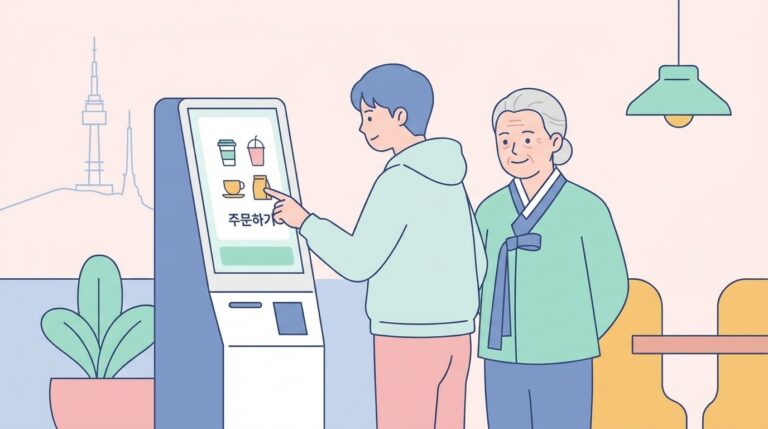
Phase 1: Empathy & Storytelling Opening
안녕하세요! 매일한글 에디터입니다. (Hello! I’m your Daily Hangul editor.)
Have you ever walked into a bustling mega-coffee shop or a fast-food joint in Seoul, eager for an iced Americano, only to freeze before a massive touchscreen? Now imagine you are a seventy-year-old grandfather in Jongno wearing your Sunday best, clutching a crisp 10,000-won paper bill. You tap the screen, but it bombards you with English words like “Takeout,” “Syrup Extra,” and “Mobile Barcode,” before flashing a harsh red alert: “카드 전용 매장” (Card-only store). As the line behind you grows and people tap their feet impatiently, your heart sinks.
This isn’t an exaggeration; it is a daily scene across modern South Korea. Korea has rapidly transformed into one of the world’s most seamless cashless societies. You can ride subways, purchase street-side toast, and pay for hospital bills with a simple swipe or phone tap. Yet, this high-speed convenience has brought an urgent social dilemma: 디지털 소외 (digital exclusion) among the elderly.
Today, we’re stepping beyond tourist basics. At the B1 (Intermediate) level, being able to talk about social trends, show empathy, and offer gentle assistance in Korean transforms you from an outsider into a considerate local friend. Let’s unpack the key language, etiquette, and cultural mindset so you can navigate this dilemma with warmth and confidence!
Phase 2: Core Expressions in Depth
1. 키오스크 사용이 서툴러서 도와드렸어요. (Kiosk sayong-i seotulleoseo dowadeulyeosseoyo.)
- Pronunciation: [Kee-oh-seu-keu sah-yong-ee suh-tool-luh-suh doh-wah-deu-ryuh-ssuh-yo] (Think of “seotul” like a “saw-tool” moving awkwardly!)
- Meaning: Literal: “Because their kiosk use was clumsy, I helped them.” | Nuance: “They were having trouble with the kiosk, so I stepped in to help.”
- K-Culture Moment: You’ll hear this in heartwarming slice-of-life dramas like My Liberation Notes or variety shows where younger guests recount helping an elder in their neighborhood.
- Editor’s Insight: The verb 서투르다 (to be clumsy/unfamiliar) is much softer and far more polite than saying 못하다 (to be unable/bad at). Saying someone is 서툴다 suggests they simply need practice, preserving their dignity.
- Situation Spectrum: Casual: ⚠️ (Sounds too formal for close pals) | Semi-formal: ✅ (Perfect for coworkers/friends) | Formal: ✅ (Excellent in speeches or essays)
- 🤔 Think About It: In your home country, is it culturally acceptable to touch someone else’s screen when helping them, or should you keep physical distance?
2. 카드 전용 매장이라 현금 결제가 안 돼요. (Kadeu jeonyong maejang-ira hyeongeum gyeoljega an dwaeyo.)
- Pronunciation: [Kah-deu jun-yong mae-jang-ee-rah hyun-geum gyul-jeh-gah ahn dweh-yo]
- Meaning: Literal: “Because it is a card-only store, cash payment does not work.” | Nuance: “This is a cashless store, so you can’t pay with cash.”
- K-Culture Moment: The cashier or kiosk assistant in a trendy Seongsu-dong dessert boutique gently informing an older customer who only has paper notes.
- Editor’s Insight: 전용 (jeonyong) means “exclusive use.” You will see this everywhere in Korea: 카드 전용 (card only), 버스 전용 (bus lane only), and 직원 전용 (staff only).
- Situation Spectrum: Casual: ⚠️ | Semi-formal: ✅ | Formal: ✅
- 🤔 Think About It: How does the total disappearance of paper cash impact social inclusivity for marginalized groups in your culture?
3. 편리하긴 한데 디지털 소외 문제가 생겨요. (Pyeonlihagin hande dijiteol so-oe munjega saeng-gyeoyo.)
- Pronunciation: [Pyun-ree-hah-geen hahn-deh dee-jee-tul soh-weh moon-jeh-gah seng-gyuh-yo]
- Meaning: Literal: “It is indeed convenient, but a problem of digital alienation occurs.” | Nuance: “It’s super convenient, but it definitely creates digital exclusion for some people.”
- K-Culture Moment: A debate scene on an intellectual talk show like You Quiz on the Block, where everyday citizens reflect on societal speed.
- Editor’s Insight: The grammar pattern -긴 한데 (-gin hande) is your best friend at the B1 level. It means “It is true that A, but on the other hand, B.” It allows you to deliver balanced, mature opinions without sounding dismissive.
- Situation Spectrum: Casual: ✅ | Semi-formal: ✅ | Formal: ✅
- 🤔 Think About It: Is fast technological adoption always perceived as purely positive in your native language, or is there a similar term for digital alienation?
Phase 3: Textbook Korean vs. Real-Life Korean
Situation 1: Asking if Cash is Accepted
- 📖 교과서 한국어 (Textbook): 현금을 받습니까? (Hyeongeumeul batseumnikka? – “Do you receive cash?”)
- 🗣️ 진짜 한국어 (Real-Life): 혹시 여기 현금 결제도 돼요? (Hoksi yeogi hyeongeum gyeoljedo dwaeyo? – “By any chance, can I pay in cash here too?”)
- 💡 Why the difference? Textbook phrasing sounds like an interrogation. Adding 혹시 (by any chance) and using the flexible verb 되다 (to work/be acceptable) instantly softens the inquiry.
Situation 2: Offering Help to an Elderly Person at a Screen
- 📖 교과서 한국어 (Textbook): 제가 도와드릴까요? (Jega dowadeurilkkayo? – “Shall I help you?”)
- 🗣️ 진짜 한국어 (Real-Life): 어르신, 제가 주문 눌러드릴까요? (Eoreusin, jega jumun nulleodeurilkkayo? – “Sir/Ma’am, would you like me to press the order buttons for you?”)
- 💡 Why the difference? Generic “help” can make seniors feel embarrassed or defensive. Specifying the physical action (눌러드릴까요? – Shall I press it for you?) feels practical, friendly, and non-judgmental.
Phase 4: K-Culture Deep Dive & Non-Verbal Manners
4-1. 눈치 (Nunchi) & Spatial Etiquette
When an elderly person is having trouble at a kiosk in Korea, you cannot simply rush over and push buttons over their shoulder. That disrupts their personal space and causes a loss of face (체면).
* The 45-Degree Approach: Stand at an angle, not directly behind their back.
* Two-Handed Pointing: Never use an index finger aggressively toward the screen. Point softly with an open palm or use both hands slightly tilted.
* Tone Modulation: Lower your pitch and speak slightly slower, but do not use child-like speech. Treat them with respect as an esteemed elder (어르신).
4-2. Cultural Code: ‘Ppalli-Ppalli’ vs. ‘Hyo’ (Filial Piety)
Korea is famous for its 빨리빨리 (hurry-hurry) culture—everything from ultra-fast fiber internet to 20-minute grocery deliveries. However, this collides head-on with traditional 효 (hyo – filial respect). While younger generations instinctively prioritize speed, public campaigns across Seoul subway stations now encourage citizens to slow down and wait patiently when seniors navigate ticket gates and kiosks.
Phase 5: Real-Life Roleplay Scenario
- Setting: A busy sandwich shop near Jongno 3-ga, Seoul.
- Characters: You (kind intermediate Korean speaker) and Park Halmeoni (74, clutching a paper bill, visibly confused by the UI).
- 할머니: 아이고, 이게 왜 안 넘어가지? 커피 한 잔 마시기 참 힘드네…
(Aigo, ige wae an neomeogaji? Keopi han jan masigi cham himdeune…)
“Oh dear, why isn’t it moving to the next page? Drinking a cup of coffee has gotten so hard…”
🎭 (Frustratedly tapping the plastic border of the touchscreen) -
나: 어르신, 혹시 도움이 필요하세요? 제가 눌러드릴까요?
(Eoreusin, hoksi doum-i piryohaseyo? Jega nulleodeurilkkayo?)
“Sir/Ma’am, do you happen to need a hand? May I press the buttons for you?”
🎭 (Stepping up gently with hands folded together) -
할머니: 고마워요, 학생. 따뜻한 아메리카노 한 잔 마시고 싶은데, 돈 넣는 구멍이 없네?
(Gomawoyo, haksaeng. Ddateuthan amerikano han jan masigo sipeunde, don neonneun gumeong-i eomne?)
“Thank you, student. I want a warm Americano, but there’s no coin slot?”
🎭 (Showing a 5,000-won paper bill) -
나: 아, 어르신. 여기는 카드 전용 매장이라서 현금 결제가 안 돼요.
(A, eoreusin. Yeogineun kadeu jeonyong maejang-iraseo hyeongeum gyeoljega an dwaeyo.)
“Ah, ma’am. This is a card-only shop, so cash payments don’t go through here.”
🎭 (Gesturing politely to the 'Card Only' sign) -
할머니: 그래요? 카드가 없는데 어쩌나… 그냥 나가야겠네.
(Geuraeyo? Kadeuga eomneunde eojjeona… Geunyang nagayagenne.)
“Is that so? I don’t have a card, what should I do… I suppose I should just leave.”
🎭 (Looking dejected and turning around) -
나: 괜찮으시면 제가 제 카드로 먼저 결제해 드릴게요! 현금으로 주시면 돼요.
(Gwaenchaneusimyeon jega je kadeuro meonjeo gyeoljehae deurilgeyo! Hyeongeumeuro jusimyeon dwaeyo.)
“If it’s okay with you, I can swipe my card first! You can just hand me the cash.”
🎭 (Pulling out your card with a warm smile) -
할머니: 정말? 아이고, 외국인 학생인데 마음씨가 너무 곱네. 정말 고마워요!
(Jeongmal? Aigo, oegugin haksaeng-inde maeumssiga neomu gomne. Jeongmal gomawoyo!)
“Really? Oh my, you’re a foreign student but your heart is so sweet. Thank you so much!”
🎭 (Handing over the exact paper money with both hands) -
나: 별말씀을요. 영수증이랑 주문 번호 여기 나왔어요, 어르신.
(Byeolmalsseumeullyo. Yeongsujeung-irang jumun beonho yeogi nawasseoyo, eoreusin.)
“Don’t mention it at all. Here are the receipt and your order number, ma’am.”
🎭 (Holding out the receipt using both hands)
🔀 Interactive Choice Point
What would you say if an elder refuses your offer because they feel embarrassed?
* Option A: “그냥 제가 해드릴 테니까 가만히 계세요.” (Just stay still because I’ll do it for you.)
* 🚫 Feedback (Bad): Disrespectful! Using informal commands removes their agency and sounds rude.
* Option B: “바쁘니까 빨리 비켜주세요.” (It’s busy, so please move aside quickly.)
* 🚫 Feedback (Risk): Harsh and offensive. You will likely trigger strong disapproval from everyone nearby.
* Option C: “저도 처음에 이 기계가 서툴렀어요. 천천히 같이 해봐요!” (I was also clumsy with this machine at first. Let’s try it together slowly!)
* ✅ Feedback (Best): Empathetic mastery! Acknowledging shared difficulty protects their pride.
Phase 6: 10-Second Emotion Shadowing Drill
Read aloud focusing on natural rhythm, breathing pauses (/), and emotional intent:
[😊 다정하고 조심스럽게 - Gentle & Polite]
어르신, / 혹시 주문이 어려우시면 / 제가 눌러드릴까요?
(Eoreusin, / hoksi jumun-i eoryeousimyeon / jega nulleodeurilkkayo?)-
[🤔 안타까워하며 공감하듯 - Sympathetic & Thoughtful]
편리하긴 한데, / 어르신들에게는 / 키오스크가 너무 복잡해요.
(Pyeonlihagin hande, / eoreusindeul-egeneun / kiosk-ga neomu bokjaphaeyo.) -
[💡 차분하고 명확하게 - Calm & Informative]
요즘은 / 카드 전용 매장이 많아져서 / 현금을 안 받는 곳이 늘었어요.
(Yojeumeun / kadeu jeonyong maejang-i manajyeoseo / hyeongeumeul an banneun gosi neureosseoyo.)
Phase 7: K-Culture Mini Dictionary
- 키오스크 (Kiosk / Ki-oh-seu-keu): Unmanned interactive terminal. In Korea, kiosks have rapidly replaced cashiers in fast food, cafes, bupyeong street stalls, and express photo booths.
- 카드 전용 (Card-Only / Kadeu Jeonyong): Indicates a terminal or store that refuses physical bills and coins, accepting only debit/credit cards or mobile pay (Samsung Pay, Apple Pay).
- 디지털 소외 (Digital Alienation/Exclusion / Dijiteol So-oe): The socio-technological phenomenon where demographic groups (especially seniors) cannot access basic life services due to digitisation.
- 어르신 (Elder / Eoreusin): The most respectful and polite title for an older person in public. Far safer and more dignified than using 할머니 or 할아버지 with strangers.
Phase 8: Traveler’s Survival Kit
Survival Expressions TOP 3
- 키오스크 주문 도와드릴까요? (Kiosk jumun dowadeurilkkayo?)
- Pro Tip: Use this when you see an elder staring blankly at a screen for more than 30 seconds.
- 이 매장은 현금 결제가 안 된대요. (I maejang-eun hyeongeum gyeoljega an doendae-yo.)
- Pro Tip: The indirect speech ending -대요 shows you are simply reporting the store’s policy.
- 포장으로 해드릴까요, 매장에서 드실 건가요? (Pojang-euro haedeurilkkayo, maejang-eseo deusil geon-gayo?)
- Pro Tip: The single most confusing first button on any Korean kiosk: Takeout vs. Dine-in.
Editor’s Travel Note
South Korea is practically 99% cashless now. If you plan to travel smoothly:
* Download essential local navigation via 네이버 지도 앱 다운로드 to check whether stores support kiosk ordering in advance.
* Pick up a foreign-tourist prepaid debit card like WOWPASS or an all-in-one transit pass like the Climate Card (기후동행카드) at airport convenience stores. Always keep a backup card handy!
Phase 9: “One Step Deeper” (Cultural Reflection)
South Korea’s speed of transformation is mesmerizing. In less than two decades, the country evolved from paper bankbooks to seamless instant face-scanning checkouts. Yet, this relentless drive toward modernization has strained the ancient social contract of 정 (Jeong – collective affection). When technology isolates seniors from basic human interactions, society loses its shared warmth. By noticing this gap and extending a helping hand in simple Korean, you help bridge hyper-tech efficiency with timeless human kindness.
💬 Your Turn: Has your home country adopted kiosks everywhere, or do stores still welcome cash? Share your observations in the comments below!
Phase 10: FAQ & Common Mistakes
Q: Can I call an elderly stranger “할머니” (Grandmother) or “할아버지” (Grandfather)?
A: While not strictly forbidden, calling an unfamiliar elder 할머니 or 할아버지 can sometimes offend those who feel active and youthful. The universal, universally respectful title to use in modern Korea is 어르신 (Eoreusin).
Q: What if a kiosk asks for a Korean phone number for points and the customer has none?
A: Look for buttons that say 건너뛰기 (Skip) or 적립 안 함 (No Points). Many seniors get stuck at this step thinking a phone number is required to proceed.
Q: Can city buses in Seoul accept cash?
A: As of recent public transit pilot projects, many Seoul city bus routes are strictly 현금 없는 버스 (Cash-free buses). If you do not have a T-money card or credit card with transit functions, you may be issued an emergency payment slip.
🚨 Common Mistakes Warning Board
- ❌ Mistake 1: Tapping the screen aggressively without asking.
- Correct Action: Always speak first: “어르신, 제가 도와드려도 될까요?” (May I help you?).
- ❌ Mistake 2: Using informal speech (반말) thinking older people prefer casual talk.
- Correct Action: Always maintain high honorifics (존댓말): use -시- endings like 드실 건가요?.
- ❌ Mistake 3: Saying “현금 없어요?” (You don’t have cash?).
- Correct Action: It sounds like an accusation. Clarify the machine’s state instead: “여기가 카드만 받아요.” (This place only accepts cards).
Phase 11: Action Missions
- 🥉 Bronze Mission (Solo Shadowing): Practice saying “어르신, 제가 주문 눌러드릴까요?” 5 times aloud until your tongue doesn’t stumble over 눌러드릴까요.
- 🥈 Silver Mission (Social/Writing): Write a 2-sentence comment on Instagram or our community board describing a recent technology that felt difficult for you using the grammar pattern -긴 한데 (-gin hande).
- 🥇 Gold Mission (Real-World Field Test): The next time you visit a Korean convenience store or fast food restaurant, look around. If someone hesitates at a kiosk, step in with a polite Korean greeting!
- 🎮 K-Culture Mission: Watch an episode of a modern Korean variety show (like Jinny’s Kitchen or Omniscient Interfering View) and count how many times orders are placed via smartphone or kiosk.
Phase 12: Interactive Quiz Challenge
Q1. Situational Judgment: An elderly customer is staring at the kiosk’s payment page holding a 1,000-won bill. What is the most natural, polite way to inform them?
1. 현금 안 돼요, 나가세요.
2. 어르신, 여기는 카드 전용 매장이라 현금 결제가 어려워요.
3. 왜 현금을 들고 오셨어요?
Q2. Fill in the Blank: Fill in the blank using the B1 grammar meaning “It’s convenient, but…”:
* 키오스크가 편리_______ 디지털 기기에 익숙하지 않은 분들은 불편해요.
Q3. True or False: In modern Seoul public manners, it is considered polite to shout across the cafe to tell an elder how to press the buttons.
* (True / False)
👉 Click to view the Answer Key and Explanations!
- Q1 Answer: 2. Option 2 uses polite honorifics (어르신) and gentle phrasing (결제가 어려워요). Option 1 is dismissive, and Option 3 is rude.
- Q2 Answer: 하긴 한데 (편리하긴 한데). Root: 편리하다 + -긴 한데 creates a balanced, nuanced concession.
- Q3 Answer: False. Shouting causes the senior to lose face (체면). You should quietly approach at a 45-degree angle and speak gently.







