

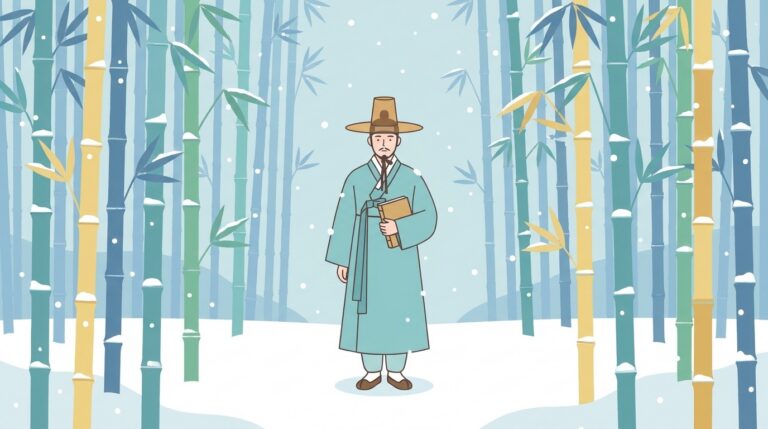
The Moral Spine of Korea: Classical Idioms Honoring Scholarly Integrity
Phase 1: 공감 (Story-Driven Opening)
안녕하세요! 매일한글 에디터입니다. (Hello! This is your Daily Hangul editor.)
Have you ever watched a gripping Korean political thriller or a grand sageuk (사극, historical drama) where the tension in the room turns razor-sharp? Think of scenes in Stranger (비밀의 숲) or Six Flying Dragons (육룡이 나르샤). A corrupt tycoon or high-ranking minister slides a discreet envelope across a lacquered table, whispering promises of immense power, instant promotions, and endless wealth. But instead of bowing, the protagonist sits motionless, eyes piercing through the compromise. Then, with quiet finality, they utter a four-character phrase—a sajaseong-eo (사자성어, classical four-character idiom)—that completely shatters the room’s corrupt atmosphere.
For advanced learners, these moments reveal a fascinating pain point: textbook Korean teaches you how to negotiate politely, but it rarely prepares you to understand the profound, non-negotiable moral convictions that define Korean intellectual history. When Korean intellectuals, journalists, or leaders face ethical crossroads, they do not just cite modern corporate compliance rules; they invoke the ghost of the Joseon Seonbi (선비, Joseon-era scholar-bureaucrat). Learning these idioms is not about memorizing dusty Hanja; it is about grasping the moral spine (도덕적 척추) that has sustained Korean civil society through colonization, military dictatorships, and turbulent democratic movements. Based on years of mentoring senior diplomats and academic researchers at Daily Hangul, mastering this vocabulary elevates your fluency from mere linguistic competence to deep cultural authority.
Phase 2: 핵심 표현 3선 심층 분석 (Deep-Dive into 3 Core Idioms)
1. 백절불굴 (百折不屈)
- Pronunciation: [Baek-jeol-bul-gul] (Sound metaphor: Think of “Baek” like ‘beckon’, “jeol” like ‘jolt’, and “bul-gul” like a swift, resonant hammer blow).
- Meaning: Literally, “bent a hundred times, but never yielding.” Nuance: Unshakable perseverance in the face of brutal oppression or temptation; a spirit that cannot be bought or broken.
- K-Culture Moment: Evoked in investigative journalism pieces when a whistleblowing prosecutor refuses political pressure from the Blue House or the Supreme Prosecutors’ Office.
- Editor’s Insight: This idiom transcends mere patience (참을성). While 참을성 implies enduring temporary discomfort, 백절불굴 is an active moral declaration. You acknowledge that your bones might break, yet your core principles remain upright.
- Situation Spectrum: Casual 🚫 | Semi-formal ⚠️ | Formal/Written ✅
- 🤔 Think About It: In English, we often say “standing your ground.” Does your native culture frame integrity as a mechanical fortress, or as something organic that bends through storm winds without snapping?
2. 청렴결백 (淸廉潔白)
- Pronunciation: [Cheong-nyeom-gyeol-baek] (Sound metaphor: crisp ‘Ch’ sound followed by clean, clipped syllables that mimic water splashing over smooth granite).
- Meaning: Pure and modest (청렴), spotless and white (결백). Nuance: Total freedom from graft, financial compromise, or petty ambition.
- K-Culture Moment: Used prominently during National Assembly confirmation hearings (인사청문회) to praise a jurist whose lifelong asset declaration reveals an ordinary, modest apartment and clean bank statements.
- Editor’s Insight: In modern corporate Korean, you will often hear 청렴 (integrity/anti-corruption) in official compliance campaigns. Adding 결백 emphasizes absolute moral innocence against baseless slander.
- Situation Spectrum: Casual 🚫 | Semi-formal ✅ | Formal/Written ✅
- 🤔 Think About It: How does your society define political cleanliness? Is it merely complying with the written law, or living an intentionally ascetic, unostentatious life?
3. 세한송백 (歲寒松柏)
- Pronunciation: [Se-han-song-baek] (Sound metaphor: “Se-han” sounds like a chilly gust of wind, grounded by the solid, resonant “song-baek”).
- Meaning: “In the freezing depth of the year, the pine and cypress stay green.” Nuance: True loyalty and virtue reveal their worth only during times of extreme crisis and betrayal.
- K-Culture Moment: Inspired by Master Gim Jeong-hui’s renowned masterpiece Sehanddo (세한도), painted during his desolate exile on Jeju Island to thank an apprentice who stayed loyal when everyone else fled.
- Editor’s Insight: When someone remains by your side when your company collapses, or when a subordinate refuses to betray you during a hostile takeover, calling them 세한송백 is the highest philosophical compliment in the Korean language.
- Situation Spectrum: Casual 🚫 | Semi-formal ⚠️ | Formal/Literary ✅
- 🤔 Think About It: When times turn cold, who stays green in your social world? How does winter act as a philosophical metaphor for character testing in your native tongue?
Phase 3: 교과서 한국어 vs 진짜 한국어 (Textbook vs. Real-World C2 Discourse)
Situation 1: Rejecting an illicit backchannel proposal at work
- 📖 교과서 한국어: 저는 뇌물을 받지 않고 원칙을 지키겠습니다. (Jeoneun noemureul batji ankko wonchigeul jikigesseumnida. / “I will not accept bribes and will protect principles.”)
- 🗣️ 진짜 한국어: 제 영혼까지 팔아가며 그 줄에 서고 싶지는 않습니다. 선비는 얼어 죽어도 곁불을 쬐지 않는 법입니다. (Je yeonghonkkaji paragamyeo geu jure seogo sipjineun anseumnida. Seonbineun eoreo jugeodo gyeotbureul jjoeji anneun beobimnida. / “I have no desire to sell my soul just to align with that faction. A true scholar would rather freeze to death than warm himself at another’s fire.”)
- 💡 왜 다를까?: Native Korean intellectual discourse relies on visceral folk-philosophical maxims. Invoking seonbi and factional alignment (줄 서기) sounds far more sophisticated and unshakeable than dry institutional rules.
Situation 2: Praising an uncompromising mentor
- 📖 교과서 한국어: 그분은 정말 정직하고 결코 타협하지 않습니다. (Geubuneun jeongmal jeongjikago gyeolko tahyeophaji anseumnida. / “That person is very honest and never compromises.”)
- 🗣️ 진짜 한국어: 그 선배는 권력 앞에서도 절대 꺾이지 않는 대쪽 같은 분이에요. (Geu seonbaeneun gwollyeok apeseodo jeoldae kkeokkiji anneun daejjok gateun bunieyo. / “That senior is like split bamboo—someone who never bends even before raw power.”)
- 💡 왜 다를까?: The botanical metaphor 대쪽 같다 (straight, sharp, and split down the middle like cured green bamboo) immediately evokes the traditional imagery of scholarly rectitude.
Phase 4: K-Culture 딥다이브 & 비언어적 매너 (K-Culture Deep Dive & Non-Verbal Manners)
4-1. Nunchi & Physical Posture: The Art of the “Unbending Gaze”
When refusing an unethical request in a high-context Korean environment, dramatic outbursts are considered unsophisticated. The traditional Seonbi ideal prizes 정좌 (Jeongjwa)—maintaining an immovable, upright posture.
* Eye Contact: Keep a steady, neutral gaze. Blinking rapidly or shifting your eyes conveys anxiety, whereas looking down can be misread as submission.
* The Rejection Gesture: If someone pushes an envelope or an unethical contract toward you, never swat it away. Gently place both palms flat on the table, or use both hands to lightly push the object back toward the center of the table while delivering your statement in a quiet, measured low register.
4-2. Cultural Code Analysis: The Legacy of Seonbi-jeongsin (선비정신)
Why are Korean audiences obsessed with dramas about uncompromising prosecutors or righteous dynastic historians? During the Joseon Dynasty, the Saganwon (사간원, Office of Censors) and Hongmungwan (홍문관, Office of Special Advisors) were institutional watchdogs whose sole duty was to critique the King’s moral failings—even at the risk of execution. This historical memory forged a collective respect for individuals who speak truth to power. In contemporary culture, whether in legal dramas like Hyena or real-world political commentary, Koreans view ethical incorruptibility as the ultimate intellectual distinction.
Phase 5: 실전 롤플레이 시나리오 (Real-World Roleplay Scenario)
Setting: A private VIP room in an Insadong Hanok restaurant. Director Kang (강 전무), a senior executive embroiled in an accounting scandal, is attempting to persuade you, a lead auditor, to sign off on an internal audit report.
- Turn 1 (Director Kang): 🎭 잔을 채워주며 낮게 속삭인다 “이번 감사 보고서 문구 하나만 다듬어 주시면, 본사 부사장 직속 라인으로 올려드리겠습니다. 융통성을 좀 발휘하시죠.” (Ibeon gamsa bogoseo mungu hanaman dadeumeo jusimyeon, bonsa busajang jiksok raineuro ollyeodeurigesseumnida. Yungtongseongeul jom balhwihasijyo. / “If you just polish one single phrase in this audit report, I’ll place you directly under the Executive VP. Show some flexibility.”)
- Turn 2 (You): 🎭 잔에 손을 대지 않고 바른 자세로 응시하며 “말씀은 감사하지만, 타협할 수 없는 선이 있습니다.” (Malsseumeun gamsahajiman, tahyeophal su eomneun seoni itseumnida. / “Thank you for the words, but there is a line I cannot compromise on.”)
- Turn 3 (Director Kang): 🎭 미간을 찌푸리며 찻잔을 내려놓는다 “이 바닥에서 혼자만 깨끗한 척한다고 세상이 알아줍니까? 송죽(松竹)처럼 꼿꼿하다간 바람에 먼저 부러지는 법입니다.” (I badageseo honjaman kkaekkeutan cheokhandago sesangi arajumnikka? Songjukcheoreom kkotkkothadagan barame meonjeo bureojineun beobimnida. / “Do you think the world cares if you act like you’re the only clean one in this business? If you stand rigid like pine and bamboo, the wind breaks you first.”)
- Turn 4 (You): 🎭 차분하게 양손을 무릎 위에 얹으며 “바람에 흔들릴지언정, 백절불굴(百折不屈)의 원칙을 버릴 생각은 없습니다.” (Barame heundeulliljieonjeong, baekjeolbulgurui wonchigeul beoril saenggageun eopseumnida. / “I may sway in the wind, but I have no intention of abandoning the principle of unyielding resolve.”)
- Turn 5 (Director Kang): 🎭 헛웃음을 지으며 봉투를 앞으로 내민다 “선비 놀음은 책 속에서나 하세요. 현실은 실리입니다.” (Seonbi noreumeun chaek sogeseona haseyo. Hyeonsireun silliyimnida. / “Leave the scholar cosplay to your textbooks. Reality is about pragmatism.”)
- Turn 6 (You): 🎭 두 손으로 서류 봉투를 부드럽게 밀어내며 “선비는 얼어 죽어도 곁불을 쬐지 않는다고 했습니다. 전무님의 호의는 정중히 사양하겠습니다.” (Seonbineun eoreo jugeodo gyeotbureul jjoeji anneundago haesseumnida. Jeonmunimui houineun jeongjung-i sayanghagesseumnida. / “As the saying goes, a scholar would rather freeze to death than warm himself at another’s fire. I respectfully decline your favor, Director.”)
- Turn 7 (Director Kang): 🎭 당황한 기색을 숨기지 못하고 굳은 표정으로 “…후회하지 않겠습니까?” (…Huhoehaji ankkesseumnikka? / “…Will you not regret this?”)
- Turn 8 (You): 🎭 눈을 피하지 않고 단호한 미소를 띠며 “청렴결백(淸廉潔白)하게 제 책임을 다하는 것이 제 자존심입니다. 물러가겠습니다.” (Cheongnyeomgyeolbaek-hage je chaegimeul dahaneun geosi je jajonsimimnida. Mulleogagesseumnida. / “Fulfilling my duty with spotless integrity is my pride. I will take my leave.”)
🔀 인터랙티브 분기점 (Interactive Choice)
If Director Kang makes one final threatening remark at the exit, how do you respond?
* Choice A: “앞으로 제 인사고과에 불이익을 주시면 법적으로 대응하겠습니다.” (I will sue you if you penalize my performance review.)
* Choice B: “권력은 유한하나, 기록과 양심은 영원합니다.” (Power is finite, but records and conscience are eternal.)
* Choice C: “죄송합니다, 제가 생각이 좀 짧았습니다. 다시 검토해 보겠습니다.” (I apologize, I was short-sighted. Let me review it again.)
- Decision Feedback:
- Choice A [Risk]: Too transactional and legalistic. In corporate Korean power dynamics, threatening lawsuits prematurely destroys negotiation leverage.
- Choice B [Best]: Masterful C2 register. It invokes historical justice and scholarly gravitas, completely disarming raw political bullying.
- Choice C [Bad]: Total collapse of your stance. You lose professional credibility and become complicit.
Phase 6: 10초 감정 섀도잉 드릴 (10-Second Emotional Shadowing Drill)
Practice reading these lines aloud with the emotional signposts and rhythmic pauses (/):
[🔥 서늘하고 흔들림 없이 / Cold, calm, and resolute]
선비는 / 얼어 죽어도 / 곁불을 쬐지 않는 법입니다.
(Seonbineun / eoreo jugeodo / gyeotbureul jjoeji anneun beobimnida.)-
[🏛️ 묵직하고 단호한 위엄 / Heavy, authoritative dignity]
백 번 꺾일지언정 / 불의 앞에서는 / 백절불굴(百折不屈)할 것입니다.
(Baek beon kkeokkiljieonjeong / burui apeseoneun / baekjeolbulgul-hal geosimnida.) -
[❄️ 고결하고 담담하게 / Noble, serene, and unbribable]
권력과 물질의 유혹 앞에서도 / 청렴결백(淸廉潔白)의 가치를 / 결코 내려놓지 않겠습니다.
(Gwollyeokgwa muljirui yuhok apeseodo / cheongnyeomgyeolbaegui gachireul / gyeolko naeryeonotji ankkesseumnida.)
Phase 7: K-Culture 미니 사전 (Core Cultural Lexicon)
- 선비정신 (Seonbi-jeongsin) | Scholarly Integrity / The Seonbi Spirit
- The philosophical ethos of Joseon Confucian scholars who prioritized moral duties, ethical rectitude, and academic pursuit above wealth, fame, and life itself.
- 지조 (Jijo) | Steadfast Principle / Moral Constancy
- An unwavering loyalty to one’s core conviction or conscience, especially when subjected to coercion, persecution, or financial ruin.
- 대쪽 (Daejjok) | Split Bamboo / Uncompromising Character
- Refers to a split piece of bamboo that runs straight down the grain. Used idiomatically in 대쪽 같은 사람 to describe an incorruptible person who cannot be bent.
- 결백 (Gyeolbaek) | Spotless Innocence / Purity of Record
- The state of being entirely untainted by corruption or criminality; frequently leveraged in high-stakes legal debates.
Phase 8: 여행자를 위한 생존 키트 (Traveler’s Cultural Survival Kit)
High-Register Expressions for Cultural Situations
- 원칙대로 처리해 주십시오. (Wonchikdaero cheorihae jusipsio. / “Please handle this strictly according to standard regulations.”)
- Pro Tip: Perfect when a merchant, vendor, or agent attempts an opaque surcharge or unofficial transaction.
- 정중하게 사양하겠습니다. (Jeongjunghage sayanghagesseumnida. / “I respectfully decline your offer.”)
- Pro Tip: Use this polite, elevated phrase when declining pushy sales pitches or unwelcome social overtures with definitive finality.
- 공과 사는 엄격히 구분되어야 합니다. (Gong-gwa saneun eomgyeoki gubundoeeoya hamnida. / “Public duties and private interests must remain strictly separated.”)
- Pro Tip: Use this in business negotiations when someone tries to leverage personal friendship for corporate concessions.
Editor’s Travel Note: In the Footsteps of Korean Scholars
If you want to feel the authentic atmosphere of Joseon scholarly integrity, visit the Historic Dosan Seowon in Andong or explore the tranquil pavilions of Changdeokgung Palace. For navigation, download the Naver Map navigation application to find historic scholar residences (고택, gotaek). In historic teahouses, remember that credit cards and T-money are universally accepted, but speaking with measured courtesy will unlock an entirely different level of hospitality.
Phase 9: “한 발 더 깊이” (Deep Reflection on Korean Culture)
In Western intellectual traditions, individualism often positions personal freedom as the highest good. In the Korean tradition, however, integrity (절개와 지조) has historically been viewed as a collective civic duty. The Joseon scholar was not living purely for personal enlightenment; their moral standing was the intellectual architecture upholding the entire state. Even today, public figures who compromise their values for money face severe social ostracization, while those who sacrifice wealth for principle gain lasting respect.
💬 Your Turn: Have you ever had to choose between practical compromise and personal integrity in your career? How would you express that dilemma using the metaphor of bamboo or winter pine? Share your thoughts below!
Phase 10: FAQ & 흔한 실수 (FAQ Schema & Misconceptions)
Q: Can I use idioms like 백절불굴 or 청렴결백 during casual dinners with Korean friends?
A: You should avoid using them literally in casual banter, as it can sound pretentious, dramatic, or excessively theatrical. However, you can use them ironically or jokingly (e.g., watching a friend refuse to break their diet: “다이어트 의지가 백절불굴이네!”).
Q: What is the difference between 지조 (Jijo) and 절개 (Jeolgae)?
A: While often used together as a pair (지조와 절개), 지조 refers to holding firm to one’s intellectual or political convictions over time, whereas 절개 historically focused on loyalty and fidelity in personal and institutional bonds.
Q: Is the concept of “선비 (Seonbi)” always used as a positive compliment?
A: Not always! In modern slang, 선비질 (Seonbi-jil) or 선비 코스프레 (Seonbi cosplay) can refer pejoratively to someone who acts overly self-righteous, rigid, or preachy on internet forums. Context and delivery dictate whether it is veneration or mockery.
🚨 Common Mistakes Warning Board
- Mistake 1: Translating “I have strong willpower” as 저는 백절불굴입니다. (Incorrect: 백절불굴 is an adjective/noun phrase applied to spirit or action, not an identity copula. Use 백절불굴의 의지를 가지고 있습니다 instead).
- Mistake 2: Using 청렴결백 to describe being tidy or cleanly dressed. (Incorrect: That is 단정하다 or 깔끔하다. 청렴결백 strictly refers to moral and financial ethics).
- Mistake 3: Bowing deeply while delivering a strong verbal rejection. (Incorrect: Over-bowing softens your moral stance. Keep your spine erect, shoulders relaxed, and nod minimally).
Phase 11: 액션 미션 & 참여 유도 (Action Missions)
- 🥉 Bronze Mission: Stand in front of a mirror, adopt the Jeongjwa posture, and recite Phase 6 Drill #1 three times without breaking eye contact.
- 🥈 Silver Mission: Write a 2-sentence journal entry describing a historical figure you admire using the idiom 백절불굴 (Baekjeolbulgul) or 세한송백 (Sehansongbaek).
- 🥇 Gold Mission: Use the phrase 대쪽 같다 in a discussion with your Korean language exchange partner or tutor to describe an uncompromising character in a Korean drama.
- 🎮 K-Culture Mission: Watch an episode of a legal or historical K-Drama (such as Stranger or Mr. Sunshine) and spot a scene where someone refuses a bribe or coercion. Did they mention integrity, wind, or bamboo?
Phase 12: 인터랙티브 퀴즈 챌린지 (Interactive Quiz Challenge)
1. Situational Judgment: A junior colleague asks how to praise a respected judge who lived an unostentatious life and refused corporate kickbacks throughout a 30-year career. Which idiom is most appropriate?
* A) 세한송백 (歲寒松柏)
* B) 청렴결백 (淸廉潔白)
* C) 부귀영화 (富貴榮華)
2. Fill-in-the-Blank:
선비는 얼어 죽어도 ______을/를 쬐지 않는다.
(A true scholar would rather freeze to death than warm himself at another’s fire.)
3. True or False: The phrase 대쪽 같은 사람 refers to someone whose personality is fragile and easily shattered under slight pressure.
🔍 Click to reveal answers & explanations
- Answer: B (청렴결백). While 세한송백 refers to remaining loyal in harsh adversity, 청렴결백 specifically honors spotless financial and moral integrity.
- Answer: 곁불 (Gyeotbul – side fire / another’s fire). This classic proverb epitomizes unbending scholarly pride.
- Answer: False. 대쪽 같다 means upright, straight, and unyielding like split cured bamboo—never compromised or cowardly!






