

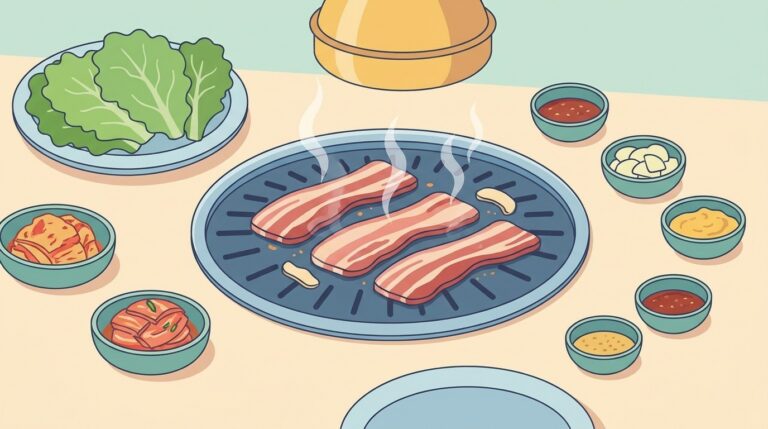
안녕하세요! 매일한글 에디터입니다. Have you ever stepped into a lively Korean BBQ restaurant in Seoul, surrounded by the mesmerizing hiss of sizzling pork belly and joyful toasts of geonbae, only to freeze the second the server looks your way? The restaurant is packed, golden smoke billows from the copper exhaust pipes, and the menu looks like an intimidating wall of Korean text. You want pork belly—crispy, juicy samgyeopsal—but how do you say you want two servings? Do you wave your hands? Do you yell? Don’t worry! Every single Korean language learner has faced that exact moment of panic. This guide is crafted directly from real classroom experiences and traveler feedback to turn that nervous sweat into pure culinary triumph. By the end of this lesson, you will summon servers like a Seoulite and feast with absolute confidence!
Phase 2: Top 3 Core Expressions In-Depth
1. 삼겹살 2인분 먼저 주세요 (Samgyeopsal i-inbun meonjeo juseyo)
- Pronunciation: [Sam-gyup-sal ee-in-boon meon-jeo joo-seh-yo] (Think: Sam as in ‘sample’, gyup like ‘cup’ with a g, i like the letter ‘E’, and juseyo sounds like ‘juice-say-yo’)
- Meaning: “Two servings of pork belly first, please.” (Literal: Pork belly 2-person-portion first give-please)
- K-Culture Moment: In almost every workplace K-drama dinner (hoesik), the junior employee sits near the grill, presses the table buzzer, and smoothly fires off this order before the drinks arrive.
- Editor’s Insight: The magic word here is 먼저 (meonjeo), which means “first.” It signals to the server: “We are starting with this, but keep the grill hot because we might order more later!”
- Situation Spectrum: Casual ✅ | Semi-formal ✅ | Formal ⚠️
- 🤔 Think About It: In many Western restaurants, everyone orders their own individual plate. Why do you think Korean BBQ is fundamentally counted and ordered in collective “portions per person” (inbun)?
2. 여기요! / 저기요! (Yeogiyo! / Jeogiyo!)
- Pronunciation: [Yeo-gi-yo / Jeo-gi-yo] (Yeo rhymes with ‘yaw’, Jeo sounds like ‘juh’)
- Meaning: “Over here, please!” / “Excuse me!”
- K-Culture Moment: Remember that scene in Weightlifting Fairy Kim Bok-joo where the squad enters the restaurant and instantly calls out with bright energy? That’s the power of Yeogiyo!
- Editor’s Insight: Raising your hand timidly and whispering will get you nowhere in a noisy restaurant. Saying “Jeogiyo!” with a clear, cheerful tone is not rude in Korea—it’s polite, efficient, and expected!
- Situation Spectrum: Casual ✅ | Semi-formal ✅ | Formal ✅
- 🤔 Think About It: How does directly calling out to staff reflect the fast-paced, attentive nature of Korean customer service compared to your home country?
3. 소주 한 병이랑 맥주 한 병 주세요 (Soju han byeong-irang maekju han byeong juseyo)
- Pronunciation: [So-ju han byeong-ee-rang maek-ju han byeong joo-seh-yo]
- Meaning: “Please give us one bottle of soju and one bottle of beer.”
- K-Culture Moment: The iconic Somaek (Soju + Maekju cocktail) mixing scenes in Itaewon Class start with this exact sentence.
- Editor’s Insight: The connector 랑/이랑 (-rang / -irang) means “and/with.” It turns separate items into a smooth, rhythmic combo order.
- Situation Spectrum: Casual ✅ | Semi-formal ✅ | Formal ⚠️
- 🤔 Think About It: Drinking in Korea is deeply communal. Drinks are rarely consumed solo at BBQ tables—why is ordering both soju and beer such a staple social ritual?
Phase 3: Textbook Korean vs. Real Korean
Situation 1: Calling the Server
- 📖 교과서 한국어: 실례합니다, 종업원님. (Sillyehamnida, jongeobwonnim. / Excuse me, employee.)
- 🗣️ 진짜 한국어: 사장님, 여기요! (Sajangnim, yeogiyo! / Boss/Owner, over here!) or 저기요! (Jeogiyo!)
- 💡 왜 다를까? Calling someone “employee” sounds mechanical and distancing. Calling restaurant workers Sajangnim (Boss) or Imo-nim (Auntie) creates warm, familial rapport and usually gets you faster service (and sometimes free side dishes!).
Situation 2: Asking for a Clean Grill Plate
- 📖 교과서 한국어: 불판을 교체해 주시겠습니까? (Bulpaneul gyochaehae jusigessseumnikka? / Would you please replace the grill plate?)
- 🗣️ 진짜 한국어: 판 갈아주세요! (Pan gara-juseyo! / Please change the grill plate!)
- 💡 왜 다를까? Korean BBQ places are bustling. Short, clear, polite verb forms (-a/eojuseyo) are far more natural and effective than overly stiff textbook grammar.
Phase 4: K-Culture Deep Dive & Non-Verbal Manners
4-1. 눈치 (Nunchi) & Gestures
- The Call Button Magic: Look closely at the corner of your wooden table or the tissue dispenser. See that small round button? That is the hoechul-bel (call bell). Don’t shout across three tables if you have a bell—press it gently! A sweet chime rings, and the server will come right over.
- Two-Handed Respect: When side dishes, meat plates, or drinks arrive, slightly support your right forearm with your left hand or hold the glass with both hands. It instantly shows deep cultural respect without saying a single word.
4-2. Cultural Code: The “Minimum 2 Servings” Rule
In Korea, raw meat (gogi) is meant to be shared. Most BBQ restaurants have an unwritten rule: you must place an initial order of at least 2 servings (2인분 / i-inbun), even if you dine alone. The grill takes time to heat, and the charcoal is costly! Once you order your base 2 servings, you can easily add single portions (1인분 / il-inbun) later.
Phase 5: Real-World Roleplay Scenario
Setting: A vibrant, neon-lit BBQ joint in Mapo-gu. Thick aromas of garlic and caramelized pork fill the air. The energetic Auntie (Imo-nim) approaches with water bottles and a smile.
- 이모님 (Server): 어서 오세요! 몇 분이세요? (Eoseo oseyo! Myeot bun-iseyo?) 🎭 Wiping down the tabletop cheerfully
- 나 (You): 두 명이요! (Du myeong-iyo!) 🎭 Holding up two fingers with a polite nod
- 이모님 (Server): 편한 데 앉으세요. 뭐 드릴까요? (Pyeonhan de anjeuseyo. Mwo deurilkkayo?) 🎭 Handing over two menus
- 나 (You): 삼겹살 2인분 먼저 주세요! (Samgyeopsal i-inbun meonjeo juseyo!) 🎭 Pointing clearly at the menu item
- 이모님 (Server): 네! 마실 건 뭐 드릴까? (Ne! Masil geon mwo deurilkka?) 🎭 Taking notes on her electronic order pad
- 나 (You): 맥주 한 병이랑 사이다 하나 주세요. (Maekju han byeong-irang saida hana juseyo.) 🎭 Smiling comfortably
- 이모님 (Server): 알겠어요, 금방 가져다줄게요! (Algesseoyo, geumbang gajyeodajulgeyo!) 🎭 Setting down cold side dishes and fresh lettuce
- 나 (You): 감사합니다! (Gamsahamnida!) 🎭 Slightly bowing head in appreciation
🔀 Interactive Choice Point
The pork starts burning on the edge of the grill mesh, and smoke is rising! What do you do?
- Option A: Stand up, walk into the kitchen, and grab a pair of clean tongs yourself.
- Option B: Ring the table bell, make eye contact, and politely say: “판 갈아주세요!” (Pan gara-juseyo!)
- Option C: Wave your arms frantically while shouting “Fire! Fire! 뜨거워요!”
Feedback:
* Option A [Bad]: Never enter the commercial kitchen! It’s a safety hazard and creates chaos for the staff.
* Option B [Best]: Absolutely spot on! Staff will quickly glide over, swap the iron plate with tongs in three seconds flat, and adjust your flame.
* Option C [Risk]: Unless there is a genuine emergency, yelling creates unnecessary alarm. A quick bell press solves it effortlessly!
Phase 6: 10-Second Emotional Shadowing Drill
Speak these aloud, pausing at the slashes (/), matching the emotional tags!
[😊 Confidently and brightly]
삼겹살 / 2인분 / 먼저 주세요!
(Samgyeopsal / i-inbun / meonjeo juseyo!)-
[🙋 Cheerful and assertive]
사장님! / 여기 / 판 갈아주세요!
(Sajangnim! / yeogi / pan gara-juseyo!) -
[😋 Hungry and delighted]
된장찌개 하나랑 / 공깃밥 두 개 / 주세요!
(Doenjang-jjigae hana-rang / gonggitbap du gae / juseyo!)
Phase 7: K-Culture Mini Dictionary
- 불판 (Bulpan) | Grill plate | The metal or stone surface where meat sizzles. When charred, ask for pan gyoche (판 교체) or pan gara-juseyo (판 갈아주세요).
- 쌈 (Ssam) | Leaf wrap | The art of wrapping grilled pork in lettuce or perilla leaf, topped with garlic, ssamjang sauce, and kimchi into a one-bite parcel.
- 볶음밥 (Bokkeumbap) | Fried rice | The legendary “K-dessert.” After finishing the meat, locals leave a few scraps and ask the staff to stir-fry rice, seaweed, and sesame oil directly on the grill.
- 회식 (Hoesik) | Company dinner | A core Korean social custom where colleagues gather after work over BBQ and drinks to bond and blow off steam.
Phase 8: Traveler’s Survival Kit
Top 3 Survival Phrases
- 물 좀 더 주세요 (Mul jom deo juseyo): “Please give us some more water.” (Pro Tip: Look for a sign saying ‘물은 셀프’ [mul-eun sel-peu], meaning water is self-service from the filtration cooler!).
- 앞치마 있어요? (Apchima isseoyo?): “Do you have an apron?” (Essential to protect your shirt from popping pork grease).
- 계산해 주세요 (Gyesanhae juseyo): “Check, please / We would like to pay.” (Head to the front counter register to pay; Korean tables rarely settle bills at the dining seat).
Editor’s Travel Note
- Navigation: Google Maps does not provide reliable walking directions in South Korea. Always look up restaurant locations using the [Naver Map Navigation App Guide] for precise subway exits and real-time open hours.
- Tipping: Never leave tip money on the table! Outstanding service is included in the bill, and leaving extra cash can cause confusion for the cashier.
Phase 9: “One Step Deeper” (Cultural Reflection)
In many Western dining cultures, eating is an individual experience centered around personal portions on separate plates. In contrast, Korean dining is grounded in 정 (Jeong)—a deep sense of communal bonding and warmth. Sitting around a single, radiating fire, sharing scissors, flipping meat for your companion, and dipping into shared stew bowls dissolves social barriers. Eating BBQ is not just consuming protein; it is actively sharing warmth and solidarity.
💬 Your Turn: Does your home culture have a shared meal ritual like this, or do you prefer having your own separate plate? Drop your thoughts in the comments below!
Phase 10: FAQ & Avoiding Misunderstandings
Q: Can I order just 1 serving of pork belly if I’m eating alone?
A: At most traditional BBQ places, the minimum opening order for the table is 2 servings. However, if you are dining solo (honbap), you can simply say: “혼자인데 2인분 시킬게요” (Honja-inde i-inbun sikilgeyo – “I’m alone, but I’ll order 2 servings”). They will gladly seat you!
Q: Do I need to pay for all those side dishes (banchan) that crowd the table?
A: No! All banchan—including kimchi, salad, pickled onions, and wraps—are 100% complimentary and almost always refillable. If you run out, say: “반찬 좀 더 주세요” (Banchan jom deo juseyo)!
Q: Should I flip the meat constantly?
A: Resist the urge! Locals typically wait until the bottom side turns golden-brown before making the first flip. Flipping too frequently loses the succulent juices.
🚨 Common Mistakes Alert
- Mistake: Handing payment cards or drinks with only one hand.
Correct Action: Use two hands, or place your left hand gently under your right wrist as a sign of courteous etiquette. - Mistake: Cutting raw meat the moment it lands on the grill.
Correct Action: Wait until the meat is halfway cooked and firm; cutting raw cold pork with kitchen scissors will tear the meat. - Mistake: Leaving the restaurant without checking your clothes for scent.
Correct Action: Look near the exit door! Most BBQ joints keep fabric deodorizing spray (Pebreze) for customers to freshen up.
Phase 11: Action Missions
- 🥉 Bronze Mission (Solo): Stand in front of your bathroom mirror and practice saying “삼겹살 2인분 먼저 주세요!” three times with a bright, friendly smile.
- 🥈 Silver Mission (Social): Share your favorite Korean dish photo on Instagram or Threads and caption it with today’s target phrase written in Korean.
- 🥇 Gold Mission (Real Life): Visit a local Korean restaurant or grocery store, locate the staff, and use “저기요!” and “…주세요!” to order.
- 🎮 K-Culture Mission: Watch an episode of any food-centric K-drama (like Let’s Eat or Business Proposal) and spot the exact second someone orders food using the counter word 인분 (inbun)!
Phase 12: Interactive Quiz Challenge
1. Situational Judgment: You sit down with a friend and want to order 2 portions of grilled pork belly first. What do you say?
(A) 불판 갈아주세요 (Pan gara-juseyo)
(B) 삼겹살 2인분 먼저 주세요 (Samgyeopsal i-inbun meonjeo juseyo)
(C) 계산해 주세요 (Gyesanhae juseyo)
2. Fill in the Blank:
“소주 한 병______ 맥주 한 병 주세요.” (Please give me one bottle of soju AND one bottle of beer.)
3. True or False: In Korea, pressing the table call button (ding-dong) is considered extremely rude and offensive to the restaurant staff. (True / False)
👉 Click to reveal answers & explanations!
- Answer: (B)
Explanation: (A) asks to change the grill plate, and (C) asks for the check! (B) correctly orders 2 portions of pork belly first. -
Answer: 이랑 (irang)
Explanation: Since byeong (병) ends with a consonant (받침), we attach 이랑 (irang) to mean “and/with.” -
Answer: False
Explanation: Call buttons are specifically installed to increase customer convenience and streamline staff service. It is polite and encouraged!
🎬 Watch Our Daily Videos! (Daily Hangul Official Instagram)
Review the expressions you learned in this article with our fun daily short videos! Check out native pronunciation and real-life nuances in action.
- Instagram @dailyhangul_en







