

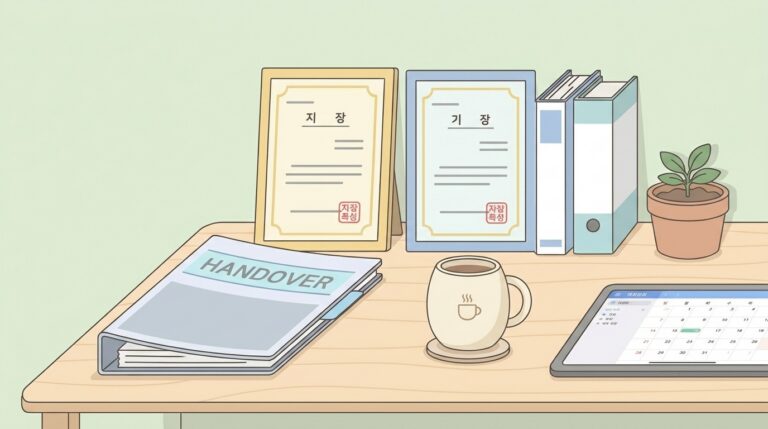
Leaving Your Korean Job Gracefully: How to Collect Your Career Certificate and Tax Receipt from HR
Phase 1: Empathy (Story-Driven Opening)
안녕하세요! 매일한글 에디터입니다. (Hello! This is your Daily Hangul editor.)
Picture this classic K-drama scene from Misaeng (미생): an office worker quietly organizes their desk on a rainy Friday evening in Yeouido. They pack up their favorite mug, return their employee badge, and exchange warm handshakes with teammates. But the next Monday morning, panic sets in: “Wait! How do I prove my exact job title to my new employer? Where is my tax withholding paper for the year-end settlement?”
Navigating a company resignation in South Korea is not merely about submitting a formal letter of resignation (사직서) and having a farewell dinner (환송 회식). Once your corporate portal login expires and your Slack account is deactivated on your final day, requesting official administrative paperwork from the outside turns into an awkward, bureaucratic hassle. Many international professionals working in Korea mistakenly assume these documents arrive automatically by mail. They don’t! Knowing how to politely yet firmly request your Certificate of Career Experience (경력증명서) and Income Tax Withholding Receipt (근로소득 원천징수영수증) from Human Resources before your last day protects your career trajectory and saves you tens of thousands of won in overpaid taxes. Based on real feedback from dozens of expat professionals across Pangyo and Gangnam, this comprehensive guide will equip you with natural, respectful Korean phrases and essential cultural codes to close this chapter with absolute confidence.
Phase 2: Core 3 Expressions Deep-Dive
1. 경력증명서 발급 부탁드립니다
- Pronunciation: Gyeong-nyeok-jeung-myeong-seo bal-geup bu-tak-deu-rim-ni-da (Sounds like: Gyung-nyuk-jeung-myung-suh bahl-geup boo-tahk-deu-rim-nee-dah)
- Meaning: Literal: “I request the issuance of my certificate of career experience.” / Real nuance: “Could you please issue my official Certificate of Career Experience?”
- K-Culture Moment: Seen in career dramas like Search: WWW when a star planner transitions between rival tech firms and hands over a certified portfolio of verifiable past titles.
- Editor’s Insight: 재직증명서 (Jae-jik-jeung-myeong-seo) proves you are currently an employee, whereas 경력증명서 (Gyeong-nyeok-jeung-myeong-seo) certifies both past and current service history, including exact departments and final dates. Always ask specifically for the latter when leaving a company.
- Situation Spectrum: Casual: 🚫 | Semi-formal: ⚠️ | Formal: ✅
- 🤔 Think About It: Why does Korean corporate administration rely so heavily on sealed physical documents (직인) compared to digital LinkedIn endorsements commonly used in Western job markets?
2. 재직 기간과 담당 직무를 구체적으로 기재해 주실 수 있나요?
- Pronunciation: Jae-jik gi-gan-gwa dam-dang jing-mu-reul gu-che-jeog-eu-ro gi-jae-hae ju-sil su in-na-yo? (Sounds like: Jae-jeek gee-gahn-gwah dahm-dahng jeeng-moo-reul goo-cheh-juhg-eu-roh gee-jae-hae joo-sheel soo een-nah-yoh?)
- Meaning: Literal: “Can you record the service period and assigned duties concretely?” / Real nuance: “Could you please specify my exact tenure and key responsibilities in detail on the document?”
- K-Culture Moment: A mid-level manager negotiating their salary tier at a new startup in Start-Up confirms their previous technical lead credentials.
- Editor’s Insight: Standard HR templates in Korea sometimes print only a generic department name like ‘영업부 (Sales Division)’. Adding 구체적으로 (specifically/in detail) ensures that critical responsibilities such as ‘글로벌 마케팅 총괄 (Head of Global Marketing)’ appear explicitly on the verified page.
- Situation Spectrum: Casual: 🚫 | Semi-formal: ✅ | Formal: ✅
- 🤔 Think About It: In your home culture, does HR dictate your documented duties, or can you negotiate how your official work history is worded on reference papers?
3. 근로소득 원천징수영수증도 함께 챙겨 주시면 감사하겠습니다
- Pronunciation: Geun-ro-so-deuk won-cheon-jing-su-yeong-su-jeung-do ham-kke chaeng-gyeo ju-si-myeon gam-sa-ha-get-seum-ni-da (Sounds like: Geun-roh-soh-deuk wahn-chuhn-jeeng-soo-yuhng-soo-jeung-doh hahm-kkeh chaeng-gyuh joo-shee-myun gahm-sah-hah-get-seum-nee-dah)
- Meaning: Literal: “If you pack together the earned income withholding receipt, I will be thankful.” / Real nuance: “I would really appreciate it if you could also prepare my income tax withholding receipt alongside it.”
- K-Culture Moment: The relatable accountant in Good Manager (김과장) sorting out end-of-year tax adjustments and reminding employees to claim their mid-year resignation tax records.
- Editor’s Insight: The verb 챙기다 (chaeng-gida) carries a warm, diligent nuance of ‘looking after’ or ‘making sure not to miss something important’. Pairing it with -주시면 감사하겠습니다 strikes a perfect balance between polite professionalism and humble gratitude.
- Situation Spectrum: Casual: 🚫 | Semi-formal: ⚠️ | Formal: ✅
- 🤔 Think About It: Notice how the Korean sentence frames the request around mutual care (챙겨 주시다) rather than an assertive transactional demand. How does this protect workplace harmony?
Phase 3: Textbook Korean vs. Real Korean
Situation 1: Asking the HR team for your tax and career documents before resignation day
- 📖 교과서 한국어 (Textbook Korean): 서류를 발급해 주십시오. (Seoryureul balgeuphae jusipsio.) — “Issue the documents.”
- 🗣️ 진짜 한국어 (Real Korean): 퇴사 전에 경력증명서랑 원천징수영수증 미리 메일로 받아볼 수 있을까요? (Toesa jeone gyeongnyeokjeungmyeongseorang woncheonjingsuyeongsujeung miri meillo badabol su isseulkkayo?) — “Could I possibly receive the career certificate and withholding tax receipt via email before my last day?”
- 💡 왜 다를까? (Why is it different?): The textbook imperative -십시오 sounds cold and demanding. Real Korean professionals use indirect conditional questions (-아/어 볼 수 있을까요?) combined with colloquial connectives like ~랑 to sound polite and cooperative.
Situation 2: Requesting detailed job descriptions rather than generic department titles
- 📖 교과서 한국어 (Textbook Korean): 직무 내역을 서류에 작성하십시오. (Jingmu naeyeogeul seoryue jakseonghasipsio.) — “Write the job details in the document.”
- 🗣️ 진짜 한국어 (Real Korean): 이직할 회사에서 필요해서 그런데요, 담당 업무 항목을 조금만 구체적으로 적어주실 수 있을까요? (Ijikal hoesaeseo piryohaeseo geureondeyo, damdang eommu hangmogeul jogeumman guchejeogeuro jeogeojusil su isseulkkayo?) — “My next company requested it, so would it be possible to write the job duties out in a bit more detail?”
- 💡 왜 다를까? (Why is it different?): Koreans rarely make direct demands without soft preambles. Starting with 이직할 회사에서 필요해서 그런데요 provides an external justification, removing personal blame and making HR much more willing to assist.
Phase 4: K-Culture Deep-Dive & Non-Verbal Manners
4-1. 눈치 (Nunchi) & Office Mannerisms
When visiting the HR department (인사팀) to request personal leaving paperwork, timing and non-verbal cues matter tremendously:
* The Golden Time Window: Never approach HR on Monday mornings (team meetings) or Friday afternoons past 4:30 PM (weekly wrap-ups). The ideal window is Tuesday through Thursday between 2:00 PM and 3:30 PM, right after the post-lunch rush.
* Two-Handed Respect: When handing over your formal request slip or receiving stamped documents, always use two hands (두 손) with your elbows slightly tucked against your ribs. If signing a confirmation roster, hold the pen with your right hand while lightly supporting your right forearm with your left fingertips.
* The Final Bow: A crisp, polite 30-degree bow combined with a smile and the phrase “그동안 신경 써 주셔서 정말 감사했습니다” (Geu-dong-an sin-gyeong sseo ju-syeo-seo jeong-mal gam-sa-haet-seum-ni-da – Thank you sincerely for looking after me all this time) leaves an enduring positive impression.
4-2. Cultural Code: 유종의 미 (Yujong-ui Mi) — The Beauty of a Graceful Exit
In South Korean corporate life, how you leave an organization defines your professional reputation just as much as how you entered it. Koreans refer to this as 유종의 미 (Yujong-ui mi – 有終의 美), which translates to ‘achieving a successful and beautiful ending’. Because Seoul’s professional circles (especially in tech, advertising, and finance) are surprisingly tight-knit, former managers and HR staff frequently receive informal reference calls (평판 조회 / 레퍼런스 체크). Handling your handover manuals (인수인계서) cleanly and organizing your paperwork courteously ensures that your former colleagues speak glowing praise when your future employers call.
Phase 5: Real-World Roleplay Scenario
Setting: 2:30 PM inside a sunlit, bustling HR office at a tech firm in Pangyo.
Characters: Alex (Foreign Project Manager, resigning next week) and Assistant Manager Min-ji (민지 대리, HR Team).
- Turn 1 (Alex):
한글: 민지 대리님, 바쁘신데 잠시 말씀 좀 나눠도 괜찮을까요?
Romanization: Min-ji dae-ri-nim, ba-ppeu-sin-de jam-si mal-sseum jom na-nwo-do gwaen-chan-eul-kka-yo?
English: “Assistant Manager Min-ji, I know you’re busy, but do you have a quick moment to speak?”
🎭 행동 지문: (Knocks softly on the partition, bowing head slightly with an apologetic smile) -
Turn 2 (Min-ji):
한글: 아, 알렉스 님! 네, 마침 서류 검토 끝나서 괜찮아요. 무슨 일이세요?
Romanization: A, Al-lek-seu nim! Ne, ma-chim seo-ryu geom-to kkeut-na-seo gwaen-chan-a-yo. Mu-seun ir-i-se-yo?
English: “Ah, Alex! Yes, I just finished reviewing my files, so I’m free. What’s on your mind?”
🎭 행동 지문: (Pushes keyboard aside, looking up attentively) -
Turn 3 (Alex):
한글: 다름이 아니라, 다음 주가 마지막 출근일이라서요. 퇴사 전에 경력증명서 발급을 미리 부탁드려도 될까 싶어서 찾아왔습니다.
Romanization: Da-reum-i a-ni-ra, da-eum ju-ga ma-ji-mak chul-geun-il-i-ra-seo-yo. Toe-sa jeo-ne gyeong-nyeok-jeung-myeong-seo bal-geup-eul mi-ri bu-tak-deu-ryeo-do doel-kka sip-eo-seo cha-ja-wat-seum-ni-da.
English: “Well, next week is my last day of work. I stopped by to ask if I could request my Certificate of Career Experience in advance before resigning.”
🎭 행동 지문: (Holds hands neatly in front, speaking in a calm, respectful tone) -
Turn 4 (Min-ji):
한글: 물론이죠. 기본 양식으로 출력해 드릴까요, 아니면 제출처에서 요구하는 특별한 양식이 있으신가요?
Romanization: Mul-ron-i-jyo. Gi-bon yang-sik-eu-ro chul-ryeok-hae deu-ril-kka-yo, a-ni-myeon je-chul-cheo-e-seo yo-gu-ha-neun teuk-byeol-han yang-sik-i its-eu-sin-ga-yo?
English: “Of course. Should I print our standard template, or does your destination organization require a specific form?”
🎭 행동 지문: (Opens the internal company administration portal on her monitor) -
Turn 5 (Alex):
한글: 회사 기본 양식이면 충분한데요, 혹시 재직 기간이랑 담당 직무가 명시되도록 기재해 주실 수 있나요?
Romanization: Hoe-sa gi-bon yang-sik-i-myeon chung-bun-han-de-yo, hok-si jae-jik gi-gan-i-rang dam-dang jing-mu-ga myeong-si-doe-do-rok gi-jae-hae ju-sil su in-na-yo?
English: “The company’s standard format is plenty, but could you please ensure that both my tenure and specific job responsibilities are explicitly noted?”
🎭 행동 지문: (Nods gently, gesturing lightly toward the screen) -
Turn 6 (Min-ji):
한글: 네, 알겠습니다. 프로젝트 매니징이랑 글로벌 파트너십 담당하셨던 내용 명시해서 직인 찍어둘게요. 다른 서류는 더 필요 없으세요?
Romanization: Ne, al-get-seum-ni-da. Peu-ro-jek-teu mae-ni-jing-i-rang geul-ro-beol pa-teu-neo-sip dam-dang-ha-syeot-deon nae-yong myeong-si-hae-seo jik-in jji-geo-dul-ge-yo. Da-reun seo-ryu-neun deo pir-yo eop-seu-se-yo?
English: “Understood. I will explicitly list your project management and global partnership responsibilities and stamp our official corporate seal. Do you need any other documents?”
🎭 행동 지문: (Takes notes with a pen and smiles reassuringly) -
Turn 7 (Alex):
한글: 아! 실례가 안 된다면, 근로소득 원천징수영수증도 중도퇴사 정산분으로 함께 챙겨주실 수 있을까요?
Romanization: A! Sil-lye-ga an doen-da-myeon, geun-ro-so-deuk won-cheon-jing-su-yeong-su-jeung-do jung-do-toe-sa jeong-san-bun-eu-ro ham-kke chaeng-gyeo-ju-sil su is-seul-kka-yo?
English: “Ah! If it’s not too much trouble, could you also prepare my mid-year income tax withholding receipt along with it?”
🎭 행동 지문: (Brightens up with polite gratitude, bowing hands together slightly) -
Turn 8 (Min-ji):
한글: 네, 마지막 급여일 이후 정산해서 대표 이메일로 PDF 보내드릴게요. 퇴사 당일에 종이 원본도 봉투에 넣어 드리겠습니다!
Romanization: Ne, ma-ji-mak geup-yeo-il i-hu jeong-san-hae-seo dae-pyo i-me-il-ro PDF bo-nae-deu-ril-ge-yo. Toe-sa dang-ir-e jong-i won-bon-do bong-tu-e neo-eo deu-ri-get-seum-ni-da!
English: “Sure, I will calculate it after the final payroll and email the PDF to your personal inbox. I’ll also hand you the stamped physical copies in an envelope on your last day!”
🎭 행동 지문: (Smiles warmly and marks it on her desktop calendar)
🔀 Interactive Choice Point
How should Alex conclude this productive interaction with Min-ji?
- Option A: “빨리 주셔서 감사합니다. 지금 당장 인쇄해 주시면 바로 갈게요!” (“Thanks for giving it fast. If you print it right now, I’ll go right away!”)
- Option B: “바쁘신 업무 중에 챙겨주셔서 정말 감사합니다, 대리님! 인수인계 마무리 잘해 놓겠습니다.” (“Thank you so much for taking care of this amid your busy schedule, Assistant Manager! I will make sure to wrap up my handover thoroughly.”)
- Option C: “서류 안 주시면 노동청에 신고할 수도 있으니까 꼭 잊지 마세요.” (“Make sure you don’t forget, or I could report this to the Ministry of Employment and Labor.”)
Feedback:
* Option A (Risk): Demanding immediate printing disregards HR’s scheduled batch processes and ruins the polite rapport Alex just established.
* Option B (Best!): Perfect! Acknowledging their effort and reaffirming a responsible handover (인수인계) demonstrates peak 유종의 미 professionalism.
* Option C (Bad): Highly aggressive and inappropriate. While issuing certificates is legally mandated under Korean Labor Standards, threatening legal reporting unprovoked damages references permanently.
Phase 6: 10-Second Emotional Shadowing Drill
Practice these lines out loud, matching the emotional tone and rhythm marked by the slashes (/).
- [💼 정중하고 조심스럽게 – Respectfully & Tactfully]
퇴사 전에 / 경력증명서랑 원천징수영수증을 / 미리 받아볼 수 있을까요?
(Toesa jeone / gyeongnyeokjeungmyeongseorang woncheonjingsuyeongsujeung-eul / miri badabol su isseulkkayo?) -
[🔍 명확하고 똑 부러지게 – Clearly & Confidently]
재직 기간과 담당 직무가 / 서류에 구체적으로 / 적혀 있는지 확인했습니다.
(Jaejik gigangwa damdang jingmuga / seoryue guchejeogeuro / jeokhyeo inneunji hwaginhaesseumnida.) -
[😊 진심으로 감사하며 – With Genuine Gratitude & Warmth]
신경 써서 챙겨주신 덕분에 / 마음 편하게 / 마무리할 수 있을 것 같아요!
(Sin-gyeong sseo-seo chaeng-gyeo-ju-sin deok-bune / ma-eum pyeon-hage / mamurihal su isseul geot gat-a-yo!)
Phase 7: K-Culture Mini Dictionary
-
경력증명서 (Gyeong-nyeok-jeung-myeong-seo)
- Translation: Certificate of Career Experience / Employment History Record.
- Practical Usage: An official corporate document proving your period of service, final job title, and detailed responsibilities, verified with the company seal (법인직인). Indispensable for mid-career job switching in Korea.
- 원천징수영수증 (Won-cheon-jing-su-yeong-su-jeung)
- Translation: Income Tax Withholding Receipt.
- Practical Usage: Korean companies withhold income tax at the source each month. When you change jobs during the tax year, your new company requires this document to combine your tax calculations during the annual Year-End Tax Settlement (연말정산).
- 인수인계서 (In-su-in-gye-seo)
- Translation: Business Handover Manual / Transition Report.
- Practical Usage: The sacred document an outgoing employee writes for their successor, outlining active project statuses, passwords, key stakeholder contact lists, and daily operation protocols.
- 유종의 미 (Yu-jong-ui Mi)
- Translation: The beauty of a successful and graceful conclusion.
- Practical Usage: Used frequently in workplace farewell speeches and retirement announcements: “유종의 미를 거두겠습니다” (I will do my very best to bring this to an honorable conclusion).
Phase 8: Expat Professional Survival Kit
Survival Phrases TOP 3
- 법인 직인이 찍혀 있어야 해요. (Beop-in jik-in-i jjik-hyeo iss-eo-ya hae-yo.)
- Meaning: “It must have the official corporate seal stamped on it.”
- Pro Tip: Many government portals and new employers reject career certificates if they feature a digital image signature rather than the red corporate stamp.
- 인수인계서 바탕화면에 정리해 두었습니다. (In-su-in-gye-seo ba-tang-hwa-myeon-e jeong-ri-hae du-eot-seum-ni-da.)
- Meaning: “I have organized the handover manual on my computer desktop.”
- Pro Tip: Telling your team leader where your handover files are saved leaves a lasting reputation as a considerate team player.
- 퇴직금 지급 예정일을 알 수 있을까요? (Toe-jik-geum ji-geup ye-jeong-ir-eul al su iss-eul-kka-yo?)
- Meaning: “Could I know the expected payout date for my severance pay?”
- Pro Tip: Under Korean Labor Law, statutory severance pay (퇴직금) must be paid into your IRP account within 14 days of your official termination date.
Editor’s Expat Note
Did you leave your company without getting hard copies? Don’t panic! You can access national records online. Log into the official Government24 online verification portal or download the National Pension Service app to print your National Pension Subscription History (국민연금 가입증명서), which Korean companies widely accept as legal proof of tenure. For historical tax documents, log in using your digital certificate on the Hometax National Tax Service portal to retrieve past withholding statements directly without contacting your ex-boss!
Phase 9: “One Step Deeper” (Cultural Reflection)
In Western corporate environments, workers often view administrative documents as transactional entitlements: you resign, and the automated system generates your W-2 or P45. In South Korea, however, organizational departure is deeply tied to relational continuity (인연 / In-yeon). Labor laws strictly require companies to issue career certificates upon request, but the willingness of HR to write glowing details in your duty description depends on how gracefully you navigate the transition. Taking time to thank your colleagues personally and handing over your duties diligently isn’t just politeness—it is a conscious investment in your long-term reputation within Korea’s interconnected professional web.
💬 Your Turn: In your home country, is it customary to request tax receipts and career letters directly from colleagues, or is it handled completely anonymously by an automated system? Share your experience in the comments below!
Phase 10: FAQ & Mistake Prevention
Q: What is the difference between a 재직증명서 and a 경력증명서?
A: 재직증명서 (Certificate of Employment) proves you are an active employee today, often required for bank loans or visa renewals. 경력증명서 (Certificate of Career Experience) certifies your completed career history after leaving (or nearing the end of your contract) and includes precise start dates, end dates, and project assignments.
Q: Can my company legally refuse to issue my Certificate of Career Experience?
A: Absolutely not! Under Article 39 of the Korean Labor Standards Act (근로기준법 제39조), employers are legally obligated to issue a certificate stating the period of employment, kinds of work performed, and position immediately upon an employee’s request, even after retirement. Failure to comply can result in administrative fines.
Q: Why do I need my Withholding Tax Receipt (원천징수영수증) immediately?
A: If you join another company within the same calendar year, your new HR team must combine your earlier earnings with your new salary to calculate your Year-End Tax Settlement (연말정산) in January. If you don’t provide this receipt, you may face double taxation or have to file a complicated personal return at the tax office independently in May.
🚨 Common Mistakes Warning Board
- Mistake 1: Relying on generic department titles on the certificate.
- Correct Action: Request that HR specify your exact functional roles (e.g., “Software Engineer, Backend Architecture”) instead of broad labels like “Development Division”.
- Mistake 2: Leaving only your company email address.
- Correct Action: Make sure HR records your personal email and Korean phone number so they can send your mid-year tax statement (중도퇴사 원천징수영수증) after final payroll calculations.
- Mistake 3: Forgetting to confirm the official red seal (법인직인).
- Correct Action: Always verify that the physical document bears the crisp circular red seal of the corporation before stepping out of the office for the last time.
Phase 11: Action Mission & Participation
- 🥉 Bronze Mission (Solo Practice): Read the Phase 6 shadowing sentences aloud 3 times, focusing on smooth transitions around the technical term 원천징수영수증.
- 🥈 Silver Mission (Social Share): Leave a comment below using the phrase “~도 함께 챙겨주셔서 감사합니다” describing a time a colleague or friend helped you gather essential items.
- 🥇 Gold Mission (Real Application): Open your notes or email draft and compose a polite 3-sentence request to your current HR or mentor using: 경력증명서, 담당 직무, and 원천징수영수증.
🎮 K-Culture Mission: Watch an episode of the workplace comedy-drama Gaus Electronics (가우스전자) or Misaeng (미생) and spot how characters address team leaders when discussing career changes or administrative files!
Phase 12: Interactive Quiz Challenge
Quiz 1: Situational Judgment
You are leaving your Korean marketing agency next week and need documents for your new job. What is the most culturally adept way to ask the HR manager?
* A) “인사팀, 내일까지 서류 빨리 떼어주세요.” (“HR team, print my documents quickly by tomorrow.”)
* B) “대리님, 실례가 안 된다면 퇴사 전에 경력증명서랑 원천징수영수증 미리 받아볼 수 있을까요?” (“Assistant Manager, if it’s not rude, could I possibly receive my career certificate and withholding tax receipt before my last day?”)
* C) “서류 안 주시면 법적으로 문제 생깁니다.” (“If you don’t give me the papers, there will be legal issues.”)
Quiz 2: Fill-in-the-Blank
Fill in the blank with the appropriate workplace verb meaning ‘to look after / prepare attentively’:
“원천징수영수증도 서류 봉투에 함께 [ ] 주셔서 감사합니다.”
Quiz 3: True or False
Statement: Korean companies are legally permitted to omit your specific job duties on your career certificate if they consider it internal company confidentiality.
👉 Click to reveal answers & explanations!
- Quiz 1 Answer: B. Option B uses respectful titles (대리님), polite softening phrases (실례가 안 된다면), and polite indirect questioning (-아/어 볼 수 있을까요?).
- Quiz 2 Answer: 챙겨 (chaeng-gyeo). The expression 챙겨 주셔서 감사합니다 conveys genuine gratitude for attentive care.
- Quiz 3 Answer: False! Under Korean Labor Standards Act Article 39, the employee has the legal right to demand that only the items they request (including specific duties performed) be entered onto the career certificate.
🎬 Watch Our Daily Videos! (Daily Hangul Official Instagram)
Review the expressions you learned in this article with our fun daily short videos! Check out native pronunciation and real-life nuances in action.
- Instagram @dailyhangul_en







