

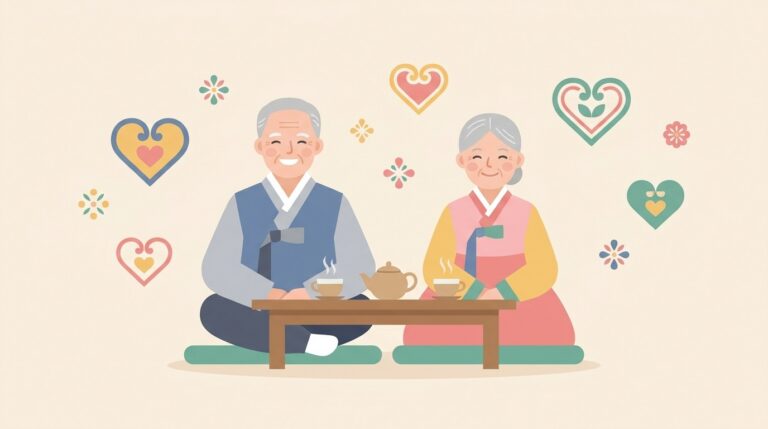
Phase 1: 공감 (A Heartwarming Family Moment)
안녕하세요! 매일한글 에디터입니다. (Hello! I’m your Daily Hangul editor.)
Have you ever watched a scene in a K-drama like Reply 1988 where an elderly neighbor hands a steaming sweet potato to a child, calling them “내 강아지” (my puppy)? Or maybe you watched your favorite idol tear up on a variety show talking about their grandmother’s home-cooked food? In Korean culture, grandparents are not distant relatives; they are the warm, emotional heartbeat of the family.
Many of our beginner learners tell us: “I know the word ‘saranghae’, but I freeze when I want to tell an elder I respect and care for them! What if I sound rude or use child-like slang?” That hesitation is completely normal. In Korean, showing love to your elders requires a gentle balance of warmth and respect. In this lesson, built on real feedback from hundreds of beginner students, you will master how to introduce your grandparents with confidence and express your heartfelt love without feeling awkward.
Phase 2: 핵심 표현 3선 심층 분석 (Top 3 Essential Expressions)
1. 할머니, 사랑해요 (Halmeoni, saranghaeyo)
- Pronunciation: [Hal-meo-ni, sa-rang-hae-yo] (Say “Hal” like Hulk, “muh-nee” like money, and “sa-rang-hae-yo” like “ha” in hard + “yo”)
- Meaning: “Grandmother, I love you.” (Direct: Grandmother, doing love.)
- K-Culture Moment: Often whispered by characters hugging their grandmothers before moving to Seoul or leaving for military service in K-dramas.
- Editor’s Insight: Adding “-요 (-yo)” at the end transforms “사랑해 (saranghae)” into a sweet, respectful expression suitable for elders. Never drop the “-요” when talking to your grandparents!
- Situation Spectrum: Casual ⚠️ | Semi-formal ✅ | Formal ✅
- 🤔 Think About It: In English, “I love you” sounds the same whether spoken to a pet, a friend, or a grandparent. Why do you think Korean adds a polite ending for family elders?
2. 우리 할아버지예요 (Uri harabeoji-yeyo)
- Pronunciation: [U-ri hal-a-beo-ji-ye-yo] (“Oo-ree” + “Hahl-ah-buh-jee-yeh-yo”)
- Meaning: “This is my grandfather.” (Direct: “Our grandfather is.”)
- K-Culture Moment: When introducing family photos to friends or teachers in Korean schools.
- Editor’s Insight: Notice the word “우리 (uri)”, which literally means “our”. Koreans say “our grandfather” even when speaking solely for themselves, reflecting communal warmth.
- Situation Spectrum: Casual ⚠️ | Semi-formal ✅ | Formal ✅
- 🤔 Think About It: Why does Korean culture favor saying “our” family instead of “my” family?
3. 건강하세요 (Geonganghaseyo)
- Pronunciation: [Geon-gang-ha-se-yo] (“Guhn-gahng-ha-seh-yo”)
- Meaning: “Please stay healthy” or “Wishing you good health.”
- K-Culture Moment: The quintessential holiday greeting said during Seollal (Lunar New Year) and Chuseok alongside deep traditional bows.
- Editor’s Insight: For elderly Koreans, wishing good health is often considered a deeper and more thoughtful declaration of love than simply saying “I love you.”
- Situation Spectrum: Casual 🚫 | Semi-formal ✅ | Formal ✅
- 🤔 Think About It: How does your culture verbally express wishes of longevity and wellness to seniors?
Phase 3: 교과서 한국어 vs 진짜 한국어 (Textbook vs. Real Korean)
Situation 1: Showing a photo of your grandmother to a friend
- 📖 교과서 한국어: 저의 조모이십니다. (Jeoui jomoisimnida. – She is my paternal grandmother.)
- 🗣️ 진짜 한국어: 우리 할머니예요! (Uri halmeoniyeyo! – This is my grandma!)
- 💡 왜 다를까?: “조모 (jomo)” is a legal, documentary term. In everyday spoken Korean, native speakers always say “우리 할머니 (uri halmeoni)” to sound loving and approachable.
Situation 2: Ending a phone call with your grandfather
- 📖 교과서 한국어: 안녕히 계십시오. (Annyeonghi gyesipsio. – Farewell.)
- 🗣️ 진짜 한국어: 할아버지, 사랑해요! 건강하세요~ (Harabeoji, saranghaeyo! Geonganghaseyo~ – Grandpa, love you! Stay healthy~)
- 💡 왜 다를까?: While “안녕히 계십시오” is grammatically polite, it sounds like a business report when said to family. Combining “사랑해요” with “건강하세요” shows true filial warmth.
Phase 4: K-Culture 딥다이브 & 비언어적 매너 (Culture Deep Dive & Manner)
4-1. 눈치(Nunchi) & 제스처 (Gestures with Elders)
- Two-Hand Rule (두 손): When handing a gift, a cup of tea, or your family photo to an elderly person, always support your right forearm with your left hand, or use both hands completely. Handing anything with a single hand looks careless.
- Soft Bow & Eye Contact: Do not lock eyes aggressively. Give a warm, gentle smile, lower your gaze slightly, and nod your head in a 15-degree courteous bow when greeting.
4-2. 문화 코드 분석: The “Halmeoni” Phenomenon in K-Food & Life
In Korea, elderly women are affectionately seen as master culinary artists. You will often see restaurants named “할머니 국수 (Grandmother’s Noodles)” or “원조 할머니 순대국 (Original Halmeoni Soup)”. Calling a market vendor “할머니 (Halmeoni)” with respect makes her heap extra side dishes (서비스 – service) into your bag. It conveys deep trust and communal kinship.
Phase 5: 실전 롤플레이 시나리오 (Interactive Roleplay)
Setting: Minjun’s living room in Seoul during family dinner. Minjun’s grandmother brings you a plate of fresh fruit.
- Turn 1 (Grandmother): 학생, 사과 좀 깎아 왔어. 많이 먹어요. (Haksaeng, sagwa jom kkakka wasseo. Mani meogeoyo.)
🎭 Hands you a plate of sliced apples with a broad, wrinkled smile.
(English: Student, I sliced some apples. Eat a lot.) -
Turn 2 (You): 와, 감사합니다! 할머니, 잘 먹겠습니다. (Wa, gamsahamnida! Halmeoni, jal meokgetseumnida.)
🎭 Receiving the plate with two hands, bowing slightly.
(English: Wow, thank you! Grandma, I will enjoy this.) -
Turn 3 (Grandmother): 착하기도 하지. 한국 생활은 재미있어요? (Chakhagido haji. Hanguk saenghwareun jaemiisseoyo?)
🎭 Sitting beside you warmly.
(English: How sweet. Are you having fun living in Korea?) -
Turn 4 (You): 네! 정말 좋아요. 할머니, 우리 할머니도 생각나요. (Ne! Jeongmal joayo. Halmeoni, uri halmeonido saenggangnayo.)
🎭 Smiling gently while taking your phone out.
(English: Yes! I love it. Halmeoni, you remind me of my own grandmother too.) -
Turn 5 (Grandmother): 그래? 어디 사진 한번 봐봐요. (Geurae? Eodi sajin hanbeon bwabwayo.)
🎭 Leaning in with curiosity.
(English: Really? Let me see a picture.) -
Turn 6 (You): 여기요. 우리 할머니랑 할아버지예요. (Yeogiyo. Uri halmeonirang harabeojiyeyo.)
🎭 Showing the family vacation photo on your screen.
(English: Here it is. This is my grandmother and grandfather.) -
Turn 7 (Grandmother): 아이고, 두 분 다 참 인상이 좋으시네! (Aigo, du bun da cham insangi joeusine!)
🎭 Patting your shoulder happily.
(English: Oh my, both of them look so wonderfully kind!) -
Turn 8 (You): 감사합니다. 우리 할머니, 할아버지 많이 사랑해요. (Gamsahamnida. Uri halmeoni, harabeoji mani saranghaeyo.)
🎭 Speaking sincerely with a warm heart.
(English: Thank you. I love my grandmother and grandfather very much.)
🔀 인터랙티브 분기점 (What would you say next to Minjun’s grandma?)
- Option A: “할머니, 더 주세요! (Halmeoni, deo juseyo! – Grandma, give me more!)”
- Option B: “할머니, 사과 정말 달아요. 건강하세요! (Halmeoni, sagwa jeongmal darayo. Geonganghaseyo! – Grandma, the apples are so sweet. Please stay healthy!)”
- Option C: “할머니, 안녕! (Halmeoni, annyeong! – Bye, grandma!)”
Feedback:
* Option A (Risk): Demanding food without gratitude can sound childish or pushy.
* Option B (Best): Complimenting the food and offering a warm wish for her health is the ultimate respectful grandchild move!
* Option C (Bad): Never use informal “안녕” with an elder; it is considered disrespectful.
Phase 6: 10초 감정 섀도잉 드릴 (Emotion Shadowing Drill)
Practice repeating these lines aloud with the tone indicators:
[😊 따뜻하고 다정하게 / Warm & Loving]
우리 할머니, / 정말 / 사랑해요.
(Uri halmeoni, / jeongmal / saranghaeyo.)
Pause at the slashes and let your voice rise gently.
(English: I really / love / my grandmother.)-
[✨ 또박또박 자랑스럽게 / Proud & Clear]
이 분은 / 우리 / 멋진 할아버지예요.
(I buneun / uri / meotjin harabeojiyeyo.)
Speak brightly as if showing off your favorite person.
(English: This person / is our / wonderful grandfather.) -
[🙏 공손하고 따뜻하게 / Respectful & Tender]
할아버지, / 할머니, / 항상 건강하세요!
(Harabeoji, / halmeoni, / hangsang geonganghaseyo!)
Keep your intonation steady and sincere.
(English: Grandpa, / Grandma, / please always stay healthy!)
Phase 7: K-Culture 미니 사전 (Mini Dictionary)
- 할아버지 (Harabeoji) | Grandfather | Formal term for grandfather; also politely used towards elderly gentlemen in daily life.
- 할머니 (Halmeoni) | Grandmother | Formal term for grandmother; frequently used affectionately toward elderly female restaurant owners.
- 우리 (Uri) | Our / We | The cultural concept of “us”; placed before family names (우리 엄마, 우리 할머니) to express intimacy.
- 건강 (Geongang) | Health | A core concept in Korean etiquette; wishing elders good health demonstrates true respect.
Phase 8: 여행자를 위한 생존 키트 (Traveler’s Survival Kit)
Top 3 Survival Phrases
- 할머니, 이거 얼마예요? (Halmeoni, igeo eolmayeyo?)
Pro Tip: Use this at traditional street food stalls (like Gwangjang Market) to instantly melt the vendor’s heart. - 감사합니다! 건강하세요! (Gamsahamnida! Geonganghaseyo!)
Pro Tip: Say this when leaving an elderly taxi driver or traditional teahouse host. - 할아버지, 사진 한 장 찍어 드릴까요? (Harabeoji, sajin han jang jjigeo deurilkkayo?)
Pro Tip: Use this if you see an elderly tourist couple struggling with a selfie at Gyeongbokgung Palace.
Editor’s Travel Note
When navigating Korea to find traditional folk villages or century-old family restaurants, avoid foreign map apps that lack transit updates. Instead, use the 네이버 지도 앱 다운로드 (Download Naver Map App) to find historic local spots. Don’t forget that using 티머니 카드 충전하기 (Recharging T-Money Card) at subway stations makes your journey across traditional markets seamless.
Phase 9: “한 발 더 깊이” (Deep Cultural Insight)
In Korean society, family boundaries extend naturally outward into the neighborhood. Calling an elderly stranger “할머니” or “할아버지” is not considered offensive or an insult about age; rather, it acknowledges them as valued elders within our shared community umbrella. When you say “우리 할아버지 (our grandfather)”, you invite the listener into a warm circle of collective family bonds.
💬 Your Turn: What special nickname or term of respect do you use for your grandparents in your native language? Drop a comment below!
Phase 10: FAQ & 오해 방지 (FAQ Schema & Common Mistakes)
Q: Can I call any elderly person Halmeoni or Harabeoji on the street?
A: Yes! It is common and polite at markets, bus stops, or small neighborhood diners. However, in formal professional or corporate environments, use occupational titles with “-님 (-nim)” instead.
Q: What is the difference between 외할머니 (oehalmeoni) and 할머니 (halmeoni)?
A: “외 (oe)” literally means outside, referring to your mother’s side of the family. “외할머니” is your maternal grandmother, while “할머니” typically refers to your paternal grandmother (or grandmothers in general).
Q: Can I just say “사랑해 (saranghae)” to my Korean grandparents?
A: No, omitting the polite “-요 (-yo)” or using casual talk (반말 – banmal) with elders is considered disrespectful unless the elder explicitly asks for it.
🚨 Common Mistakes Alert
- Mistake 1: Calling your grandfather “내 할아버지 (nae harabeoji)”.
Correct Action: Use 우리 할아버지 (uri harabeoji). “내” sounds distant and overly possessive. - Mistake 2: Using informal “안녕 (annyeong)” while waving one hand at grandparents.
Correct Action: Bow your head and say 안녕하세요 (annyeonghaseyo). - Mistake 3: Handing a cup or phone using one single hand.
Correct Action: Always present items using two hands (두 손).
Phase 11: 액션 미션 (Action Missions)
- 🥉 Bronze Mission: Stand before a mirror and practice saying: “할머니, 사랑해요! (Halmeoni, saranghaeyo!)” with a two-handed gesture 5 times.
- 🥈 Silver Mission: Post a picture of your family or favorite pet on Instagram/X with the Korean caption: “우리 가족 사랑해요! (Uri gajok saranghaeyo! – I love our family!)”.
- 🥇 Gold Mission: When ordering at a traditional Korean market or restaurant run by seniors, greet the owner with “할머니, 안녕하세요! (Halmeoni, annyeonghaseyo!)”.
- 🎮 K-Culture Mission: Watch an episode of a family K-drama and count how many times characters say “우리 (uri)” instead of “my”.
Phase 12: 인터랙티브 퀴즈 챌린지 (Interactive Quiz)
Q1. Situational Judgment
You are visiting your Korean friend’s grandparents’ house. What is the most polite greeting when entering?
– A) 안녕! 밥 줘. (Annyeong! Bap jwo.)
– B) 할머니, 할아버지, 안녕하세요! 건강하세요. (Halmeoni, harabeoji, annyeonghaseyo! Geonganghaseyo.)
– C) 내 할머니, 사랑해! (Nae halmeoni, saranghae!)
👉 Click to Reveal Answer & Explanation
Correct Answer: B
Explanation: Option B uses respectful titles (할머니, 할아버지), formal greeting (안녕하세요), and wishing good health (건강하세요). Option A and C use informal speech (반말) which is rude to elders.
Q2. Fill-in-the-Blank
Complete the sentence to say: “This is our grandfather.”
“[ _____ ] 할아버지예요.”
👉 Click to Reveal Answer & Explanation
Correct Answer: 우리 (Uri)
Explanation: In Korean, “우리” (our) is naturally used instead of “내” (my) when introducing family members.
Q3. Culture True or False
In Korea, calling an elderly market vendor “할머니 (Halmeoni)” is considered impolite because it points out their age.
👉 Click to Reveal Answer & Explanation
Correct Answer: False
Explanation: Calling an elderly vendor “할머니” is considered warm, respectful, and family-like in Korean community culture!
🎬 Watch Our Daily Videos! (Daily Hangul Official Instagram)
Review the expressions you learned in this article with our fun daily short videos! Check out native pronunciation and real-life nuances in action.
- Instagram @dailyhangul_en







