

Master Yeonam Pak Chi-won’s Rhetoric: Finding the Sacred in the Profane
Phase 1: Empathy (Story-Driven Opening)
안녕하세요! It is your Daily Hangul editor and cultural navigator. Imagine sitting across from a literary critic in a quiet, book-lined café tucked into the alleyways of Bukchon Hanok Village. You are sipping steeped persimmon leaf tea, and the conversation turns toward 18th-century Joseon literature. You want to articulate something far more profound than the standard historical clichés: you want to dissect how Yeonam Pak Chi-won (연암 박지원) detonated the rigid neo-Confucian caste system from within.
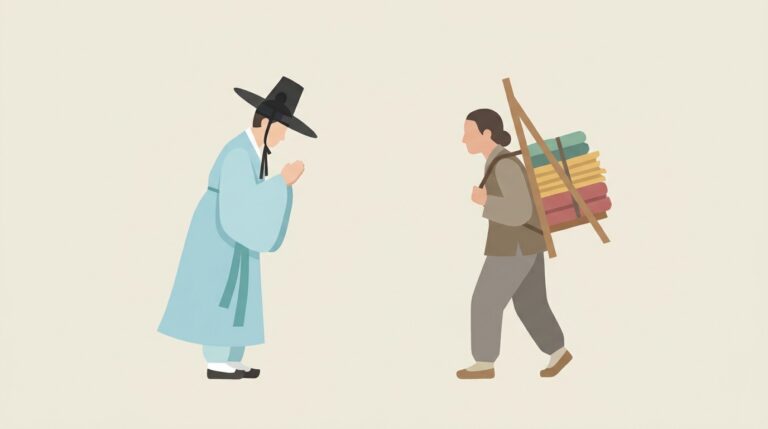
In his revolutionary satirical essay Yedeok Seonsaengjeon (예덕선생전, ‘The Tale of Master Yedeok’), Yeonam took an audacious leap. While aristocrats obsessed over genealogy and ethereal metaphysics, he singled out Eom Haeng-su—a humble laborer whose daily task was shoveling and transporting human night-soil across Hanyang—and christened him a ‘Master’ (선생) of the supreme moral Way (도, Do).
For advanced learners at the C2 level, the challenge is not memorizing ancient dates; it is mastering the sophisticated rhetorical dexterity needed to articulate Beopgochangsin (법고창신)—the craft of honoring classical form while exploding ideological dogma. Many learners stumble here, oscillating between dry textbook phrasing and overly colloquial slang that strips classical critiques of their razor-sharp elegance. Based on years of mentoring senior diplomats, literary translators, and Korean studies scholars, this guide unpacks the precise phrasing, subversive wit, and intellectual depth required to discuss Korean classical literature with true native-level authority.
Phase 2: Core Expressions Deep Dive
1. 법고창신 (法古創新)
- Pronunciation: Beop-go-chang-sin (Think: Bup-go-chahng-sheen, blending crisp plosives with resonant vowels)
- Meaning: ‘Creating the novel while deeply rooted in the ancient’ (Literal: Modeling after the old to innovate the new). It captures the dynamic tension between classical precedent and daring vanguard creativity.
- K-Culture Moment: Used by elite art directors and screenwriters in period-piece interviews (e.g., discussing how modern cinematic techniques reshape historical dramas like Mr. Sunshine or The Red Sleeve).
- Editor’s Insight: Do not confuse this with mere traditional preservation (Jeontong gyesung, 전통 계승). Beopgochangsin requires an element of irreverent rupture—using old canons as launchpads to defy contemporary complacency.
- Situation Spectrum: Casual 🚫 | Semi-formal ⚠️ | Formal ✅
- 🤔 Think About It: How does the Anglo-American tradition of ‘standing on the shoulders of giants’ differ from the East Asian dialectic of transforming classical precedent from within?
2. 예덕 (穢德)
- Pronunciation: Ye-deok (Think: Ye-duck, a soft palatal glide followed by a firm, unreleased final consonant)
- Meaning: ‘Virtue discovered amidst filth’ (Literal: Dirty/foul virtue). It conveys an olfactory paradox: a person engaged in base physical labor whose integrity emits a spiritual fragrance.
- K-Culture Moment: Evoked in modern investigative journalism or social critiques when honoring invisible sanitation workers or frontline manual laborers whose quiet dedication shames corrupt elites.
- Editor’s Insight: This is Yeonam’s supreme satirical weapon. While hypocritical aristocrats (Yangban) reek of moral corruption beneath perfumed robes, Eom Haeng-su’s manual labor is transparent, necessary, and entirely devoid of deceit.
- Situation Spectrum: Casual 🚫 | Semi-formal ⚠️ | Formal ✅
- 🤔 Think About It: Why does olfactory imagery (scent vs. stench) serve as such a devastating metaphor for social hypocrisy across different cultures?
3. 반상의 전복 (班常의 顚覆)
- Pronunciation: Ban-sang-ui jeon-bok (Think: Bahn-sahng-eui jawn-bohk)
- Meaning: ‘The complete subversion of the aristocratic-commoner caste divide’ (Literal: Inversion of Yangban nobility and Sangmin commoners).
- K-Culture Moment: Frequently referenced in modern cinema analysis, notably in reviews discussing Bong Joon-ho’s Parasite or historical films exploring peasant revolts.
- Editor’s Insight: At the C2 level, pair this phrase with verbs like Kkwe-hada (꾀하다, to scheme/aim for) or Chokbalhada (촉발하다, to trigger) to analyze philosophical and socioeconomic revolutions.
- Situation Spectrum: Casual 🚫 | Semi-formal ⚠️ | Formal ✅
- 🤔 Think About It: When a language possesses distinct hierarchical registers embedded in its grammar, how does ideological subversion manifest through speech itself?
Phase 3: Textbook Korean vs. Real Native Korean
Situation 1: Analyzing an author who destroys ideological hypocrisy
- 📖 Textbook Korean: 박지원은 소설을 통해 양반들의 위선을 비판했습니다.
(Bak Ji-won-eun soseol-eul tonghae yangbandeul-ui wiseon-eul bipanhaetseumnida.)
“Pak Chi-won criticized the hypocrisy of the nobility through his novels.” - 🗣️ Real Native Literary Korean: 연암은 특유의 해학과 풍자로 통념의 허를 찌르며 사대부들의 가식을 통렬하게 발가벗겼어요.
(Yeonam-eun teug-yu-ui haehak-gwa pungjaro tongnyeom-ui heoreul jjireumyeo sadaebudeul-ui gasigeul tongryeolhage balgabeotgyeosseoyo.)
“With his signature wit and satire, Yeonam pierced the soft underbelly of conventional wisdom and ruthlessly stripped bare the pretenses of the literati.” - 💡 Why It Differs: Modern literary discourse in Korean relies on vivid sensory idioms (heoreul jjireuda – to strike an unguarded weak spot; balgabeotgida – to strip bare) rather than passive academic labels.
Situation 2: Praising an unsung worker whose labor sustains the community
- 📖 Textbook Korean: 그는 낮은 직업을 가졌지만 매우 훌륭한 사람입니다.
(Geuneun najeun jigeob-eul gajyeotjiman maeu hullyunghan saram-imnida.)
“He has a low job, but he is a very great person.” - 🗣️ Real Native Literary Korean: 세간의 천대 속에서도 묵묵히 제 몫을 다하며 삶의 숭고한 도(道)를 체현하고 있어요.
(Segan-ui cheondae sogeseodo mungmuki je mokseul dahamyeo salm-ui sunggohan doreul chehyeonhago isseoyo.)
“Despite the contempt of the world, he quietly fulfills his station, embodying the sublime philosophical Way in everyday life.” - 💡 Why It Differs: Educated Korean speakers avoid direct, condescending adjectives like najeun jigeop (low job) and instead employ reflective idioms that critique societal prejudice (segan-ui cheondae).
Phase 4: K-Culture Deep Dive & Non-Verbal Manners
4-1. Nunchi & Demeanor: The Rhetoric of Deference and Demeanor
When discussing philosophical works that question social stratification, your physical presence must mirror intellectual humility (Gyeomson, 겸손). In high-level Korean seminars or cultural exchanges:
* The Gaze: Avoid aggressive, unblinking eye contact while dismantling another scholar’s premise. Lower your gaze slightly to mid-chest level when delivering a radical thesis, signaling that your critique is directed at historical constructs, not the listener’s pedigree.
* The Tilt: Accompany nuanced assertions with a slow, contemplative nod (Gogaereul kkeudeog-ida). This conveys that your philosophical conclusions were weighed through rigorous contemplation.
4-2. Cultural Code: The Olfactory Paradox in Korean Storytelling
Pak Chi-won’s Yedeok Seonsaengjeon inaugurated an enduring motif in Korean aesthetics: scent as an index of authentic morality. In the story, Master Yedeok handles excrement, yet Yeonam describes his ethical life as producing an untainted fragrance. Conversely, aristocrats who reek of greed while doused in floral oils are unmasked as fundamentally putrid.
Notice how this identical aesthetic code powers modern Korean masterpieces. In Bong Joon-ho’s Parasite, the subterranean scent of the Kim family becomes the ultimate catalyst for class tension. By mastering Yeonam’s prose, you are unlocking the exact cultural genealogy that contemporary Korean creators draw upon to explore social inequality today.
Phase 5: Real-Life Roleplay Scenario
Setting: A dimly lit traditional teahouse near Sungkyunkwan University. Rain taps against paper screens (Changhoji). You are conversing with Professor Min, an exacting Silhak specialist.
- Professor Min: 연암이 똥거름을 나르는 엄행수를 ‘선생’이라 칭한 것은 단순한 지식인의 유희적 역설에 불과하지 않을까요?
(Yeonam-i ddong-georeum-eul nareuneun Eom Haeng-su-reul ‘seonsaeng’-ira chinghan geoseun dansunhan jisik-in-ui yuhuijeok yeokseor-e bulgwahaji aneulkkayo?)
“Was Yeonam’s designation of Eom Haeng-su, a carrier of dung, as a ‘Master’ merely an intellectual’s playful paradox?”
🎭 [안경을 고쳐 쓰며 날카로운 눈빛으로 반문한다 - Adjusts his glasses and questions sharply] -
You: 단순한 유희로 치부하기엔 그 안에 담긴 ‘법고창신’의 서슬이 너무도 시퍼렇습니다.
(Dansunhan yuhuiro chibuhagien geu ane damgin ‘beopgochangsin’-ui seoseur-i neomudo sipeoreotseumnida.)
“To dismiss it as mere playfulness overlooks the razor-sharp edge of his innovative rhetoric.”
🎭 [찻잔을 두 손으로 감싸 쥐며 단호하게 시선을 맞춘다 - Cups the teacup with both hands and holds a firm gaze] -
Professor Min: 서슬이라니요? 구체적으로 어떤 지점에서 그렇습니까?
(Seoseur-iranyo? Guchejeog-euro eotteon jijeom-eseo geureoseumnikka?)
“A razor-sharp edge? At what precise juncture do you see that?”
🎭 [흥미롭다는 듯 찻잔을 내려놓는다 - Sets down his cup with growing intrigue] -
You: 엄행수의 불의불취(不義不取)하는 삶을 빌려, 사대부들의 헛된 명분론을 밑바닥부터 뒤흔들었기 때문입니다.
(Eom Haeng-su-ui buruibulchwi-haneun salm-eul billyeo, sadaebudeul-ui heotdoen myeongbunroneul mitbadakbuteo dwiheundeureotgi ddaemun-imnida.)
“Because through Eom Haeng-su’s life of refusing unearned gain, he shook the empty moralizing of the literati to its foundations.”
🎭 [차분하지만 확신에 찬 목소리로 강조한다 - Emphasizes in a calm yet utterly convinced tone] -
Professor Min: 그렇다면 자네는 예덕선생전이 당대 신분제를 전면 부정했다고 보는 겐가?
(Geureotdamyeon jane-neun Yedeok-seonsaeng-jeon-i dangdae sinbunje-reul jeonmyeon bujeonghaetdago boneun genga?)
“Do you then argue that the Tale of Master Yedeok was a wholesale rejection of the contemporary caste system?”
🎭 [눈을 가늘게 뜨고 논리적 허점을 시험하듯 묻는다 - Narrows his eyes, testing for logical vulnerabilities] -
You: 전면적 체제 전복이라기보다는, 도덕적 실천이 거세된 신분의 허구성을 폭로한 내적 해체에 가깝습니다.
(Jeonmyeonjeok cheje jeonbog-iragibodaneun, dodeokjeok silcheon-i gesedoen sinbun-ui heoguseong-eul pongnohan naejeok haeche-e gakkapseumnida.)
“Rather than an overt overthrow of the regime, it is an internal deconstruction that exposed the absurdity of caste stripped of ethical practice.”
🎭 [고개를 미세하게 끄덕이며 차분히 논리를 펼친다 - Nods slightly while laying out the argument with precision] -
Professor Min: 허구성을 폭로한 내적 해체라… 아주 흥미로운 통찰이군.
(Heoguseong-eul pongnohan naejeok haeche-ra… Aju heungmiroun tongchar-igun.)
“An internal deconstruction exposing absurdity… A remarkably astute insight.”
🎭 [미소를 머금으며 만족스러운 듯 고개를 끄덕인다 - Smiles slightly and nods with genuine approval] -
You: 결국 가장 낮은 곳에서 가장 맑은 도를 발견하는 역발상이야말로 연암 문학의 정수이지요.
(Gyeolguk gajang najeun goseseo gajang malgeun doreul balgyeonhaneun yeokbalsang-iyamalro Yeonam munhag-ui jeongsu-ijiyo.)
“Ultimately, that counter-intuitive vision of locating the purest Way in the lowliest corner is the true quintessence of Yeonam’s literature.”
🎭 [찻잔을 들어 예를 표하며 마무리 짓는다 - Raises the teacup in a respectful concluding toast]
🔀 Interactive Decision Branch
What would you say if Professor Min pushed you on whether Yeonam advocated for an immediate peasant revolution?
* Option A: 연암은 마르크스주의자처럼 계급 투쟁을 선동한 것입니다! (Yeonam-eun mareukseuju-uijacheoreom gyegeup tujaeng-eul seondonghan geosimnida!)
👉 Feedback [Risk]: Highly anachronistic. Forcing 19th-century European dialectical materialism onto an 18th-century Silhak thinker diminishes the historical specificity of Yeonam’s Confucian reformism.
* Option B: 연암은 체제 붕괴를 꿈꾸기보다는, 양반 계층의 통렬한 자기반성과 도덕적 각성을 촉구한 개혁론자였습니다. (Yeonam-eun cheje bunggoereul kkumkkugibodaneun, yangban gyecheung-ui tongryeolhan jagibanseong-gwa dodeokjeok gakseong-eul chokguhan gaehyeongnonja-yeosseumnida.)
👉 Feedback [Best]: Demonstrates flawless C2 historical nuance. It respects the classical boundaries while accentuating Yeonam’s radical reformist agenda.
* Option C: 솔직히 옛날이야기일 뿐이니 현대 사회와는 별 상관이 없지 않을까요? (Soljikhi yennari-yagi-il ppun-ini hyeondae sahoewaneun byeol sanggwan-i eopji aneulkkayo?)
👉 Feedback [Bad]: Fatal conversation-ender. It shatters the intellectual rapport and dismisses the continuity of Korean philosophical thought.
Phase 6: 10-Second Emotion Shadowing Drill
Practice reading these rhythmically marked lines aloud, honoring the pause slashes (/) and capturing the indicated intellectual register.
[🔥 지적이고 당당하게 - Confident, intellectual assertiveness]
가장 비천한 노동 속에서 / 천하의 대도(大道)를 발견하는 통찰이야말로 / 연암 산문의 백미입니다.
(Gajang bicheonhan nodong sogeseo / cheonha-ui daedo-reul balgyeonhaneun tongchar-iyamalro / Yeonam sanmun-ui baengmi-imnida.)
“The insight that discovers the great Way of the cosmos / within the lowliest labor / is indeed the crown jewel of Yeonam’s prose.”-
[🌿 차분하고 깊은 울림으로 - Calm, contemplative depth]
겉치레에 눈먼 사대부의 향기보다 / 정직하게 땀 흘리는 이의 거름 냄새가 / 진정으로 향기롭지 않습니까?
(Geotchi-ree nunmeon sadaebu-ui hyanggiboda / jeongjikhage ttam heullineun i-ui georeum naemsaega / jinjeong-euro hyanggiropji anseumnikka?)
“Is not the scent of honest manure from one who sweats in integrity / infinitely more fragrant / than the vanity of aristocrats blinded by superficiality?” -
[⚡ 단호하고 통찰력 있게 - Resolute and incisive]
옛것을 본받되 변화를 꾀하고 / 새로움을 짓되 근본을 잃지 않는 것, / 이것이 바로 법고창신의 길입니다.
(Yetgeoseul bonbatdoe byeonhwareul kkwe-hago / saeroumeul jitdoe geunboneul ilji anneun geot, / igeosi baro beopgochangsin-ui girimnida.)
“To model after antiquity while orchestrating transformation / and to craft novelty without severing fundamental roots— / that is the precise path of Beopgochangsin.”
Phase 7: K-Culture Mini Dictionary
- 실학 (實學, Silhak): ‘Practical Learning.’ A late Joseon intellectual movement emphasizing empirical science, commercial pragmatism, and structural social critique against dogmatic Neo-Confucian metaphysics.
- 불의불취 (不義不取, Bul-ui-bul-chwi): ‘Refusing to take what is not earned through righteousness.’ In Yedeok Seonsaengjeon, Eom Haeng-su epitomizes this by never demanding more than his rightful daily wage for cleaning outhouses.
- 엄행수 (嚴行首, Eom Haeng-su): The protagonist of Yeonam’s essay. Haeng-su denotes an elder or head among manual guilds; Yeonam elevates this lowest laborer to a philosophical lodestar for the entire nation.
- 지기지우 (知己之友, Jigi-ji-u): ‘A kindred spirit who truly knows one’s heart.’ Pak Chi-won uses this concept to demonstrate that authentic friendship transcends the rigid walls of caste and material wealth.
Phase 8: Traveler’s Survival Kit for Literary Pilgrims
Top 3 Intellectual Survival Phrases
- 연암 박지원 선생의 친필본이나 관련 목판본을 열람할 수 있을까요?
(Yeonam Bak Ji-won seonsaeng-ui chinpilbon-ina gwanryeon mokpanboneul yeolramhal su isseulkkayo?)
Pro Tip: Essential when visiting specialized rare-book archives at national university libraries. - 조선 후기 실학파 산문의 수사학적 특징을 다룬 도서가 어디에 있나요?
(Joseon hugi silhakpa sanmun-ui susahakjeok teukjingeul dareun doseoga eodi-e innayo?)
Pro Tip: Perfect for navigating the towering aisles of Kyobo Book Centre in Gwanghwamun. - 이 소설에서 신분 전복적 복선이 드러나는 결정적 대목은 어디인가요?
(I soseoreseo sinbun jeonbokjeok bokseon-i deureonaneun gyeoljeongjeok daemog-eun eodi-ingnayo?)
Pro Tip: Ideal for breaking the ice during graduate literature seminars or cultural colloquiums.
Editor’s Travel Note
When tracing Yeonam’s intellectual footprint in Seoul, set your compass to Jongno and the Kyujanggak Institute for Korean Studies at Seoul National University. To explore the historic neighborhoods where Northern Learning (Bukhak, 북학) scholars once gathered, download the navigation tool via the Naver Map app official store portal. Use it to plot a walking tour starting from Pagoda Park (the historic site of Tapgol where the White Pagoda Circle convened) through the tranquil backstreets of Wonseo-dong.
Phase 9: Going One Step Deeper
Language is never an innocent bystander to class structure. The Korean speech register system (Nopimmal and Banmal) crystallizes centuries of relational hierarchy. When Pak Chi-won applied the reverent honorific Seonsaeng (선생) to a human manure carrier, he was staging an ontological insurrection within the syntax of Sino-Korean prose. By dismantling the linguistic equivalence between high birth and moral elevation, he exposed a radical truth: integrity is an active ethical praxis, not an inherited social title. In our own hyper-stratified digital age, where algorithms quantify human worth by prestige and metrics, Yeonam’s counter-intuitive gaze compels us to re-examine who we celebrate as teachers.
💬 Your Turn: Which unsung professions in modern society do you believe embody the noble Way (Do) that institutional elites have forgotten? Share your perspective in Korean in the comments below!
Phase 10: Structured FAQ & Common Mistakes
Q: Why did Joseon authorities view Pak Chi-won’s prose style (Munche) as dangerous?
A: King Jeongjo initiated the Munche Banjeong (문체반정, Literary Style Rectification) because Yeonam discarded orthodox Neo-Confucian sentence structures in favor of vernacular rhythms, vulgar slang, and street-level parables. Authorities feared this stylistic informality would unravel the ideological foundations of the state.
Q: Is Yedeok Seonsaengjeon written in pure Korean Hangul or Classical Chinese?
A: It was written in Hanmun (Classical Sino-Korean), which makes its thematic content even more astonishing. Yeonam weaponized the very elite script used by the ruling class to celebrate a night-soil collector and lampoon those same ruling elites.
Q: How does Beopgochangsin differ from mere Western postmodern parody?
A: While postmodern parody often destabilizes all foundations without providing an ethical anchor, Beopgochangsin insists on deep reverence for foundational roots (Beopgo). It seeks revitalization rather than nihilistic destruction.
🚨 Common Mistakes Warning Board
- Mistake: Using Ha-da-che (해라체) abruptly when debating classical literature with native professors.
Correct Action: Always frame your literary arguments using the polished formal deference of Hao-che or Hapsio-che (~라고 사료됩니다, “It is considered that…”). - Mistake: Translating ‘Yedeok’ (穢德) simply as ‘filthiness.’
Correct Action: Recognize it as an intentional oxymoron meaning ‘virtue born of uncorrupted, humble toil.’ - Mistake: Assuming Silhak thinkers completely rejected Confucianism.
Correct Action: Frame them as internal reformers seeking to recover the pristine moral urgency of original Confucian texts from later scholastic sclerosis.
Phase 11: Action Missions
- Bronze Level: Record yourself reading Phase 6’s Shadowing Drill 3 times, paying strict attention to breath control and the rhythm of the slashes (
/). - Silver Level: Write a 3-sentence book reflection on Instagram using the terms 법고창신, 역발상, and 묵묵히, and tag
#DailyHangulLiterature. - Gold Level: Attend a Korean literary discussion circle or post on a Korean humanities forum analyzing how modern Korean cinema uses scent as a metaphor for social caste.
- 🎮 K-Culture Mission: Watch an episode of a period K-Drama (such as Under the Queen’s Umbrella or Tree With Deep Roots) and spot the exact moment an aristocratic character is intellectually outwitted by an artisan or commoner.
Phase 12: Interactive Quiz Challenge
1. Situational Judgment
When describing an intellectual who takes traditional Korean pottery methods and applies them to futuristic industrial design, which idiom is the most culturally and stylistically refined?
* (A) 온고지신은 되지만 너무 진부해요.
* (B) 전통의 법고창신을 이룩하여 현대적 조형미로 승화시켰군요.
* (C) 옛날 방식을 그냥 그대로 베낀 것에 불과합니다.
2. Fill in the Blank
연암 박지원은 겉으로는 화려하나 속은 썩은 양반들보다, 똥거름을 치우며 자신의 분수를 지키는 엄행수에게서 참된 ( )을/를 발견했다.
3. Cultural True or False
True or False: The Joseon royal court enthusiastically embraced Yeonam’s innovative writing style and subsidized the mass publication of The Tale of Master Yedeok across public academies.
Click to reveal answers & explanations
-
Answer: (B)
Explanation: Option (B) captures the highest level of intellectual elegance, properly framing Beopgochangsin as an artistic sublimation (seunghwa) rather than static repetition. -
Answer: 예덕 (穢德)
Explanation: ‘Ye-deok’ (Virtue born amidst foulness) is the exact title and conceptual core of the essay, expressing moral purity within manual labor. -
Answer: False
Explanation: King Jeongjo launched the Literary Style Rectification (Munche Banjeong) specifically to suppress Yeonam’s satirical, free-wheeling prose, viewing it as a threat to ideological orthodoxy.







