

Clear Your Mind: How ‘Morning Pages’ and Mindful Korean Phrases Beat Burnout
Phase 1: Empathy & Storytelling Opening
안녕하세요! 매일한글 에디터입니다. (Hello! This is your Daily Hangul editor.) Have you ever woken up in your Seoul officetel or your home bedroom, feeling like your brain is a browser running 50 tabs at once? You stare blankly at your phone screen while K-drama characters in My Liberation Notes talk about feeling exhausted by everyday life, and you murmur to yourself, “I have zero energy.” In South Korea’s vibrant yet high-speed society, where everyone strives for God-saeng (diligent living), experiencing 번아웃 (burnout) and 무기력증 (lethargy) is an all-too-common silent battle.
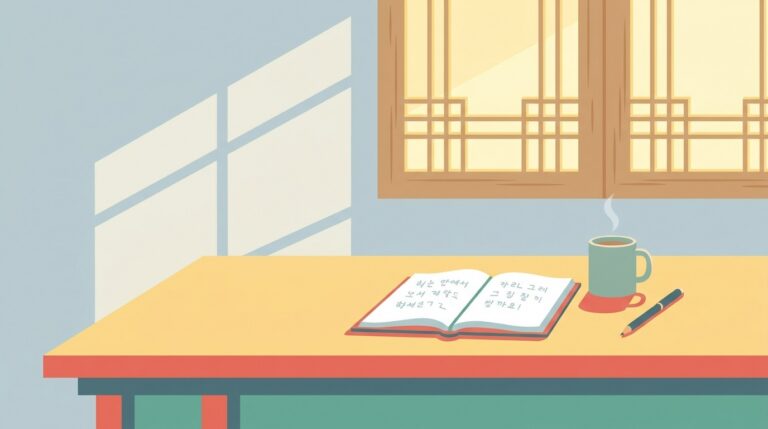
A few years ago, when our tutoring team was overwhelmed with lesson preparations, a student named Sarah shared a life-changing tip with us: “머릿속을 복잡하게 만드는 생각들을 노트에 있는 그대로 다 적어 내려가는 ‘모닝 페이지’ 글쓰기가 큰 도움이 됐어요” (Writing morning pages—pouring out tangled thoughts onto paper without judgment—helped immensely). By putting pen to paper every sunrise, she didn’t just regain her calm; she unlocked a whole new vocabulary of emotional self-care in Korean. This guide is crafted from real student breakthroughs to help you articulate your mental fatigue, discover solace in morning journaling, and express your emotional journey smoothly in intermediate Korean.
Phase 2: Core Expressions Deep Dive
1. 머릿속이 복잡하다 (Meoritsogi bokjaphada)
- Pronunciation: [Meo-rit-sso-gi bok-jap-ha-da] (Think of meorit like “merit” with a soft ‘t’, and bok-jap like “pork-chop” with a crisp ‘b’ sound).
- Meaning: Literally “The inside of the head is complicated”; naturally translates to “My head is full of thoughts” or “My mind is tangled.”
- K-Culture Moment: Commonly heard in workplace dramas like Misaeng, when an overwhelmed rookie sits on the company rooftop holding a can of warm coffee, sighing before a major presentation.
- Editor’s Insight: While English speakers say “I’m stressed,” Koreans often describe the physical sensation of mental clutter as 머릿속이 복잡하다. It implies an internal tangle rather than external aggression.
- Situation Spectrum:
- Casual (to close friends): 머릿속이 너무 복잡해. (✅)
- Semi-formal (colleagues): 요즘 머릿속이 좀 복잡해요. (✅)
- Formal (business meeting): 머릿속이 복잡합니다. (⚠️ – slightly too personal for formal reporting unless sharing deep reflections).
- 🤔 Think About It: In English, we often say “I have a headache” or “I’m stressed out.” Why do you think Korean specifically visualizes the inside of the skull (머릿속) as a crowded, intricate maze?
2. 있는 그대로 적어 내려가다 (Inneun geudaero jeogeo naeryeogada)
- Pronunciation: [In-neun geu-dae-ro jeo-geo nae-ryeo-ga-da] (Flow smoothly: in-neun rhymes with “in noon”, geudaero sounds like “good day-row”).
- Meaning: Literally “To write down descending just as it is”; naturally means “To pour onto paper freely without filter or judgment.”
- K-Culture Moment: Used by journaling YouTubers and indie essay authors in Hongdae when discussing therapeutic journaling and unfiltered stream-of-consciousness writing.
- Editor’s Insight: The auxiliary verb phrase -어 내려가다 emphasizes a continuous, cascading downward motion—just like ink flowing uninterrupted down a crisp notebook page.
- Situation Spectrum:
- Casual: 그냥 있는 그대로 적어 내려가 봐. (✅)
- Semi-formal: 생각을 있는 그대로 적어 내려가는 편이에요. (✅)
- Formal: 솔직한 감정을 있는 그대로 적어 내려갔습니다. (✅)
- 🤔 Think About It: Notice how Korean attaches spatial verbs (-내려가다 / to go down) to writing. How does this spatial mental image change your approach to journaling compared to simply saying “write it down”?
3. 큰 도움이 되다 (Keun doumi doeda)
- Pronunciation: [Keun do-um-i doe-da] (Keun sounds like “coon” but with a flat, relaxed ‘eu’; doum sounds like “dough-oom”).
- Meaning: Literally “To become a big help”; naturally means “To help immensely” or “To be a game-changer.”
- K-Culture Moment: Found in celebrity interview segments on shows like You Quiz on the Block, where guests reflect on rituals that saved their sanity during dark periods.
- Editor’s Insight: Instead of repeatedly using the verb 돕다 (to help), using noun + 되다 (도움이 되다) sounds significantly more natural, humble, and mature for B1 learners.
- Situation Spectrum:
- Casual: 그거 진짜 큰 도움 됐어! (✅)
- Semi-formal: 모닝 페이지가 정말 큰 도움이 됐어요. (✅)
- Formal: 이번 프로젝트에 큰 도움이 되었습니다. (✅)
- 🤔 Think About It: Why does Korean prefer expressing that an action “became a help” rather than directly saying “it helped me”? Notice the subtle focus on the resulting state.
Phase 3: Textbook Korean vs. Real Korean
Situation 1: Describing feeling utterly drained and lethargic
- 📖 교과서 한국어 (Textbook): 저는 요즘 피곤해서 아무것도 하고 싶지 않습니다. (Jeo-neun yo-jeum pi-gon-hae-seo a-mu-geot-do ha-go sip-ji an-seumnida. / “Because I am tired lately, I do not want to do anything.”)
- 🗣️ 진짜 한국어 (Real-life): 요즘 완전 번아웃 와서 무기력증이 심해요. (Yo-jeum wan-jeon beon-a-ut wa-seo mu-gi-ryeok-jjeung-i sim-hae-yo. / “Lately burnout hit me completely, so my lethargy is pretty bad.”)
- 💡 왜 다를까?: Native speakers describe mental fatigue as external states arriving or “coming over” them (번아웃이 오다), acknowledging conditions like 무기력증 (lethargy) with emotional clarity rather than mere physical tiredness (피곤하다).
Situation 2: Explaining how you write your thoughts out
- 📖 교과서 한국어 (Textbook): 공책에 제 생각들을 전부 씁니다. (Gong-chae-ge je saeng-gak-deul-eul jeon-bu sseum-ni-da. / “I write all my thoughts in a notebook.”)
- 🗣️ 진짜 한국어 (Real-life): 복잡한 머릿속을 비우려고 노트에 다 털어놓고 있어요. (Bok-jap-han meo-rit-so-geul bi-u-ryeo-go no-teu-e da teol-eo-noh-go iss-eo-yo. / “To empty my cluttered head, I’m pouring everything out onto my notebook.”)
- 💡 왜 다를까?: The verb 털어놓다 literally means “to shake out and place down.” It captures the raw relief of unburdening your soul on paper, making your Korean sound deep and emotionally expressive.
Phase 4: K-Culture Deep Dive & Non-Verbal Manners
4-1. 눈치 (Nunchi) & Emotional Gestures
When discussing burnout and emotional struggles in Korean, non-verbal delivery is crucial:
* Lowered Gaze and Gentle Sigh (가벼운 한숨): Don’t proclaim your burnout loudly like an office announcement. Lower your pitch, take a brief breath, and slightly tilt your head downward. This demonstrates modesty and signals vulnerability.
* Hand on Heart or Temple: Placing two fingers against your temple when saying 머릿속이 복잡해요 (My head is tangled) physically mirrors your inner world and invites empathetic active listening (공감).
* The Two-Handed Hold: If a friend shows you their morning pages or journal, hold the edges with both hands to show deep respect for their personal private space (사생활).
4-2. Cultural Code: ‘갓생’ (God-saeng) vs. ‘힐링’ (Healing)
Modern Korean society is fueled by the pursuit of 갓생 (a portmanteau of English “God” and Korean saeng meaning “life”)—striving to live an ultra-productive, disciplined life with 5 AM routines and continuous self-improvement. However, this high pressure frequently triggers sudden 번아웃 (burnout) and 무기력증 (lethargy). In response, the Korean stationery and wellness culture has exploded with “다꾸” (diary decorating), “모닝 루틴” (morning routines), and mindful journaling. Sharing that you do morning pages shows you value mindful self-regulation amidst the societal rush.
Phase 5: Real-Life Roleplay Scenario
- Setting: A quiet, plant-filled cafe in Yeonnam-dong on a rainy Saturday afternoon.
- Characters:
- 민서 (Minseo): A talented UI/UX designer friend who has been looking completely exhausted from overtime work.
- You (학습자): A caring friend offering thoughtful advice over warm sweet potato lattes.
Dialogue:
1. 민서: 요즘 회사 일 때문에 진짜 멘탈이 나갈 것 같아. (Yo-jeum hoe-sa il ttae-mun-e jin-jja men-tal-i na-gal geot gat-a.)
* 🎭 Sighs deeply, staring down at her untouched latte.
* (“Work has been so crazy lately, I feel like I’m losing my mind.”)
2. You: 많이 힘들지? 얼굴 보니까 번아웃이 온 것 같아서 걱정돼. (Man-i him-deul-ji? Eol-gul bo-ni-kka beon-a-ut-i on geot gat-a-seo geok-jeong-dwae.)
* 🎭 Nods slowly with an empathetic gaze.
* (“It’s tough, right? Seeing your face, I’m worried you’ve hit burnout.”)
3. 민서: 맞아, 아침에 눈뜨면 무기력해서 침대에서 일어나기도 힘들어. (Mat-a, a-chim-e nun-tteu-myeon mu-gi-ryeok-hae-seo chim-dae-e-seo il-eo-na-gi-do him-deul-eo.)
* 🎭 Rubs her temples in frustration.
* (“Exactly. When I wake up, I feel so lethargic it’s hard to even get out of bed.”)
4. You: 나도 지난달에 머릿속이 너무 복잡해서 고생했거든. (Na-do ji-nan-dal-e meo-rit-so-gi neo-mu bok-jap-hae-seo go-saeng-haet-geo-dun.)
* 🎭 Places hand on chest gently, sharing mutual experience.
* (“I struggled with a really cluttered head last month too.”)
5. 민서: 그래? 넌 그때 그 무기력증을 어떻게 극복했어? (Geu-rae? Neon geu-ttae geu mu-gi-ryeok-jjeung-eul eo-tteoh-ge geuk-bok-haess-eo?)
* 🎭 Looks up curiously, eager for a solution.
* (“Really? How did you overcome that lethargy back then?”)
6. You: 머릿속을 복잡하게 만드는 생각들을 노트에 있는 그대로 다 적어 내려가는 ‘모닝 페이지’ 글쓰기가 큰 도움이 됐어. (Meo-rit-so-geul bok-jap-ha-ge man-deu-neun saeng-gak-deul-eul no-teu-e in-neun geu-dae-ro da jeog-eo nae-ryeo-ga-neun ‘mo-ning pe-i-ji’ geul-sseu-gi-ga keun do-um-i dwaess-eo.)
* 🎭 Smiles warmly, taking out a small worn notebook to demonstrate.
* (“Writing morning pages—pouring out all the tangled thoughts onto a notebook just as they are—helped immensely.”)
7. 민서: 그냥 필터 없이 막 쓰는 건데도 정리가 돼? (Geu-nyang pil-teo eop-si mak sseu-neun geon-de-do jeong-ri-ga dwae?)
* 🎭 Leans in with widening eyes.
* (“Even if you just write without filtering, does it really clear your head?”)
8. You: 응, 마음속 찌꺼기를 종이에 버리는 느낌이라 머리가 맑아져. (Eung, ma-eum-sok jji-kkeo-gi-reul jong-i-e beo-ri-neun neu-kkim-i-ra meo-ri-ga malg-a-jyeo.)
* 🎭 Taps the notebook lightly with a pen tip.
* (“Yeah, it feels like tossing emotional residue onto the paper, so your mind clears up.”)
🔀 Interactive Choice Point
How would you invite Minseo to try it with you tomorrow morning?
* Option A: “내일 아침에 모닝 페이지 10분만 같이 써 볼래? 내가 모닝콜 해줄게!” (Nae-il a-chim-e mo-ning pe-i-ji sip-bun-man gat-i sseo bol-lae? Nae-ga mo-ning-kol hae-jul-ge!)
* Feedback: Best! Friendly, supportive, and action-oriented without being intrusive. Shows warm jeong (affection).
* Option B: “너 게으르면 평생 번아웃 못 고쳐. 내일부터 무조건 써.” (Neo ge-eu-reu-myeon pyeong-saeng beon-a-ut mot go-chyeo. Nae-il-bu-teo mu-jo-geon sseo.)
* Feedback: Bad. Accusing someone suffering from burnout of being lazy (게으르다) damages rapport and shows a lack of empathy.
* Option C: “선생님, 노트를 구매하여 매일 아침 글을 쓰십시오.” (Seon-saeng-nim, no-teu-reul gu-mae-ha-yeo mae-il a-chim geul-eul sseu-sip-si-o.)
* Feedback: Risk. Overly robotic, rigid honorifics (선생님 / -십시오) sound alienating between close friends in a café.
Phase 6: 10-Second Emotion Shadowing Drill
Read these lines aloud, following the pauses (/) and matching the emotional cues:
[😮💨 한숨 쉬며 솔직하게 고백하듯]- 머릿속이 너무 복잡해서 / 요즘 아침마다 / 멍하니 앉아 있었어요.
- (Meo-rit-so-gi neo-mu bok-jap-hae-seo / yo-jeum a-chim-ma-da / meong-ha-ni an-ja iss-eoss-eo-yo.)
- “Because my head was so tangled / every morning lately / I was just sitting blankly.”
[✍️ 담담하고 편안한 어조로]- 있는 그대로 / 다 적어 내려가다 보면 / 마음이 한결 가벼워져요.
- (In-neun geu-dae-ro / da jeog-eo nae-ryeo-ga-da bo-myeon / ma-eum-i han-gyeol ga-byeo-wo-jyeo-yo.)
- “When pouring everything down / just as it is / your heart feels noticeably lighter.”
[✨ 확신에 차서 밝게 추천하며]- 번아웃을 극복하는 데 / 모닝 페이지 쓰기가 / 정말 큰 도움이 됐어요!
- (Beon-a-ut-eul geuk-bok-ha-neun de / mo-ning pe-i-ji sseu-gi-ga / jeong-mal keun do-um-i dwaess-eo-yo!)
- “In overcoming burnout / writing morning pages / was genuinely a huge help!”
Phase 7: K-Culture Mini Dictionary
- 번아웃 (Beon-a-ut): The Korean phonetic loanword for “burnout.” Widely used across Korean companies, universities, and social media to describe emotional exhaustion and cynicism from prolonged overwork.
- 무기력증 (Mu-gi-ryeok-jjeung): Pure Sino-Korean noun (無氣力症: no-energy-state). It refers to the physical and mental state of lacking the will or stamina to start even simple tasks.
- 모닝 페이지 (Mo-ning Pe-i-ji): The popularized stream-of-consciousness journaling technique (originally from The Artist’s Way by Julia Cameron), now a core trend among Korean self-care creators.
- 멘탈 케어 (Men-tal Ke-eo): English-derived Korean slang meaning “mental wellness management.” Koreans frequently speak of “멘탈 관리” (mental control) or “멘탈 케어” when describing mindfulness practices.
Phase 8: Traveler’s Survival Kit
Top 3 Survival Phrases for Quiet Cafes & Stationery Shopping
- 혹시 조용히 글쓰기 좋은 자리 있을까요? (Hok-si jo-yong-hi geul-sseu-gi jo-eun ja-ri iss-eul-kka-yo?)
- Pro Tip: Use this when entering cozy cafes in Bukchon or Hapjeong to find a corner desk with power outlets.
- 줄 없는 무지 노트 어디에 있어요? (Jul eop-neun mu-ji no-teu eo-di-e iss-eo-yo?)
- Pro Tip: “무지 노트” (blank page notebook) is essential for unfiltered morning pages without grid constraints.
- 마음이 복잡할 때 읽기 좋은 책 추천해 주실 수 있나요? (Ma-eum-i bok-jap-hal ttae ilk-gi jo-eun chaek chu-cheon-hae ju-sil su inn-a-yo?)
- Pro Tip: Independent Korean bookstore owners in Yeonnam-dong love answering this with hidden essay gems!
Editor’s Travel Note
When in Seoul, recharge your mental batteries by visiting the massive stationery floor at Kyobo Book Centre Gwanghwamun or curated lifestyle shops in Hongdae like Object. Before heading out, plan your relaxing walking route through quiet alleys using the Naver Map App navigation guide instead of international map apps, which often lack accurate pedestrian walking shortcuts in Korea.
Phase 9: “One Step Deeper” (Cultural Reflection)
In Korean culture, communal solidarity has historically triumphed over individual vulnerability. For generations, phrases like “힘내!” (Cheer up / muster strength!) were the default response to exhaustion. Yet today, Korean youth are shifting the conversation: recognizing that relentless striving without pause breeds deep internal fracture.
By saying, “머릿속을 있는 그대로 적어 내려가는 연습이 필요해요” (We need practice writing down our thoughts as they are), you align with a contemporary Korean cultural movement that values emotional honesty over performative perfection. Embracing your limits is no longer seen as defeat—it is respected as mature self-mastery.
💬 Your Turn: What ritual clears your mind when your thoughts become tangled? Have you ever tried writing in Korean when journaling? Share your thoughts below in the comments!
Phase 10: FAQ & Avoiding Misunderstandings
Q: Can I use “도움이 되다” when asking for someone’s help?
A: Be careful! “도움이 되다” means to be helpful or to become a help. If you want to request help from someone, say “도와주실 수 있나요?” (Could you help me?) or “도움 부탁드립니다” (I ask for your help). Save “큰 도움이 됐어요” for thanking someone after their advice made a real difference!
Q: Is “번아웃” considered an official medical term in Korean clinics?
A: While psychiatrists understand “번아웃 증후군” (Burnout Syndrome), clinical forms will more formally categorize it under 만성 피로 (chronic fatigue), 우울감 (depressive feelings), or 스트레스 장애 (stress disorder). In conversation, however, 번아웃 is universally understood by all generations under 50.
Q: Why do we say “적어 내려가다” instead of just “적다”?
A: Adding “-어 내려가다” injects vivid visual motion and rhythm into the action. “적다” simply means to write a note, whereas “적어 내려가다” paints a cinematic picture of continuous, fluid writing from top to bottom of a page.
🚨 흔한 실수 (Common Mistakes) Warning Board
- Mistake: Saying “제 머리가 복잡해요” (My hair is complicated).
- Correct Action: Always use 머릿속이 복잡해요 (The inside of my head is tangled). “머리” alone can ambiguously refer to your physical hairstyle!
- Mistake: Saying “생각을 버리다” when you mean unloading thoughts on paper.
- Correct Action: Say 생각을 털어놓다 (pour out/confide thoughts) or 생각을 비우다 (empty out thoughts). “생각을 버리다” sounds like you are abandoning ideas forever.
- Mistake: Saying “도움이 많이 했어요” (I did a lot of help).
- Correct Action: Say 큰 도움이 됐어요 (It became a big help) or 많은 도움이 되었어요.
Phase 11: Action Missions & Engagement
- 🥉 Bronze Mission (Solo Practice): Take out a blank notebook right now. Write down today’s top 3 lingering worries in raw, simple Korean using the pattern: “[사건/생각] 때문에 머릿속이 복잡하다.”
- 🥈 Silver Mission (Social Challenge): Post a photo of your morning coffee and journal on Instagram with the caption: “아침마다 생각을 있는 그대로 적어 내려가는 중! #모닝페이지 #멘탈케어”
- 🥇 Gold Mission (Real Interaction): In your next Korean conversation class or language exchange, explain how you handle stress using our full key sentence: “머릿속을 복잡하게 만드는 생각들을 노트에 다 적어 내려가는 것이 저에게 큰 도움이 돼요.”
- 🎮 K-Culture Mission: Watch an episode of a healing Korean slice-of-life drama (like Summer Strike or Daily Dose of Sunshine) and listen for when characters confess feeling exhausted using terms like 무기력하다 or 털어놓다.
Phase 12: Interactive Quiz Challenge
Test your knowledge from today’s masterclass! Pick your answers, then check the explanations below.
Q1. (Situational Judgment) Your Korean friend looks totally drained at work and whispers that they have no motivation. What is the most natural and compassionate thing to say?
* A) 왜 일을 안 해요? 게으르면 안 돼요.
* B) 요즘 많이 힘들죠? 번아웃이 온 것 같아서 걱정돼요.
* C) 저에게 큰 도움이 되십시오.
Q2. (Fill in the Blank) Choose the correct particle and verb pair:
“복잡한 생각들을 공책에 있는 그대로 적어 ________ 큰 도움이 됐어요.”
* A) 올라가서
* B) 내려가는 것이
* C) 버리는 것을
Q3. (True or False) In natural Korean, saying “머리가 복잡해요” is always better and more accurate than saying “머릿속이 복잡해요.”
* A) True
* B) False
👉 Click to view answers and explanations
- Q1 Answer: B
- Explanation: Option B expresses gentle, perceptive concern (Nunchi) without blame. Option A is offensive, and Option C is grammatically incorrect nonsense.
- Q2 Answer: B (내려가는 것이)
- Explanation: The grammatical pattern is “[동사]는 것이 큰 도움이 되다” (Doing [verb] helped immensely), and “적어 내려가다” is the exact expression for writing continuously down a page.
- Q3 Answer: B (False)
- Explanation: “머릿속이 복잡해요” (inside the head is tangled) is the standard, natural expression for mental clutter. “머리가 복잡하다” is colloquial, but “머릿속” prevents any silly misunderstanding regarding your hair!
- Explanation: “머릿속이 복잡해요” (inside the head is tangled) is the standard, natural expression for mental clutter. “머리가 복잡하다” is colloquial, but “머릿속” prevents any silly misunderstanding regarding your hair!







