

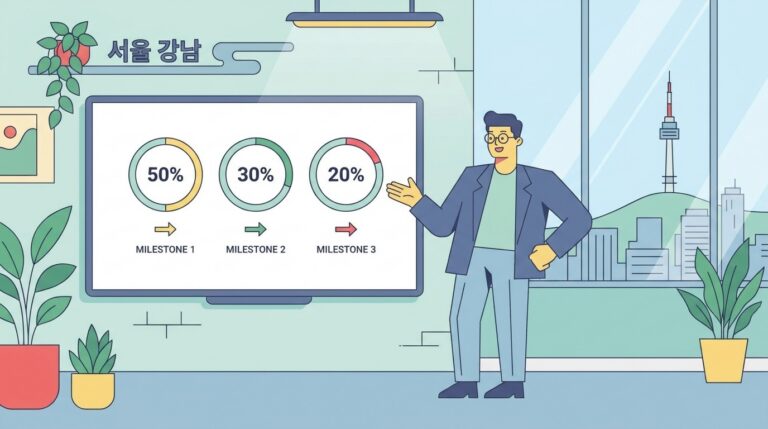
Phase 1: Empathy & K-Culture Immersion
안녕하세요! 매일한글 에디터입니다. Have you ever watched the hit drama Start-Up (스타트업) and felt your heart race during the IR pitch battles at Sandbox? Picture this: You are standing in a sleek, glass-walled conference room on Teheran-ro in Gangnam—Seoul’s bustling Silicon Valley. Across the table, a seasoned Korean venture capitalist leans back, sips their iced Americano, flips through your slide deck, and asks with sharp eyes: “So, how exactly will you deploy this investment round?”
If you translate word-for-word from English, your explanation can sound mechanical, rigid, or detached. Explaining capital deployment—allocating 50% for core developer hiring, 30% for global marketing expansion, and 20% for infrastructure scaling—requires professional precision, high conviction, and cultural nuance. Today’s guide draws directly from real-world pitch coaching sessions with cross-border tech entrepreneurs. Let’s master the exact vocabulary and tone that earn trust and term sheets from Korean investors!
Phase 2: Core 3 Expressions Deep Dive
1. 확보된 투자금은 핵심 인력 채용과 마케팅에 집중 투입할 계획입니다
- Pronunciation: Hak-bo-doen tu-ja-geum-eun haek-sim in-ryeok chae-yong-gwa ma-ke-ting-e jip-jung tu-ip-hal gye-hoek-im-ni-da. (Say it like: Hahk-bo-dwen too-jah-geum-oon hack-seem een-ryuk chae-yong-gwa mah-keh-ting-eh jeep-joong too-eep-hahl gyeh-hwek-eem-nee-dah)
- Meaning: “We plan to strategically deploy the secured investment into core hiring and marketing.”
- K-Culture Moment: Recall when Nam Do-san or Seo Dal-mi presented their burn-rate breakdown in Start-Up. They didn’t just say they would “spend money” (돈을 쓰다); they used 집중 투입하다 (to deploy strategically/concentrate resources) to project managerial confidence.
- Editor’s Insight: 투입하다 (to inject/deploy) transforms a simple expense into an intentional strategic investment. It tells the investor that every Won spent has a targeted ROI.
- Situation Spectrum: Casual: 🚫 | Semi-formal: ⚠️ | Formal: ✅
- 🤔 Think About It: In English, we often say “We will spend the budget on X.” Why do Korean business leaders prefer 투입하다 (inject/deploy) rather than 사용하다 (use) when talking to VCs?
2. 단계별 마일스톤에 맞춰 자금을 효율적으로 집행하겠습니다
- Pronunciation: Dan-gye-byeol ma-il-seu-ton-e mat-chwo ja-geum-eul hyo-yul-jeok-eu-ro jip-haeng-ha-get-seum-ni-da. (Say it like: Dahn-gyeh-byul mah-eel-soo-tohn-eh maht-chwoh jah-geum-ool hyoh-yool-juck-oo-roh jeep-haeng-hah-get-soom-nee-dah)
- Meaning: “We will execute the funds efficiently in alignment with staged milestones.”
- K-Culture Moment: In corporate boardrooms and Korean tech accelerators like SparkLabs or D.CAMP, the buzzword 집행하다 (to execute/disburse funds) immediately signals financial governance and fiscal discipline.
- Editor’s Insight: 집행하다 carries formal legal and managerial weight. Pairing it with 단계별 마일스톤 shows you won’t blow through the runway overnight; you unlock funds based on measurable KPIs.
- Situation Spectrum: Casual: 🚫 | Semi-formal: ⚠️ | Formal: ✅
- 🤔 Think About It: How does tying spending directly to “milestones” reassure risk-averse institutional investors in fast-moving Asian markets?
3. 서버 인프라를 고도화하여 트래픽 급증에 선제적으로 대응하겠습니다
- Pronunciation: Seo-beo in-peu-ra-reul go-do-hwa-ha-yeo teu-rae-pik geup-jeung-e seon-je-jeok-eu-ro dae-eung-ha-get-seum-ni-da. (Say it like: Suh-buh een-poh-rah-rool goh-doh-hwah-hah-yuh too-rae-peek goop-joong-eh sun-jeh-juck-oo-roh dae-oong-hah-get-soom-nee-dah)
- Meaning: “We intend to upgrade our server infrastructure to preemptively respond to traffic surges.”
- K-Culture Moment: South Korea has one of the world’s fastest digital infrastructures. When consumer platforms go viral on Korean social media, servers can crash instantly. Korean tech angels love the word 고도화 (advancement/sophistication/upgrading).
- Editor’s Insight: 고도화하다 sounds dramatically more strategic than simply 업그레이드하다 (upgrade) or 바꾸다 (change). It connotes optimization, stability, and enterprise-grade resilience.
- Situation Spectrum: Casual: 🚫 | Semi-formal: ⚠️ | Formal: ✅
- 🤔 Think About It: Notice the adverb 선제적으로 (preemptively). Why is being proactive rather than reactive such a critical trait in Korean startup ecosystems?
Phase 3: Textbook Korean vs. Real Business Korean
Situation 1: Explaining how you will spend the investment
- 📖 교과서 한국어 (Textbook):
투자받은 돈을 어떻게 쓸 것인지 말씀드리겠습니다.
(Tu-ja-ba-deun don-eul eo-tteoh-ge sseul geos-in-ji mal-sseum-deu-ri-get-seum-ni-da.)
“I will tell you how we will use the invested money.” - 🗣️ 진짜 한국어 (Real Business):
확보된 투자 자금의 구체적인 집행 계획과 로드맵을 말씀드리겠습니다.
(Hak-bo-doen tu-ja ja-geum-ui gu-che-jeok-in jip-haeng gye-hoek-gwa ro-deu-maep-eul mal-sseum-deu-ri-get-seum-ni-da.)
“I would like to present our concrete deployment plan and roadmap for the secured capital.” - 💡 왜 다를까? (Why the difference?):
Using colloquial words like 돈을 쓰다 (spending money) sounds like an amateur pocket-money budget. High-level executives use 자금 집행 계획 (capital deployment plan) to project professional credibility.
Situation 2: Stating that you will hire more engineers
- 📖 교과서 한국어 (Textbook):
개발자를 더 많이 뽑아서 제품을 만들겠습니다.
(Gae-bal-ja-reul deo man-i ppo-ba-seo je-pum-eul man-deul-get-seum-ni-da.)
“We will pick more developers to make products.” - 🗣️ 진짜 한국어 (Real Business):
투자금의 50%를 핵심 개발 인력 채용에 집중 배분하여 기술 격차를 벌리겠습니다.
(Tu-ja-geum-ui o-sip-peo-sen-teu-reul haek-sim gae-bal in-ryeok chae-yong-e jip-jung bae-bun-ha-yeo gi-sul gyeok-cha-reul beol-li-get-seum-ni-da.)
“We will allocate 50% of the funds to hiring core tech talent to widen our technological moat.” - 💡 왜 다를까? (Why the difference?):
Venture capitalists want to hear about strategic moats (기술 격차) and focused allocation (배분), rather than casual hiring descriptions (뽑다).
Phase 4: K-Culture Deep Dive & Non-Verbal Manners
4-1. Nunchi & Stage Demeanor in Korean Pitch Rooms
- The Two-Hand Clicker Hold: When advancing your pitch slides, avoid casually swinging the presentation clicker with one hand. Resting your non-clicking hand gently beneath your wrist or holding the clicker with both hands during slide transitions shows respect (예의) and calm focus.
- Receiving Valuation Challenges with Nunchi: Korean VCs often test a founder’s composure by directly questioning capital allocations: “Isn’t 50% on R&D hiring too heavy right now?” Never counter instantly with an abrupt “아닙니다” (No, that’s wrong). Instead, deploy Nunchi (tactful situational awareness): nod attentively, pause for one second, and say: “지적해 주신 리스크에 깊이 공감합니다. 다만 저희의 관점은…” (“We deeply understand the risk you pointed out. However, our strategic perspective is…”).
4-2. The Teheran-ro “Speed & Scale” Culture
In the Gangnam and Pangyo tech corridors, the phrase 압도적 실행력 (overwhelming execution power) is gospel. Korean investors love bold, fast execution (빨리빨리 in tech form), but Series A demands balancing that speed with fiscal responsibility. Presenting clean allocations (50% R&D, 30% Global Expansion, 20% Infrastructure) reassures Korean institutional partners that your startup will neither run out of cash (런웨이가 마르다) nor stagnate.
Phase 5: Real-World Pitch Roleplay Scenario
- Setting: A high-stakes Series A pitch day inside a glass boardroom overlooking Teheran-ro, Gangnam.
- Characters:
- Alex (알렉스): Founder & CEO presenting his expansion strategy.
- Partner Park (박 대표): Sharp, analytical Lead Partner from a prominent Korean VC firm.
Turn 1
박 대표: 이번 라운드에서 유치하고자 하는 30억 원의 자금 집행 계획은 어떻게 수립하셨습니까?
(I-beon ra-un-deu-e-seo yu-chi-ha-go-ja ha-neun sam-sip-eok won-ui ja-geum jip-haeng gye-hoek-eun eo-tteoh-ge su-rip-ha-syeot-seum-ni-kka?)
“How have you established the capital deployment plan for the 3 billion KRW you seek in this round?”
🎭 [Stands upright, clicks to the Allocation Breakdown slide]
Turn 2
알렉스: 네, 확보된 투자금은 철저히 세 가지 핵심 마일스톤에 맞춰 배분했습니다.
(Ne, hak-bo-doen tu-ja-geum-eun cheol-jeo-hi se ga-ji haek-sim ma-il-seu-ton-e mat-chwo bae-bun-haet-seum-ni-da.)
“Yes, the raised capital is strictly allocated according to three core milestones.”
🎭 [Makes confident eye contact across the table]
Turn 3
알렉스: 먼저 전체의 50%는 경쟁사와 기술 격차를 벌릴 핵심 테크 인재 영입에 투입됩니다.
(Meon-jeo jeon-che-ui o-sip-peo-sen-teu-neun gyeong-jaeng-sa-wa gi-sul gyeok-cha-reul beol-ril haek-sim te-keu in-jae yeong-ip-e tu-ip-doem-ni-da.)
“First, 50% of the total will be deployed into acquiring core tech talent to widen our technical moat.”
Turn 4
박 대표: 요즘 개발자 인건비가 상당한데, 50% 배분이 런웨이에 부담되지 않을까요?
(Yo-jeum gae-bal-ja in-geon-bi-ga sang-dang-han-de, o-sip-peo-sen-teu bae-bun-i reon-we-i-e bu-dam-doe-ji anh-eul-kka-yo?)
“Developer payroll is very high these days; won’t allocating 50% strain your runway?”
🎭 [Nods thoughtfully, acknowledging the concern]
Turn 5
알렉스: 합리적인 우려이십니다. 그래서 저희는 시니어 풀스택 리드 중심으로 소수정예 채용을 진행하여 18개월 이상의 런웨이를 유지합니다.
(Hap-ri-jeok-in u-ryeo-i-sim-ni-da. Geu-rae-seo jeo-hui-neun si-ni-eo pul-seu-taek ri-deu jung-sim-eu-ro so-su-jeong-ye chae-yong-eul jin-haeng-ha-yeo sip-pal-gae-wol i-sang-ui reon-we-i-reul yu-ji-ham-ni-da.)
“That is a valid concern. Therefore, we focus on a lean, elite team around senior full-stack leads, preserving an 18-month runway.”
Turn 6
알렉스: 다음으로 자금의 30%는 일본 및 동남아 시장 확장을 위한 현지화 마케팅에 투입할 예정입니다.
(Dae-eum-eu-ro ja-geum-ui sam-sip-peo-sen-teu-neun il-bon mit dong-nam-a si-jang hwak-jang-eul wi-han hyeon-ji-hwa ma-ke-ting-e tu-ip-hal ye-jeong-im-ni-da.)
“Next, 30% of the capital will be designated for localization marketing to expand into Japan and Southeast Asia.”
Turn 7
알렉스: 마지막 20%는 트래픽 급증을 견딜 수 있도록 클라우드 인프라를 고도화하는 데 집행하겠습니다.
(Ma-ji-mak i-sip-peo-sen-teu-neun teu-rae-pik geup-jeung-eul gyeon-dil su it-do-rok keul-ra-u-deu in-peu-ra-reul go-do-hwa-ha-neun de jip-haeng-ha-get-seum-ni-da.)
“Lastly, the remaining 20% will be disbursed to advance cloud infrastructure to withstand sudden traffic surges.”
🎭 [Leans slightly forward, pen in hand, smiling warmly]
Turn 8
박 대표: 자금 배분 구조가 매우 명확하고 공격적이면서도 안정적이군요. 다음 장 지표도 봅시다.
(Ja-geum bae-bun gu-jo-ga mae-u myeong-hwak-ha-go gong-gyeok-jeok-i-myeon-seo-do an-jeong-jeok-i-gun-yo. Dae-eum jang ji-pyo-do bop-si-da.)
“Your capital allocation structure is clear, aggressive yet sound. Let’s look at the metrics on the next slide.”
🔀 Interactive Decision Point
Suppose Partner Park asks: “What happens if global marketing customer acquisition costs (CAC) end up doubling our projections?”
- Option A: “마케팅을 멈추고 그냥 개발에 올인하겠습니다.” (We will just stop marketing and go all-in on dev.)
- Option B: “지표를 주 단위로 트래킹하여 CAC 임계점 초과 시 마케팅 예산을 인프라와 제품 락인 기능 개발로 즉각 재배분하겠습니다.” (We will track metrics weekly and instantly reallocate marketing budget into infrastructure and product lock-in features if CAC thresholds are breached.)
- Option C: “걱정하지 마세요. 저희 마케팅 팀은 무조건 성공합니다.” (Don’t worry. Our marketing team will definitely succeed no matter what.)
Feedback:
* Option A (Bad): Shows a total lack of contingency planning and treats marketing capital as expendable.
* Option B (Best! ⭐): Exemplifies data-driven agility (데이터 기반 기민성), using professional terminology like 재배분 (reallocation) and 임계점 (thresholds).
* Option C (Risk): Overly casual and unsubstantiated optimism is a massive red flag (위험 신호) for professional institutional investors.
Phase 6: 10-Second Emotion Shadowing Drill
Practice these lines out loud with the exact vocal inflections used by successful startup founders!
- [💼 Confident & Authoritative]
확보된 투자금은 / 핵심 테크 인재 영입에 / 최우각으로 집중 투입하겠습니다.
(Hak-bo-doen tu-ja-geum-eun / haek-sim te-keu in-jae yeong-ip-e / choe-u-seon-eu-ro jip-jung tu-ip-ha-get-seum-ni-da.) -
[🎯 Analytical & Persuasive]
각 단계별 마일스톤 달성 여부에 따라 / 자금을 탄력적으로 / 집행할 계획입니다.
(Gak dan-gye-byeol ma-il-seu-ton dal-seong yeo-bu-e tta-ra / ja-geum-eul tan-ryeok-jeok-eu-ro / jip-haeng-hal gye-hoek-im-ni-da.) -
[🚀 Visionary & Reassuring]
서버 인프라를 선제적으로 고도화하여 / 폭발적인 글로벌 트래픽을 / 완벽히 수용하겠습니다.
(Seo-beo in-peu-ra-reul seon-je-jeok-eu-ro go-do-hwa-ha-yeo / pok-bal-jeok-in geul-ro-beol teu-rae-pik-eul / wan-byeok-hi su-yong-ha-get-seum-ni-da.)
Phase 7: K-Culture Mini Dictionary
- 자금 집행 (Ja-geum Jip-haeng) | Fund Execution / Capital Deployment
Usage: The formal business term for disbursing and utilizing allocated capital according to an approved budget schedule. - 런웨이 (Reon-wei) | Runway
Usage: Adopted directly from startup English, Korean VCs use 런웨이가 몇 개월 남았습니까? (“How many months of runway remain?”) to measure how long cash reserves last. - 인프라 고도화 (In-peu-ra Go-do-hwa) | Infrastructure Upgrading & Scaling
Usage: Frequently seen in tech roadmaps; refers to upgrading cloud servers, database architectures, and microservices for enterprise-level capacity. - 소수정예 (So-su-jeong-ye) | Small but Elite Team
Usage: A favorite cultural idiom in Korean startups; describes staying hyper-efficient by hiring a handful of top-tier performers rather than over-hiring.
Phase 8: Startup Traveler’s Survival Kit
Survival Expressions for Visiting Gangnam / Teheran-ro
- Expression 1: IR 피칭 덱 공유해 드려도 될까요? (IR pi-ching dek gong-yu-hae deu-ryeo-do doel-kka-yo?)
Pro Tip: Use this when meeting angel investors at networking events to ask politely: “May I share our pitch deck with you?” - Expression 2: 시리즈 A 라운드를 오픈했습니다. (Si-ri-jeu E-i ra-un-deu-reul o-peun-haet-seum-ni-da.)
Pro Tip: Clean, standard industry phrase meaning: “We have opened our Series A funding round.” - Expression 3: 미팅 장소로 가려면 몇 번 출구로 나가야 하나요? (Mi-ting jang-so-ro ga-ryeo-myeon myeot beon chul-gu-ro na-ga-ya ha-na-yo?)
Pro Tip: Crucial for surviving Yeoksam or Gangnam subway stations, which have over a dozen complex exits!
Editor’s Travel Note: Pitching in Seoul
If you have pitch meetings scheduled around Teheran-ro, Pangyo Techno Valley, or Yeouido Financial Island, make sure you download the [Naver Map app for fast pedestrian and subway transit] before stepping out. Google Maps does not provide real-time walking and transit paths accurately in South Korea due to local mapping regulations. Also, download the [Kakao T taxi booking app] so you don’t show up late sweating to an investor meeting because of unexpected Gangnam traffic jams!
Phase 9: One Step Deeper (한 발 더 깊이)
In Korean corporate philosophy, an investment is rarely viewed as just a transactional financial exchange. It is fundamentally seen as 신뢰 (Sin-roe—mutual, bonded trust). When an institutional partner invests in your Seed or Series A round, they are placing their faith in your character (대표의 진정성) and your stewardship of shared resources. Framing your capital deployment as 마일스톤 중심 집행 (milestone-oriented execution) demonstrates that you honor the relationship and view their capital with the utmost respect and fiduciary discipline.
💬 Your Turn: If you were pitching your current project or dream company to a Korean VC today, what percentage would you allocate to tech talent versus marketing? Tell us your strategy in the comments below!
Phase 10: FAQ & Common Pitfalls
Q: Can I use the English word “Milestone” in my Korean pitch?
A: Absolutely! 마일스톤 (ma-il-seu-ton) is standard industry terminology across Korean tech venture circles, just like 런웨이 (runway) and 피벗 (pivot).
Q: What is the difference between 채용 (chae-yong) and 영입 (yeong-ip)?
A: 채용 refers to standard hiring or recruitment. 영입 carries the prestigious nuance of actively scouting, headhunting, or bringing on board distinguished key talent or executives. Saying 인재 영입 sounds far more strategic.
Q: Should I use ~할 것입니다 or ~하겠습니다 during my pitch deck presentation?
A: Always favor ~하겠습니다 (-ha-get-seum-ni-da). While 할 것입니다 states a plain future probability, 하겠습니다 expresses personal will, founder resolve, and managerial accountability.
🚨 Common Mistakes Alert
| Mistake | What It Sounds Like | Correct Action |
|---|---|---|
| “돈을 쓰겠습니다” | “We will spend money casually.” | Say: “자금을 효율적으로 집행하겠습니다” (We will efficiently deploy the capital). |
| Overusing 진짜/정말 for emphasis | Sounds like teenage street slang. | Replace with business adverbs like 선제적으로 (preemptively) or 공격적으로 (aggressively). |
| Using casual past tense (배분했어요) | Lacks formal executive authority. | Always finish slides with formal endings: 배분했습니다 or 투입할 계획입니다. |
Phase 11: Action Mission & Community Challenge
- 🥉 Bronze Mission (Solo Practice): Stand in front of your mirror and practice saying the 50%/30%/20% capital breakdown using 투입할 계획입니다 in one breath without stuttering.
- 🥈 Silver Mission (Social Audio Practice): Record a 15-second voice memo introducing your startup’s core hiring plan using the words 핵심 인재 영입 and tag
@DailyHangulon Instagram or Threads! - 🥇 Gold Mission (Real Application): Use at least two expressions from Phase 2 in your next real investor update email or pitch deck translation.
- 🎮 K-Culture Mission: Watch an episode of Start-Up or Itaewon Class (the boardroom investment scene). Count how many times they use the words 투자 (investment) and 자금 (funds)!
Phase 12: Interactive Quiz Challenge
Test your mastery of Korean investor pitching!
1. Situation Judgment Quiz
You are on slide 12 of your IR pitch. Which of the following sentences sounds most persuasive and executive-level to a Korean angel investor?
* A) 남은 돈으로 서버를 더 살 것입니다.
* B) 인프라 고도화에 자금의 20%를 배분하여 대규모 트래픽에 선제적으로 대응하겠습니다.
* C) 마케팅에 돈을 다 쓰면 서버 살 돈이 없을 수도 있습니다.
2. Fill-in-the-Blank
확보된 투자금은 단계별 ________에 맞춰 투명하고 효율적으로 ________하겠습니다.
(Hint: Words meaning ‘milestone’ and ‘execute/disburse funds’)
3. Cultural True or False
In Korean business pitch culture, directly defending your assumptions without acknowledging the VC’s risk concern is seen as impressive alpha leadership. (True / False)
👉 Click to reveal answers & explanations!
- Answer: B
Explanation: Option B uses high-tier business vocabulary (인프라 고도화, 배분하여, 선제적으로 대응하겠습니다) demonstrating strategic planning. - Answer: 마일스톤 (Milestone) / 집행 (Deploy/Disburse)
Full Sentence: 확보된 투자금은 단계별 마일스톤에 맞춰 투명하고 효율적으로 집행하겠습니다. - Answer: False
Explanation: In Korea, dismissing an investor’s concern abruptly damages rapport. Founders should display Nunchi by validating the investor’s perspective first before elaborating on strategic risk mitigation.







