

Phase 1: 공감 (Story-Driven Opening)
안녕하세요! 매일한글 에디터입니다.
Picture this: It is 10:30 PM on a Friday in the buzzing streets of Hongdae, Seoul. Neon signs reflect off the pavement, street performers are singing heartfelt ballad covers, and the delicious aroma of roasted chicken skewers tempts you at every corner. You instinctively reach into your jacket pocket to grab your phone for a photo—and your stomach suddenly drops. Your pouch with your passport, credit cards, and subway pass is gone.
Panic kicks in. Your heart races, the lively chatter around you blurs into white noise, and you realize you have no idea how to explain your emergency to anyone nearby. We have all seen K-drama scenes where the flustered protagonist stumbles straight into a glowing neighborhood police box and gets comforted with warm barley tea. But when it happens to you in real life, being unable to utter a single word of Korean turns an exciting adventure into an overwhelming ordeal.
Take a deep breath! You are not alone. This guide was built directly from the real-life struggles of beginner travelers and students who navigated this exact moment. By learning just a few simple, survival-ready phrases today, you will gain the peace of mind to explore South Korea with absolute confidence. Let’s master emergency communication step-by-step!
Phase 2: 핵심 표현 3선 심층 분석 (Top 3 Core Expressions)
1. 경찰서가 어디에 있어요? (Gyeongchalseoga eodie isseoyo?)
- Pronunciation: Gyeong-chal-seo-ga eo-di-e is-seo-yo? (Think of “Gyeong” like the English name Young with a soft ‘G’, and “eo-di” like uh-dee).
- Meaning: Literal: “Where is the police station located?” | Real Nuance: “Could you tell me where the nearest police station is? I need urgent help!”
- K-Culture Moment: In dramas like Signal or Live, characters urgently ask passing pedestrians this exact line when running to report an incident or report a lost item.
- Editor’s Insight: At the A1 level, the pattern
[Noun] + 어디에 있어요?(Where is [Noun]?) is your ultimate golden key. You can swap out “경찰서” (police station) for “화장실” (restroom) or “지하철역” (subway station) anywhere, anytime! - Situation Spectrum: Casual (⚠️ With close friends: 경찰서 어디야?) | Semi-formal (✅ Daily standard: 경찰서가 어디에 있어요?) | Formal (✅ High respect: 경찰서가 어디에 있습니까?)
- 🤔 Think About It: Notice how Korean places the location question word 어디 (where) in the middle of the sentence rather than at the very start like English. How does waiting until the middle to state the question word change your conversational focus?
2. 저기요, 도와주세요! (Jeogiyo, dowajuseyo!)
- Pronunciation: Jeo-gi-yo, do-wa-ju-se-yo! (Sounds like Juh-ghee-yo, doh-wah-joo-seh-yoh).
- Meaning: Literal: “Over there, please give help!” | Real Nuance: “Excuse me, please help me!”
- K-Culture Moment: Commonly heard in variety shows like Running Man when members get trapped or desperately ask strangers for assistance during city missions.
- Editor’s Insight: 저기요 is the ultimate polite attention-grabber in Korea. It does not mean “Hey you!”—it literally points attention outward (“Over there”), making it non-confrontational and polite.
- Situation Spectrum: Casual (🚫 Rude to strangers) | Semi-formal (✅ Perfect for strangers on the street) | Formal (⚠️ Too casual for official podium speeches)
- 🤔 Think About It: In English, shouting “Help!” can sound like an extreme life-or-death crisis. In Korean, 도와주세요 covers everything from carrying a heavy suitcase on stairs to reporting an incident. Why do you think Korean uses one versatile phrase for both?
3. 지갑을 잃어버렸어요. (Jigabeul ireobeoryeosseoyo.)
- Pronunciation: Ji-ga-beul i-reo-beo-ryeo-sseo-yo. (Jee-gah-bool ee-ruh-buh-ryuh-ssuh-yoh).
- Meaning: Literal: “I lost my wallet away.” | Real Nuance: “I lost my wallet / My wallet is missing.”
- K-Culture Moment: A staple trope in slice-of-life K-dramas where a broke university student checks their empty pockets in front of a convenience store counter.
- Editor’s Insight: The ending -버렸어요 carries an emotional weight of unintended regret, signaling: “Oh no, it happened accidentally, and I am so sad about it.”
- Situation Spectrum: Casual (⚠️ 지갑 잃어버렸어) | Semi-formal (✅ Standard: 지갑을 잃어버렸어요) | Formal (✅ 지갑을 분실했습니다)
- 🤔 Think About It: Why does Korean grammar attach feelings of regret directly onto action verbs? It immediately shows the listener that you didn’t mean for this bad thing to happen!
Phase 3: 교과서 한국어 vs 진짜 한국어 (Textbook vs. Real-Life Korean)
Situation 1: Asking for directions on the street
- 📖 교과서 한국어 (Textbook): 실례지만 경찰서가 어디에 위치해 있습니까? (Sillyejiman gyeongchalseoga eodie wichihae isseumnikka? – “Pardon me, where is the police station situated?”)
- 🗣️ 진짜 한국어 (Real-Life): 저기요, 근처에 경찰서 있어요? (Jeogiyo, geuncheoe gyeongchalseo isseoyo? – “Excuse me, is there a police station nearby?”)
- 💡 왜 다를까?: The textbook version sounds like a formal written report or military radio talk. In daily life, using simple words like 근처에 있어요? (“Is it nearby?”) is much faster, more natural, and easier to understand when you are stressed.
Situation 2: Informing an officer you lost an item
- 📖 교과서 한국어 (Textbook): 저는 귀중품 분실 사고를 당하였습니다. (Jeoneun gwijungpum bunsil sagoreul danghayeotseumnida. – “I have suffered a loss of valuables incident.”)
- 🗣️ 진짜 한국어 (Real-Life): 가방을 잃어버렸어요. 도와주세요! (Gabangeul ireobeoryeosseoyo. Dowajuseyo! – “I lost my bag. Please help me!”)
- 💡 왜 다를까?: Real emergencies require clarity over high-level Sino-Korean legal vocabulary. Specifying the exact item (가방 – bag, 지갑 – wallet, 여권 – passport) with 잃어버렸어요 immediately communicates your crisis.
Phase 4: K-Culture 딥다이브 & 비언어적 매너 (Culture Deep Dive & Non-Verbal Manners)
4-1. 눈치 (Nunchi) & Polite Street Gestures
When asking a busy Korean stranger on the street for help, physical cues matter just as much as your words:
* The Soft Hands Clasp: Do not tap someone’s shoulder or grab their arm, as personal space is highly valued. Instead, stop about two steps away, give a gentle 15-degree bow, and bring your hands together in front of your chest.
* The Pointing Etiquette: Never point toward a direction with a single index finger! If you are asking “Is it that way?”, use an open palm facing slightly upward. Pointing with a finger can feel accusatory or sharp in Korean cultural body language.
* Eye Contact: Keep soft, friendly eye contact. Staring intensely while frantic can startle people, but looking down while speaking shows hesitation. A warm, polite nod works wonders.
4-2. Cultural Code: 경찰서 (Gyeongchalseo) vs. 파출소 (Pachulso)
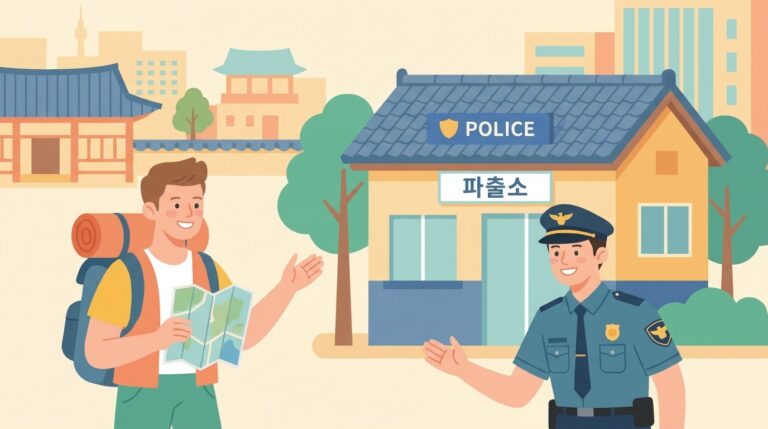
In Korea, you will see two kinds of police facilities. A 경찰서 is a large district police headquarters. A 파출소 (Pachulso) or 지구대 (Jigudae) is the friendly neighborhood substation you see on busy street corners with bright blue-and-yellow signs.
South Korea is globally renowned for its exceptional public safety (치안, Chian). Neighborhood substations are open 24/7, warm, and highly accessible. If you lose an item late at night, you don’t need to hunt for the massive district headquarters—simply look for the glowing sign of your nearest 지구대 or 파출소! Officers there are accustomed to helping foreign travelers with lost items.
Phase 5: 실전 롤플레이 시나리오 (Real-Life Roleplay Scenario)
Setting: You are standing in front of a 24-hour convenience store in Sinchon at 9:00 PM. You just noticed your bag is missing. You nervously approach the kind store clerk, Minho.
- Turn 1 (You): 저기요, 죄송한데 도와주세요! (Jeogiyo, joesonghande dowajuseyo!)
🎭 Clasping hands together, bowing slightly with an anxious look.
“Excuse me, I’m so sorry, but please help me!” - Turn 2 (Minho): 네? 무슨 일이세요? 괜찮으세요? (Ne? Museun iriseyo? Gwaenchaneuseyo?)
🎭 Setting down the box he was stocking and looking concerned.
“Yes? What’s going on? Are you okay?” - Turn 3 (You): 가방을 잃어버렸어요. (Gabangeul ireobeoryeosseoyo.)
🎭 Showing empty hands and patting shoulders.
“I lost my bag.” - Turn 4 (Minho): 아이고, 어쩌다가요… 여권도 들어있어요? (Aigo, eojjeodagayo… yeogwondo deureoisseoyo?)
🎭 Gasps sympathetically with wide eyes.
“Oh dear, how did that happen… Is your passport in it too?” - Turn 5 (You): 네, 여권이랑 지갑 다 있어요. 경찰서가 어디에 있어요? (Ne, yeogwon-irang jigap da isseoyo. Gyeongchalseoga eodie isseoyo?)
🎭 Nodding urgently, pointing toward the main road.
“Yes, both my passport and wallet are inside. Where is the police station?” - Turn 6 (Minho): 여기서 직진해서 50미터만 가면 파출소 있어요. (Yeogiseo jikjinhaeseo o-sip-miteoman gamyeon pachulso isseoyo.)
🎭 Pointing down the street with an open hand.
“If you go straight from here for just 50 meters, there’s a police substation.” - Turn 7 (You): 직진이요? 정말 감사합니다! (Jikjiniyo? Jeongmal gamsahamnida!)
🎭 Bowing deeply with a relieved expression.
“Straight ahead? Thank you so very much!” - Turn 8 (Minho): 조심히 가세요! 꼭 찾으실 거예요! (Josimhi gaseyo! Kkok chajeusil geoyeyo!)
🎭 Waving encouragingly with a warm smile.
“Go safely! You will definitely find it!”
🔀 Interactive Decision Point
How would you reply if Minho asks: “경찰서 같이 가 드릴까요?” (Gyeongchalseo gachi ga deurilkkayo? – “Shall I walk to the police station with you?”)
- Choice A: 아니, 싫어! (Ani, sireo!)
- Feedback [Bad]: 아니, 싫어 is blunt, rude informal speech meaning “No, I hate that!”. Even though you’re in a hurry, this will deeply shock the clerk who was trying to be kind.
- Choice B: 아니요, 괜찮아요. 혼자 갈 수 있어요. 감사합니다! (Aniyo, gwaenchanayo. Honja gal su isseoyo. Gamsahamnida!)
- Feedback [Best]: Polite, crystal clear, and expresses gratitude while declining courteously.
- Choice C: 응, 가자. (Eung, gaja.)
- Feedback [Risk]: 응, 가자 is casual banmal meaning “Yeah, let’s go.” While it gets your wish across, talking down to a stranger who is helping you creates unnecessary social awkwardness.
Phase 6: 10초 감정 섀도잉 드릴 (10-Second Emotion Shadowing Drill)
Practice these lines out loud! Follow the pause markers (/) and embody the emotion tags:
[😰 Anxious & Urgent]
저기요! / 도와주세요! / 지갑을 / 잃어버렸어요!
(Jeogiyo! / Dowajuseyo! / Jigabeul / ireobeoryeosseoyo!)-
[🥺 Polite & Desperate]
죄송하지만, / 경찰서가 / 어디에 있어요?
(Joesonghajiman, / gyeongchalseoga / eodie isseoyo?) -
[😮💨 Relieved & Grateful]
아, 저기요? / 정말 / 감사합니다!
(A, jeogiyo? / Jeongmal / gamsahamnida!)
Phase 7: K-Culture 미니 사전 (Mini Dictionary)
- 파출소 (Pachulso) | Noun: Neighborhood Police Substation
The most accessible local branch of law enforcement in Korea. Ideal for reporting lost phones, asking for emergency directions, or seeking shelter if you feel unsafe. - 분실물 (Bunsilmul) | Noun: Lost Property / Lost Item
You will see this word in train stations and police counters (분실물 센터 = Lost & Found Center). - 신분증 (Sinbunjeung) | Noun: Identification Card (ID)
Police officers or bank clerks will ask: “신분증 있으세요?” (Do you have an ID?). As a traveler, your passport serves as your primary 신분증. - 112 (Il-il-i) | Noun: Emergency Police Hotline
Korea’s equivalent to 911 (police only; medical emergencies are 119). Calling 112 offers an immediate foreign language translation service.
Phase 8: 여행자를 위한 생존 키트 (Traveler’s Survival Kit)
Survival Expressions TOP 3
- 영어로 말씀해 주실 수 있나요? (Yeongeoro malsseumhae jusil su innayo?)
Can you speak in English?
Pro Tip: If panic freezes your Korean, use this gentle sentence before switching to English. - 여기에 적어 주세요. (Yeogie jeogeo juseyo.)
Please write it down here.
Pro Tip: When receiving complex directions, hand the person your phone notes app so you don’t forget Korean street names. - 112에 전화해 주세요. (Il-il-ie jeonhwahae juseyo.)
Please call 112 for me.
Pro Tip: Essential if your phone battery has died and you face an urgent safety concern.
Editor’s Travel Note
- Navigation Guide: Google Maps often has limited walking navigation in South Korea due to national geographic data regulations. Before landing at Incheon Airport, ensure you complete your Naver Map app download for English navigation. It accurately pins every local 파출소 with English search support.
- The 112 English Hot Tip: If you ever call 112, simply say “English, please.” The Korean National Police Agency will instantly conference call a 24/7 professional interpreter via the Korea Tourism Organization emergency translation line.
Phase 9: “한 발 더 깊이” (Reflective Question)
In many Western cultures, asking strangers for help on the street can feel like an intrusion. In Korea, however, there is a deep-seated cultural concept known as 정 (Jeong)—a warm, invisible bond of communal empathy and collective responsibility. Even in the midst of bustling modern city life, if a foreign visitor shows humility and politely asks for emergency help, ordinary citizens will often walk multiple blocks out of their way to ensure you reach the station safely.
💬 Your Turn: Have you ever experienced unexpected kindness from a stranger while traveling abroad? Or how would someone in your hometown react if a lost traveler asked for help in broken English? Share your story in the comments below!
Phase 10: FAQ & 오해 방지 (FAQ Schema)
Q: What is the real difference between 경찰서 (Gyeongchalseo) and 파출소 (Pachulso)?
A: 경찰서 is a major central district police station handling serious investigations, driving licenses, and administrative filings. 파출소 (or 지구대) is a smaller, local street-level substation handling neighborhood patrol and lost-and-found items. For immediate street emergencies or lost wallets, head to the nearest 파출소.
Q: Can Korean police officers speak English?
A: While not all officers are fluent English speakers, most younger officers have basic conversational skills. Furthermore, all patrol cars and stations utilize three-way live phone translation services or mobile translation tools to communicate effectively with foreigners.
Q: What should I say if I lost my smartphone in a taxi?
A: Go to the nearest 파출소 and say: “택시에 핸드폰을 두고 내렸어요.” (Taeksie haendeuponeul dugo naeryeosseoyo. – I left my cell phone in a taxi). If you paid with a credit card or T-money card, bring your payment receipt or bank app record so the police can trace the taxi’s vehicle license number immediately.
🚨 흔한 실수 (Common Mistakes) Warning Board
- Mistake: Shouting “야!” (Ya!) to get someone’s attention on the street.
Correct Action: 야 is extremely informal and equates to “Hey, you!”. Always use 저기요 (Jeogiyo). - Mistake: Using 도와줘 (Dowajwo) with elders or police officers.
Correct Action: 도와줘 is casual banmal. Always attach the polite ending: 도와주세요 (Dowajuseyo). - Mistake: Calling 119 when you lost your passport.
Correct Action: 119 is strictly for fire, rescue, and ambulance ambulances. For lost items and police help, dial 112.
Phase 11: 액션 미션 & 참여 유도 (Action Missions)
- 🥉 Bronze Mission (Solo Practice): Stand in front of your bathroom mirror. Say “경찰서가 어디에 있어요?” three times with an urgent yet polite facial expression.
- 🥈 Silver Mission (Community Share): Open your social media or language exchange app (like HelloTalk) and record a 5-second voice note asking for directions using 어디에 있어요?. Ask a native speaker to critique your intonation!
- 🥇 Gold Mission (Real-World Ready): Open your Korean map app right now, search for “파출소” near your favorite Seoul landmark (e.g., Myeongdong, Gangnam), and locate the nearest one on the map.
- 🎮 K-Culture Mission: Watch any Korean drama crime or mystery episode this week. Listen closely for the word 경찰 (Gyeongchal) or 어디 (Eodi). When you catch it, pat yourself on the back!
Phase 12: 인터랙티브 퀴즈 챌린지 (Interactive Quiz Challenge)
Test what you’ve learned today!
1. Situation Quiz: You lost your passport in a busy market. What is the most polite and natural way to call out to a nearby store owner?
* (A) 야! 도와줘!
* (B) 저기요, 도와주세요!
* (C) 실례지만, 나를 구원하라!
2. Fill-in-the-Blank: Complete the sentence: “Where is the police station?”
* 경찰서가 [ ] 있어요?
* (A) 누구에 (nugue)
* (B) 언제에 (eonjee)
* (C) 어디에 (eodie)
3. True or False Culture Quiz: In South Korea, calling 119 is the correct emergency number to report a stolen or missing wallet.
* (True / False)
👉 Click to view answers and explanations!
Answers & Explanations:
1. Answer: (B) – 저기요, 도와주세요! is the polite, standard way to ask for assistance. (A) is rude banmal, and (C) sounds like an archaic biblical command!
2. Answer: (C) – 어디에 means “where”. 누구 means “who”, and 언제 means “when”.
3. Answer: False – 119 is for fire and medical emergencies. For lost property or police intervention, you should call 112 or visit a local 파출소.







