

Don’t Panic on Your First Day at a Korean Startup: How to Ask for the Office Wi-Fi Like a Pro
Phase 1: Empathy & Story Opening
안녕하세요! 매일한글 에디터입니다. (Annyeonghaseyo! Editor from Daily Hangul here.)
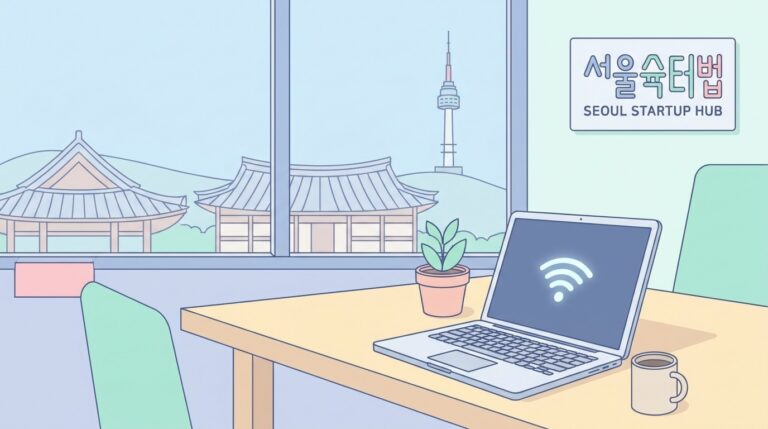
Picture this: It is your very first morning as a new team member at an exciting IT startup in Pangyo Techno Valley or trendy Seongsu-dong, looking just like a scene out of the K-Drama Start-Up. You sit down at your sleek wooden desk, open your laptop, and get ready to check your onboarding tasks. But then reality strikes: your international roaming is crawling, Slack is disconnected, and you have zero internet access.
You glance around. Your desk neighbor is typing at 120 words per minute with sleek noise-canceling headphones on, sipping an iced Americano. You want to ask for the Wi-Fi network and password, but your mind freezes. Will you interrupt their deep work? What if you sound too abrupt or accidentally use overly formal textbook grammar from twenty years ago?
Take a deep breath! Getting set up on the company network is the very first social touchpoint in any Korean workspace. Based on real questions from hundreds of our global learners at Daily Hangul, we have designed this friendly A1 survival guide. By the end of this lesson, you will know the exact, polite expressions to get connected effortlessly while making a wonderful first impression.
Phase 2: Core Expressions Deep Dive
1. 와이파이 비밀번호 뭐예요? (Wai-pai bi-mil-beon-ho mwo-ye-yo?)
- Pronunciation: [Wai-pai bi-mil-beon-ho mwo-ye-yo?] (Pronounce it like: Why-pie bee-meal burn-ho mwo-yeah-yo)
- Meaning: Literal: “Wi-Fi secret number, what is it?” | Actual Nuance: “What is the Wi-Fi password?”
- K-Culture Moment: Think of Seo Dal-mi and Nam Do-san in Start-Up, quickly sharing system credentials on a colorful sticky note during hackathon setup.
- Editor’s Insight: In Korean, the everyday word for password is “비밀번호” (bi-mil-beon-ho), literally meaning “secret number.” While tech engineers occasionally say “패스워드” (pae-seu-wo-deu), “비밀번호” (or its super-popular abbreviation “비번” – bi-beon) is what 95% of native speakers say out loud.
- Situation Spectrum:
- Casual (Friends/Close Peers): ✅ (비번 뭐야?)
- Semi-formal (Coworkers/Office): ✅ (비밀번호 뭐예요? / 비번 뭐예요?)
- Strict Formal (Boardroom/VIPs): ⚠️ (비밀번호가 어떻게 되나요?)
- 🤔 Think About It: In English, we call it a “word” (password), but Korean emphasizes “secret number” (비밀번호). Why do you think digital credentials became known as numbers in everyday Korean speech?
2. 와이파이 연결이 안 돼요. (Wai-pai yeon-gyeol-i an dwae-yo.)
- Pronunciation: [Wai-pai yeon-gyeol-i an dwae-yo?] (Pronounce it like: Why-pie yun-gyul-ee ahn dway-yo)
- Meaning: Literal: “Wi-Fi connection doesn’t become.” | Actual Nuance: “The Wi-Fi is not connecting / I can’t connect to the Wi-Fi.”
- K-Culture Moment: That classic moment in office dramas like Misaeng when an intern gently turns their laptop screen toward their mentor with an apologetic look.
- Editor’s Insight: Koreans love using “안 돼요” (an dwae-yo – it doesn’t work / it is not possible). It is polite because it explains that the connection is failing on its own, avoiding any implication that someone gave you the wrong information.
- Situation Spectrum:
- Casual: ✅ (연결 안 돼)
- Semi-formal: ✅ (연결이 안 돼요)
- Strict Formal: ✅ (연결이 되지 않습니다)
- 🤔 Think About It: In English, we usually say “I cannot connect,” placing the action on ourselves. Korean says “The connection is not happening.” Notice how Korean grammar naturally softens direct blame!
3. 사내 네트워크 이름이 뭐예요? (Sa-nae ne-teu-wo-keu i-reum-i mwo-ye-yo?)
- Pronunciation: [Sa-nae ne-teu-wo-keu i-reum-i mwo-ye-yo?] (Pronounce it like: Sah-nay neh-teu-wuh-kuh ee-reum-ee mwo-yeah-yo)
- Meaning: Literal: “Company-inside network name, what is it?” | Actual Nuance: “What is the internal company network name (SSID)?”
- K-Culture Moment: When a new hire walks into a multi-tenant shared office in Gangnam and sees forty different Wi-Fi signals listed on their screen.
- Editor’s Insight: “사내” (sa-nae) means “in-house” or “internal.” Tech startups usually separate internal employee networks from guest networks for security. Asking this proves you are workplace-smart.
- Situation Spectrum:
- Casual: ⚠️ (A bit formal for close friends at home)
- Semi-formal: ✅ (Perfect for teammates)
- Strict Formal: ✅ (사내 네트워크 명이 무엇입니까?)
- 🤔 Think About It: Korean workplace language often creates boundaries between inside (사내 – sa-nae) and outside (사외 – sa-oe). How does this reflect the cultural value of the corporate “in-group” (우리 회사)?
Phase 3: Textbook Korean vs. Real Korean
Situation 1: Asking for the Wi-Fi Password
- 📖 교과서 한국어 (Textbook Korean): 와이파이 비밀번호가 무엇입니까? (Wai-pai bi-mil-beon-ho-ga mu-eot-im-ni-ka?)
- 🗣️ 진짜 한국어 (Real-World Korean): 혹시 와이파이 비번이 뭐예요? (Hok-si wai-pai bi-beon-i mwo-ye-yo?)
- 💡 왜 다를까? (Why is it different?): The textbook phrase sounds like an automated robotic prompt. Real coworkers use the contraction 비번 (bi-beon) and soften the entry with 혹시 (hok-si – by any chance) to sound warm and considerate.
Situation 2: Confirming Success
- 📖 교과서 한국어 (Textbook Korean): 인터넷에 성공적으로 접속하였습니다. (In-teo-net-e seong-gong-jeok-eu-ro jeop-sok-ha-yeot-seum-ni-da.)
- 🗣️ 진짜 한국어 (Real-World Korean): 와, 이제 잘 잡혀요! (Wa, i-je jal jap-hyeo-yo!)
- 💡 왜 다를까? (Why is it different?): In conversational Korean, Wi-Fi signal is figuratively “caught” using the verb 잡히다 (jap-hi-da). Saying “잘 잡혀요” (It catches well) is how native speakers say “I have a strong signal!”
Phase 4: K-Culture Deep Dive & Non-Verbal Manners
4-1. 눈치 (Nunchi) & Office Gestures
Before asking someone for tech assistance, practice a little nunchi (the art of reading the room):
1. The Headphone Check: If your coworker has both headphones over their ears and their eyes glued to code, do not tap their shoulder abruptly. Wait until they look up or reach for their water cup.
2. The Polite Lean: Lean slightly toward their desk partition, make gentle eye contact, and softly bow your head around 15 degrees.
3. Screen Cue: Hold your smartphone or point toward your laptop screen discreetly. This non-verbally signals “I have a quick equipment question,” so they know it will take less than thirty seconds.
4-2. The Startup Pantry Code
In modern Korean startup hubs like Pangyo, Seongsu, or Teheran-ro, you will often find the office credentials already written down before you even need to ask! Look for yellow Post-it notes near the shared espresso machine, on the refrigerator in the pantry (탕비실 – tang-bi-sil), or written in dry-erase marker at the corner of the main conference room whiteboard.
Phase 5: Real-World Roleplay Scenario
Setting: 9:30 AM at a tech incubator in Pangyo. You sit next to Jiho (지호), a friendly junior developer who is setting up his keyboard.
- Turn 1 (You): 저기… 지호 씨, 혹시 잠깐 시간 괜찮으세요? (Jeo-gi… Ji-ho ssi, hok-si jam-kkan si-gan gwaen-chan-eu-se-yo?)
🎭 Softly speaking with a gentle head tilt and warm smile
(Excuse me… Jiho-ssi, do you happen to have a quick minute?) -
Turn 2 (Jiho): 네, 그럼요! 무슨 일 있으세요? (Ne, geu-reom-yo! Mu-seun il iss-eu-se-yo?)
🎭 Sliding one headphone ear off and turning toward you
(Yes, of course! What is going on?) -
Turn 3 (You): 사내 와이파이 이름이 뭐예요? (Sa-nae wai-pai i-reum-i mwo-ye-yo?)
🎭 Pointing toward the Wi-Fi list on your laptop screen
(What is the company Wi-Fi network name?) -
Turn 4 (Jiho): 아, ‘Startup_Office_5G’로 연결하시면 돼요! (A, ‘Startup_Office_5G’-ro yeon-gyeol-ha-si-myeon dwae-yo!)
🎭 Pointing to the second network option on your display
(Ah, you can connect to ‘Startup_Office_5G’!) -
Turn 5 (You): 감사합니다! 그런데 혹시 비번이 뭐예요? (Gam-sa-ham-ni-da! Geu-reon-de hok-si bi-beon-i mwo-ye-yo?)
🎭 Hands placed politely over the keyboard, ready to type
(Thank you! But by any chance, what is the password?) -
Turn 6 (Jiho): 소문자로 ‘welcome2026!’ 이에요. (So-mun-ja-ro ‘welcome2026!’ i-e-yo.)
🎭 Writing it neatly on a mini yellow sticky note for you
(It is all lowercase ‘welcome2026!’.) -
Turn 7 (You): 와, 이제 잘 잡혀요! 정말 감사합니다. (Wa, i-je jal jap-hyeo-yo! Jeong-mal gam-sa-ham-ni-da.)
🎭 Nodding with relief as the browser loads
(Wow, it connects smoothly now! Thank you so much.) -
Turn 8 (Jiho): 다행이네요! 슬랙 안 되면 또 말씀해 주세요. (Da-haeng-i-ne-yo! Seul-laek an dwae-myeon tto mal-sseum-hae ju-se-yo.)
🎭 Giving a supportive thumbs-up before returning to his monitor
(Glad to hear that! Let me know if Slack does not work either.)
🔀 Interactive Choice Point
Imagine that after Jiho told you the password, the laptop screen showed a red error message: “Incorrect password.” What do you say?
- Option A: “비밀번호 틀렸는데요? 다시 알려주세요.” (Bi-mil-beon-ho teul-lyeot-neun-de-yo? Da-si al-lyeo-ju-se-yo.)
- Option B: “죄송한데, 비번을 넣어도 연결이 안 돼요. 한 번만 봐주실 수 있어요?” (Joe-song-han-de, bi-beon-eul neo-eo-do yeon-gyeol-i an dwae-yo. Han beon-man bwa-ju-sil su iss-eo-yo?)
- Option C: “인터넷 고장 났어요! IT 팀에 전화할까요?” (In-teo-net go-jang nat-eo-yo! IT tim-e jeon-hwa-hal-kka-yo?)
Feedback:
- Option A [Risk]: Too confrontational! Saying “틀렸는데요” (It is wrong) sounds like you are accusing your helpful coworker of lying or being careless.
- Option B [Best]: ⭐ Perfect! Starting with “죄송한데” (I am sorry to bother) and phrasing it as “연결이 안 돼요” (it won’t connect) maintains great teamwork etiquette.
- Option C [Bad]: Overly dramatic! The entire office might think the server rack crashed when it is just a typo in your password field.
Phase 6: 10-Second Emotional Shadowing Drill
Repeat these three lines out loud! Pay attention to the pause slashes (/) and adopt the indicated emotion.
[😊 조심스럽고 다정하게 - Cautious and friendly]
혹시 / 와이파이 비번 / 뭐예요?
(Hok-si / wai-pai bi-beon / mwo-ye-yo?)-
[🥺 곤란하지만 예의 바르게 - Slightly stuck but polite]
비번을 넣었는데 / 연결이 안 돼요.
(Bi-beon-eul neo-eot-neun-de / yeon-gyeol-i an dwae-yo.) -
[😄 개운하고 감사하게 - Relieved and cheerful]
우와, / 이제 신호 / 잘 잡혀요!
(U-wa, / i-je sin-ho / jal jap-hyeo-yo!)
Phase 7: K-Culture Mini Dictionary
- 비번 (Bi-beon) | Noun (Slang)
Short for 비밀번호 (password/PIN). Used everywhere from front door keypads to Wi-Fi passwords and mobile unlock codes. - 잡히다 (Jap-hi-da) | Verb
Literally “to be caught.” In everyday tech talk, it refers to wireless signals (Wi-Fi, Bluetooth, LTE) being successfully locked onto by your device. - 사내망 (Sa-nae-mang) | Noun
The internal corporate intranet network. Crucial when accessing secure cloud repositories and company wikis. - 슬랙 (Seul-laek) | Noun
The Slack messaging platform. In almost every Korean startup, “슬랙으로 공유할게요” (I’ll share it via Slack) is heard ten times a day.
Phase 8: Survival Kit for Travelers
Top 3 Instant Survival Lines
- 와이파이 있어요? (Wai-pai iss-eo-yo?)
Pronunciation: [Wai-pai iss-uh-yo?]
Pro Tip: Essential for cafes, airport waiting lounges, and co-working spaces. - 비번 대문자예요, 소문자예요? (Bi-beon dae-mun-ja-ye-yo, so-mun-ja-ye-yo?)
Pronunciation: [Bi-beon dae-moon-jah-yeah-yo, so-moon-jah-yeah-yo?]
Pro Tip: Saves minutes of frustration when distinguishing capital letters (대문자) from lowercase letters (소문자). - QR 코드로 연결돼요? (QR ko-deu-ro yeon-gyeol-dwae-yo?)
Pronunciation: [Kyu-al ko-deu-ro yeon-gyul-dway-yo?]
Pro Tip: Many hip Seoul cafes now print Wi-Fi QR codes directly onto receipts or acrylic desk stands.
Editor’s Travel Note
Before stepping into a shared workspace in Seoul, make sure to complete your KakaoMap app download for navigation and keep your Papago translation app ready. If you drop by a cafe in Gangnam to work remotely before your startup meeting, check the bottom of your paper receipt first—the Wi-Fi SSID and password are almost always printed right under the order total!
Phase 9: Think Deeper: Culture Behind the Words
In many Western workplaces, direct efficiency is celebrated: “Give me the Wi-Fi code, please.” In Korea’s modern tech spaces, however, even the most innovative developers operate with an underlying respect for 배려 (baeryeo – mutual consideration).
Adding small cushion words like 혹시 (by any chance) and stating connection errors objectively (연결이 안 돼요 instead of “You gave me the wrong code”) creates an emotional buffer. It ensures that asking for technical help never disrupts the social harmony of the team. Technology in Korea moves at breakneck speed, but the language connecting colleagues remains rooted in empathy and mutual respect.
💬 Your Turn: How do newcomers typically ask for IT help or Wi-Fi credentials in your home country? Is it super casual, or do you have to file a formal IT ticket? Tell us in the comments below!
Phase 10: FAQ & Common Mistakes
Q: Can I just speak English when asking for Wi-Fi in a Korean tech office?
A: While many software engineers in Korean startups read and write English comfortably, initiating with Korean—such as “혹시 와이파이 비번이 뭐예요?”—shows that you respect local workspace customs. It instantly establishes warm rapport!
Q: What is the real difference between 비밀번호 and 패스워드?
A: They denote the identical concept! However, 비밀번호 (and its short form 비번) feels much more organic in spoken conversation. 패스워드 is mostly seen on system pop-up dialogues or formal IT security manuals.
Q: How do I say the Wi-Fi signal is weak or unstable?
A: You can say: 와이파이가 자꾸 끊겨요. (Wai-pai-ga ja-kku kkeun-kyeo-yo.) This means “The Wi-Fi keeps dropping/disconnecting.”
🚨 Common Mistakes Alert!
- Calling a colleague “너” (Neo – you): Never say “너 비번 알아?” to a coworker on your first day! In a Korean workplace, always address colleagues by their Name + 씨 (e.g., 지호 씨).
- Skipping the cushion word “혹시”: Blurted out without “혹시” (hok-si), the question “비번 뭐예요?” can sound like a direct demand rather than a polite inquiry.
- Mixing up case sensitivity: Koreans will say 대문자 (dae-mun-ja) for uppercase and 소문자 (so-mun-ja) for lowercase. Always verify before guessing!
Phase 11: Action Mission & Engagement
- 🥉 Bronze Mission: Stand in front of your mirror and practice saying “혹시 와이파이 비번이 뭐예요?” smoothly three times without looking at your notes.
- 🥈 Silver Mission: Open your social media story or language diary and post: “Today I learned how to connect to office Wi-Fi in Korean: 와이파이 비번 뭐예요? #DailyHangul”
- 🥇 Gold Mission: Visit a Korean cafe, restaurant, or cultural library and ask the staff for the Wi-Fi password entirely in Korean without switching to English!
- 🎮 K-Culture Mission: Watch an episode of Start-Up or Search: WWW this week. Listen for the words 네트워크 (network), 비번 (password), or 슬랙 (Slack) in the office scenes!
Phase 12: Interactive Quiz Challenge
1. Situation Challenge: You just sat down at your new startup desk and need the Wi-Fi. What is the most natural and polite phrase to ask your neighboring coworker?
* A) 야! 비번 당장 내놔.
* B) 혹시 와이파이 비번이 뭐예요?
* C) 사내 보안 코드를 지금 입력하십시오.
2. Fill in the Blank: Complete the sentence to say “The Wi-Fi is not connecting.”
* “와이파이 _______이 안 돼요.” (Hint: Connection)
3. True or False: In Korean cafes and workspaces, the Wi-Fi name and password are often printed directly on the sales receipt.
* True / False
Click here to reveal the Answers & Explanations!
Answers & Explanations:
1. Answer: B. “혹시 와이파이 비번이 뭐예요?” is the gold-standard polite, modern phrase. (A is rude slang; C sounds like a robotic computer prompt!)
2. Answer: 연결 (yeon-gyeol). Full sentence: 와이파이 연결이 안 돼요. (The Wi-Fi connection isn’t working.)
3. Answer: True. In Korea, it is standard practice to print the Wi-Fi SSID and password near the bottom of receipts or display it right next to the pick-up counter!







