

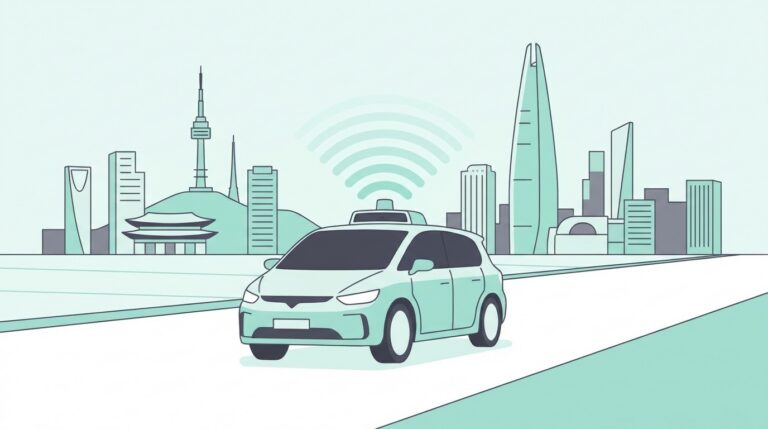
Navigating Korea’s High-Tech Boardrooms: Vision AI vs. Sensor Fusion Debates
Phase 1: Empathy (Story-Driven Opening)
안녕하세요! 매일한글 에디터입니다. (Annyeonghaseyo! It’s your Daily Hangul editor.)
Picture this: You are sitting in a sleek glass conference room overlooking Pangyo Techno Valley—South Korea’s bustling Silicon Valley. Across the polished granite table sits a team of elite automotive engineers from a major Korean mobility conglomerate, passionately arguing over autonomous driving architectures. One engineer slams their tablet gently on the table and declares that relying purely on camera vision is an algorithmic gamble, while an AI architect counters that heavy sensor fusion creates catastrophic computational latency. You want to interject with your nuanced perspective on safety redundancy and legal liability under Korean product liability law, but your tongue freezes. You know the technical concepts in English, yet phrasing them in high-register, natural C2-level Korean that commands respect feels like navigating Gangnam traffic in the middle of a torrential downpour.
Many advanced Korean learners hit this exact wall. You have moved past ordering food or talking about your favorite K-pop idols, but stepping into specialized, high-stakes professional debates—where cutting-edge technology intersects with corporate governance and jurisprudence—demands a sophisticated linguistic toolkit. Based on dozens of mentoring sessions with foreign tech executives and legal consultants working in Seoul, this guide is crafted to elevate your Korean from merely fluent to authoritative, natural, and culturally resonant. Let’s conquer the vocabulary and rhetorical nuances of the ultimate mobility clash: Camera Vision vs. LiDAR Sensor Fusion.
Phase 2: Core Key Expressions Deep Dive
1. 안전 중복성을 확보하다 (Anjeon jungbokseong-eul hwakbohata)
- Pronunciation: [An-jeon jung-bok-seong-eul hwak-bo-ha-da] (Sounds like “ahn-jun joong-bok-sung-ool hwahk-bo-ha-da”, rhythmically crisp with a firm release on ‘hwak’)
- Meaning: Literal: “To secure safety redundancy” | Nuanced: To architect multi-layered fallback systems that ensure zero single-point failures in mission-critical applications.
- K-Culture Moment: In a high-stakes board meeting scene from a Korean corporate drama like Agency (대행사), an engineering director uses this phrase to shut down cost-cutting bean-counters trying to compromise vehicle safety.
- Editor’s Insight: ‘중복’ (duplication/redundancy) often carries a negative connotation of wastefulness in daily speech, but when paired with ‘안전’ (safety) and ‘확보하다’ (to secure/guarantee), it becomes the golden standard of engineering prestige.
- Situation Spectrum: Casual 🚫 | Semi-formal ⚠️ | Formal ✅
- 🤔 Think About It: In Korean corporate culture, where collective responsibility (책임론) weighs heavily, how does framing engineering choices around ‘안전 중복성’ protect both the end-user and the executive team from institutional blame?
2. 시각 인지를 모사하다 (Sigak inji-reul mosahada)
- Pronunciation: [Si-gak in-ji-reul mo-sa-ha-da] (Sounds like “she-gahk een-jee-reul mo-sah-ha-dah”, with gentle cadence on ‘mo-sa’)
- Meaning: Literal: “To imitate visual cognition” | Nuanced: To replicate biological human optical perception through purely neural, vision-based artificial intelligence.
- K-Culture Moment: Reminiscent of Nam Do-san in the hit drama Start-Up (스타트업), explaining neural network vision processing to venture capitalists at Sand Box.
- Editor’s Insight: ‘모사하다’ is far more literary and technical than ‘따라 하다’ (to copy). It implies high-fidelity structural emulation, establishing that your AI model seeks to reproduce biological complexity rather than just mimicking shallow behavior.
- Situation Spectrum: Casual 🚫 | Semi-formal ⚠️ | Formal ✅
- 🤔 Think About It: English uses “mimic” or “replicate” loosely, but Korean separates ‘모방’ (imitation with potential commercial copying connotations) from ‘모사’ (faithful scientific/artistic emulation). How does precision in terminology shift stakeholder trust?
3. 대립각을 세우다 (Daeripgag-eul se-uda)
- Pronunciation: [Dae-rip-ga-geul se-u-da] (Think of “day-rip-gah-gool seh-oo-dah”, with emphasis on the sharp plosive ‘k’ transition)
- Meaning: Literal: “To establish an angle of opposition” | Nuanced: To draw sharp battle lines; to stand in fundamental ideological, strategic, or technical confrontation with an opposing faction.
- K-Culture Moment: Seen regularly in Korean tech and economic journalism headlines describing the fierce rivalry between domestic conglomerates and Silicon Valley disruptors.
- Editor’s Insight: This is an indispensable rhetorical idiom in professional debate. Instead of saying the pedestrian ‘반대하다’ (to oppose), ‘대립각을 세우다’ paints a vivid spatial metaphor of two clashing titans squaring off.
- Situation Spectrum: Casual ⚠️ | Semi-formal ✅ | Formal ✅
- 🤔 Think About It: Korean social harmony often discourages direct friction, yet idioms like ‘대립각을 세우다’ are essential in editorial and analytical discourse. How does using metaphor allow speakers to critique ideas without launching personal attacks?
Phase 3: Textbook Korean vs. Real Korean
Situation 1: Expressing that two approaches cannot be reconciled
- 📖 교과서 한국어 (Textbook): 두 기술은 서로 매우 다르고 합치기 어렵습니다. (Du gisur-eun seoro maeu dareugo hapchigi eoryeopseumnida.) — “The two technologies are very different and difficult to combine.”
- 🗣️ 진짜 한국어 (Real-World C2): 두 진영은 지향점 자체가 달라 평행선을 달릴 수밖에 없습니다. (Du jin-yeong-eun jihyangjeom jachega dalla pyeonghaengseon-eul dallil subakke eopseumnida.) — “Because the core design philosophies of both camps diverge fundamentally, they are bound to run on parallel tracks without converging.”
- 💡 왜 다를까? (Why the difference?): Native tech leaders avoid simplistic descriptors like ‘다르다’ (different). Instead, they deploy conceptual spatial metaphors such as ‘평행선을 달리다’ (running on parallel tracks) to eloquently describe philosophical impasses.
Situation 2: Emphasizing sudden fatal errors in edge cases
- 📖 교과서 한국어 (Textbook): 예상 밖의 상황에서 카메라가 작동을 멈추면 사고가 납니다. (Yesang bakk-ui sanghwang-eseo kameraga jakdong-eul meomchumyeon sagoga napnida.) — “If the camera stops working in an unexpected situation, an accident occurs.”
- 🗣️ 진짜 한국어 (Real-World C2): 극한의 엣지 케이스에서 센서 단일 장애점(SPOF)이 치명적인 인명 피해로 직결될 수 있습니다. (Geukhan-ui etji keiseu-eseo senseo dan-il jang-aejeom-i chimyeongjeog-in inmyeong pihae-ro jikgyeol-doel su itseumnida.) — “In extreme edge cases, a single point of failure (SPOF) in the sensor array can directly result in fatal casualties.”
- 💡 왜 다를까? (Why the difference?): High-level engineering briefings in Korea weave technical loanwords (‘엣지 케이스’, ‘SPOF’) into formal, high-impact Sino-Korean verbs like ‘직결되다’ (to link directly/inevitably).
Phase 4: K-Culture Deep Dive & Non-Verbal Manners
4-1. Nunchi & Gestures: The Art of Disagreement in Pangyo
In a Korean high-tech symposium or boardroom, openly telling a senior colleague or competitor “당신 의견은 틀렸습니다” (You are wrong) is a social catastrophe. Even in the relatively progressive tech ecosystem of Pangyo, hierarchy and collective face (체면) dictate body language.
- The Head Tilt and Inhale: When an opposing speaker finishes advocating for a camera-only vision approach, do not immediately counter. Nod slightly twice, tilt your head approximately 15 degrees, and take a soft, audible breath through your teeth—a non-verbal marker known as ‘쿠션 동작’ (cushioning gesture). This signals: “I have internalized your premise, and my counterargument is born of careful deliberation, not hostility.”
- Two-Handed Pointing to Data: Never point a single index finger at a presenter’s slide. Instead, gesture toward the projected latency graph with your open palm facing upward, supported gently at the wrist by your left hand. This physical manifestation of politeness creates an objective buffer: you are critiquing the empirical data, not the person.
4-2. Culture Code: The “Pangyo Way” Meets Traditional Chaebol Safety
Korea’s mobility landscape is unique. On one side stands Pangyo’s software startup scene, heavily influenced by Silicon Valley’s “move fast and break things” ethos. On the other side sits the heritage automotive manufacturing base (Ulsan and Namyang R&D centers), where safety validation has been drilled down through decades of rigorous hardware standards. When the camera-only vision philosophy clashes with sensor-fusion architectures in Korea, it is not merely an engineering debate—it is a cultural duel between rapid software iteration and traditional hardware manufacturing prudence. Understanding this duality is your secret superpower when analyzing Korean legal liability debates regarding software-defined vehicles (SDVs).
Phase 5: Real-World Roleplay Scenario
Setting: A mobility innovation forum at the Pangyo Global R&D Center. You are debating Director Min (민 이사), an ardent champion of end-to-end vision AI, over the safety architecture of Level 4 autonomous shuttles.
Turn 1: Director Min (민 이사)
인간도 오직 두 눈의 시각 정보만으로 완벽하게 운전하지 않습니까? 라이다 센서의 중복 탑재는 원가 상승과 연산 비효율만 초래할 뿐입니다.
(Ingando ojik du nun-ui sigak jeongboman-euro wanbyeokhage unjeonhaji anseumnikka? Raida senseo-ui jungbok tapjaeneun wonga sangseung-gwa yeonsan bihyeoyulman choraehal ppun-imnida.)
“Humans drive perfectly well relying solely on visual information from two eyes, don’t they? Adding LiDAR redundancy merely inflates manufacturing costs and computational inefficiency.”
🎭 팔짱을 끼고 단호한 눈빛으로 청중을 둘러보며 (Crossing his arms and surveying the audience with an assertive gaze)
Turn 2: You
이사님의 통찰에 깊이 공감합니다만, 생체 시각 인지와 인공신경망의 인지 메커니즘 사이에는 근본적인 괴리가 존재합니다.
(Isanim-ui tongchar-e gipi gonggamhamnidaman, saengche sigak inji-wa ingongsingyeongmang-ui inji mekeonijeum saieneun geunbonjeog-in goeriga jonjaehamnida.)
“While I deeply appreciate your insight, Director Min, a fundamental disparity remains between biological visual perception and neural network cognitive mechanisms.”
🎭 고개를 가볍게 끄덕이며 양손을 모으고 경청하는 자세로 (Nodding lightly with hands clasped together in an attentive posture)
Turn 3: Director Min (민 이사)
괴리라니요? 대규모 파운데이션 모델과 방대한 주행 데이터가 축적된다면 비전만으로도 초인적인 안전성을 달성할 수 있습니다.
(Goeriraniyo? Daegyumo paundeisyeon moder-gwa bangdaehan juhaeng deiteoga chukjeokdoendamyeon bijeonman-eurodo cho-injeog-in anjeonseong-eul dalseonghal su itseumnida.)
“A disparity? If large-scale foundation models and vast driving datasets are accumulated, superhuman safety can be attained via vision alone.”
🎭 눈썹을 살짝 치켜올리며 태블릿 화면을 톡톡 두드린다 (Raising an eyebrow slightly and tapping the tablet screen)
Turn 4: You
데이터 학습량과 무관하게, 폭우나 역광 같은 광학적 한계 상황에서는 알고리즘 자체가 무력화될 위험이 상존합니다.
(Deiteo hakseupnyang-gwa mugwanhage, poguna yeokgwang gateun gwanghakjeok hangye sanghwang-eseoneun algorijeum jachega muryeokhwa-doel wiheom-i sangjonhamnida.)
“Regardless of dataset volume, in optical boundary conditions such as torrential rain or direct glare, the inherent risk of algorithmic failure persists.”
🎭 차분하고 흔들림 없는 어조로 데이터 차트를 손바닥으로 가리키며 (Pointing to the data chart with an open palm in a calm, steady tone)
Turn 5: Director Min (민 이사)
그렇다고 고가의 센서들을 덕지덕지 붙이는 방식이 양산차 시장에서 현실적인 대안이 될 수 있을까요?
(Geureotdago goga-ui senseodeur-eul deokji-deokji buchineun bangsik-i yangsancha sijang-eseo hyeonsiljeog-in dae-an-i doel su isseulkkayo?)
“Even so, can tacking on expensive sensors cluttering the vehicle truly serve as a realistic alternative in the mass-production market?”
🎭 씁쓸한 미소를 지으며 안경을 고쳐 쓴다 (Smiling wryly and adjusting his glasses)
Turn 6: You
양산 단가 절감도 중요하지만, 사고 시 제조물 책임법상 입증 책임과 징벌적 손해배상 리스크를 감안하면 센서 퓨전은 선택이 아닌 필수입니다.
(Yangsan danga jeolgamdo jungyohajiman, sago si jejomul chaegimbeopsang ipjeung chaegim-gwa jingbeoljeok sonhaebaesang riseukeu-reul gamanhamyeon senseo pyujeon-eun seontaek-i anin pilsu-imnida.)
“Reducing mass-production unit costs is crucial, but considering the burden of proof under product liability law and the risk of punitive damages in fatal accidents, sensor fusion is an absolute necessity, not an optional feature.”
🎭 법률 자료 문서를 정중하게 테이블 중앙으로 제시하며 (Politely presenting the legal document to the center of the table)
Turn 7: Director Min (민 이사)
결국 법률적 리스크 헤지와 기술적 급진성 사이의 타협점을 어디에 두느냐의 문제로 귀결되는군요.
(Gyeolguk beopryuljeok riseukeu heji-wa gisuljeok geupjinseong sai-ui tahyeopjeom-eul eodie dununya-ui munje-ro gwigyeoldoeneungunyo.)
“In the end, it boils down to the fundamental question of where we establish the compromise between legal risk hedging and radical technological innovation.”
🎭 팔짱을 풀고 턱을 괴며 깊은 생각에 잠긴다 (Uncrossing his arms and resting his chin on his hand in deep contemplation)
Turn 8: You
정확히 짚으셨습니다. 안전 중복성은 단순한 기술적 과잉 투자가 아니라, SDV 생태계에서 기업의 영속성을 담보하는 법적 방파제입니다.
(Jeonghwakhi jipeusyeotseumnida. Anjeon jungbokseong-eun dansunhan gisuljeok gwa-ing tuja-ga anira, SDV saengtaegye-eseo gi-eop-ui yeongsokseong-eul dambohaneun beopjeok bangpaje-imnida.)
“You hit the nail right on the head. Safety redundancy is not merely technological over-engineering; it is the legal breakwater that guarantees a corporation’s perpetuity within the SDV ecosystem.”
🎭 신뢰감 넘치는 미소를 지으며 눈을 맞춘다 (Making steady eye contact with a warm, confident smile)
🔀 Interactive Decision Point
How would you formulate your concluding remark to Director Min to cement the alliance?
- Option A: “그러니까 비전만 고집하는 테슬라 방식은 한국 도로 환경에서 무조건 실패할 수밖에 없습니다.” (Geureonikka bijeonman gojiphaneun Teseulla bangsik-eun hanguk doro hwangyeong-eseo mujokeon silpaehal subakke eopseumnida. – “Therefore, the Tesla approach of stubbornly sticking to vision is bound to fail unconditionally in Korean road conditions.”)
- Option B: “엔드투엔드 AI의 학습 속도와 센서 퓨전의 물리적 안전망을 결합한 하이브리드 아키텍처야말로 한국 시장에 최적화된 해법입니다.” (Endeutueondeu AI-ui hakseup sokdowa senseo pyujeon-ui mulrijeok anjeonmang-eul gyeolhabhan haibeurideu akitekcheoyamallo hanguk sijang-e choejeokhwa-doen haebeop-imnida. – “A hybrid architecture that synthesizes the learning velocity of end-to-end AI with the physical safety net of sensor fusion is indeed the optimized solution for the Korean market.”)
- Option C: “라이다 없이 차를 만들면 나중에 국토교통부 인증 통과하기 힘들 텐데 감당되시겠습니까?” (Raida eopsi char-eul mandeulmyeon najung-e Guktogyotongbu injeung tonggwahagi himdeul tende gamdangdoesigesseumnikka? – “If you build cars without LiDAR, it’ll be tough to pass Ministry of Land, Infrastructure and Transport certifications later—can you handle that?”)
Feedback on Options:
- Option A (Bad): Aggressive, black-and-white thinking. Criticizing specific competitors bluntly breaches Korean business etiquette and makes you sound dogmatic rather than analytical.
- Option B (Best! 🏆): Masterful C2 synthesis! It honors the opponent’s premise (end-to-end AI speed) while establishing the non-negotiable imperative of your position (safety net), concluding with an actionable strategic consensus.
- Option C (Risk): Passive-aggressive. Questioning their competence (“감당되시겠습니까?”) will provoke defensive hostility and shatter business rapport instantly.
Phase 6: 10-Second Emotion Shadowing Drill
Practice these lines using the emotion signposts and pause markers (/) to achieve authentic C2 professional delivery.
Drill 1: The Measured Analytical Rebuttal
[🧐 차분하고 객관적인 지적 / Calm and intellectually rigorous]
카메라 비전 기반의 인공신경망은 / 조도 변화에 극도로 취약하므로, / 라이다를 통한 물리적 거리 측정의 / 상호 보완이 불가피합니다.
(Kamera bijeon giban-ui ingongsingyeongmang-eun / jodo byeonhwa-e geukdoro chwiyakhameuro, / raida-reul tonghan mulrijeok geori cheukjeong-ui / sangho bowan-i bulgahpihamnida.)
“Because vision-based neural networks / are exceedingly vulnerable to luminance fluctuations, / the mutual complementary data / of physical LiDAR distance measurement is inevitable.”
Drill 2: The High-Stakes Legal Warning
[⚖️ 단호하고 무게감 있게 / Gravitas with legal conviction]
사고 발생 시 / 소프트웨어의 알고리즘 블랙박스는 / 제조물 책임 소송에서 / 면책 사유로 인정받기 어렵습니다.
(Sago balsaeng si / sopeutu-weo-ui algorijeum beullaekbakseu-neun / jejomul chaegim sosong-eseo / myeonchaek sayu-ro injeongbatgi eoryeopseumnida.)
“In the event of a catastrophic failure, / the algorithmic black box of the software / will struggle to be recognized / as an exonerating defense in product liability litigation.”
Drill 3: The Collaborative Consensus
[🤝 신뢰를 형성하는 온화하고 확신에 찬 어조 / Warm, reassuring consensus-builder]
궁극적으로 시장의 신뢰를 선점하는 쪽은 / 기술적 급진성보다 / 안전 중복성을 제도화한 기업이 될 것입니다.
(Gung-geukjeog-euro sijang-ui sinnoe-reul seonjeomhaneun jjok-eun / gisuljeok geupjinseongboda / anjeon jungbokseong-eul jedohwahan gi-eob-i doel geosimnida.)
“Ultimately, the entity that seizes dominant market trust / will not be the one chasing mere technological radicalism, / but the enterprise that institutionalizes safety redundancy.”
Phase 7: K-Culture Mini Dictionary
- 센서 퓨전 (Senseo Pyujeon) | Sensor Fusion
Usage: Combining radar, LiDAR, and camera vision telemetry into a coherent spatial matrix. In Korean business discussions, it is frequently used as a metaphor for holistic decision-making: “우리 부서 간 정보도 센서 퓨전처럼 유기적으로 결합해야 합니다” (Our inter-departmental information must also combine organically like sensor fusion). -
소프트웨어 정의 차량 [SDV] (Sopeutu-weo Jeong-ui Charyang) | Software-Defined Vehicle
Usage: Refers to vehicles whose hardware capabilities are orchestrated, upgraded, and monetized via over-the-air (OTA) software. A standard buzzword in Pangyo, Yeouido securities briefings, and Hyundai Motor Group keynote speeches. -
제조물 책임법 (Jejomul Chaegimbeop) | Product Liability Act
Usage: A core legal pillar in Korea (equivalent to strict liability). Crucial when debating who pays when Level 3 or Level 4 autonomous systems crash: the vehicle manufacturer, the software vendor, or the human driver. -
귀책사유 (Gwicheoksayu) | Attributable Cause / Reason for Liability
Usage: The foundational legal term determining fault. In mobility contracts: “오작동에 대한 귀책사유를 명확히 규정해야 법적 리스크를 차단할 수 있습니다” (We must clearly delineate the attributable fault for malfunctions to preempt legal risk).
Phase 8: Traveler’s Survival Kit (Pangyo Tech Valley Edition)
Top 3 Professional Survival Phrases
-
회의 아젠다를 센서 아키텍처 비교로 좁히시죠.
Hwoe-ui ajendareul senseo akitekcheo bigyoro jophisijyo.
Pro Tip: Deploy this when Korean engineers get sidetracked by minor mechanical bugs. It pulls everyone straight back to high-level strategic alignment. -
배상 책임 한도(Cap) 조항을 다시 검토해 주십시오.
Baesang chaegim hando johang-eul dasi geomtohae jusipsio.
Pro Tip: The polite yet firm way to halt a vendor contract review until the liability limitation ceiling is settled. -
필드 테스트 실증 데이터가 뒷받침되어야 합니다.
Pildeu teseuteu siljeung deiteoga dwitbatchimdoeeoya hamnida.
Pro Tip: The ultimate phrase to dismiss unsubstantiated theoretical AI claims without sounding rude.
Editor’s Travel Note: Conquering Pangyo Like an Insider
If you are traveling to South Korea for technology meetings, you will inevitably head to Pangyo Station (판교역) on the Shinbundang Line (the blazing-fast red subway line that links Gangnam to Pangyo in just 14 minutes).
- Navigation: Google Maps is severely restricted in South Korea due to national security map-data export laws. Make sure you use the 네이버 지도 앱 다운로드 to search for corporate addresses like Pangyo Techno Valley (판교테크노밸리) and track exact real-time bus arrivals.
- Calling Rides: Taxis from Gangnam to Pangyo fill up fast during evening rush hour. Skip hailing cabs on the street and book directly with the 카카오 T 앱 다운로드 platform.
- Lunch Etiquette: In Pangyo tech cafeterias and nearby Sundubu-jjigae restaurants, younger engineers often split bills (더치페이 or 각자 계산), but if meeting senior executives, the inviting party almost always pays the entire bill at the register. Never place your corporate credit card on the counter while they are pulling out their wallet; step back, bow slightly, and offer: “정말 잘 먹었습니다, 이사님” (Thank you for the wonderful meal, Director).
Phase 9: “한 발 더 깊이” (Deep Cultural Reflection)
In Western software paradigms, bold experimentation and beta-testing in public domains are celebrated under the mantra of disruption. However, in South Korea, mobility is intrinsically bound to communal security. The societal expectation of 무결성 (Zero-Defect Integrity) and the collective memory of historical engineering catastrophes mean that public tolerance for catastrophic AI failure is virtually nonexistent. When Korean regulatory bodies debate autonomous vehicle legislation, the burden placed on software creators to eliminate single points of failure is overwhelming. Thus, championing “Camera-Only Vision” in Korea is not just a technological statement—it requires confronting a deeply risk-averse legal landscape that prioritizes collective public safety over venture-backed speed.
💬 Your Turn: Does your country’s legal and cultural framework favor rapid AI deployment (even with edge-case vulnerabilities), or does it mandate strict sensor-redundancy before public road access? Share your thoughts below in advanced Korean!
Phase 10: FAQ & Avoiding Misconceptions
Q: Can I use the word “스포프 (SPOF)” directly in Korean engineering meetings?
A: Absolutely! Technical terms like Single Point of Failure (SPOF), End-to-End (E2E), and Sensor Fusion are universally recognized in Korean tech circles. However, pair them with Sino-Korean verbs: e.g., “SPOF를 배제하다” (to eliminate SPOF) or “E2E 모델을 고도화하다” (to refine/advance the E2E model).
Q: What is the exact difference between ‘배상’ (Baesang) and ‘보상’ (Bosang)?
A: This is the #1 mistake foreign legal/business professionals make in Korea!
* 배상 (Baesang): Compensation for unlawful/illegal harm or breach (e.g., 손해배상 – tort damages from a car collision caused by defective code).
* 보상 (Bosang): Compensation for lawful loss (e.g., 손실보상 – government eminent domain compensation or insurance payouts under lawful terms).
Using ‘보상’ when drafting a tort lawsuit will immediately reveal non-native phrasing to a Korean attorney.
Q: How do I politely tell a senior Korean director that their technical opinion is obsolete?
A: Cushion it using temporal evolution: “이사님의 고견은 초기 아키텍처 모델링에서는 주효했으나, 최근 법 개정과 센서 단가 하락 국면에서는 재평가가 요구되는 시점인 것 같습니다.” (Your insight was highly effective during initial architectural modeling, but amidst recent legal revisions and falling sensor prices, it seems we have arrived at a juncture requiring re-evaluation).
🚨 흔한 실수 (Common Mistakes) 경고판
- Mistake: Using “당신” (Dangsin) to address your debate counterparty.
Correct Action: Never use ‘당신’ in corporate debates; it sounds provocative, almost like you want to start a fistfight. Address them by their title: “이사님” (Director), “팀장님” (Team Leader), or “박사님” (Dr.). - Mistake: Translating “Redundancy” as “쓸데없는 중복” (Useless duplication).
Correct Action: Always specify “안전 중복성” (Safety redundancy) or “다중화 설계” (Redundant multi-architecture). - Mistake: Confusing “인공신경망” (Neural Network) with “신경망” in informal slang contexts.
Correct Action: Keep technical terminology precise. In formal presentations, stick to “인공신경망 아키텍처” or “딥러닝 기반 인지 알고리즘”.
Phase 11: Action Missions
🥉 Bronze Mission (Solo Practice)
Read the Phase 6 Shadowing Drills out loud three times. Record your voice on your smartphone and check if your pauses match the / breaks, ensuring that legal keywords like ‘제조물 책임 소송’ flow effortlessly without hesitation.
🥈 Silver Mission (Social Media / Community)
Write a 3-sentence summary on LinkedIn or your Korean study blog evaluating the Vision AI vs. LiDAR debate, using at least two expressions learned today: ‘안전 중복성을 확보하다’ and ‘대립각을 세우다’.
🥇 Gold Mission (Real-World Execution)
Next time you participate in a tech meetup, business exchange, or language exchange with native Korean professionals, steer the conversation toward mobility or AI liability. Drop the phrase: “결국 엣지 케이스에서의 법적 귀책사유 입증이 상용화의 핵심 쟁점 아니겠습니까?” (Isn’t proving legal attributable fault during edge cases the core contention of commercialization?) and observe their eyes light up at your mastery!
🎮 K-Culture Media Challenge
Watch Episode 5 of the Korean legal drama Extraordinary Attorney Woo (이상한 변호사 우영우) or Stranger (비밀의 숲). Identify instances where legal liability (‘손해배상’) and corporate negligence are argued. Notice the distinct intonation cadence of Korean attorneys when grilling technical experts on the stand.
Phase 12: Interactive Quiz Challenge
Question 1: Situation Judgment
You are presenting to Korean mobility venture capitalists. They question whether LiDAR sensors make an autonomous taxi too expensive to produce. Which response demonstrates the highest degree of business acumen and persuasive C2 phrasing?
- A) “비싸도 할 수 없습니다. 안전이 제일이니까요.” (Even if expensive, nothing can be done. Safety comes first.)
- B) “초기 하드웨어 원가 상승분보다 무인화로 절감되는 운전원 인건비 및 잠재적 사고 배상 리스크 헤지 효과가 현저히 큽니다.” (The reduction in human driver labor costs and the potential accident liability hedging effect significantly outweigh the initial hardware cost increase.)
- C) “테슬라는 라이다 안 쓰는데 왜 우리만 써야 합니까?” (Tesla doesn’t use LiDAR, so why should only we use it?)
Question 2: Fill in the Blank
급격한 조도 변화나 기상 악화 시, 카메라 단일 시스템의 한계를 극복하기 위해 센서 간 데이터를 결합하여 안전성을 높이는 설계를 ( ) 설계라고 부른다.
Question 3: True / False Cultural Legal Quiz
Under South Korean Product Liability principles, if an autonomous vehicle crashes because of an unpredicted “edge case” in vision algorithm processing, the OEM software maker is automatically immune from civil liability because the AI’s neural network functions as a closed black box. (True / False)
정답 및 해설 보기 (Click to expand answer & detailed feedback)
Question 1 Answer: B
Explanation: Option B deploys top-tier executive register (‘원가 상승분’, ‘인건비 절감’, ‘배상 리스크 헤지’, ‘현저히 큽니다’) to transform an engineering cost complaint into an undeniable financial ROI model. Option A is too simplistic, and Option C is whining and defensive.
Question 2 Answer: 다중화 (또는 안전 중복성)
Explanation: ‘다중화 설계’ (Redundant architecture) or ‘안전 중복성’ (Safety redundancy) is the technical standard for systems with multi-sensor fallback capabilities.
Question 3 Answer: FALSE
Explanation: In South Korea, courts and the Ministry of Land, Infrastructure and Transport impose strict standards of proof on vehicle manufacturers. A “black box algorithm defense” does not absolve the manufacturer from strict liability if reasonable engineering measures (like sensor redundancy or fail-safe operational designs) could have prevented catastrophic harm.







