

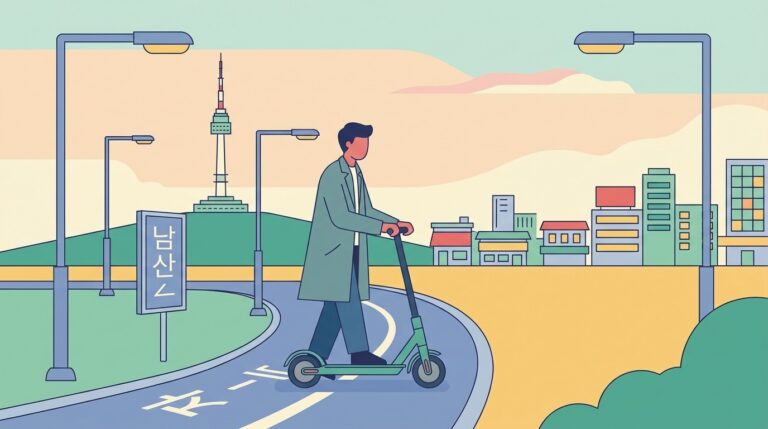
Phase 1: Empathy (Story-driven Opening)
안녕하세요! (Annyeonghaseyo!) It’s your Daily Hangul editor here. Picture this: you just stepped out of Hongdae Station Exit 9 on a gorgeous, breezy autumn evening. Neon street signs are flickering awake, street performers are tuning their guitars, and right there on the corner, you spot rows of sleek, colorful shared electric scooters waiting to be rented with just a smartphone tap. It feels tempting to hop on one to glide down toward the Han River just like you might in Austin, Berlin, or Paris, right?
Suddenly, you see a university student getting pulled aside by local police officers near the crosswalk. The rider looks bewildered, fumbling through their pockets while the officer politely explains the law. Here is the reality check that catches almost every foreign traveler and expat off guard: under the amended Korean Road Traffic Act, an electric kickboard is legally categorized as a motorized vehicle, not a toy or a simple bicycle! You cannot legally ride one without at least a moped operator’s license (원동기장치자전거 면허) or an authentic driver’s license (운전면허증).
If you get caught without one, you can face an on-the-spot fine of 100,000 KRW, not to mention extra penalties for riding without a helmet or riding on pedestrian sidewalks. After working with dozens of international students who panicked after receiving unexpected traffic violation tickets during their first month in Korea, I designed this guide to keep your wallet safe, your Korean natural, and your travels smooth. Let’s master the essential safety expressions and cultural road manners every smart traveler needs!
Phase 2: Top 3 Core Expressions Deep Dive
1. 면허증 있어야 탈 수 있어요 (Myeonheojeung isseoya tal su isseoyo)
- Pronunciation: [Myeon-heo-jeung ee-sseo-ya tal soo ee-sseo-yo] (Sound analogy: Think of ‘myeon’ like ‘puree’ with an ‘m’, and ‘heo’ like a soft English exhale ‘huh’)
- Meaning: Literal: “You must have a license to be able to ride.” / Nuance: “A driver’s license is an absolute prerequisite to unlock or ride this.”
- K-Culture Moment: You will hear this frequently in youth-centered K-Dramas or web-dramas set around Sinchon or Gangnam when an exchange buddy stops their friend from doing something reckless on the sidewalk.
- Editor’s Insight: The grammar pattern
-어야/아야 타다(must do X in order to Y) implies a mandatory condition. Koreans use this when gently warning friends about strict legal or social boundaries. - Situation Spectrum: Casual: ✅ (면허증 있어야 탈 수 있어) | Semi-formal: ✅ | Formal: ✅ (면허증이 있으셔야 탑승이 가능합니다)
- 🤔 Think About It: In many Western countries, shared micro-mobility is treated as pedestrian gear. Why do you think Korea’s dense urban layout prompted authorities to classify e-scooters under motor vehicle laws instead?
2. 헬멧 안 쓰면 벌금 나와요 (Helmet an sseumyeon beolgeum nawayo)
- Pronunciation: [Hel-met an sseu-myeon beol-geum na-wa-yo] (Sound analogy: ‘Beol-geum’ sounds like ‘ball-gum’ with a flat, short ‘u’ sound)
- Meaning: Literal: “If you don’t wear a helmet, a fine comes out.” / Nuance: “You will get ticketed and fined if you ride bareheaded.”
- K-Culture Moment: Seen in Korean variety shows and vlog reels where members tease each other about helmet hair, yet rigidly fasten their chin straps before riding scooters or bikes along the Han River.
- Editor’s Insight: Koreans naturally say 벌금이 나오다 (a fine comes out) rather than ‘you have to pay a fine’. It distances the personal blame and frames it as an inevitable outcome of the system.
- Situation Spectrum: Casual: ✅ | Semi-formal: ✅ | Formal: ⚠️ (Use ‘범칙금이 부과됩니다’ in official administrative contexts)
- 🤔 Think About It: Notice how Korean uses passive phrasing like ‘fines appear’ to soften social confrontation. Does your language assign direct personal blame or use institutional phrasing?
3. 인도에서 타면 안 돼요! (Indo-eseo tamyeon an dwaeyo!)
- Pronunciation: [In-do-eh-seo ta-myeon an dwae-yo] (Sound analogy: ‘Indo’ sounds like the start of ‘indoor’, and ‘dwae’ rhymes with ‘bed’)
- Meaning: Literal: “You must not ride on the sidewalk!” / Nuance: “Keep off the sidewalk—it’s illegal and dangerous for pedestrians!”
- K-Culture Moment: Common in street safety public announcements near bus stops in Seoul, or shouted by worried moms protecting their toddlers.
- Editor’s Insight: In Korean, 인도 (In-do) means ‘pedestrian pavement’, while 차도 (Cha-do) means ‘car roadway’. Riding an e-scooter on the 인도 is strictly illegal; you must use designated bicycle lanes (자전거 도로) or the far right side of the road.
- Situation Spectrum: Casual: ✅ | Semi-formal: ✅ | Formal: ✅
- 🤔 Think About It: How does your home city delineate boundaries between pedestrians and micro-mobility riders? In Korea, pedestrian safety in crowded alleys is a paramount social value.
Phase 3: Textbook Korean vs. Real Korean
Situation 1: Explaining the license requirement
- 📖 교과서 한국어 (Textbook): 전동 킥보드를 운전하려면 반드시 운전면허를 소지해야 합니다. (Jeondong kikbodeureul unjeonhayeomyeon bandeusi unjeonmyeonheoreul sojihayeoya hamnida.)
- 🗣️ 진짜 한국어 (Real-Life): 킥보드 타려면 면허증 필수예요! (Kikbodeu taryeomyeon myeonheojeung pilsu-yeyo!)
- 💡 왜 다를까? (Why is it different?): Textbook Korean uses legalistic phrasing like ‘소지하다’ (to possess). Native speakers in casual settings shorten words to 킥보드 (kickboard) and use the trendy buzzword 필수 (must-have / absolute requirement).
Situation 2: Warning someone about sidewalk riding
- 📖 교과서 한국어 (Textbook): 보도에서 주행할 경우 범칙금이 부과될 수 있습니다. (Bodo-eseo juhaenghal gyeong-u beomchikgeumi bugwadoel su itseumnida.)
- 🗣️ 진짜 한국어 (Real-Life): 인도에서 타면 위험해서 경찰한테 잡혀요. (Indo-eseo tamyeon wiheomhaeseo gyeongchalhante japhyeoyo.)
- 💡 왜 다를까? (Why is it different?): Instead of dry administrative terms like ‘보도’ (footpath) and ‘범칙금 부과’ (fine assessment), real people focus on direct tangible consequences: getting flagged down by the police (경찰한테 잡히다).
Phase 4: K-Culture Deep Dive & Non-Verbal Manners
4-1. 눈치 (Nunchi) & Street Gestures
When navigating Korean streets, pedestrian right-of-way is fiercely guarded. Sidewalks in commercial districts like Myeongdong, Gangnam, or Euljiro are narrow and crowded with office workers, delivery couriers, and elders. If you accidentally ring a bell loudly on a sidewalk, pedestrians will not just step aside; they will give you a sharp, disapproving stare (눈총, nunchong).
* Eye Contact & Nodding: If you are pushing a kickboard past pedestrians, keep your head slightly dipped in a micro-bow (목례) to signal humility and apology for taking up space.
* Couriers First: Motorbike couriers (배달 라이더) dominate narrow alleyways. Korean pedestrians and micro-riders constantly exercise sensory Nunchi—listening for the buzz of an approaching delivery bike before turning a corner.
4-2. Cultural Code: The Rise of “Kick-rani” (킥라니)
Koreans coined the viral satirical compound word 킥라니 (Kick-rani), blending 킥보드 (kickboard) with 고라니 (water deer). In the Korean countryside, water deer are notorious for suddenly darting out from nowhere into dark highways, causing sudden accidents. Similarly, reckless e-scooter riders who blast through red lights or pop out between parked buses are labeled ‘Kick-rani’.
Public sentiment toward rule-breaking riders is very severe due to several high-profile pedestrian collisions covered on Korean evening news programs. Understanding this background helps you see why Korean citizens and police enforce license checks and helmet regulations so diligently.
Phase 5: Real-Life Roleplay Scenario
- Setting: Outside Sinchon Subway Station Exit 3 on a Friday evening. Alex (an international exchange student) is looking at a shared scooter on the sidewalk. Min-jun (Alex’s Korean classmate) steps in.
-
Min-jun: 어? 알렉스, 뭐 보고 있어? 설마 그거 타려고? (Eo? Alex, mwo bogo isseo? Seolma geugeo taryeogo?)
🎭 Eyes widening in surprise, pointing at the green kickboard.
(Huh? Alex, what are you looking at? You’re not thinking of riding that, are you?) -
Alex: 어, 신촌에서 연남동까지 날씨도 좋은데 킥보드 타고 갈까 해서! (Eo, Sinchon-eseo Yeonnam-dong-kkaji nalssido joeunde kikbodeu tago galkka haeseo!)
🎭 Pulling out his smartphone with a cheerful smile.
(Yeah, the weather is nice, so I thought I’d ride a kickboard from Sinchon to Yeonnam-dong!) -
Min-jun: 잠깐만! 알렉스, 한국 운전면허증 있어? (Jamkkanman! Alex, Hanguk unjeonmyeonheojeung isseo?)
🎭 Waving his hand urgently in front of Alex’s phone screen.
(Hold on! Alex, do you have a Korean driver’s license?) -
Alex: 아니, 없는데? 그냥 앱 설치하고 결제 카드 등록하면 되는 거 아니야? (Ani, eomneunde? Geunyang aep seolchihago gyeolje kadeu deongnokhayeon doeneun geo aniya?)
🎭 Tilting his head with an innocent, puzzled expression.
(No, I don’t? Don’t you just install the app and register a payment card?) -
Min-jun: 큰일 날 소리! 면허증 없으면 법적으로 아예 못 타. 무면허 운전으로 걸려. (Keunil nal sori! Myeonheojeung eopseumyeon beopjeogeuro aye mot ta. Mumyeonheo unjeoneuro geollyeo.)
🎭 Shaking his head firmly with a serious gaze.
(No way! Without a license, you legally cannot ride it at all. You’ll get caught for unlicensed driving.) -
Alex: 진짜? 외국인은 국제운전면허증이나 다른 인증이 필요한 거야? (Jinjja? Oegugineun gukje-unjeonmyeonheojeung-ina dareun injeung-i pil-yohan geoya?)
🎭 Lowering the phone, clearly shocked.
(Really? Do foreigners need an International Driving Permit or another verification?) -
Min-jun: 응, 원동기 면허 이상 있어야 돼. 게다가 헬멧 안 쓰면 바로 벌금 2만 원이야! (Eung, wondonggi myeonheo isang isseoya dwae. Gedaga helmet an sseumyeon baro beolgeum i-man won-iya!)
🎭 Tapping the top of his head to mimic a helmet.
(Yeah, you need at least a motorized bicycle license. Plus, without a helmet, it’s an immediate 20,000 won fine!) -
Alex: 와, 몰랐으면 경찰서 갈 뻔했네. 그냥 지하철 타고 가자! (Wa, mollasseumyeon gyeongchalseo gal ppeonhaenne. Geunyang jihacheol tago gaja!)
🎭 Sighing in relief and slipping his phone back into his pocket.
(Wow, if I didn’t know that, I could’ve ended up at the police station. Let’s just take the subway!)
🔀 Interactive Branching Decision Point
Suppose your friend asks you to ride on the back of their shared scooter together (two people on one board) without helmets.
- Choice A: “둘이 같이 타면 위험하니까 지하철 타자!” (Duri gachi tamyeon wiheomhanikka jihacheol taja! – It’s dangerous for two people to ride together, let’s take the subway!)
- Choice B: “딱 5분만 인도에서 천천히 타자.” (Ttak obunman indo-eseo cheoncheonhi taja. – Let’s just ride slowly on the sidewalk for 5 minutes.)
- Choice C: “헬멧 없으니까 걸리면 네가 벌금 내.” (Helmet eopseunikka geollyimyeon nega beolgeum nae. – Since we don’t have helmets, if we get caught, you pay the fine.)
-
Outcome Evaluation:
- Choice A (Best): Perfect safety and legal fluency! Riding tandem on an e-scooter carries a 40,000 KRW fine, and sidewalk riding adds another 30,000 KRW. Taking public transit saves money and avoids danger.
- Choice B (Risk): Dangerous! Pedestrian sidewalks are heavily monitored by CCTV and foot patrol. Riding tandem on a sidewalk exposes you to multiple severe violations.
- Choice C (Bad): Disrespects your friend and the law. Even as a passenger, you put both parties at high risk of severe head injury and legal liability.
Phase 6: 10-Second Emotional Shadowing Drill
Practice matching your tone to natural native emotional reactions:
[🚨 당황하며 진지하게 / Panicked & Serious]- 면허증 없으면 / 절대 타면 안 돼요! (Myeonheojeung eopseumyeon / jeoldae tamyeon an dwaeyo!)
(If you don’t have a license / you must never ride it!)
- 면허증 없으면 / 절대 타면 안 돼요! (Myeonheojeung eopseumyeon / jeoldae tamyeon an dwaeyo!)
[💡 깨달은 듯 명쾌하게 / Realizing & Informative]- 킥보드는 / 차도나 자전거 도로에서만 / 탈 수 있어요. (Kikbodeuneun / chadona jajeon-geo doro-eseoman / tal su isseoyo.)
(Kickboards / can only be ridden / on car roads or bike paths.)
- 킥보드는 / 차도나 자전거 도로에서만 / 탈 수 있어요. (Kikbodeuneun / chadona jajeon-geo doro-eseoman / tal su isseoyo.)
[🚴 단호하고 확실하게 / Firm & Protective]- 헬멧 꼭 쓰세요, / 안 쓰면 바로 벌금 나와요! (Helmet kkok sseuseyo, / an sseumyeon baro beolgeum nawayo!)
(Make sure to wear a helmet, / if you don’t, you’ll get fined right away!)
- 헬멧 꼭 쓰세요, / 안 쓰면 바로 벌금 나와요! (Helmet kkok sseuseyo, / an sseumyeon baro beolgeum nawayo!)
Phase 7: K-Culture Mini Dictionary
- 전동 킥보드 (Jeondong Kikbodeu) | Personal Mobility (PM) / Electric Scooter
- In everyday conversation, locals omit 전동 and simply call it 킥보드. Legally referred to as 개인형 이동장치 (PM).
- 킥라니 (Kick-rani) | Reckless Scooter Rider (Kickboard + Elk)
- A slang term widely used in news headlines, YouTube car dashboard cam videos (한문철 TV), and social forums criticizing unpredictable riders.
- 원동기장치자전거면허 (Wondonggi-jangchi-jajeon-geo-myeonheo) | Motorized Bicycle License (Moped License)
- The minimum legal certification level required to operate an electric scooter in South Korea. Can be acquired from age 16.
- 범칙금 (Beom-chik-geum) | Traffic Violation Fine
- The official financial sanction issued on the spot by police officers for infractions such as no helmet (20,000 KRW), unlicensed riding (100,000 KRW), or sidewalk riding (30,000 KRW).
Phase 8: Traveler’s Survival Kit
Top 3 Survival Phrases
- 여기 자전거 도로 있어요? (Yeogi jajeon-geo doro isseoyo?)
- Meaning: “Is there a bicycle path around here?”
- Pro Tip: Use this when renting a city bike to confirm you don’t end up trapped between heavy highway traffic and prohibited sidewalks.
- 헬멧은 어디서 빌려요? (Helmeteun eodiseo billyeoyo?)
- Meaning: “Where can I borrow/rent a helmet?”
- Pro Tip: Most shared scooter kiosks don’t provide clean helmets. If an officer spots you helmetless, claiming you couldn’t find one does not exempt you from the fine.
- 따릉이 정류장이 어디예요? (Ttareung-i jeongnyujang-i eodiyeyo?)
- Meaning: “Where is the Ddareungi (Seoul Public Bike) docking station?”
- Pro Tip: Don’t have a Korean driver’s license? Seoul’s famous public green bicycles (Ddareungi) do NOT require a driver’s license!
Editor’s Travel Note
Before planning your micro-commutes across Seoul, download and set up your navigation using the 네이버 지도 앱 다운로드. Naver Map features a dedicated “Bicycle” navigation mode that highlights official bike-friendly roads while steering you clear of restricted expressways and pedestrian zones.
If you lack an eligible driver’s license, bypass e-scooters altogether and review the 따릉이 서울 공공자전거 대여 가이드. Ddareungi is cheaper, safer, accepts foreign credit cards seamlessly, and keeps you well outside the crosshairs of traffic police.
Phase 9: “한 발 더 깊이” (Deep Cultural Reflection)
In South Korea’s hyper-dense metropolitan centers, shared space is governed by an unwritten social compact: individual convenience must never undermine communal safety. Because generations grew up navigating narrow alleys packed with street vendors, residential entrances, and bustling markets, the sidewalk is considered an inviolable sanctuary for children, the elderly, and strollers. When electric kickboards flooded Seoul sidewalks, public backlash was swift, prompting the National Assembly to enact some of the strictest micro-mobility regulations in the world. Embracing these rules is not merely about avoiding fines; it is your active demonstration of respect toward the everyday citizens sharing the pavement beside you.
💬 Your Turn: Have you ever encountered shared e-scooters in your home country? How are the license and helmet rules different from Korea? Share your hometown rules in the comments below!
Phase 10: FAQ & Common Mistakes
Q: Can I use an International Driving Permit (IDP) to rent an electric kickboard on Korean apps?
A: In legal theory, yes—an IDP (Category A or B) or a domestic Korean Class 2 Ordinary Driver’s License allows you to ride. However, in practice, many domestic Korean kickboard apps (like Swing, Beam, or Kickgoing) require verification via a Korean telecommunications carrier (휴대폰 본인인증) or a registered Korean Alien Registration Card (ARC), making it technically difficult for short-term tourists on 90-day visas to unlock them.
Q: What happens if I get caught riding an e-scooter while intoxicated after drinking Soju?
A: Never do this under any circumstances! Korea treats riding a personal mobility device under the influence identically to driving a motor vehicle under the influence (음주운전). If your blood alcohol concentration exceeds 0.03%, you will face an immediate 100,000 KRW fine, your regular driving license can be suspended or revoked, and criminal charges may apply if an accident occurs.
Q: Can two people share one electric scooter if we both wear helmets?
A: Absolutely not! Korea’s Road Traffic Act strictly bans tandem riding (동승자 탑승 금지) on single-rider personal mobility devices. If two people ride on one board together, the operator will be fined 40,000 KRW immediately, regardless of whether helmets are worn.
🚨 Common Mistakes Alert
- Mistake 1: Riding on pedestrian sidewalks to avoid fast cars.
- Correct Action: If there is no dedicated bicycle path (자전거 도로), you must ride on the right-hand edge of the regular vehicular road (차도 우측). If road traffic feels intimidating, dismount and walk the scooter on the sidewalk!
- Mistake 2: Assuming shared kickboards work like bicycles without license checks.
- Correct Action: Always check the legal vehicle status. Rent a Seoul Public Bike (Ddareungi) instead if you do not possess an authenticated license.
- Mistake 3: Abandoning the scooter right in front of subway entrances or tactile paving for the visually impaired.
- Correct Action: Seoul implements tow-away fines (견인료) of up to 40,000 KRW plus storage fees for improperly parked scooters. Park scooters neatly alongside roadside bicycle racks or designated PM parking zones.
Phase 11: Action Mission & Community Engagement
- 🥉 Bronze Mission (Solo Mastery): Practice saying the shadowing sentence: “면허증 없으면 절대 타면 안 돼요!” 5 times aloud until your tongue naturally flows without hesitating at ‘-면 안 돼요’.
- 🥈 Silver Mission (Social Connect): Take a photo of an official Korean bike lane marker or public Ddareungi rack, post it to your Instagram story, and caption it: “킥보드 대신 따릉이 타요! (Riding Ddareungi instead of a kickboard!)” and tag
@dailyhangul. - 🥇 Gold Mission (Real-life Practice): Next time you spot an unattended electric kickboard in Seoul, look at the safety sticker on the steering column and identify the Hangul words for ‘면허’ (license), ‘헬멧’ (helmet), and ‘인도 주행 금지’ (no riding on sidewalks)!
- 🎮 K-Culture Mission: Watch an episode of a modern Seoul-based web drama or vlog and spot how pedestrians react when a delivery bike or kickboard passes by. Notice their eye direction and shoulder shifts!
Phase 12: Interactive Quiz Challenge
Test your knowledge before hitting the streets of Korea! Pick your answers, then expand the toggle below to verify.
- Situational Judgment: You are traveling in Busan with your friend. Both of you want to ride shared electric kickboards along the beachfront, but neither of you holds a Korean or International driver’s license. What should you do?
- (A) Ride slowly on the pedestrian boardwalk where cars cannot hit you.
- (B) Rent city bicycles (which do not require a driver’s license) and wear helmets.
- (C) Have both friends stand together on one kickboard to share one rental.
- Fill-in-the-Blank: Complete the safety warning in Korean:
- “인도에서 타면 안 돼요! 자전거 ______로 가세요.” (You must not ride on the sidewalk! Please go to the bicycle ______.)
- (A) 식당 (sikdang)
- (B) 도로 (doro)
- (C) 서점 (seojeom)
- True or False Culture Check: In South Korea, riding an electric kickboard without a safety helmet is considered a minor guideline, and police cannot issue monetary fines to foreigners.
- (True / False)
👉 Click to reveal answers & explanations!
- Answer: (B)
- Explanation: Electric kickboards strictly require a valid driver’s license. Operating one without it constitutes unlicensed driving (무면허 운전) with a 100,000 KRW fine. Bicycles, however, are open to non-license holders!
- Answer: (B) 도로 (doro – road/path)
- Explanation: 자전거 도로 translates directly to ‘bicycle path/road’. You must avoid sidewalks (인도) and use designated bicycle lanes or the right shoulder of the car road.
- Answer: False
- Explanation: Wearing a certified safety helmet (안전모) is an active legal mandate under Article 50 of the Korean Road Traffic Act. Failure to wear one results in an immediate 20,000 KRW traffic fine for citizens and foreigners alike!
- Explanation: Wearing a certified safety helmet (안전모) is an active legal mandate under Article 50 of the Korean Road Traffic Act. Failure to wear one results in an immediate 20,000 KRW traffic fine for citizens and foreigners alike!







