

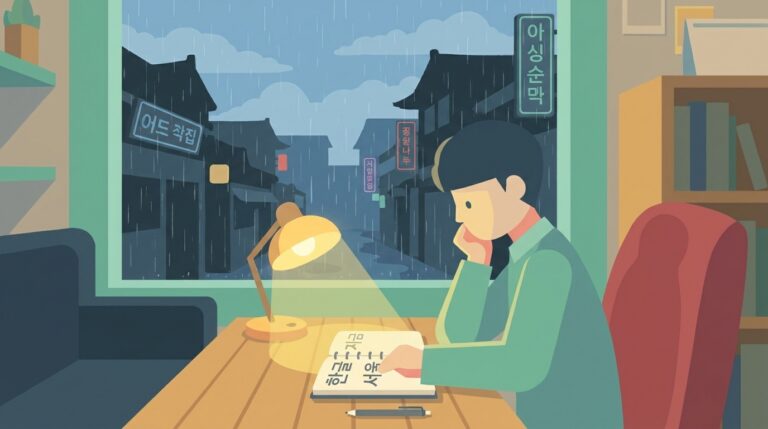
Crafting an Inimitable Human Literary Style in the Age of AI
Phase 1: Empathy & Immersion Opening
안녕하세요! 매일한글 에디터입니다. (Hello! It is your Daily Hangul editor.)
Have you ever spent hours polishing an advanced Korean essay or personal statement, only to run it through DeepL or ChatGPT and feel a sudden sinking sensation in your chest? The machine-generated version is grammatically flawless. Its particles are immaculate, its conjunctions seamlessly placed. Yet, as you read it aloud, it feels curiously sterile—like walking into an air-conditioned, plastic-scented hotel lobby rather than breathing in the intoxicating petrichor of a rain-soaked Seoul alleyway. Many C1 and C2 learners come to me with this exact creative crisis: “If neural networks can write textbook Korean with zero errors, what is left for my own voice? How do I write something that machine translation could never invent?”
Here is the liberating truth: authentic Korean literary aura (아우라) cannot be synthesized by predictive token matching. True stylistic brilliance is not born from an algorithm calculating probability; it is forged in the sensory grit of physical reality, the tears you swallowed in silence after a devastating setback, and the courage to articulate contradictory, messy emotions without flinching. When Nobel laureate Han Kang writes or when master screenwriters like Park Hae-young (My Liberation Notes, My Mister) construct dialogue, they draw from lived, tactile friction that AI simply cannot experience. Based on years of mentoring advanced international writers, translators, and creators, this masterclass provides the architectural blueprint to break free from algorithmic monotony and cultivate an unmistakable, deeply human literary voice in Korean.
Phase 2: Deep Dive into 3 Core Literary Expressions
1. 날것의 감각 (Nalgeot-ui gamgak)
- Pronunciation: [Nal-geot-ui gam-gak] (Think of ‘nal’ as in ‘nullify’ cut short, ‘geot’ sounding like ‘gut’, and ‘gam-gak’ mirroring ‘gum-guck’)
- Meaning: Literally “raw/uncooked sensation”; nuanced as unvarnished, visceral sensory truth untainted by conceptual clichés.
- K-Culture Moment: Seen frequently in critical literary reviews and auteur cinema commentaries (such as analyses of Bong Joon-ho’s Parasite or Lee Chang-dong’s Burning), celebrating text or scenes that plunge straight into tactile human reality without decorative euphemisms.
- Editor’s Insight: Machines default to sanitized abstractions: “힘들었다” (it was hard) or “슬펐다” (it was sad). Humans who write with authority evoke 날것의 감각—the metallic tang of blood in your mouth, the damp chill of a basement apartment in Sillim-dong, or the greasy steam rising from a late-night pojangmacha.
- Situation Spectrum: Casual ⚠️ | Semi-formal ✅ | Formal/Literary ✅
- 🤔 Think About It: Does your native tongue distinguish between mere “vivid detail” and “raw truth”? How does acknowledging the uncurated grime of life shift a sentence from sterile description to haunting prose?
2. 속울음을 삼키다 (Sok-ureum-eul samkida)
- Pronunciation: [Sok-u-reum-eul sam-ki-da] (Pronounce ‘sok’ like ‘soak’ but abruptly clipped, ‘u-reum’ like ‘oo-reum’, and ‘sam-ki-da’ like ‘sahm-key-dah’)
- Meaning: Literally “to swallow inner crying”; nuanced as the disciplined, dignified suppression of tears, enduring gut-wrenching grief without making a spectacle.
- K-Culture Moment: The thematic backbone of legendary K-dramas like My Mister (나의 아저씨). It describes characters who carry the unbearable weight of life in stoic silence, revealing pain only through an unhurried exhale or a trembling hand.
- Editor’s Insight: AI translates sorrow into explicit hysterics. Korean emotional intelligence (Jeong and Han), however, finds its highest aesthetic climax in restraint. When you use 속울음을 삼키다, the reader senses the immense hydraulic pressure of grief held beneath a calm surface.
- Situation Spectrum: Casual 🚫 | Semi-formal ✅ | Formal/Literary ✅
- 🤔 Think About It: In many Western traditions, catharsis requires vocal externalization. Why does Korean culture revere the aesthetic weight of swallowed suffering?
3. 서럽도록 찬란하다 (Seoreopdorok chanranhada)
- Pronunciation: [Seo-reop-do-rok chan-ran-ha-da] (Sound analogy: ‘Sir-up-dough-rock chahn-rahn-ha-dah’)
- Meaning: Literally “sorrowful to the point of being radiant”; nuanced as an agonizingly exquisite, bittersweet contradiction where joy and grief coexist at their absolute peaks.
- K-Culture Moment: A quintessential oxymoronic cadence frequently found in modern Korean poetry, indie songwriting (such as Lucid Fall or Kim Kwang-seok), and melancholic romance cinema. It captures spring blossoms falling over a graveyard or a triumphant graduation attended alone.
- Editor’s Insight: Generative language models despise contradiction; they smooth out paradoxes into logical consistency. But human emotional depth is inherently paradoxical. Embracing emotional oxymorons like 서럽도록 찬란하다 makes your prose immediately inimitable.
- Situation Spectrum: Casual 🚫 | Semi-formal ⚠️ | Formal/Literary ✅
- 🤔 Think About It: Can something be so dazzling that it actually breaks your heart? What does this reveal about how Korean thinkers view the impermanence of beauty?
Phase 3: Textbook Korean vs. Real Korean
Scenario 1: Describing a grueling personal trial
- 📖 교과서 한국어 (Textbook/AI Korean):
저는 많은 고난과 역경을 겪었지만 포기하지 않고 끝내 극복해 냈습니다. (Jeoneun maneun gonangwa yeokgyeongeul gyeokeotjiman pogihaji anko kkeunnae geukbokanet-seumnida.)
“I experienced much hardship and adversity, but did not give up and finally overcame it.” - 🗣️ 진짜 한국어 (High-Human Literary Mastery):
진흙탕에 처박힌 채 바닥을 박박 긁어본 사람만이 뿜어내는 날선 문장이 있습니다. (Jinheuktange cheobakin chae badeageul bakbak geulgeobon sarammani ppumeonaeneun nalseon munjangi itseumnida.)
“There exists a razor-sharp sentence that can only be exhaled by someone who has clawed desperately at bedrock while face-down in the mud.” - 💡 왜 다를까? (Cultural & Stylistic Nuance): The textbook sentence relies on flat, abstract Sino-Korean nouns (고난, 역경, 극복) that read like a corporate mission statement. The real human literary register employs visceral physical verbs and onomatopoeia (처박히다, 박박 긁다, 뿜어내다) to make the agony physically felt.
Scenario 2: Articulating complex, ambushed nostalgia
- 📖 교과서 한국어 (Textbook/AI Korean):
과거를 회상하니 슬프면서도 기쁜 복합적인 감정이 듭니다. (Gwagoreul hoesanghani seulpeumyeonseodo gippeun bokhapjeogin gamjeongi deumnida.)
“Recalling the past gives rise to complex emotions that are both sad and happy.” - 🗣️ 진짜 한국어 (High-Human Literary Mastery):
그 시절을 떠올리면 가슴 한구석이 아릿하면서도 서글픈 미소가 번집니다. (Geu sijeoreul tteoollimyeon gaseum hanguseogi arit-hamyeonseodo seogeulpeun misoga beonjimnida.)
“Whenever that era surfaces in my mind, an aching pang grazes a corner of my heart, and a faintly desolate smile spreads across my lips.” - 💡 왜 다를까? (Cultural & Stylistic Nuance): Stating that an emotion is “complex” (복합적인) is analytical telling. Using sensory descriptors like 아릿하다 (a stinging, bruised ache) alongside 번지다 (to spread like watercolor) evokes true empathetic resonance.
Phase 4: K-Culture Deep Dive & Non-Verbal Nuance
4-1. Nunchi & The Physicality of Vulnerability
In advanced Korean composition and public discourse, vulnerability is not delivered with theatrical flamboyance. It is conveyed through physical stillness and vocal containment. When a Korean author or intellectual shares a hard-won truth during a book talk or an intimate podcast, notice their non-verbal grammar:
* The Gaze (시선 처리): They do not stare aggressively into the lens. Instead, their gaze drops slightly to their hands or a neutral point on the table—a physical manifestation of looking inward to retrieve an unvarnished memory.
* The Micro-Pause (숨고르기): Rather than filling silence with transition fillers (어, 음), the speaker allows a two-second silence to linger, letting the atmospheric weight settle in the room.
* The Lowered Pitch (속내를 터놓는 톤): Emotional honesty is delivered a half-octave lower than social pleasantries, signaling that the social mask has been set aside.
4-2. Cultural Code: The Evolution from ‘Han’ (한) to Translucent Honesty
For decades, international scholars fixated on Han (한)—the collective, pent-up grief and unresolved sorrow of Korean history. However, contemporary 21st-century Korean literature and cinema have transformed Han into something far more intimate: radical transparency. In the essays of Lee Seul-ah or the fiction of Kim Ae-ran, writers no longer romanticize misery; they examine the exact cost of living in hyper-competitive Seoul with surgical precision and self-deprecating grace. They do not write about poverty or heartbreak in high-flown poetic rhetoric; they count the exact won left in their bank account and describe the humidity clinging to their socks. AI models trained on averages will always choose predictable, grand metaphors. Human aura lives in these hyper-specific, humble details.
Phase 5: Real-World Roleplay Scenario
Setting: A quiet, book-lined café tucked inside the publishing enclave of Paju Book City (파주출판도시). Soft rain taps against floor-to-ceiling glass.
Characters:
* 민서 편집장 (Editor Minseo): A seasoned, discerning literary editor known for rejecting manuscripts that lack emotional pulse.
* 학습자 (You): An advanced Korean writer submitting a deeply personal memoir chapter that was previously critiqued for feeling “mechanically sterile.”
— Dialogue (8 Turns) —
Turn 1: 민서 편집장
* 🎭 원고를 책상에 내려놓고, 안경을 벗으며 진지한 눈빛으로 바라본다. (Won-goreul chaeksange naeryeonoko, angyeongeul beoseumyeo jinjihan nunbicheuro barabonda.)
* “지난번 초고는 솔직히 인공지능이 쓴 것처럼 문장만 번지르르했어요. 그런데 이번 수정본은 첫 문장부터 질감이 완전히 다르네요.”
* (Jinambeon chogoneun soljiki ingongjineungi sseun geotcheoreom munjangman beonjireureuhaesseoyo. Geureonde ibeon sujeongboneun cheot munjangbuteo jilgami wanjeonhi dareuneyo.)
* “To be candid, your previous draft was all glossy surface, as if written by an AI. But this revision… the sensory texture is completely different right from the opening line.”
Turn 2: 학습자 (You)
* 🎭 따뜻한 찻잔을 두 손으로 감싸 쥐며 엷은 미소를 짓는다. (Ttatteutan chatjaneul du soneuro gamssa jwimyeo yeolbeun misoreul jinneunda.)
* “교과서적인 어휘를 다 걷어내고, 제가 그 골목에서 직접 삼켰던 눈물의 맛을 날것 그대로 적어봤습니다.”
* (Gyogwaseojeogin eohwireul da geodeonaego, jega geu golmogeseo jikjeop samkyeotdeon nunmul-ui maseul nalgeot geudaero jeogeobwasseumnida.)
* “I stripped away the textbook vocabulary and wrote down the raw taste of the tears I swallowed in that alleyway, exactly as it was.”
Turn 3: 민서 편집장
* 🎭 원고지의 한 구절을 손가락 끝으로 짚으며 고개를 끄덕인다. (Wongoji-ui han gujeoreul songarak kkeuteuro jipeumyeo gogaereul kkeodeoginda.)
* “여기 ‘서럽도록 시린 새벽 공기’라는 대목… 이건 데이터셋을 긁어모아서는 절대 나올 수 없는 체온이 느껴져요.”
* (Yeogi ‘seoreopdorok sirin saebyeok gonggi’raneun daemok… Igeon deiteose-eul geulgeomowaseoneun jeoldae naol su eomneun che-oni neukkyeojyeoyo.)
* “This passage right here—’the dawn air that was piercingly, sorrowfully crisp’… It radiates a human body heat that no aggregated dataset could ever synthesize.”
Turn 4: 학습자 (You)
* 🎭 시선을 잠시 창밖의 빗줄기로 돌렸다가 다시 편집장을 응시한다. (Siseoneul jamsi changbakk-ui bitjulgiro dollyeotdaga dasi pyeonjipjangeul eungsihanda.)
* “실패를 미화하지 않고 바닥까지 솔직해지려고 하니, 오히려 문장에 비로소 숨구멍이 트이는 것 같았습니다.”
* (Silpaereul mihwahaji anko badakkkaji soljikaejiryeogo hani, ohiryeo munjange biroso sumgumeongi teu-ineun geot gatatseumnida.)
* “When I stopped romanticizing my failures and allowed myself to be honest down to the bedrock, it felt as though the prose finally found room to breathe.”
Turn 5: 민서 편집장
* 🎭 만족스러운 표정으로 찻잔을 들어 한 모금 마신다. (Manjokseureoun pyojeongeuro chatjaneul deureo han mogeum masinda.)
* “맞아요. 기계는 실패를 부끄러워하거나 모순된 마음에 아파하지 못하죠. 바로 그 결함이 인간 문체의 독보적인 지문이에요.”
* (Majayo. Gigyeneun silpaereul bukkeureowohagona mosundoen maeume apahaji mot-hajo. Baro geu gyeolhami ingan munche-ui dokboyeogin jimun-ieyo.)
* “Precisely. Machines cannot feel shame over failure or ache over contradictory impulses. Those very imperfections are the inimitable fingerprint of human style.”
Turn 6: 학습자 (You)
* 🎭 가벼운 안도의 한숨을 내쉬며 자세를 고쳐 앉는다. (Gabyeoun ando-ui hansumeul naeswimyeo jasereul gocheo anneunda.)
* “번역기의 완벽함에 주눅 들었던 시간들이, 결국 제 고유한 결을 찾는 통과의례였던 셈이네요.”
* (Beon-yeoggi-ui wanbyeokhame junuk deureotdeon sigandeuri, gyeolguk je goyuhan gyeoreul channeun tonggwa-uiryeyeotdeon semineyo.)
* “The time I spent intimidated by the flawless precision of machine translation was, in the end, just a rite of passage to finding my own innate grain.”
Turn 7: 민서 편집장
* 🎭 붉은색 만년필을 꺼내 원고 맨 앞장에 서명한다. (Bulgeunsaek man-yeonpireul kkeonae won-go maen apjange seomyeonghanda.)
* “이 원고로 출판 계약 진행합시다. 이제 독자들에게 당신의 진짜 목소리를 들려줄 차례입니다.”
* (I won-goro chulpan gyeyak jinhaenghapsida. Ije dokjadeurege dangsin-ui jinjja moksorireul deullyeojul charye-imnida.)
* “Let’s proceed with the publishing contract on this manuscript. It is time to let readers hear your authentic voice.”
Turn 8: 학습자 (You)
* 🎭 깊이 고개 숙여 인사하며 단단한 어조로 답한다. (Gipi gogae sugyeo insahamyeo dandanhangeuro daphanda.)
* “제 속울음과 날것의 삶을 믿어주셔서 감사합니다. 끝까지 정직하게 쓰겠습니다.”
* (Je sok-ureumgwa nalgeot-ui sarmeul mideojusyeoseo gamsahamnida. Kkeutkkaji jeongjikage sseugesseumnida.)
* “Thank you for trusting my swallowed tears and my raw life. I will write with unwavering honesty until the very end.”
— 🔀 Interactive Decision Branch —
Imagine Editor Minseo challenges your climax: “이 단락은 감정이 너무 정돈되어 있어서 AI가 쓴 요약본 같아요. 어떻게 고치실 건가요?” (This paragraph is so neatly organized that it reads like an AI summary. How will you rewrite it?)
- Choice A (Best): “이론적인 설명 대신, 실패했던 날 새벽 버스 창문에 이마를 대고 느꼈던 유리의 차가운 감각부터 다시 시작하겠습니다.”
- Outcome: Exceptional. Grounding the narrative in visceral physical sensations (날것의 감각) instantly shatters the AI sheen.
- Choice B (Bad): “더 어려운 사자성어와 고급 한자어를 추가해서 문장의 격을 높이겠습니다.”
- Outcome: Dreadful. Layering archaic Sino-Korean idioms only makes the text stiffer, accelerating its artificial, mechanical quality.
- Choice C (Risk): “문법을 일부러 파괴하고 비속어를 섞어 충격적인 문장으로 바꾸겠습니다.”
- Outcome: High Risk. Slang can convey rawness, but without emotional authenticity, it degenerates into cheap shock value rather than literary depth.
Phase 6: 10-Second Emotion Shadowing Drill
Train your vocal cords to internalize the pauses (/) and visceral emotional colors that generative algorithms can never replicate:
- [🌧️ 비장하고 솔직하게 – Solemn & Unvarnished Honesty]
화려한 수식어를 / 다 걷어내고 나니 / 비로소 / 내 진짜 밑바닥이 드러났다.
(Hwaryeohan susigeoreul / da geodeonaego nani / biroso / nae jinjja mitbadagi deureonatda.)
“Only after stripping away / all the ornate rhetoric / did my true bedrock / finally emerge.” -
[🍂 담담하지만 깊은 여운으로 – Calm yet Haunting Resonance]
기계는 결코 / 차가운 골목길에서 삼킨 / 그 쓰디쓴 눈물의 온도를 / 흉내 낼 수 없다.
(Gigyeneun gyeolko / chagaun golmokgireseo samkin / geu sseudisseun nunmul-ui ondoreul / hyungnae nael su eopda.)
“A machine can never / imitate the searing temperature / of those bitter tears / swallowed in a cold back-alley.” -
[✨ 모순된 감정의 절정에서 – At the Height of Paradoxical Emotion]
모든 것이 무너져 내린 폐허 위에서도 / 생은 / 서럽도록 찬란하게 피어오른다.
(Modeun geosi muneojyeo naerin pyeheo wieseodo / saengeun / seoreopdorok chanranhage pieo-oreunda.)
“Even atop the ruins where everything has collapsed / life / blossoms with piercing, sorrowful radiance.”
Phase 7: K-Culture Mini Dictionary
-
결 (Gyeol)
- Translation: The natural grain, texture, or intrinsic temperament.
- Usage: Originating from wood grain (나뭇결), it is used in creative critique to describe a person’s unique stylistic aura or emotional temperament: “그 작가의 글은 결이 곱다” (That writer’s prose possesses a tender, exquisite grain).
- 살풀이 (Salpuri)
- Translation: Spiritual exorcism of ill-fortune; emotional catharsis through artistic ritual.
- Usage: Originally a shamanic dance, it now describes intense, deeply personal creative work that exorcises deep trauma: “이번 자전적 소설은 내게 일종의 살풀이였다” (This autobiographical novel was a form of spiritual exorcism for me).
- 자조 (Jajo)
- Translation: Self-mockery; rueful self-derision.
- Usage: Essential for modern Korean literary voice. Rather than pitying oneself, 자조적 유머 (self-deprecating wit) creates an instant bond of solidarity with the reader.
- 현장감 (Hyeonjanggam)
- Translation: Sensory presence; the palpable feeling of being on-site.
- Usage: Critical in narrative nonfiction. Describes text steeped in ambient noise, smells, and spatial reality: “글에서 노량진 수산시장의 비릿한 현장감이 느껴진다” (One can feel the raw, briny presence of Noryangjin Fish Market in this prose).
Phase 8: Survival Kit for Travelers & Field-Writers
To write with human grit, you must step away from screens and immerse yourself in the tactile reality of Korea. Here are three field expressions for documenting living culture:
- TOP 1: 여기가 삶의 터전인 게 피부로 와닿네요. (Yeogiga salm-ui teojeonin ge piburo wadatneyo.)
- Meaning: “I can feel in my very skin that this is a crucible of real human livelihood.”
- Pro Tip: Use this when visiting historic, hard-working communities like Euljiro metal-tool alleys or Jagalchi Market in Busan. It shows profound respect for working people.
- TOP 2: 세월의 흔적이 문체에 고스란히 묻어납니다. (Seweor-ui heunjeogi munche-e goseuranhi mudeonamnida.)
- Meaning: “The patina of time has soaked completely into the style.”
- Pro Tip: Perfect for praising an elder artisan, independent publisher, or classic bookshop owner.
- TOP 3: 숨은 맛과 멋을 온몸으로 느끼고 갑니다. (Sumeun matgwa meoseul onmomeuro neukkigo gamnida.)
- Meaning: “I leave having experienced the hidden flavor and soulful grace with my entire body.”
- Pro Tip: Say this to the owner of an unpretentious, historic eatery (노포) before stepping out into the evening chill.
Editor’s Travel Note: When conducting field writing in Seoul, don’t stay glued to algorithmic tourist recommendations. Use the Naver Map app to search for 노포 (heritage diners) or 독립서점 (indie bookstores) in Seongbuk-dong or Mullae-dong. Take the subway out to Paju Book City on the red bus #2200 from Hapjeong Station; the tactile rustle of paper and damp concrete will give your Korean prose an instant infusion of human aura.
Phase 9: “One Step Deeper” (Philosophical Essay & Reflection)
Language models are trained to optimize predictability. By statistical definition, an AI seeks the safest, most likely token to follow the preceding one. But human literature has never been about predictability. The most transcendent sentences in Korean literature are precisely those that violate probability—where a writer holds two irreconcilable truths at once: fierce love and quiet resentment, crushing despair and blinding joy.
In Korean, we call this elusive texture 체온 (human body heat). When you write from your actual scars, your vocabulary changes. You stop choosing Latinate or Sino-Korean generalizations and begin selecting native Korean words that carry physical weight: 짓무르다 (to become raw and chafed), 에이다 (to be lacerated by cold), 아스라하다 (to be faintly, hauntingly distant). These are words shaped by vocal cords that have known thirst, fatigue, and wonder. In an era where flawless text can be produced in milliseconds, your most precious literary asset is not syntactic perfection—it is your unrepeatable human footprint.
💬 Your Turn: What is one personal failure or contradictory emotion in your life that no machine translation tool could ever capture? In the comments below, try writing one sentence about it using 날것의 감각 or 속울음!
Phase 10: FAQ & Misconceptions
Q: Can an advanced learner at C1/C2 really surpass native-level AI Korean?
A: Absolutely. AI writes like a composite of public internet text: polished, hyper-normative, and devoid of genuine stakes. Advanced international learners possess a unique perspective—the friction between two worldviews. When you combine precise Korean sensory vocabulary with your original cross-cultural experience, your prose possesses an idiosyncratic aura that algorithms cannot simulate.
Q: Does writing with “raw sensory truth” mean I should ignore grammatical etiquette or honorifics?
A: Not at all. Authentic literary style is not sloppiness. In Korean literature, honorifics (존댓말) can be used with devastating vulnerability or razor-sharp irony. The mastery lies in choosing exact, sensory verbs while keeping your grammatical register (문체) coherent and deliberate.
Q: How can I tell if my Korean writing sounds too much like an AI translation?
A: Read your sentences out loud. If you see an overabundance of passive constructions (-되어지다), redundant pronouns (그는, 그녀는), and abstract nouns (상황, 측면, 요인), your text is trapped in machine translation cadence. Human Korean is driven by active verbs, sensory adjectives, and natural subject elision.
🚨 Common Mistakes Warning Board
- Over-using Sino-Korean Clichés: Swapping visceral bodily experience for four-character idioms (고진감래, 파란만장).
- Correct Action: Describe the sensory reality instead: “피가 배어 나오는 발바닥” (soles of the feet seeping with blood).
- Synthesizing Artificial Melodrama: Using loud words like 비극적 (tragic) or 통곡 (wailing) to force emotion.
- Correct Action: Rely on understated physical actions: “밥숟가락을 멍하니 내려놓았다” (silently setting down the rice spoon).
- Translating Idioms Word-for-Word: Forcing English figures of speech into Korean.
- Correct Action: Ground your metaphor in Korean spatial and emotional concepts like 결, 틈, or 체온.
Phase 11: Action Missions
- 🥉 Bronze Mission (Solo Shadowing):
Record yourself reading the three Phase 6 shadowing sentences aloud. Pay strict attention to the breath pauses (/) and make sure your pitch drops half an octave to capture authentic introspection. - 🥈 Silver Mission (Sensory Micro-Journaling):
Step outside. Find one ugly or overlooked physical detail—a rusted padlock, boiling broth at a market stall, a wet bus window. Write a 2-sentence micro-essay in Korean using 날것의 감각 without using any abstract adjectives like 좋다 or 나쁘다. - 🥇 Gold Mission (Real Human Exchange):
Share your micro-essay with a native Korean writer, tutor, or language exchange partner. Ask them: “이 문장에서 제 고유한 결이 느껴지나요, 아니면 번역기 같나요?” (Can you feel my unique human grain in this sentence, or does it sound like a translator?) - 🎮 K-Culture Mission:
Watch one episode of My Liberation Notes (나의 해방일지). Notice how dialogue pauses last longer than in Western television. Transcribe one line that embodies 속울음 or emotional honesty, and analyze why ChatGPT would have translated it differently.
Phase 12: Interactive Quiz Challenge
Test your instinct for human aura versus synthetic calculation:
1. Situational Judgment: You want to describe the bitter loneliness of living in a tiny studio apartment after arriving in Seoul. Which sentence possesses genuine literary aura?
* (A) 저는 서울 원룸에서 살면서 극심한 소외감과 외로움을 체감하게 되었습니다.
* (B) 방음조차 되지 않는 좁은 방, 옆집의 기침 소리를 벽 너머로 들으며 나는 굳은 밥을 물에 말아 넘겼다.
* (C) 1인 가구의 증가에 따른 고립 현상은 제 삶에서도 명백한 비극이었습니다.
2. Fill-in-the-Blank: Complete this paradoxical human reflection:
비록 모든 계획이 수포로 돌아갔지만, 그 처절했던 청춘의 한 페이지는 지금 돌아봐도 ( ) 아름답다.
* (A) 과학적으로
* (B) 서럽도록
* (C) 기계적으로
3. True or False: Highly authentic Korean literary prose strictly avoids contradictory emotional states to ensure logical persuasiveness.
* (A) True
* (B) False
👉 Click to reveal answers & explanations!
- 1. Answer: (B)
- Explanation: Option (A) and (C) read like sociological essays or AI-translated reports filled with conceptual abstractions (극심한 소외감, 1인 가구의 증가, 명백한 비극). Option (B) plunges straight into sensory reality (소리, 벽, 굳은 밥) to make loneliness visceral.
- 2. Answer: (B) 서럽도록
- Explanation: 서럽도록 아름답다 creates that master-level human oxymoron—beauty that is so radiant it aches.
- 3. Answer: (B) False
- Explanation: The hallmark of mature human literature is emotional ambivalence—embracing paradoxical, contradictory feelings that algorithms naturally smooth away.
- Explanation: The hallmark of mature human literature is emotional ambivalence—embracing paradoxical, contradictory feelings that algorithms naturally smooth away.







