

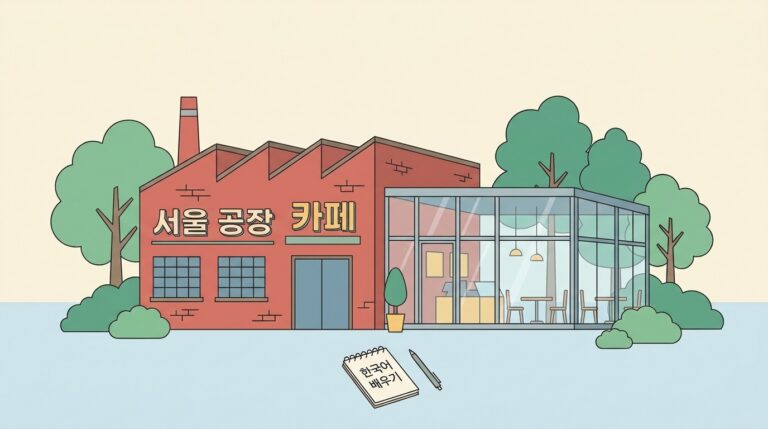
Breathing Life into Heritage: Discussing Korean Urban Regeneration Like an Insider
Phase 1: Empathy (Story-Driven Opening)
안녕하세요! 매일한글 에디터입니다. (Hello! This is your Daily Hangul Editor!)
Picture this: You are standing in the middle of Seongsu-dong (성수동) or winding through the maze-like alleys of Euljiro (을지로)—often affectionately called Hipjiro. Around you, red-brick shoe factories and grease-stained ironworks from the 1970s have transformed into bustling artisanal bakeries, exhibition spaces, and espresso bars. As you sip your flat white next to a vintage lathe machine, your Korean friend leans over and asks: “Do you think preserving this neighborhood actually honors its history, or is it just another commercial gimmick wiping out the original tenants?”
You want to express an intellectual, nuanced thought: “True spatial preservation shouldn’t lock history away in a taxidermied museum; it must breathe organically alongside contemporary lifestyles.” But your tongue freezes. You default to simple phrases like “옛날 건물 좋아요. 카페 예뻐요.” (I like old buildings. The cafe is pretty.) Frustrating, isn’t it? At the C1 level, discussing abstract urban spatial dynamics, the risk of placelessness (장소상실), and thoughtful adaptive reuse (도시 재생) requires vocabulary that reflects both social awareness and linguistic elegance.
Over the past decade of guiding global learners through Korea’s rapidly evolving cultural landscape, I have seen so many advanced students hit this exact wall. Urban development discourse in Seoul is deeply tied to collective trauma, lightning-fast industrialization, and generational nostalgia. Mastering this lexicon will elevate your Korean from “technically correct” to deeply analytical and culturally resonant. Let’s dive into the authentic expressions that will make you sound like a true Seoul spatial urbanist!
Phase 2: Core 3 Expressions In-Depth Analysis
1. 박제된 공간이 아닌 살아 숨 쉬는 공간 (Bakjedoen gonggan-i anin sara sum swineun gonggan)
- Pronunciation: Bak-je-doen gong-gan-i a-nin sa-ra sum swi-neun gong-gan (Think: bahk-jeh-dwen like a crisp shutter click, followed by the soft sigh of sum-swi-neun).
- Meaning: Literal: “Not a taxidermied/stuffed space, but a space that breathes alive.” | Cultural Nuance: Used to critique stale heritage conservation in favor of active, adaptive reuse where modern people actively engage with history.
- K-Culture Moment: Commonly heard in architectural documentaries like EBS’s Space Architecture or design panel discussions on revitalizing abandoned hanoks into community hubs.
- Editor’s Insight: 박제 (taxidermy) is a powerful, slightly provocative metaphor in Korean intellectual discourse. Calling an initiative 박제된 보존 suggests it has lost its soul and social utility.
- Situation Spectrum: Casual ⚠️ | Semi-formal ✅ | Formal ✅
- 🤔 Think About It: In Western urbanism, people often say “living history.” Does viewing an unused heritage site as “taxidermied” (박제) reflect Korea’s intense focus on functional utility and continuous social vitality?
2. 구도심의 장소성을 현대적으로 재해석하다 (Gudosim-ui jangsoseong-eul hyeondaejeog-euro jaehae-seokhada)
- Pronunciation: Gu-do-sim-ui jang-so-seong-eul hyeon-dae-jeog-eu-ro jae-hae-seok-ha-da (Smoothly link jang-so and seong with a resonant nasal ng).
- Meaning: Literal: “To recontextualize the placeness of the old city center in a contemporary manner.” | Cultural Nuance: Praising a project that preserves the genius loci (장소성) of historic downtown areas while adapting them to modern urban aesthetics.
- K-Culture Moment: Featured prominently when urban planners and lifestyle magazines (like Magazine B) analyze areas like Jongno, Euljiro, or Busan’s Yeongdo shipyard transformations.
- Editor’s Insight: 장소성 (placeness/spatial identity) is the polar opposite of 장소상실 (placelessness). C1 speakers use this pair to evaluate whether redevelopment destroys unique local character.
- Situation Spectrum: Casual 🚫 | Semi-formal ✅ | Formal ✅
- 🤔 Think About It: How does the English term “placemaking” differ from the philosophical weight of “preserving placeness” (장소성 보존) against rapid real estate cycles?
3. 과거의 유산과 현대 라이프스타일의 유기적 공존 (Gwagweo-ui yusan-gwa hyeondae ripeuseutair-ui yugijeok gongjon)
- Pronunciation: Gwa-geo-ui yu-san-gwa hyeon-dae la-i-peu-seu-ta-il-ui yu-gi-jeok gong-jon (Emphasize the balanced rhythm of yu-gi-jeok [organic]).
- Meaning: Literal: “The organic coexistence of past heritage and contemporary lifestyles.” | Cultural Nuance: Describing a seamless, non-forced harmony where historical structures naturally serve modern habits (e.g., remote work in a 90-year-old renovated brewery).
- K-Culture Moment: Used when lifestyle architects describe projects like Onion Cafe in Seongsu-dong or Ground Seesaw in Seochon.
- Editor’s Insight: The word 유기적 (organic/interconnected) elevates your statement from basic coexistence (공존) to a dynamic, functional ecosystem.
- Situation Spectrum: Casual ⚠️ | Semi-formal ✅ | Formal ✅
- 🤔 Think About It: Why has “lifestyle” (라이프스타일) become an essential loanword in Korean urban redevelopment when discussing the daily routines of MZ generations?
Phase 3: Textbook Korean vs. Real Korean
Scenario 1: Evaluating a renovated industrial warehouse in Seongsu-dong
- 📖 교과서 한국어 (Textbook Style):
“이 카페는 오래된 공장을 고쳐서 손님들이 많이 방문할 수 있게 만들었습니다.”
(I kape-neun orae-doen gongjang-eul gocheoseo sonnimdeul-i mani bangmunhal su itge mandeureosseumnida.)
“This cafe repaired an old factory so that many customers can visit.” - 🗣️ 진짜 한국어 (Authentic C1 Style):
“과거의 시간성을 날것 그대로 살리면서도, 현대적인 감각과 절묘하게 버무려냈네요.”
(Gwagweo-ui siganseong-eul nalgeot geudaero sarimyeonseodo, hyeondaejeogin gamgak-gwa jeolmyohage beomuryeonaenneyo.)
“It preserves the raw passage of time while exquisitely blending it with contemporary sensibility.” - 💡 Why the difference? Textbook phrasing relies on mechanical action verbs (고치다, 방문하다). Natural C1 speakers utilize evocative nouns (시간성, 날것) and sensory fusion verbs like 버무려내다 (to toss/mix harmoniously, borrowed from culinary art).
Scenario 2: Expressing worry over commercialized gentrification
- 📖 교과서 한국어 (Textbook Style):
“재개발 때문에 원래 살던 사람들이 다른 곳으로 이사를 가야 해서 슬픕니다.”
(Jaegaebal ttaemune wonrae saldeon saramdeul-i dareun goseuro isa-reul gaya haeseo seulpeumnida.)
“Because of redevelopment, it is sad that original residents must move elsewhere.” - 🗣️ 진짜 한국어 (Authentic C1 Style):
“자본의 논리에 밀려 동네 고유의 결이 바래지고, 둥지 내몰림이 심화되는 건 경계해야 해요.”
(Jabon-ui nolrie milryeo dongne goyu-ui gyeor-i baraejigo, dungji naemollim-i simhwadoeneun geon gyeong-gyehaeya haeyo.)
“We must guard against the erosion of the neighborhood’s authentic texture under capital logic and the deepening of gentrification.” - 💡 Why the difference? While standard Korean simply mentions moving away (이사), intellectual Korean Discourse uses the vivid indigenous metaphor 둥지 내몰림 (being pushed out of one’s nest) and poetic spatial imagery like 결이 바래지다 (texture fading).
Phase 4: K-Culture Deep Dive & Non-Verbal Manners
4-1. Nunchi & Physical Gestures
When discussing urban transformation in Korea, remember that real estate (부동산) and gentrification (젠트리피케이션) are sensitive socio-economic topics. Rapid redevelopment made some property owners wealthy overnight while displacing long-time residents and artists.
* The Pensive Head Tilt (사색적 끄덕임): When someone praises a flashy new commercial complex built on historic ruins, avoid a flat, aggressive contradiction. Slightly tilt your head downward, furrow your brow with a micro-pause, and begin with “물론 상권 활성화 측면도 있지만…” (While there’s certainly the aspect of commercial revitalization…). This shows emotional maturity and intellectual reservation.
* Soft Palm Gestures: When describing a space’s “texture” (결), hold your palm upward, gently tracing an imaginary curve in the air rather than pointing index fingers at buildings or shops.
4-2. Cultural Code Analysis: The Paradox of “Newtro” (뉴트로)
In cities like London or Paris, century-old buildings are common. However, because much of Seoul was leveled during the Korean War and reconstructed hastily during the 1970s–80s economic boom (한강의 기적), “old” spaces carry an intense emotional vulnerability. When young Koreans embrace Newtro (New + Retro), they aren’t just taking Instagram photos; they are seeking tactile heritage in a city dominated by uniform high-rise apartments (아파트 단지).
Watch K-Dramas like My Mister (나의 아저씨) or architecture documentaries on JTBC: you will notice characters finding solace not in sterile modern towers, but in weathered train crossings and brick alleys. When you critique a regenerated space, acknowledging this psychological yearning for roots will make your Korean conversation partners look at you with profound respect.
Phase 5: Real-World Roleplay Scenario
Setting: An old yarn-spinning factory in Mullae-dong (문래동) that was just transformed into a multi-use cultural complex. You are walking through with Ji-min (지민), an urban curator and native Seoulite.
- Turn 1 (Ji-min): 🎭 Looking around the exposed concrete walls and rusty cranes hanging above modern bookshelves
“여기 원래 문래동 철공소 골목의 방적 공장이었거든요. 이렇게 현대식 서점 겸 복합문화공간으로 바뀌니까 감회가 새롭네요. 어때 보여요?”
(Yeogi wonrae Mullaedong cheolgongso golmok-ui bangjeok gongjang-ieotgeodeunyo. Ireoke hyeondaesik seojeom gyeom bokhapmunhwagonggan-euro bakkwinikka gamhoega saeromneyo. Eottae boyeoyo?)
“This used to be a yarn-spinning factory in Mullae-dong’s ironworks alley. Seeing it turn into a modern bookstore and complex cultural space brings back memories. How does it look to you?” -
Turn 2 (You): 🎭 Observing the old machinery preserved behind sleek glass tables
“과거의 유산을 박제된 전시품으로 두지 않고, 오늘날 사람들의 일상과 자연스럽게 맞닿게 한 점이 인상 깊어요.”
(Gwagweo-ui yusan-eul bakjedoen jeonsipum-euro duji anko, oneulnal saramdeul-ui ilsang-gwa jayeonseureopge matdatge han jeom-i insang gipeoyo.)
“It’s impressive that they didn’t treat past heritage as a taxidermied exhibit, but let it naturally interface with people’s daily lives.” -
Turn 3 (Ji-min): 🎭 Nodding thoughtfully while pointing at an upscale wine counter next to an old iron press
“맞아요. 하지만 일각에서는 상업화가 너무 과해서 장소성이 퇴색되고 원주민들이 밀려난다는 비판도 거세거든요.”
(Majayo. Hajiman ilgak-eseoneun sang-eophwaga neomu gwahaeseo jangsoseong-i toesaekdoego wonjumindeul-i milryeonandaneun bipando geoseogeodeunyo.)
“True. But on the flip side, some criticize that hyper-commercialization dulls its placeness and displaces original residents.” -
Turn 4 (You): 🎭 Touching the weathered wooden pillar with a measured expression
“충분히 일리 있는 지적이에요. 장소의 고유한 결을 잃어버리면 결국 어디에나 있는 소비 공간으로 전락할 테니까요.”
(Chungbunhi illi inneun jijeok-ieyo. Jangso-ui goyuhan gyeor-eul ireobeorimyeon gyeolguk eodiena inneun sobi gonggan-euro jeonrakhal tenikkayo.)
“That’s a very valid critique. If it loses the unique texture of the place, it will ultimately degenerate into just another generic consumer space.” -
Turn 5 (Ji-min): 🎭 Smiling gently, appreciating your depth of perspective
“정확해요! 그래서 도시 재생에서 가장 어려운 게 바로 그 ‘수위 조절’ 같아요. 보존과 개발 사이의 균형이랄까요?”
(Jeonghwakhaeyo! Geuraeseo dosi jaesaeng-eseo gajang eoryeoun ge baro geu ‘suwi jojeol’ gatayo. Bojongwa gaebal sai-ui gyunhyeong-iralkkayo?)
“Exactly! That’s why the hardest part of urban regeneration is regulating that delicate balance between conservation and commercial development.” -
Turn 6 (You): 🎭 Looking toward the outdoor courtyard where local neighborhood elders and young creators are mingling
“결국 현대 라이프스타일과 호흡한다는 건 외형만 남기는 게 아니라, 지역 공동체의 기억을 함께 엮어내는 것이어야겠죠.”
(Gyeolguk hyeondae ripeuseutair-gwa hoheuphandaneun geon oehyeongman namgineun ge anira, jiyeok gongdongche-ui gieok-eul hamkke yeok-eonaeneun geos-ieoyagetjyo.)
“Ultimately, breathing with modern lifestyles shouldn’t just mean keeping the physical shell; it must weave together the memories of the local community.” -
Turn 7 (Ji-min): 🎭 Impressed, taking out a coffee token to offer you
“와, 한국인 도시계획 전문가와 대화하는 기분인데요? 커피 한잔하면서 공간 디자인에 대해 더 이야기 나눠볼까요?”
(Wa, Hanguk-in dosigyehoek jeonmunga-wa daehwahaneun gibun-indeoyo? Keopi hanjanhamyeonseo gonggan dijain-e daehae deo iyagi nanwobolkkayo?)
“Wow, I feel like I’m talking to a Korean urban planning expert! Shall we grab a coffee and chat more about spatial design?” -
Turn 8 (You): 🎭 Chuckling softly and gesturing toward the barista counter
“좋습니다! 이 공간의 맥락을 음미하면서 마시는 커피라면 마다할 이유가 없죠.”
(Jotseumnida! I gonggan-ui maengnak-eul eummihamyeonseo masineun keopiramyeon madahal iyu-ga eopjyo.)
“Sounds wonderful! How could I refuse a coffee enjoyed while savoring the context of this space?”
🔀 Interactive Choice Point!
At Turn 4, how would you respond if you wanted to pivot the discussion toward economic sustainability?
- Option A: “상업적인 성공 없이 세금으로만 유지되는 유산은 결국 방치되고 말아요. 자생적인 수익 모델이 필수적입니다.”
(Best C1 Nuance: Articulates economic self-sustainability [자생적 모델] cleanly and persuasively without sounding dismissive.) - Option B: “돈을 많이 벌어야 옛날 건물도 지킬 수 있으니까 상업화가 제일 중요한 거 아닌가요?”
(Risk: A bit too blunt and transactional; misses the cultural nuance expected in high-level architectural dialogues.) - Option C: “그냥 옛날 건물 다 부수고 높은 아파트를 짓는 게 집값에는 더 이득일 것 같아요.”
(Bad: Completely ignores the value of historic preservation, sounding unmindful of spatial heritage.)
Phase 6: 10-Second Emotion Shadowing Drill
Practice these lines with pause marks (/) and distinct emotional registers:
[🧐 사색하듯 진중하게 - Contemplative & Serious]
“과거의 유적을 / 박제된 유물로 가두는 건 / 진정한 보존이 아니에요.”
(Gwagweo-ui yujeok-eul / bakjedoen yumul-ro gaduneun geon / jinjeonghan bojoni anieyo.)
“Locking past ruins into taxidermied relics / is not genuine preservation.”-
[💡 통찰력을 발휘하며 - Insightful & Confident]
“구도심의 장소성을 / 현대적인 감각으로 재해석할 때 / 공간에 생명력이 돕니다.”
(Gudosim-ui jangsoseong-eul / hyeondaejeogin gamgak-euro jaehae-seokhal ttae / gonggan-e saengmyeongnyeog-i domnida.)
“When we recontextualize the placeness of old downtowns / through contemporary sensibility / true spatial vitality blossoms.” -
[🥺 아쉬움과 경각심을 담아 - Concerned & Reflective]
“상업적 성공에 취해 / 원래 있던 결마저 지워버린다면 / 결국 장소상실에 빠지게 됩니다.”
(Sang-eopjeok seonggong-e chwihae / wonrae itdeon gyeolmajeo jiwobeorindamyeon / gyeolguk jangso-sangsil-e ppajige doemnida.)
“If we get intoxicated by commercial gains / and wipe out the original texture / we inevitably fall into placelessness.”
Phase 7: K-Culture Mini Dictionary
- 도시 재생 (Dosi Jaesaeng) | Urban Regeneration / Adaptive Reuse
Unlike sweeping reconstruction (재개발), which demolishes entire blocks, 도시 재생 focuses on preserving structural skeletons and historical memory while inserting new economic and social vitality. - 장소성 (Jangsoseong) | Placeness / Genius Loci
The unique identity, memories, and sensory atmosphere inherently belonging to a specific geographic locale, preventing it from being swapped with anywhere else. - 둥지 내몰림 (Dungji Naemollim) | Gentrification / Tenant Displacement
The poetic and widely adopted Korean term for gentrification—evoking young fledglings and established residents being forced out of their communal “nests” due to soaring commercial rent. - 결 (Gyeol) | Inherent Grain / Texture / Aura
Originally referring to the grain of wood or fabric, modern Korean urbanists use 결 to depict the organic, accumulated layers of lifestyle and historical patina in an old neighborhood.
Phase 8: Survival Kit for Travelers
Top 3 Spatial Observation Phrases
- “옛 건물의 골조를 그대로 살려냈네요.”
(Yet geonmul-ui goljo-reul geudaero sallyeonaenneyo.)
Pro Tip: Use this when walking into a warehouse cafe where concrete girders and timber rafters remain visible. - “인위적이지 않고 동네 풍경에 자연스럽게 스며들어요.”
(Inwijeog-iji anko dongne punggyeong-e jayeonseureopge seomyeodeureoyo.)
Pro Tip: A classy compliment to give an architect or store owner whose new boutique doesn’t overpower the alley. - “장소의 역사성을 해치지 않는 선에서 잘 정돈되었네요.”
(Jangso-ui yeoksaseong-eul haechiji anneun seon-eseo jal jeongdondoeeotneyo.)
Pro Tip: The ultimate balanced assessment when an old market stalls area has been cleanly renovated.
Editor’s Travel Note: Exploring Seoul’s Living Layers
To truly witness adaptive reuse in action, take subway line 2 to Seongsu Station or line 1/3/5 to Jongno 3-ga. Skip typical tourist maps and search for community cultural centers on your 네이버 지도 앱 다운로드 (Naver Map app download). Use search terms like 복합문화공간 (complex cultural space) or 도시재생지원센터 (urban regeneration support center). When visiting Euljiro’s printing alleys, remember these are active industrial zones during the day—walk single-file, watch for moving delivery motorcycles (오토바이), and patronize small snack bars (노포 분식) to support the local neighborhood fabric.
Phase 9: “한 발 더 깊이” (Philosophical Reflection)
Korea experienced compressed modernization unlike almost any other nation in the twentieth century. Within half a century, the collective priority was erasing the visual poverty of the past and constructing modern apartment complexes (아파트). Yet today, that rapid pace has yielded a profound cultural realization: hyper-modernity without memory induces psychological homelessness. The modern passion for retro spaces is not a passing commercial fad; it is a society attempting to reconcile its forward momentum with its ancestral roots. When you speak about space in Korea, you are speaking about the struggle between memory and speed.
💬 Your Turn: Which renovated historic site in Korea (or your home country) struck the best balance between preserving its past and accommodating modern needs? Drop your thoughts in the comments using 장소성 or 살아 숨 쉬는 공간!
Phase 10: FAQ & Common Mistakes
Q: Can I use the word “젠트리피케이션” (Gentrification) directly in Korean conversations?
A: Yes, absolutely! 젠트리피케이션 is widely used in news, academic discourse, and daily conversation. However, using the native Korean term 둥지 내몰림 showcases a much deeper command of contemporary socio-cultural language and carries a more empathetic tone.
Q: What is the exact difference between ‘재개발’ and ‘도시 재생’?
A: 재개발 (Redevelopment) usually implies bulldozing old residential areas to construct new high-rise complexes. 도시 재생 (Urban Regeneration) is centered around adaptive reuse, preserving historical structural fabric, and revitalizing community identity without total demolition.
Q: How do I praise a hip spot without sounding superficial?
A: Instead of saying “분위기 힙해요!” (The vibe is hip!), say: “과거의 정취와 현대적 감각이 조화롭게 어우러졌네요.” (The antique mood and contemporary sensibility harmonize beautifully.)
🚨 Common Mistakes Warning Board
- Using ‘고치다’ (to fix) for heritage spaces:
Correction: Saying 건물을 고쳤다 sounds like repairing a broken pipe. Use 재해석하다 (recontextualize), 새 생명을 불어넣다 (breathe new life into), or 리모델링/재단장하다 (renovate). - Confusing ‘박물관’ (museum) with passive preservation:
Correction: Saying 박물관 같아요 is a compliment for artifact collection, but calling an urban project a 박제된 박물관 implies it is lifeless and disconnected from modern life. - Overusing ‘옛날 것’ instead of nuanced spatial nouns:
Correction: Upgrade 옛날 것 (old things) to 장소의 기억 (memory of the place), 역사적 층위 (historical layers), or 시대적 유산 (heritage of the era).
Phase 11: Action Missions
- 🥉 Bronze Mission (Solo Shadowing): Record yourself reading Phase 6 Drill #2 out loud. Match the contemplative rhythm and post-vocal pause.
- 🥈 Silver Mission (Social Media Micro-Review): Take a photo of an old cafe or renovated building in your city. Post it on Instagram with the caption: “박제된 공간이 아닌 살아 숨 쉬는 공간. 과거와 현대의 유기적 공존이 돋보인다.”
- 🥇 Gold Mission (Live Discourse Challenge): Next time you visit a cafe in Ikseon-dong, Mullae-dong, or Seongsu-dong with a Korean speaker, ask them this exact question: “여기는 장소성을 잘 살린 것 같아요, 아니면 상업화로 퇴색된 것 같아요?”
🎮 K-Culture Media Mission: Watch an episode of an urban documentary or travel show featuring Euljiro. Listen closely for the terms 골목상권 (alley commercial district) and 원형 보존 (original form preservation)!
Phase 12: Interactive Quiz Challenge
1. Context Judgment
Which expression best critiques an old street that kicked out all original craftspeople to install identical chain dessert shops?
* A) “지역 상권이 유기적으로 공존하고 있네요.”
* B) “자본에 의해 장소성이 훼손되고 둥지 내몰림이 일어났어요.”
* C) “박제된 유물처럼 원형이 아주 잘 보존되었어요.”
🔍 Click for the Answer & Explanation
Correct Answer: B
Explanation: B accurately identifies tenant displacement (둥지 내몰림) and the loss of unique identity (장소성 훼손). Option A is inaccurate because there is no coexistence, and Option C misuses the idea of preservation.
2. Fill-in-the-Blank
과거의 산업 시설을 단순히 ( ) 유물로 두지 않고, 청년 예술가들의 창작 공간으로 탈바꿈시켰습니다.
(They didn’t leave the old industrial facility as a taxidermied relic, but transformed it into a creative workshop for young artists.)
🔍 Click for the Answer & Explanation
Correct Answer: 박제된 (bak-je-doen)
Explanation: 박제된 (taxidermied/stuffed) is the quintessential intellectual metaphor used to describe heritage that has ceased interacting with modern life.
3. True / False Cultural Check
Statement: In contemporary Korean urban regeneration discussions, 재개발 (demolition redevelopment) and 도시 재생 (urban regeneration/adaptive reuse) refer to the exact same administrative approach. (T / F)
🔍 Click for the Answer & Explanation
Correct Answer: False (F)
Explanation: 재개발 focuses on bulldozing the existing environment for completely new construction, whereas 도시 재생 emphasizes adaptive reuse, preserving the historical grain (결), and community sustainability.






