

Phase 1: 공감 (스토리 몰입형 오프닝)
안녕하세요! 매일한글 에디터입니다.
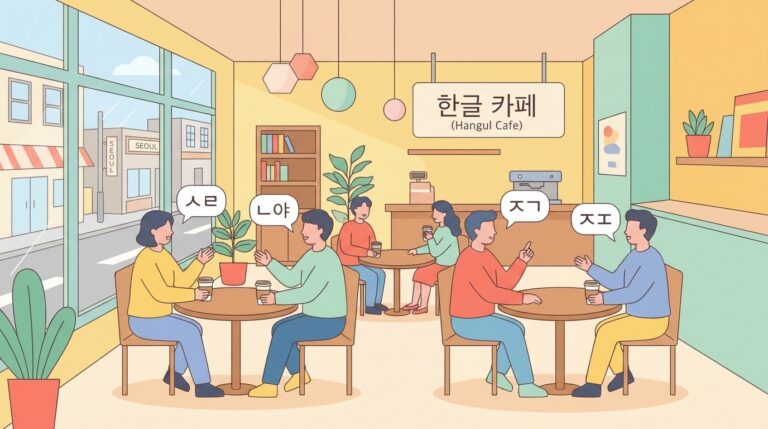
Imagine walking into a bustling café near Hongdae on a rainy Friday evening. You hear the clinking of iced Americano glasses and the warm buzz of conversation around you. You finally hold in your hand a cup of coffee and sit down across from a friendly local for your very first language exchange meetup. Your heart begins to race. Your hands are slightly sweaty, and your mind is frantically trying to calculate verb endings: Is it -아요 (-ayo), -어요 (-eoyo), or did I just conjugate that completely wrong? You freeze. The words stay trapped behind your teeth because you are terrified of sounding silly.
Take a deep breath—you are not alone! Over the past ten years coaching hundreds of Korean learners, I have seen this exact moment happen countlessly. Every beginner feels this heavy anxiety. But here is the secret that changed everything for my students: in Korean communication, your courage to speak out loud is valued ten times more than flawless grammar. Native speakers never expect textbook perfection; they genuinely admire your effort. In this guide, designed from real learner breakthroughs, you will discover practical tools to unlock your voice and speak boldly without fear!
Phase 2: 핵심 표현 3선 심층 분석
1. 틀려도 괜찮아요! (Teullyeodo gwaenchanayo!)
- Pronunciation: [Teul-lyeo-do gwaen-chan-ah-yo] (Sounds like tuhl-yuh-doh gwen-chan-ah-yo)
- Meaning: “Even if it’s wrong, it’s totally okay!”
- K-Culture Moment: Often seen in variety shows like Running Man when foreign guests attempt fast-paced Korean word games and cast members cheer them on warmly.
- Editor’s Insight: The ending ~도 괜찮아요 (~do gwaenchanayo) is a magical phrase that releases tension. You can say this to your language partner or even whisper it to yourself like a comforting chant.
- Situation Spectrum:
- Casual: ✅ (틀려도 괜찮아! / Teullyeodo gwaenchana!)
- Semi-formal: ✅ (틀려도 괜찮아요! / Teullyeodo gwaenchanayo!)
- Formal: ✅ (틀려도 괜찮습니다! / Teullyeodo gwaenchansumnida!)
- 🤔 Think About It: In your native language, do you feel pressured to apologize when you make a mistake? Why do you think acknowledging mistakes openly can create warmth in conversation?
2. 일단 말해 볼게요. (Ildan malhae bolgeyo.)
- Pronunciation: [Il-dan mal-hae bol-ge-yo] (Sounds like eel-dahn mal-heh bohl-geh-yo)
- Meaning: “I’ll just try saying it first.”
- K-Culture Moment: In youth K-Dramas like Twenty-Five Twenty-One, characters use 일단 (ildan – ‘first / for now’) when leaping into challenges with unstoppable grit.
- Editor’s Insight: 일단 (ildan) means taking the leap before overthinking. Adding ~아/어 볼게요 (~a/eo bolgeyo) signals that you are treating speaking as a fun experiment rather than an exam.
- Situation Spectrum:
- Casual: ✅ (일단 말해 볼게. / Ildan malhae bolge.)
- Semi-formal: ✅ (일단 말해 볼게요. / Ildan malhae bolgeyo.)
- Formal: ⚠️ (일단 말씀드려 보겠습니다. / Ildan malsseumdeuryeo bogetsumnida.)
- 🤔 Think About It: Why does declaring that you are “trying” take the pressure off both the speaker and the listener?
3. 한국어로 편하게 말해주세요. (Hangugeoro pyeonhage malhaejuseyo.)
- Pronunciation: [Han-guk-eo-ro pyeon-ha-ge mal-hae-ju-se-yo] (Sounds like hahn-goog-uh-roh pyun-hah-geh mal-heh-joo-seh-yo)
- Meaning: “Please feel free to speak to me in Korean.”
- K-Culture Moment: A staple phrase used by international K-Pop idols in live streams when interacting with fans, showing their earnest desire to practice.
- Editor’s Insight: Koreans often switch to English to be considerate when they see a foreigner hesitating. Using this polite request clearly invites them back to Korean without hurting any feelings.
- Situation Spectrum:
- Casual: 🚫 (Avoid with strangers or older partners)
- Semi-formal: ✅ (한국어로 편하게 말해주세요. / Hangugeoro pyeonhage malhaejuseyo.)
- Formal: ✅ (한국어로 편하게 말씀해 주세요. / Hangugeoro pyeonhage malsseumhae juseyo.)
- 🤔 Think About It: How does polite assertiveness open up authentic cultural spaces that English might unintentionally close?
Phase 3: 교과서 한국어 vs 진짜 한국어
Situation 1: Letting your partner know your Korean is still basic
- 📖 교과서 한국어: 제 한국어 실력이 부족하여 죄송합니다. (Je hangugeo sillyeogi bujokhayeo joesonghamnida. – “I apologize because my Korean ability is lacking.”)
- 🗣️ 진짜 한국어: 제가 아직 한국어가 서툴러요! (Jega ajik hangugeoga seotulleoyo! – “My Korean is still a bit clumsy!”)
- 💡 왜 다를까? Textbook Korean treats limited language skills like a formal flaw requiring an apology. Natural Korean uses the charming adjective 서툴다 (seotulda – clumsy/unpolished), which sounds friendly, humble, and approachable.
Situation 2: Asking your partner to correct your mistakes naturally
- 📖 교과서 한국어: 실수가 발생하면 정정해 주십시오. (Silsuga balsaenghamyeon jeongjeonghae jusipsio. – “If an error occurs, please rectify it.”)
- 🗣️ 진짜 한국어: 틀리면 편하게 고쳐주세요! (Teullimyeon pyeonhage gochyeojuseyo! – “If I’m wrong, please feel free to correct me!”)
- 💡 왜 다를까? Words like 정정 (jeongjeong – rectification) belong in courtrooms or news broadcasts. In real social settings, Koreans simply say 고쳐주세요 (gochyeojuseyo – please fix it for me).
Phase 4: K-Culture 딥다이브 & 비언어적 매너
4-1. 눈치 (Nunchi) & Gestures
At a Korean language meetup, non-verbal cues carry enormous emotional warmth:
* The Enthusiastic Head Nod (끄덕끄덕 – Kkeodeok-kkeodeok): While your partner speaks, maintain soft eye contact and nod gently. It conveys active listening and reassures them that you are fully engaged.
* The Self-Encouraging Smile: If you get stuck mid-sentence, don’t look down at the floor or cover your mouth in embarrassment. Take a breath, smile lightly, and tap your chest gently as if saying “let me try again!” This immediately invites your partner to wait patiently and root for you.
* Open Body Language: Avoid folding your arms or leaning back passively. Keep your elbows slightly resting on the table, leaning forward by a few degrees.
4-2. Culture Code: The “Fighting!” Mindset
Korean culture places immense social value on 노력 (noryeok – heartfelt effort) and 열정 (yeoljeong – passion). When you watch variety shows like Earth Arcade, members celebrate someone who attempts a difficult mission with loud enthusiasm, even if they fail spectacularly. In the same way, locals in language exchange settings never judge a broken sentence. Instead, they see your courage as a sign of respect toward their culture and language. Your willingness to make mistakes is literally the bridge that builds genuine friendships.
Phase 5: 실전 롤플레이 시나리오
- Setting: A cozy language exchange café near Sinchon station filled with indie background music.
- Characters:
- Alex: An enthusiastic beginner attending their very first meetup.
- Minji: A welcoming Korean university student hosting the conversation table.
- 민지 (Minji): 안녕하세요! 오늘 처음 오셨죠? 편하게 앉으세요. (Annyeonghaseyo! Oneul cheoeum osyeotjyo? Pyeonhage anjeuseyo. – “Hello! It’s your first time today, right? Please sit down comfortably.”)
🎭 Smiling warmly while pulling out a wooden chair for Alex. -
알렉스 (Alex): 안녕하세요! 만나서 반가워요. (Annyeonghaseyo! Mannaseo bangawoyo. – “Hello! Nice to meet you.”)
🎭 Sitting down carefully with a slight bow. -
민지 (Minji): 한국어 공부하신 지 얼마나 되셨어요? (Hangugeo gongbuhasin ji eolmana doesyeosseoyo? – “How long have you been studying Korean?”)
🎭 Tilting her head with a friendly, encouraging expression. -
알렉스 (Alex): 6개월 됐어요. 그런데 아직 한국어가 서툴러요. (Yukgaewol dwaesseoyo. Geureonde ajik hangugeoga seotulleoyo. – “It’s been six months. But my Korean is still a bit clumsy.”)
🎭 Scratching back of neck with a shy, endearing grin. -
민지 (Minji): 와, 발음 정말 좋으신데요? 긴장하지 마세요! (Wa, baleum jeongmal joeusindeoyo? Ginjanghaji maseyo! – “Wow, your pronunciation is really good! Don’t be nervous!”)
🎭 Clapping hands together gently to cheer Alex on. -
알렉스 (Alex): 감사합니다! 틀려도 그냥 일단 말해 볼게요. (Gamsahamnida! Teullyeodo geunyang ildan malhae bolgeyo. – “Thank you! Even if it’s wrong, I’ll just try saying it first.”)
🎭 Taking a deep breath and leaning in with newfound confidence. -
민지 (Minji): 아주 좋아요! 틀리면 제가 바로 도와드릴게요. (Aju joayo! Teullimyeon jega baro dowadeurilgeyo. – “That’s great! If you make a mistake, I’ll help you right away.”)
🎭 Giving a double thumbs-up with bright eyes. -
알렉스 (Alex): 네! 틀리면 편하게 고쳐주세요. (Ne! Teullimyeon pyeonhage gochyeojuseyo. – “Yes! If I make a mistake, please feel free to correct me.”)
🎭 Beaming with a relaxed smile.
🔀 인터랙티브 분기점 (Interactive Choice)
Minji asks: “주말에 보통 뭐 하세요?” (Jumare botong mwo haseyo? – “What do you usually do on weekends?”)
What is your best response?
- Option A: “주말에… 친구 만나… 커피 마셔요. 맞아요?” (Jumare… chingu manna… keopi masyeoyo. Majayo?)
- 👉 Feedback [BEST]: Excellent! Even though the grammar is simplified, you expressed your idea out loud and asked for gentle verification. Minji can easily jump in to validate you!
- Option B: (Saying nothing, turning red, and switching straight to English): “Sorry, my Korean is terrible.”
- 👉 Feedback [BAD]: Avoid this! It creates awkward silence and signals that you have completely given up on trying.
- Option C: “저는 주말마다 친구들과 카페에서 유흥을 즐기곤 합니다.” (Jeoneun jumalmada chingudeulgwa kapeeseo yuheungeul jeulgigon hamnida.)
- 👉 Feedback [RISK]: While grammatically correct, using hyper-formal, archaic words like ‘유흥’ (hedonistic revelry) sounds like reading a legal statement in a casual café.
Phase 6: 10초 감정 섀도잉 드릴
Read these sentences out loud by following the emotional tags and natural breath pauses (/):
[😊 차분하고 편안하게]
틀려도 괜찮아요, / 천천히 말해 볼게요.
(Teullyeodo gwaenchanayo, / cheoncheonhi malhae bolgeyo. – “It’s okay even if it’s wrong, / I’ll try speaking slowly.”)-
[🔥 씩씩하고 당당하게]
완벽하지 않아도 / 일단 입 밖으로 내뱉어 봐요!
(Wanbyeokhaji anado / ildan ip bakkeuro naebaeteo bwayo! – “Even if it’s not perfect, / let’s just spit it out of our mouth first!”) -
[🤝 다정하고 솔직하게]
제가 아직 서툴지만 / 편하게 고쳐주세요!
(Jega ajik seotuljiman / pyeonhage gochyeojuseyo! – “I’m still a bit clumsy, but / please feel free to correct me!”)
Phase 7: K-Culture 미니 사전
-
모임 (Moim)
- Meaning: A social gathering or meetup group.
- Usage: Refers to any organized gathering, from casual board game nights to neighborhood language exchanges.
- 자신감 (Jasingam)
- Meaning: Self-confidence.
- Usage: Often paired with “가지다” (to have), as in “자신감을 가지세요!” (Have confidence!).
- 언어교환 (Eoneogyohwan)
- Meaning: Language exchange.
- Usage: The exact term used across Seoul when searching for mutual learning tables in university districts.
- 티키타카 (Tikitaka)
- Meaning: Snappy, fun conversational chemistry back-and-forth.
- Usage: Originally from Spanish soccer, Koreans use it constantly to describe friends whose dialogue flows effortlessly.
Phase 8: 여행자를 위한 생존 키트
Survival Phrases TOP 3
- 조금만 천천히 말씀해 주시겠어요? (Jogeumman cheoncheonhi malsseumhae jusigesseoyo?)
- Pro Tip: Use this whenever native speakers talk too quickly in noisy cafes.
- 다시 한번 말씀해 주세요. (Dasi hanbeon malsseumhae juseyo.)
- Pro Tip: Deliver this with an attentive smile so the other person gladly repeats themselves.
- 이거 한국어로 뭐라고 해요? (Igeo hangugeoro mworago haeyo?)
- Pro Tip: Point at an object or menu item. It turns every native speaker into a spontaneous teacher.
Editor’s Travel Note
When looking for genuine community meetups in Seoul, skip shady tourist forums and check out localized platforms. You can look up community spaces directly via the 네이버 지도 앱 다운로드 to find community cafes near Hongik University Station or Sinchon. Remember that most language cafes operate on a simple entry fee system that includes one free drink (usually around 10,000 to 12,000 KRW), payable by local debit or international travel cards.
Phase 9: “한 발 더 깊이” (생각 질문)
In Korean society, communication is deeply rooted in mutual consideration and the appreciation of shared vulnerability. When you openly embrace making mistakes, you demonstrate sincerity (진심 – jinsim) rather than cold perfectionism. By stepping out of your comfort zone, you allow the listener to become an active supporter, creating an instant bond of solidarity.
💬 Your Turn: What is the biggest thought that stops you from opening your mouth when you want to speak Korean? Share your experience in the comments below!
Phase 10: FAQ & 오해 방지
Q: What should I do if the other person immediately switches to English?
A: Do not take it personally! They are simply trying to be polite and hospitable. Just smile and say: “한국어 연습하고 싶어요! 한국어로 해주세요.” (Hangugeo yeonseuphago sipeoyo! Hangugeoro haejuseyo. – “I want to practice Korean! Please speak in Korean.”). They will gladly respect your request.
Q: What if I accidentally use informal language (반말 – Banmal) by mistake?
A: Don’t panic. If an informal word slips out, simply bow slightly and say: “아, 죄송해요! 아직 서툴러요.” (A, joesonghaeyo! Ajik seotulleoyo. – “Ah, I’m sorry! I’m still clumsy.”). Locals understand beginner mix-ups completely and will appreciate your immediate self-correction.
Q: Is it bad etiquette to ask someone to correct my pronunciation every minute?
A: It can disrupt natural conversation flow. Instead, let the conversation flow for a few minutes, then ask about 1 or 2 specific phrases at the end of each topic.
🚨 흔한 실수 (Common Mistakes) 경고판
- Mistake 1: Freezing in absolute silence when thinking.
- 💡 Correct Action: Use natural fillers like “음… 잠시만요!” (Eum… jamsimanyo! – “Um… just a moment!”) to keep the conversational bridge open.
- Mistake 2: Over-apologizing with formal expressions.
- 💡 Correct Action: Instead of repeating “죄송합니다” (Joesonghamnida), smile and say “알려주셔서 감사해요!” (Allyeojusyeoseo gamsahaeyo! – “Thank you for letting me know!”).
- Mistake 3: Sticking only to pre-memorized textbook scripts.
- 💡 Correct Action: Mix incomplete sentences with hand gestures. Meaning always triumphs over mechanical accuracy!
Phase 11: 액션 미션 & 참여 유도
- 🥉 Bronze Mission (Solo Practice): Stand in front of your mirror and practice saying: “틀려도 일단 말해 볼게요!” (Teullyeodo ildan malhae bolgeyo!) three times with your biggest smile.
- 🥈 Silver Mission (Social Share): Write your favorite Korean hobby phrase on your social media story or language diary and tag your learning buddy with #DailyHangul.
- 🥇 Gold Mission (Real Life Action): The next time you order at a Korean mart or speak at an exchange table, speak out your Korean sentence within 3 seconds without second-guessing yourself!
- 🎮 K-Culture Mission: Watch an episode of a Korean variety show this week and count how many times cast members say “괜찮아!” (Gwaenchana!) when someone makes a funny mistake.
Phase 12: 인터랙티브 퀴즈 챌린지
1. [상황 판단] You want your language exchange partner to correct your errors without feeling awkward. What is the most natural thing to say?
(A) 제 모든 실수를 법적으로 처벌해 주세요.
(B) 틀리면 편하게 고쳐주세요!
(C) 한국어로 말씀하시면 안 됩니다.
2. [빈칸 채우기] Complete the sentence:
“완벽하지 않아도 [____] 말해 볼게요!” (Even if it’s not perfect, I’ll just try speaking first!)
3. [True / False 문화 퀴즈]
In Korean language exchange culture, native speakers judge beginners harshly if they use incorrect grammatical particles. (True / False)
👉 Click to reveal answers & explanations!
-
Answer: (B)
Explanation: “틀리면 편하게 고쳐주세요!” (Teullimyeon pyeonhage gochyeojuseyo!) is the warm, natural way to invite corrections. (A) talks about legal punishment, and (C) tells the person not to speak Korean! -
Answer: 일단 (ildan)
Explanation: “일단” means “for now” or “first before anything else”, capturing the spirit of bold action. -
Answer: False
Explanation: Koreans deeply respect and appreciate your genuine courage to communicate, and grammar slips are met with warm encouragement rather than judgment!






