

Phase 1: Empathy & Story Opening
안녕하세요! 매일한글 에디터입니다. (Hello! I am your Daily Hangul editor.)
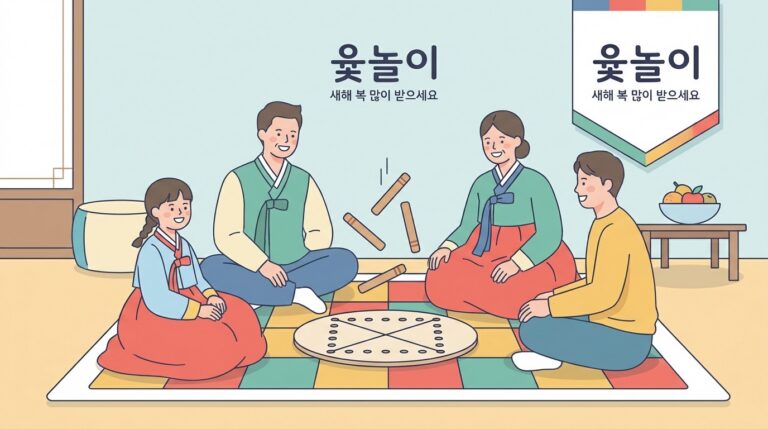
Imagine this: It is Lunar New Year (Seollal) or Harvest Moon Festival (Chuseok) in Seoul. You have been warmly invited to a Korean friend’s home. The living room smells heavenly with freshly pan-fried jeon (savory pancakes) and simmering soup. You sit down on the cozy, heated ondol floor, and suddenly, an elder unfurls a big traditional blanket. Out come four thick wooden sticks and a game board with circular tokens.
Everyone starts clapping and laughing. A lively game of Yutnori (윷놀이) is starting! You want to join the laughter, cheer for your team, and wish everyone happiness, but you suddenly freeze. What if I say the wrong greeting to Grandma? What do I yell when the sticks hit the blanket? Am I being polite or awkward?
Take a deep breath! You are not alone. Almost every international learner feels that brief flash of panic during their first traditional Korean holiday gathering. This guide is crafted directly from real-life feedback from absolute beginners (A1 level). By the end of this mini-guide, you will know the exact magic words to greet elders, cheer with child-like joy during Yutnori, and become the sweetest, most beloved guest in any Korean home.
Phase 2: Key Expressions Deep Dive
Here are the top three golden phrases you need to master before throwing the wooden sticks:
1. 새해 복 많이 받으세요! (Saehae bok mani badeuseyo!)
- Pronunciation: [Sae-hae bok mah-nee bah-deu-seh-yo] (Sound tip: “Sae-hae” sounds like “say hey”, and “bok” rhymes with “pork” without the ‘r’ sound!)
- Meaning: Literal: “Please receive lots of New Year’s fortune!” | Natural Nuance: “Happy New Year! Wishing you abundant blessings!”
- K-Culture Moment: Every year on K-Pop shows and variety specials, idols wear vibrant hanbok, bow deeply, and shout this phrase unison to their fans.
- Editor’s Insight: This is the ultimate polite formula for the Lunar New Year. Notice the word “복” (bok), which means fortune or luck. Koreans treat blessings like a gift you actively receive.
- Situation Spectrum: Casual: 🚫 | Semi-formal: ✅ | Formal: ✅
- 🤔 Think About It: In English, we simply say “Happy New Year,” but in Korean, you are actively wishing someone tangible fortune. Why do you think Korean holiday greetings focus on receiving “good fortune” rather than just feeling happy?
2. 모 나왔다! (Mo nawatta!)
- Pronunciation: [Moh nah-waht-tah] (Sound tip: “Mo” sounds just like “mow” the lawn, and “nawatta” rhymes with “now what, ah!”)
- Meaning: Literal: “A ‘Mo’ has come out!” | Natural Nuance: “JACKPOT! All five steps forward!”
- K-Culture Moment: Seen in nearly every holiday episode of Running Man or 2 Days 1 Night when a team makes an epic comeback and screams in wild disbelief.
- Editor’s Insight: In Yutnori, “Mo” (모) means all four flat sides of the sticks face up. It gives your token five moves and allows you to throw again! It is the most thrilling roll in the game.
- Situation Spectrum: Casual: ✅ | Semi-formal: ✅ | Formal: ⚠️ (Acceptable in high-energy games, but use with close peers or family!)
- 🤔 Think About It: Even in traditional, respectful family gatherings, game reactions allow people to drop rigid formalities. How does playful shouting bring different generations closer together in your culture?
3. 화이팅! / 파이팅! (Hwaiting! / Paiting!)
- Pronunciation: [Hwah-ee-ting / Pah-ee-ting] (Sound tip: Sounds like “white-ing” with a soft ‘h’ or “fighting”!)
- Meaning: Literal: “Fighting!” | Natural Nuance: “Let’s go! You can do it! Cheering for you!”
- K-Culture Moment: From sports stadiums to board games, whenever someone steps up to roll the dice or throw sticks, their teammates chant this with pumped fists.
- Editor’s Insight: Do not worry—nobody is starting a fight! This is Korea’s favorite loanword chant for encouragement. During Yutnori, shouting “화이팅!” when an elder throws the sticks shows you are engaged and fully invested in the family team.
- Situation Spectrum: Casual: ✅ | Semi-formal: ✅ | Formal: ✅
- 🤔 Think About It: Konglish words like “Fighting” carry an entirely new cultural heartbeat in Korea. Have you noticed words from your own language that changed their meaning when adopted by another culture?
Phase 3: Textbook Korean vs. Real Korean
Scenario 1: Wishing Someone a Happy Chuseok / Seollal
- 📖 교과서 한국어 (Textbook): 즐거운 명절을 보내시기 바랍니다. (Jeulgeoun myeongjeoreul bonaesigi baramnida. / “I wish that you spend a pleasant holiday season.”)
- 🗣️ 진짜 한국어 (Real-Life): 해피 추석 보내세요! (Haepi Chuseok bonaeseyo! / “Have a Happy Chuseok!”) or 새해 복 많이 받으세요! (Saehae bok mani badeuseyo! / “Happy New Year!”)
- 💡 왜 다를까? (Why the difference?): Textbook phrases are extremely stiff, resembling government notices or corporate emails. In actual homes, warm, conversational polite phrasing (ending in -요) or modern blended greetings sound much more welcoming.
Scenario 2: Rooting for a Family Member During a Game
- 📖 교과서 한국어 (Textbook): 당신을 진심으로 응원합니다. (Dangsineul jinsimeuro eung-wonhamnida. / “I sincerely cheer for you.”)
- 🗣️ 진짜 한국어 (Real-Life): 가자! 잘한다! (Gaja! Jalhanda! / “Let’s go! Doing great!”)
- 💡 왜 다를까? (Why the difference?): Nobody gives formal speeches in the middle of a board game! Short, punchy, high-energy verbs create instant laughter and warmth on the game mat.
Phase 4: K-Culture Deep Dive & Non-verbal Manners
4-1. Nunchi & Game Manners
Playing Yutnori is as much about respect and non-verbal reading (눈치 – Nunchi) as it is about luck!
* Two-Handed Pass: When it is your turn to hand the four wooden sticks to an elder (like a grandfather or aunt), always hand them over with both hands, or support your right wrist with your left hand.
* Toss, Don’t Launch: Throw the sticks so they land gently inside the mat area (멍석 or blanket). If a stick flies out of bounds, it is often ruled as 낙 (Nak – foul), nullifying your turn! Also, never throw too high—nobody wants a flying stick hitting someone’s coffee cup.
* Foot Placement: While sitting cross-legged (양반다리 – Yangbandari), make sure the soles of your feet are not pointing directly at the elders. Tucking them neatly is a quiet sign of great manners.
4-2. Cultural Code: The Drama of Yutnori
In Korean variety shows, Yutnori is considered the ultimate dramatic game because the rules allow you to “catch” (잡다) an opponent’s token and send them all the way back to start. Watching three generations—from five-year-old grandchildren to eighty-year-old grandparents—scream over a single wooden stick demonstrates the warm, communal “Jeong” (정) of Korean family culture.
Phase 5: Real-Life Roleplay Scenario
Setting: Warm living room in Suwon. Minho’s grandmother (할머니) is sitting on the floor by a colorful game mat, ready to start Yutnori.
- Turn 1 (할머니): 어서 와요! 새해 복 많이 받아요! (Eoseo wayo! Saehae bok mani badayo! / “Welcome! Happy New Year!”)
- Turn 2 (You): 🎭 Bowing politely at a 45-degree angle with two hands held together
새해 복 많이 받으세요, 할머니! (Saehae bok mani badeuseyo, halmeoni! / “Happy New Year, Grandmother!”) - Turn 3 (민호): 우리 다 같이 윷놀이 팀 나눠서 하자! (Uri da gachi yutnori tim nanwoseo haja! / “Let’s split into teams and play Yutnori together!”)
- Turn 4 (You): 🎭 Smiling with excitement while sitting down
좋아요! 저도 해보고 싶어요! (Joayo! Jeodo haebogo sipeoyo! / “Sounds great! I want to try too!”) - Turn 5 (민호): 자, 네 차례야. 양손으로 잡아봐! (Ja, ne charyeya. Yangsoneuro jababwa! / “Here, it’s your turn. Hold them with both hands!”)
- Turn 6 (You): 🎭 Gently tossing the four sticks up into the air above the blanket
윷 나와라, 얍! (Yut nawara, yap! / “Come out Yut, hup!”) - Turn 7 (할머니): 🎭 Clapping happily as four sticks show flat sides
아이고, 모 나왔다! 대단하네! (Aigo, mo nawatta! Daedanhane! / “Oh my, a Mo came out! You are amazing!”) - Turn 8 (You): 와, 신난다! 감사합니다! (Wa, sinnanda! Gamsahamnida! / “Wow, so exciting! Thank you!”)
🔀 Interactive Choice Point
Grandmother throws her turn, but gets a low roll (Do – 1 step) and looks slightly disappointed. What do you say?
- Choice A: “할머니, 괜찮아요! 파이팅!” (Halmeoni, gwaenchanayo! Paiting! / “Grandmother, it’s okay! Fighting!”)
- Outcome (Best): Grandma beams with joy! You showed empathy, respect, and great game spirit. Everyone cheers.
- Choice B: “하하! 할머니 졌어요!” (Haha! Halmeoni jyeosseoyo! / “Haha! Grandma, you lost!”)
- Outcome (Bad): Awkward silence fills the room. Gloating over an elder’s small roll feels sharp and impolite in Korean culture.
- Choice C: Look down silently at your phone.
- Outcome (Risk): You miss the bonding moment, and the host family might worry that you are bored or uncomfortable.
Phase 6: 10-Second Emotional Shadowing Drill
Practice these three key lines out loud. Match the emotion and follow the / pauses:
- [😊 Bright & Respectful]
새해 복 / 많이 받으세요! (Saehae bok / mani badeuseyo! / “Happy New Year!”) -
[🔥 Pumped Up & Hopeful]
윷 나와라! / 가자! (Yut nawara! / Gaja! / “Come out Yut! Let’s go!”) -
[🥺 Playful Disappointment]
아, / 너무 아깝다! (A, / neomu akkaptda! / “Ah, that was so close!”)
Phase 7: K-Culture Mini Dictionary
- 윷놀이 (Yutnori): Traditional Korean board game played during holidays using four marked wooden sticks as dice.
- 세배 (Sebae): A formal, ceremonial deep bow made to grandparents and parents on Lunar New Year to express respect.
- 떡국 (Tteokguk): Sliced rice cake soup eaten on Seollal morning. Eating a warm bowl symbolizes gaining one year of wisdom and age!
- 말 (Mal): Literally means “horse,” but in Yutnori, it refers to the round game pieces or tokens that race around the board.
Phase 8: Traveler’s Survival Kit
Top 3 Survival Phrases
- 맛있게 드세요! (Masitge deuseyo!) – “Enjoy your meal!” (Say this to everyone before diving into festive holiday food.)
- 한 번 더 던져요? (Han beon deo deonjyeoyo?) – “Do I throw one more time?” (Super handy when you roll a Yut or Mo!)
- 감사합니다, 잘 배웠습니다! (Gamsahamnida, jal baewotseumnida!) – “Thank you, I learned well!” (The perfect closing remark after finishing a game.)
Editor’s Travel Note
- Holiday Transit Alert: During major holidays like Seollal and Chuseok, millions of Koreans travel back to their hometowns. If you plan to travel between cities, reserve your KTX train tickets weeks in advance through the official Korail Talk train booking app.
- Local Tip: Many small mom-and-pop shops and traditional restaurants close for the three-day holiday period, but major royal palaces in Seoul (Gyeongbokgung, Changdeokgung) often offer free admission to anyone wearing a hanbok during the holidays!
Phase 9: “One Step Deeper” (Cultural Reflection)
In contemporary daily life, Korean society places strong emphasis on social hierarchies, age, and professional honorifics. Yet, during a family game of Yutnori, these boundaries soften into shared joy. When a grandmother and a grandchild jump up together screaming “모 나왔다!” (Mo nawatta!), the game creates a rare emotional space where pure play connects generations without fear of making mistakes.
💬 Your Turn: Does your family or culture have a traditional board game played during big celebrations? What is your favorite way to cheer during games? Let us know in the comments below!
Phase 10: FAQ & Mistake Prevention
Q: Can I say “새해 복 많이 받으세요” during Chuseok?
A: Technically, “새해” means “New Year,” so it is meant for Seollal! For Chuseok (Harvest Festival), say: “즐거운 추석 보내세요!” (Jeulgeoun Chuseok bonaeseyo! / “Have a joyful Chuseok!”).
Q: What happens if a Yut stick flips outside of the mat?
A: In traditional rules, if even one stick lands outside the perimeter of the blanket, it is called 낙 (Nak). Your turn ends immediately with zero points! Toss smoothly upward rather than forward.
Q: What should I wear if invited to a Korean friend’s house for holidays?
A: Neat, comfortable casual clothing is best. You will likely be sitting on the floor for meals and games, so avoid overly tight jeans or short skirts. Also, wear clean, presentable socks because you take your shoes off at the entrance!
🚨 Common Mistakes Alert
- Saying “안녕” (Annyeong) to elders: Even during a relaxed game, never say casual “안녕” to older relatives. Stick to polite endings (-요 or -세요).
- Throwing the sticks like darts: Never throw the sticks at someone or throw them too forcefully. A gentle, two-handed upward toss is standard etiquette.
- Taking pieces off the board incorrectly: Once your token rounds the board back to the starting point, don’t remove it until the exact required move is rolled! Ask your teammates: “이거 나가요?” (Igeo nagayo? / “Does this one exit?”).
Phase 11: Action Missions
- 🥉 Bronze Mission (Solo): Stand in front of the mirror and say “새해 복 많이 받으세요!” with a polite bow 3 times.
- 🥈 Silver Mission (Social): Send a text message to a Korean friend or teacher during the next holiday wishing them “즐거운 명절 보내세요!” (Have a pleasant holiday!).
- 🥇 Gold Mission (Real Life): Join a holiday gathering or cultural meetup, play a round of Yutnori, and yell “모 나왔다!” or “화이팅!” with genuine feeling.
- 🎮 K-Culture Mission: Search YouTube for your favorite K-pop group playing “윷놀이” (e.g., search “BTS Yutnori” or “TWICE Yutnori”) and spot when they shout “Nak” or “Mo”!
Phase 12: Interactive Quiz Challenge
Test your holiday skills before your first game!
1. Situation Challenge:
You are playing Yutnori with your Korean friend’s family. You throw the sticks and all four flat sides face up! What should you shout?
* (A) 배고파요! (Baegopayo!)
* (B) 모 나왔다! (Mo nawatta!)
* (C) 안녕히 계세요! (Annyeonghi gyeseyo!)
2. Fill-in-the-Blank:
When wishing an elder good fortune for the New Year, you say: “새해 (___) 많이 받으세요!”
3. True or False:
If a Yut stick flies completely off the blanket onto the wooden floor, it counts as double points.
🔍 Click here to reveal the answers and explanations!
- Answer: (B) 모 나왔다! (Mo nawatta!)
- Explanation: Rolling a “Mo” gives you five moves and another throw! (A) means “I’m hungry” and (C) means “Goodbye.”
- Answer: 복 (Bok – fortune/blessings)
- Explanation: “새해 복 많이 받으세요” is Korea’s most cherished New Year’s greeting.
- Answer: False!
- Explanation: If a stick falls outside the blanket, it is called “낙 (Nak)” and your turn is forfeited. Keep your throws centered on the mat!
- Explanation: If a stick falls outside the blanket, it is called “낙 (Nak)” and your turn is forfeited. Keep your throws centered on the mat!






