

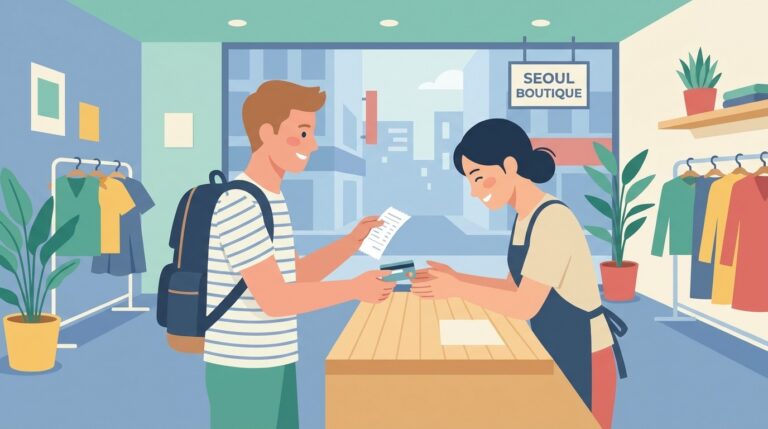
Master the Art of Returns in Korea: Receipt, Card, and Zero Drama
Phase 1: Empathy (Real-Life Opening)
안녕하세요! 매일한글 에디터입니다. (Hello! This is your Daily Hangul editor.)
Picture this: You just spent an exhilarating Saturday shopping in the heart of Hongdae. Neon signs flashing, indie music echoing down street-fashion alleys, and you finally picked up that viral oversized knit sweater you saw on your favorite K-drama lead. But when you get back to your hotel in Myeongdong and try it on, your heart sinks: the sleeve is slightly torn, or maybe the tone just does not match your style under normal lighting.
You know you need to head back to the counter, but immediate panic strikes. “Can I exchange this without speaking fluent Korean? What if the clerk speaks rapid-fire Korean and I get flustered? What if I forget the exact card I tapped?” You are definitely not alone. Over 80% of our beginner learners tell us that handling retail interactions—especially returns and exchanges—is their biggest travel fear. They worry about coming across as rude or creating an awkward public scene.
Here is the great news: Korean retail service is world-renowned for being efficient, systematic, and polite. Clerks deal with exchanges and refunds dozens of times a day. Once you know the exact rhythm and hand over the two golden items—your receipt and the original payment card—the entire transaction is over in less than 60 seconds. Based on real shopping situations experienced by hundreds of our community members, this guide gives you the confidence, phrasing, and non-verbal etiquette to walk up to any counter in Korea like a seasoned local.
Phase 2: Core Expressions Deep Dive
1. 구매할 때 받은 영수증과 결제했던 카드 여기 있어요. (Gumehal ttae badeun yeongsujeung-gwa gyeoljehaetdeon kadeu yeogi isseoyo.)
- Pronunciation: [Gu-mae-hal ttae ba-deun yeong-su-jeung-gwa gyeol-je-haet-deon ka-deu yeo-gi i-sseo-yo.] (Pronunciation tip: Think “Goo-may-hal tay bah-deun young-soo-jeung-gwa gyull-jeh-hat-don kah-deu yuh-gee ee-ssuh-yo”)
- Meaning: Literal: “Receipt received when buying and card paid with are here.” | Nuance: “Here is the receipt from my purchase and the card I paid with.”
- K-Culture Moment: Seen frequently at trendy concept stores in Seongsu-dong when a customer steps up to the return desk with paper bag in hand.
- Editor’s Insight: Notice the structure
~할 때 받은(received when doing) and~했던(which was used in the past). Even if this grammar feels long for A2, memorizing this chunk as one set phrase will instantly signal to the clerk that you know the standard return procedure.- Situation Spectrum: Casual (🚫) | Semi-formal (✅) | Formal (✅)
- 🤔 Think About It: In many Western stores, digital lookups by email or phone number are common. Why does Korean commerce place such heavy structural reliance on the physical payment card and receipt slip?
2. 이거 다른 색상으로 교환하고 싶어요. (Igeo dareun saeksang-euro gyohwanhago sipeoyo.)
- Pronunciation: [I-geo da-reun saek-sang-eu-ro gyo-hwan-ha-go si-peo-yo.] (Pronunciation tip: Think “Ee-guh dah-reun sake-sang-oo-roh gyoh-hwan-hah-go she-poh-yoh”)
- Meaning: Literal: “This, to another color, I want to exchange.” | Nuance: “I’d like to exchange this for a different color.”
- K-Culture Moment: Olive Young shoppers swapping a warm-toned lip tint for a cool-toned shade after checking swatches at home.
- Editor’s Insight: If you need a different size instead of color, simply replace
색상(saeksang, color) with사이즈(saijeu, size):다른 사이즈로 교환하고 싶어요(Dareun saijeuro gyohwanhago sipeoyo).- Situation Spectrum: Casual (🚫) | Semi-formal (✅) | Formal (✅)
- 🤔 Think About It: The particle
~으로indicates direction or choice. How does stating your preferred alternative directly help Korean retail staff help you faster?3. 결제 취소해 드릴게요. (Gyeolje chwisohae deurilgeyo.)
- Pronunciation: [Gyeol-je chwi-so-hae deu-ril-ge-yo.] (Pronunciation tip: Think “Gyull-jeh chwee-soh-hay doo-ril-gay-yoh”)
- Meaning: Literal: “I will do payment cancellation for you.” | Nuance: “I will cancel your payment now (process your refund).”
- K-Culture Moment: The sweet sigh of relief when the cashier taps the POS screen, cancels the charge, and prints your minus-receipt.
- Editor’s Insight: You do not say this phrase—the clerk says it to you.
해 드릴게요is the humble polite form of “I will do for you.” When you hear this, your refund is officially confirmed!- Situation Spectrum: Casual (🚫) | Semi-formal (✅) | Formal (✅)
- 🤔 Think About It: Notice the service honorific
드리다(to give/do humbly). How does Korean retail language elevate the customer through grammatical humility?
Phase 3: Textbook Korean vs Real Korean
Situation 1: Initiating the return at the counter
- 📖 Textbook Korean: 이 물건을 환불해 주시겠습니까? (I mulgeoneul hwanbulhae jusigesseumnikka? – “Would you please refund this item?”)
- 🗣️ Real Korean: 저, 이거 환불 좀 하려고 하는데요. (Jeo, igeo hwanbul jom haryeogo haneundeyo. – “Excuse me, I’d like to return this…”)
- 💡 Why is it different? Textbook phrases sound like an official written petition. Real Koreans soften requests using
저...(hesitation marker),좀(a little / please), and the open-ended connector-는데요(providing context politely).
Situation 2: Presenting the receipt and card
- 📖 Textbook Korean: 여기에 영수증과 신용카드가 있습니다. (Yeogi-e yeongsujeung-gwa sin-yongkadeuga itseumnida. – “Here are the receipt and the credit card.”)
- 🗣️ Real Korean: 영수증이랑 결제 카드 여기 있어요. (Yeongsujeung-irang gyeolje kadeu yeogi isseoyo. – “Here is the receipt and the payment card.”)
- 💡 Why is it different? Everyday spoken Korean naturally opts for conversational
-랑/이랑(“and”) over formal written-과/와, and drops stiff formal endings (-습니다) in favor of standard polite-어요.
Phase 4: K-Culture Deep Dive & Non-Verbal Manners
4-1. Nunchi (눈치) & The Two-Handed Handover
In Korea, non-verbal respect speaks louder than perfect grammar. When handing over your receipt and credit card:
1. The Two-Handed Rule: Never slide or toss your card across the counter. Hold the card and paper receipt with both hands, or support your right wrist/forearm with your left hand while extending them.
2. The Polite Angle: Present the card so the chip or front faces the clerk, resting it gently in the silicone tray on the counter if one is provided.
3. Eye Contact & Micro-Bow: Offer a slight head nod (목례, mongnye) while saying 여기 있어요 (Yeogi isseoyo). This non-verbal cue instantly signals good manners and creates an eager-to-help attitude in the clerk.
4-2. Cultural Code: The POS Authorization Match
Why are Korean clerks so strict about the exact payment card? In South Korea, tax laws and credit regulations (managed by the National Tax Service) enforce tight electronic audit trails. To cancel a transaction, the POS (Point of Sale) terminal requires an exact match with the initial transaction authorization number (승인번호). If you paid with a physical Hyundai card, Apple Pay on an iPhone, or an international Visa card, the refund must be reversed through that identical token. Having your card and paper slip ready before you reach the register is peak Nunchi (social etiquette) in fast-paced shopping districts.
Phase 5: Real-Life Roleplay Scenario
- Location: A hip streetwear boutique near Hongik University Station in Seoul.
- Characters:
- Alex (알렉스): An eager traveler who bought a stylish jacket yesterday but needs a larger size.
- Minji (민지 / 점원): A friendly, efficient boutique staff member behind the counter.
- Turn 1 (Alex): 안녕하세요, 저… 어제 산 옷인데 교환하고 싶어서요.
(Annyeonghaseyo, jeo… eoje san osinde gyohwanhago sipeoseoyo.)
“Hello, excuse me… I bought this clothing yesterday and would like to exchange it.”
🎭 Action: Approaching counter with paper bag, giving a polite slight bow. -
Turn 2 (Minji): 네, 고객님! 혹시 결제하셨던 영수증이랑 카드 있으실까요?
(Ne, gogaeknim! Hoksi gyeoljehayeotdeon yeongsujeung-irang kadeu isseusilkkayo?)
“Yes, valued customer! By any chance, do you have the receipt and card you paid with?”
🎭 Action: Smiling warmly, tapping the register screen to open the return window. -
Turn 3 (Alex): 네! 구매할 때 받은 영수증과 결제했던 카드 여기 있어요.
(Ne! Gumehal ttae badeun yeongsujeung-gwa gyeoljehaetdeon kadeu yeogi isseoyo.)
“Yes! Here is the receipt I received when buying and the card I paid with.”
🎭 Action: Handing the card and paper receipt across using both hands. -
Turn 4 (Minji): 감사합니다. 택(Tag)은 제거 안 하셨죠? 어떤 상품으로 교환해 드릴까요?
(Gamsahamnida. Taegeuneun jegeo an hasyeotjyo? Eotteon sangpumeuro gyohwanhae deurilkkayo?)
“Thank you. You didn’t remove the price tag, right? Which product can I exchange this for?”
🎭 Action: Scanning the receipt barcode and checking the clothing tag. -
Turn 5 (Alex): 사이즈가 작아서 라지(L) 사이즈로 바꾸고 싶어요.
(Saijeuga jagaseo raji saijeuro bakkugo sipeoyo.)
“The size is small, so I want to change it to size Large.”
🎭 Action: Pointing gently toward the clothing rack. -
Turn 6 (Minji): 네, 상품 확인했습니다. 기존 결제 취소하고 재결제 도와드릴게요. 서명 부탁드립니다.
(Ne, sangpum hwaginhaetseumnida. Gijon gyeolje chwisohago jaegyeolje dowadeurilgeyo. Seomyeong butakdeurimnida.)
“Yes, item confirmed. I will cancel the previous payment and help you re-charge. Please sign here.”
🎭 Action: Turning the digital signature pad toward Alex. -
Turn 7 (Alex): 네, 여기 서명했어요.
(Ne, yeogi seomyeonghaesseoyo.)
“Yes, I have signed here.”
🎭 Action: Signing with the digital stylus and nodding. -
Turn 8 (Minji): 교환 완료되었습니다. 새 영수증 쇼핑백에 넣어드렸어요. 좋은 하루 보내세요!
(Gyohwan wanryeodoeeotseumnida. Sae yeongsujeung syopingbaege neoheodeuryeosseoyo. Joeun haru bonaeseyo!)
“Exchange complete. I put your new receipt in the shopping bag. Have a wonderful day!”
🎭 Action: Bowing slightly and handing the new shopping bag over with two hands.
🔀 Interactive Decision Point
Imagine the clerk says: "고객님, 결제 취소 영수증입니다. 서명해 주시겠어요?" (Customer, this is your cancellation receipt. Could you sign here?)
- Option A:
"싫어요, 카드로 돌려주세요!"(Sireoyo, kadeuro dollyeojuseyo! – “I don’t want to, return it to my card!”) - Option B:
"네, 알겠습니다. 여기 서명하면 되나요?"(Ne, algetseumnida. Yeogi seomyeonghamyeon doenayo? – “Yes, understood. Do I just sign here?”) - Option C:
"그냥 갈게요!"(Geunyang galgeyo! – “I’ll just leave!”)
Feedback:
* Option A [Bad]: Refusing to sign creates confusion. The clerk is returning it to your card; signing the digital pad or paper slip is legal confirmation of the reversal!
* Option B [Best]: Polite, natural, and checks where to sign. The clerk will point directly to the signature box.
* Option C [Risk]: If you leave without signing the reversal slip, the cashier cannot close the cancelled batch, potentially stalling your refund.
Phase 6: 10-Second Emotion Shadowing Drill
Practice these lines out loud with the designated emotional markers and rhythmic pause points (/):
- Drill 1: Hesitant yet polite opening
[🥺 조심스럽고 정중하게 - Soft & Courteous]
저… / 어제 산 건데, / 환불 좀 하려고 하는데요.
(Jeo… / eoje san geonde, / hwanbul jom haryeogo haneundeyo.) -
Drill 2: Prepared and confident presentation
[😊 밝고 명확하게 - Bright & Confident]
구매할 때 받은 영수증과 / 결제했던 카드 / 여기 있어요!
(Gumehal ttae badeun yeongsujeung-gwa / gyeoljehaetdeon kadeu / yeogi isseoyo!) -
Drill 3: Friendly wrap-up
[🤝 감사하고 산뜻하게 - Crisp & Grateful]
네! / 확인해 주셔서 / 정말 감사합니다.
(Ne! / hwaginhae jusyeoseo / jeongmal gamsahamnida.)
Phase 7: K-Culture Mini Dictionary
- 영수증 (Yeongsujeung) | Receipt
In Korean shops, clerks will often ask"영수증 버려드릴까요?"(Should I throw away the receipt for you?). Always reply"아니요, 주세요!"(No, please give it to me!) if you might exchange or refund the item. - 환불 (Hwanbul) | Refund (Money back)
Used specifically for getting your payment back to cash or card. Contrast with교환(Gyohwan), which means exchanging for another item. - 교환 (Gyohwan) | Exchange / Replacement
Used when trading the current product for a different size, shade, or model. Often phrased as사이즈 교환(size exchange). - 결제 취소 (Gyeolje chwiso) | Payment Cancellation
The technical transaction term displayed on your register screen and bank app when a card charge is officially voided.
Phase 8: Traveler’s Survival Kit
Top 3 Survival Phrases for Shoppers
환불 기간이 언제까지예요?(Hwanbul gigani eonjekkajiyeyo?)
Meaning: “Until when is the refund period?”
Pro Tip: Most major apparel and cosmetics shops allow 7 to 14 days, while clearance items are often non-refundable (환불 불가).택(Tag) 안 뗐어요.(Taek an ttesseoyo.)
Meaning: “I haven’t removed the tag.”
Pro Tip: Having the original packaging and intact tag makes any exchange 10x smoother.차액만 결제하면 되나요?(Cha-aengman gyeoljehamyeon doenayo?)
Meaning: “Do I just pay the price difference?”
Pro Tip: Use this if the new item you are exchanging for costs more than the original.
Editor’s Travel Note
Before heading back to the store, verify business hours and exact shop branches using the Naver Map app navigation. Note that in Korea, franchise stores (like certain cosmetics or clothing chains) often only accept refunds at the exact branch where you purchased the item. Always check your paper slip for the store name!
Phase 9: “한 발 더 깊이” (A Deeper Look)
In Korean retail culture, speed and mutual trust are tightly bound to clear documentation. The insistence on seeing the physical card and receipt isn’t about bureaucracy; it’s a social agreement designed to eliminate credit disputes and prevent financial fraud in one of the world’s most cashless societies. By holding up your end of this unwritten contract—keeping your receipt safe and handing it over with two hands—you step into the rhythm of Korean daily life not as a confused tourist, but as a considerate, respectful participant in the community.
💬 Your Turn: Have you ever tried returning or exchanging an item in a foreign country? What felt most surprising or challenging about the experience? Share your story in the comments below!
Phase 10: FAQ & Avoiding Misunderstandings
Q: What should I do if I lost my paper receipt?
A: If you paid by card, some large chains (like Olive Young or major department stores) can search your purchase history using your payment card or store membership app. However, smaller independent boutiques in Hongdae or Dongdaemun may strictly refuse refunds without the paper receipt. Always snap a clear photo of your receipt immediately after purchasing!
Q: Can I get a cash refund if I originally paid with a credit card?
A: No. Korean consumer protection and financial laws require returns to be credited back via the original payment method to prevent card-cashing schemes. Your refund will go directly back to the card used.
Q: How long does a card refund take to show up on an international bank statement?
A: The shop cancels the authorization immediately (결제 취소), but international banks typically take between 3 to 7 business days to reflect the reversed charge on your account statement.
🚨 Common Mistakes Warning Board
- Mistake 1: Tossing clothing tags into the hotel trash before checking fit.
Correct Action: Keep all tags, plastic wrap, and boxes intact. Without tags, exchanges are almost always denied. - Mistake 2: Bringing a friend’s card or a different card to process the refund.
Correct Action: Bring the exact physical card used at checkout. POS terminals reject foreign authorization matches. - Mistake 3: Waiting longer than 7 to 14 days.
Correct Action: Check the return window printed at the very bottom of your receipt (usually marked as교환/환불: 결제일로부터 7일/14일 이내).
Phase 11: Action Missions
- 🥉 Bronze Mission (Solo Practice): Stand before a mirror with an old receipt and your bank card. Practice handing them forward with both hands while smoothly reciting:
구매할 때 받은 영수증과 결제했던 카드 여기 있어요three times. - 🥈 Silver Mission (Community Share): Leave a comment on our Instagram or blog post sharing the difference between
환불(refund) and교환(exchange) in your own words. - 🥇 Gold Mission (Real-World Test): On your next shopping trip in Korea, deliberately keep your receipt, and when buying, ask the clerk:
"환불 기간이 언제까지예요?"(Until when is the refund period?). - 🎮 K-Culture Mission: Watch an episode of a modern slice-of-life K-drama (like Work Later, Drink Now or Because This Is My First Life). Spot a scene where characters make a purchase or handle receipts, and note their hand gestures!
Phase 12: Interactive Quiz Challenge
Quiz 1: Situational Judgment
You bought a cute sweater in Myeongdong, but back at your hotel you notice a loose stitch. You return to the store with the sweater and the receipt, but you forgot your payment card at the hotel. What will likely happen?
1. The clerk will happily give you cash instead.
2. The clerk will look up your passport number and wire the money to you.
3. The clerk will likely allow an item exchange, but cannot process a full card refund until you bring the original card.
4. The store will keep the sweater without giving you anything.
Quiz 2: Fill in the Blanks
Fill in the missing words:
구매할 때 받은 _________과 결제했던 _________ 여기 있어요.
(Here is the receipt I received when buying and the card I paid with.)
Quiz 3: True or False Culture Check
Statement: In South Korea, it is considered polite and modern to flick or toss your credit card onto the counter tray with one hand so the clerk can grab it faster.
* True / False
🔍 Click here to reveal Quiz Answers & Explanations
- Quiz 1 Answer: 3
Explanation: In Korean retail systems, card cancellations strictly require the physical card to reverse the electronic token. However, most stores will happily let you exchange (교환) for another undamaged item on the spot! - Quiz 2 Answer: 영수증 (Yeongsujeung), 카드 (Kadeu)
Explanation:구매할 때 받은 영수증과 결제했던 카드 여기 있어요. - Quiz 3 Answer: False
Explanation: Tossing or sliding a card is considered rude in Korean culture. Always hand items over using both hands or with your left hand gently supporting your right forearm.







