

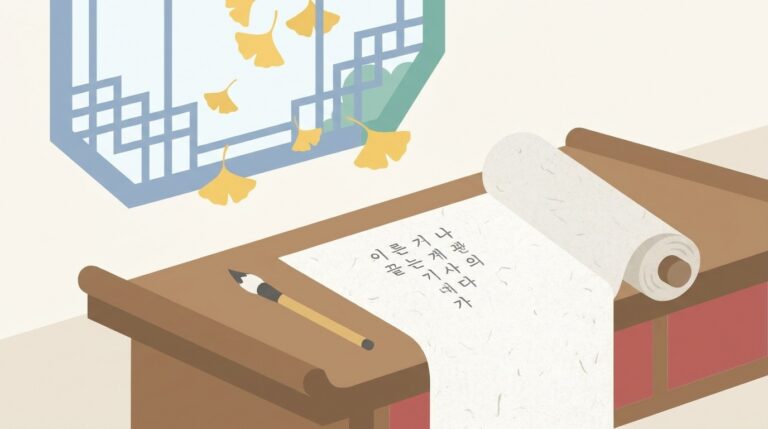
Crafting an Inimitable Human Literary Style in the Age of AI: Transcending Sterile Machine Prose
Phase 1: Empathy (Story-Driven Opening)
안녕하세요! 매일한글 에디터입니다. (Hello! This is your Daily Hangul editor.)
Have you ever fed a heartfelt prompt into an advanced AI model, requesting a poignant personal essay in Korean, only to scan the resulting paragraph and feel… absolutely numb?
Every particle is technically immaculate. The relative clauses connect with mathematical precision, and the honorific levels balance like calibrated weights. Yet, it feels like sitting in an airtight, sterilized operating theater—blindingly clean, perfectly odorless, and completely dead. In Seoul’s literary and high-end publishing scenes, editors now shudder at this phenomenon, dryly dubbing it ‘AI 슬롭’ (AI slop). When veteran showrunners in Sangam-dong or indie book curators in Seochon read manuscripts submitted by aspiring writers, they can sniff out algorithmic prose in three sentences flat.
Why? Because statistical language models generate output by predicting the most probable next token. By definition, they gravitate toward the sanitizing mean. They smooth out the jagged edges of grief, scrub away the awkward friction of lived shame, and eliminate the pregnant silences that make human speech resonate across a room. Machine prose lacks what our literary masters call 구체적 삶의 체취 (the tactile, visceral scent of lived life) and 실존적 떨림 (the existential tremor of an imperfect soul confronting truth).
If you are a C2-level learner aiming to write op-eds, author film treatments, publish essays, or hold your own among Korean intellectuals, your greatest hazard is sounding like a high-functioning translation API. Based on years of mentoring bilingual screenwriters and literary translators at Daily Hangul, this guide offers an antidote to antiseptic fluency. We are going to reclaim the organic, jagged, and luminous beauty of an authentic human voice.
Phase 2: Core Expressions in Depth
To transcend machine-like sterility, you must integrate words that carry somatic weight, historical patina, and psychological friction.
1. 삶의 궤적이 묻어나다 (Salm-ui gwejeog-i mudeonada)
- Pronunciation: [Sal-meui gwe-jeok-i mu-deo-na-da] (Think of the English word “psalm” dropping its “p”, followed by “gwe-jeok” like a quiet wheel turning on a track, and “mu-deo-na-da” like ink blooming on wet mulberry paper.)
- Meaning: Literal: The trajectory of one’s life smears through/rubs off. | Real Nuance: To exude an authentic, hard-earned depth that cannot be faked, where a person’s trials and scars naturally bleed through their words or art.
- K-Culture Moment: On the talk show You Quiz on the Block, a veteran documentary producer praised an elderly actor: 그분의 투박한 대사 한마디마다 지나온 삶의 궤적이 묻어납니다. (Geubun-ui tubakhan daesa hanmadimada jinaon salm-ui gwejeog-i mudeonamnida. / In every unpolished line of his, the weathered trajectory of his life bleeds through.)
- Editor’s Insight: The verb 묻어나다 typically refers to wet dye, grease, or dirt transferring upon contact. In literary contexts, using it elevates abstract “experience” into an involuntary, physical residue. AI writes abstract declarations; humans leave stains.
- Situation Spectrum: Casual ⚠️ | Semi-formal ✅ | Formal ✅
- 🤔 Think About It: English often uses clinical phrases like “authentic lived experience.” How does the tactile Korean image of a trajectory “rubbing off like ink” alter your sensory commitment to the sentence?
2. 실존적 떨림 (Siljonjeok tteollim)
- Pronunciation: [Sil-jon-jeok tteol-lim] (A crisp, grounded “sil-jon”, followed by the tense, double-consonant “tteol”—resembling the taut snap of a cello string before it vibrates into “lim”.)
- Meaning: Literal: Existential tremor / vibration. | Real Nuance: The raw, vulnerable hesitation of an authentic voice facing fear, mortality, or unspeakable desire; the antithesis of mechanical confidence.
- K-Culture Moment: Literary critics analyzing Nobel laureate Han Kang’s delicate cadence frequently note: 단정한 문장 아래로 집요한 실존적 떨림이 요동친다. (Danjeonghan munjang araero jibyohan siljonjeok tteollim-i yodongchinda. / Beneath the tidy sentences, an unrelenting existential tremor surges.)
- Editor’s Insight: An AI never hesitates; it calculates. When you inject phrases that articulate this tremor, you signal to the Korean reader that you are writing from the vulnerable precipice of conscious experience.
- Situation Spectrum: Casual 🚫 | Semi-formal ✅ | Formal ✅
- 🤔 Think About It: Does your native tongue celebrate certainty in formal writing, or does it honor the trembling voice of the seeker? Why does Korean intellectual prose treat vulnerability as the highest mark of sophistication?
3. 매끈하게 다듬어진 번지르르함 (Maekkeunhage dadeumeojin beonjireureuham)
- Pronunciation: [Maek-keun-ha-ge da-deu-meo-jin beon-ji-reu-reu-ham] (Notice the slick, oily glide of “beon-ji-reu-reu”—it sounds slippery, like stepping on ice with leather soles.)
- Meaning: Literal: Smoothly trimmed, slick glossiness. | Real Nuance: A disparaging critique for prose, dialogue, or rhetoric that is cosmetically perfect yet completely hollow, devoid of soul or sincerity.
- K-Culture Moment: In the creative agency drama Agency (대행사), an executive creative director trashes a slick pitch deck: 이건 그저 매끈하게 다듬어진 번지르르함일 뿐이야. 소비자의 폐부를 찌르는 통증이 없어. (Igeon geujeo maekkeunhage dadeumeojin beonjireureuham-il ppuniya. Sobijaui pyebureul jjireuneun tongjeung-i eopseo. / This is merely slick, sterile gloss. It lacks the visceral sting that pierces the consumer’s lungs.)
- Editor’s Insight: While “smooth” (매끄럽다) can be complimentary in design, compounding it with the mimetic root 번지르르하다 (greasy sheen) exposes superficiality. It is the definitive C2 weapon against AI-generated fluff.
- Situation Spectrum: Casual ✅ | Semi-formal ✅ | Formal ✅
- 🤔 Think About It: Contrast the English word “polished” (often purely positive) with Korean cultural skepticism toward things that are too smooth. Why do Koreans revere the rough texture of 투박함 (unadorned earthiness)?
Phase 3: Textbook Korean vs. Real Korean
Scenario 1: Praising an essay that deeply moved you with its gritty honesty
- 📖 교과서 한국어 (Textbook Korean):
이 수필은 작가의 진솔한 경험을 담고 있어서 매우 감동적이고 유익합니다.
(I supil-eun jakgawui jinsolhan gyeongheom-eul damgo isseoseo maeu gamdongjeog-igo yuikhamnida. / This essay contains the author’s candid experiences, so it is very moving and informative.) - 🗣️ 진짜 한국어 (Real Living C2 Korean):
문장 행간마다 손때 묻은 치열함이 배어 있어서, 읽는 내내 가슴 한구석이 뻐근하게 저려왔어요.
(Munjang haeng-ganmada sonttae mudeun chiyeolham-i baeeo isseoseo, ilgneun naenae gaseum hanguseog-i ppeogeunhage jeoryeowasseoyo. / Between every line seeps the weathered grit of genuine struggle; my chest throbbed with a heavy, dull ache throughout.) - 💡 왜 다를까? (Why the divergence?):
Textbook Korean relies on bland, abstract predicates like “감동적이다” (is touching). High-level literary Korean engages somatic markers: 손때 (the patina of worn hands) and 뻐근하게 저리다 (an ache in the marrow). It translates emotion into physical sensation.
Scenario 2: Critiquing a sterile corporate manifesto or script draft
- 📖 교과서 한국어 (Textbook Korean):
이 기획서는 논리적이고 문법적으로 올바르지만, 독창적인 개성이 다소 부족해 보입니다.
(I gihoekseoneun nonrijeog-igo munbeopjeog-euro olbareujiman, dokchangjeogin gaeseong-i daso bujokhae boimnida. / This proposal is logical and grammatically correct, but somewhat lacks original individuality.) - 🗣️ 진짜 한국어 (Real Living C2 Korean):
군더더기 없이 말끔하긴 한데, 정작 글 쓴 사람의 체온이나 숨소리가 전혀 잡히질 않네요.
(Gundeodeogi eopsi malkkeumhagin hande, jeongjak geul sseun saram-ui che-on-ina sumsoriga jeonhyeo japhijil anneyo. / It is scrubbed of all clutter, yes, but I cannot catch the slightest whisper of the author’s breath or body heat.) - 💡 왜 다를까? (Why the divergence?):
Rather than diagnosing “개성 부족” (lack of individuality), native editors evaluate presence using organic metaphors like 체온 (body temperature) and 숨소리 (sound of breathing). Writing without breath is deemed dead on arrival.
Phase 4: K-Culture Deep Dive & Non-Verbal Nuances
4-1. 눈치 (Nunchi) & The Rhetoric of the Pause
In western academic debate, uninterrupted vocal momentum signals mastery. In advanced Korean discourse, unbroken verbal velocity signals an unthinking algorithm.
When presenting a serious literary, creative, or cultural insight, observe the rule of 여백 (Yeobaek – negative space). Notice how veteran Korean auteurs—like Lee Chang-dong (Burning, Poetry) or Bong Joon-ho (Parasite)—deliver critique. When moving from analytical exposition to emotional truth, they break eye contact, drop their gaze toward their hands for 1.5 seconds, and release a soft, almost inaudible breath before uttering words like 글쎄요… (Well…) or 결국엔… (In the end…).
This deliberate hesitation is not a loss for words; it is a physical display of 실존적 떨림 (existential tremor). It reassures your listener that you are not reciting cached data, but wrestling with the weight of the idea in real time.
4-2. Cultural Code: The Cult of “투박함” (Rough Authenticity)
From the uneven, unpretentious glaze of the Joseon Moon Jar (백자 달항아리) to the raw, unglamorous dialogue of screenwriter Noh Hee-kyung (Our Blues), Korean aesthetics harbor a profound suspicion toward seamless symmetry.
When dialogue sounds too clever or when an essay flows with symmetrical ease, Korean audiences often disengage, labeling it 작위적이다 (contrived/artificial). What moves the Korean heart is 투박함—the coarse, asymmetric texture of something hammered by hand. When you write or speak, preserving an unexpected idiom, an idiosyncratic rhythm, or an unadorned emotional truth will win far more respect than clinical, textbook symmetry.
Phase 5: Real-World Roleplay Scenario
Setting: A dimly lit, script-development loft in Chungmuro, Seoul. Rain beats against the glass. On the table sit two ceramic cups of lukewarm buckwheat tea and a script draft.
Characters:
* Director Min (민 감독): A legendary 52-year-old arthouse filmmaker celebrated for coaxing raw, devastating performances out of his cast.
* You (신인 작가): A foreign-born screenwriting fellow fighting to establish an authentic Korean voice for an upcoming feature film.
[1] Director Min (민 감독)
(원고를 천천히 내려놓으며 깊은 한숨을 내쉰다)
작가님, 문장은 물 흐르듯 매끄러운데... 왜 활자 사이로 피가 안 통할까요?
(Wongoreul cheoncheonhi naeryeonoh-eumyeo gipeun hansum-eul naeswinda)
Jakganim, munjang-eun mul heureudeut maekkeureounde... wae hwalja sairo piga an tonghalkkayo?
🎭 [Action: Slowly sets the script down on the table and exhales a quiet, heavy sigh.]
"Writer-nim, the sentences flow as smooth as silk... but why does it feel like there's no blood coursing between the letters?"

[2] You (신인 작가)
(시선을 머뭇거리다 고개를 숙이며)
제가... 번역기 문체처럼 정돈된 틀 안에 스스로를 가두었던 것 같습니다.
(Siseon-eul meomutgeorida gogaereul suk-imyeo)
Jega... beon-yeokgi munchecheoreom jeongdon-doen teul an-e seuseuroreul gadueotdeon geot gatseumnida.
🎭 [Action: Hesitates with your gaze before slightly lowering your head with honest remorse.]
"I think... I trapped myself inside a sanitized box, like machine-translated prose."

[3] Director Min (민 감독)
(담배를 만지작거리며 창밖을 응시한다)
맞아요. 이건 무균실 배양액에서 자란 화초 같아. 내가 보고 싶은 건 진창에서 구른 사람의 체취거든.
(Dambaereul manjijakgeorimyeo changbagg-eul eungshihanda)
Maj-ayo. Igeon mugyunsil baeyang-aeg-eseo jaran hwacho gata. Naega bogo sipeun geon jinchang-eseo gureun saram-ui chechwigeodeun.
🎭 [Action: Fiddles with an unlit cigarette while staring out into the rain-washed city.]
"Precisely. This feels like an orchid cultivated in a sterile lab broth. What I want to smell is the sweat of someone who has rolled in the gutter."

[4] You (신인 작가)
(테이블 위 찻잔을 조용히 감싸 쥐며)
인물의 결핍을 매끈한 수사학 뒤로 숨기지 않고, 더 거칠게 밀어붙여 보겠습니다.
(Te-ibeul wi chatjan-eul joyonghi gamssa jwimyeo)
Inmul-ui gyeolpib-eul maekkeunhan susahak dwiro sumgiji anko, deo geochilge mireobutyeo bogesseumnida.
🎭 [Action: Quietly wraps both hands around the ceramic tea cup, centering your posture.]
"I won't hide the character's brokenness behind slick rhetoric; I'll push it into raw, ragged territory."

[5] Director Min (민 감독)
(날카로운 눈빛으로 작가의 눈을 쏘아보며)
거칠다는 건 막 쓰는 게 아니에요. 단어 하나를 골라도, 작가 내면의 실존적 떨림이 묻어있어야 관객이 숨을 멈추는 법이지.
(Nalkaroun nunbich-euro jakgawui nun-eul sso-abomyeo)
Geochildaneun geon mak sseuneun ge anieyo. Dan-eo hanareul golrado, jakga naemyeon-ui siljonjeok tteollim-i mudeo-isseoya gwan-gaeg-i sum-eul meomchuneun beob-iji.
🎭 [Action: Pierces your eyes with a razor-sharp, searching gaze.]
"Roughness doesn't mean careless scribbling. Even if you pick a single word, the existential tremor of your inner core must stain it—that's what makes the audience stop breathing."

[6] You (신인 작가)
(단호하지만 나지막한 어조로)
머리로 재단한 문장은 다 지우겠습니다. 손가락 끝이 저려오는 문장만 남겨올게요.
(Danhohajiman najimakhan eojoro)
Meoriro jaedanhan munjang-eun da jiugesseumnida. Songarak kkeut-i jeoryeo-oneun munjangman namgyeoolgeyo.
🎭 [Action: Speaks in a quiet, resolute timbre, grounding your shoulders.]
"I will erase every sentence tailor-made in my head. I will return only with sentences that make my fingertips throb with numbness."

[7] Director Min (민 감독)
(비로소 입꼬리를 희미하게 올리며)
좋네. 내일 아침까지 첫 씬의 호흡, 완전히 다시 엎어올 수 있겠어요?
(Biroso ipkkorireul huimihage ollimyeo)
Johne. Naeil achimkkaji cheot ssin-ui hoheup, wanjeonhi dashi eop-eool su itgesseoyo?
🎭 [Action: At last, the faint ghost of a satisfied smile curls the corner of his lips.]
"Good. Can you tear down and rebuild the rhythm of the opening scene from scratch by tomorrow morning?"

[8] You (신인 작가)
(원고를 가슴에 품고 정중히 고개를 숙인다)
네, 감독님. 밤새 활자에 제 살갗을 베여가며 다시 쓰겠습니다.
(Wongoreul gaseum-e pumgo jeongjunghi gogaereul suk-inda)
Ne, gamdongnim. Bamsae hwalja-e je salgat-eul beyeogamyeo dashi sseugesseumnida.
🎭 [Action: Pulls the draft against your chest and bows with disciplined reverence.]
"Yes, Director. I will rewrite tonight, letting the printed letters graze my bare skin until it bleeds."
🔀 Interactive Choice Point
At turn [4], how would you respond if Director Min questioned whether your prose was too foreign or detached?
- Option A: “죄송합니다. 한국어 맞춤법 검사기와 AI 도구를 더 꼼꼼히 돌려서 오류를 전면 수정하겠습니다.” (I am sorry. I will run grammar checkers and AI tools more thoroughly to eliminate every mistake.)
- Option B: “유려한 문장 뒤로 숨었던 제 안일함을 인정합니다. 서툴더라도 제 삶의 궤적이 투영된 날것의 단어들을 직조해 오겠습니다.” (I acknowledge my complacency in hiding behind slick sentences. However clumsy it may be, I will weave raw words mirrored from the trajectory of my own life.)
- Option C: “하지만 요즘 독자들은 군더더기 없는 미니멀하고 매끄러운 문체를 더 선호하지 않나요?” (But don’t modern readers prefer lean, minimal, and smooth prose without clutter?)
💡 Feedback Matrix
- Option A (Bad): You doubled down on the very sin being criticized! Relying on algorithmic checkers signals intellectual laziness and confirms to Director Min that you cannot think organically.
- Option B (Best): 정답입니다! You wielded C2 meta-language (안일함, 날것, 직조하다) while demonstrating that you value emotional vulnerability over antiseptic surface polish.
- Option C (Risk): Highly dangerous. Suggesting that the director’s creative aesthetic is out of touch will immediately freeze the meeting. You risk sounding like a corporate copywriter defending AI slop.
Phase 6: 10-Second Emotion Shadowing Drill
Practice reading these sentences aloud. Emphasize the slashes (/) as micro-pauses to master authentic rhythmic friction.
[🔥 비장하고 단호하게 - Resolute & Grounded]
매끄러운 수사학 뒤로 / 숨지 않겠습니다. / 제 결핍을 / 날것 그대로 / 드러내겠습니다.
(Maekkeureoun susahak dwiro / sumji anketseumnida. / Je gyeolpib-eul / nalgeot geudaero / deureonaeketseumnida.)
(I will not hide / behind slick rhetoric. / I will expose / my flaws / in their absolute rawness.)-
[😔 처연하고 가슴 아프게 - Poignant & Wounded]
활자 사이마다 / 손때 묻은 고통이 배어 있어서… / 차마 / 책장을 넘기지 못했어요.
(Hwalja saimada / sonttae mudeun gotong-i baeeo isseoseo… / chama / chaekjang-eul neomgiji mothaesseoyo.)
(Between the printed letters / the weathered agony seeped through so deeply… / that I simply could not / turn the page.) -
[😏 서늘하고 날카로운 비판 - Icy & Discerning]
군더더기는 없는데… / 정작 그 사람의 / 체온이나 숨소리는 / 전혀 느껴지지 않네요.
(Gundeodeogineun eomneunde… / jeongjak geu saram-ui / che-on-ina sumsorineun / jeonhyeo neukkyeojijil anneyo.)
(It lacks clutter, certainly… / but the person’s / actual body warmth or breathing / cannot be felt at all.)
Phase 7: K-Culture Mini Dictionary
-
결 (Gyeol)
Literal: The grain (of wood, fabric, or skin).
Usage: In cultural analysis, 결 describes the subtle emotional frequency, psychological texture, or spiritual orientation of an individual or text. E.g., “그 작가와 나는 문학적 결이 비슷해요” (That writer and I share a similar spiritual grain). -
날것 (Nalgeot)
Literal: Raw food / unheated ingredients.
Usage: Refers to unfiltered, unmanufactured emotion or truth. To speak or write with 날것의 감정 means daring to display vulnerability without cosmetic sanitization. -
행간 (Haeng-gan)
Literal: The space between lines of printed text.
Usage: The unspoken subtext or philosophical resonance. Advanced Koreans evaluate writing by looking at the 행간의 무게 (weight of the unwritten space). -
활자 (Hwalja)
Literal: Moveable metal type / printed font.
Usage: Often preferred over the casual “글자” (letter) or “텍스트” (text) when evoking the physical, historical gravity of published writing. E.g., “활자에 갇힌 생각” (thought trapped in rigid cold print).
Phase 8: Writer & Intellectual Traveler’s Survival Kit
When exploring Seoul’s indie bookstores and literary salons, carry these high-register expressions in your back pocket:
- 1. 문체의 결이 참 독특한데, 혹시 독립 출판물인가요?
(Munche-ui gyeol-i cham dokteukhande, hoksi dongnip chulpanmur-ingayo?)
Pro Tip: Use this when browsing in Yeonnam-dong or Seochon indie bookshops. It immediately signals that you evaluate prose by its stylistic grain (문체의 결) rather than commercial fame. -
2. 행간에 머금은 침묵이 참 깊어서 마음에 오래 남네요.
(Haeng-gan-e meogeum-eun chimmug-i cham gipeoseo ma-eum-e orae namneyo.)
Pro Tip: The quintessential compliment for a poet, essayist, or barista who shares an introspective zine with you. It means: “The silence held between your lines lingers deeply in my heart.” -
3. 인공지능이 흉내 낼 수 없는 저자 특유의 숨결이 느껴져요.
(Ingongjineung-i hyungnae nael su eomneun jeoja teug-yu-ui sumgyeol-i neukkyeojyeoyo.)
Pro Tip: The highest praise you can bestow on a contemporary Korean creator: “I can feel the author’s distinctive breath that AI could never emulate.”
🧭 Editor’s Travel Note: The Literary Sanctuary Crawl
To experience where real human friction is forged, skip the mega-chain bookstores in Gwanghwamun and head to the indie sanctuaries of Tongin-dong and Euljiro. Find narrow second-floor sanctuaries like Ira Seojeok (이어서적) or Boan 1942 (통의동 보안여관), where experimental Korean prose and zines reside.
Before you go, make sure you complete your 네이버 지도 앱 다운로드 (Naver Map app download), as foreign mapping engines often fail to locate hidden alley bookshops tucked away in old print-shop districts.
Phase 9: “한 발 더 깊이” (One Step Deeper: The Poetics of Friction)
In Korean linguistic philosophy, language is not viewed merely as a cognitive transmitter of information; it is regarded as a visceral, somatic fluid that circulates through a living community. This is why our most evocative linguistic terms are inextricably linked to bodily distress and tactile contact: 피가 통하다 (blood circulates), 살갗이 트다 (skin chaps), 가슴이 미어지다 (the heart is torn apart).
When an artificial intelligence generates Korean sentences, it operates within a frictionless vacuum of probabilistic math. It has never known the biting chill of a predawn winter subway commute on Line 1, nor has it swallowed down tears over a lukewarm bowl of Sundae-guk in a crowded market stall.
True mastery at the C2 level is not about eliminating grammatical errors; it is about cultivating the courage to leave the scars of lived experience on the page. Your non-native Korean will become unforgettable the moment you stop striving for sterile perfection and begin infusing your prose with the specific, unrepeatable friction of your own journey.
💬 Your Turn: Have you ever felt that AI-generated Korean translations sounded “too perfect to be true”? Which phrase from today’s guide could help you break that sterility? Share your thoughts in the comments below!
Phase 10: FAQ & Common Mistakes
Q: Does avoiding “AI style” mean I should deliberately use incorrect grammar or bizarre slang?
A: Absolutely not. Transcending machine style is not about embracing sloppy syntax. It is about stylistic texture (문체의 결). AI models excel at standardized, textbook grammar and abstract Latinate or Sino-Korean clichés. Human literary Korean introduces sensory metaphors, evocative native-Korean verbs (배어들다, 스며나오다), and varied syntactic rhythm (호흡의 완급 조절).
Q: Can I use idioms like “삶의 궤적이 묻어나다” in academic or business writing?
A: Yes, but context is everything. In a formal corporate contract, stick to objective technical clarity. However, in keynote speeches, editorial op-eds, artistic statements, executive cover letters, or brand identity narratives, using phrases like 삶의 궤적이 묻어나는 진정성 (authenticity bearing the trajectory of lived life) sets you apart as an extraordinary communicator.
Q: Why do my Korean teachers often correct my idiosyncratic, expressive sentences to sound more generic?
A: Most intermediate pedagogical approaches are designed to eliminate non-standard errors and enforce standardized communicative competence (B1-B2 mindset). However, once you cross the threshold into C1-C2, your goal shifts from “correctness” to “voice and aura.” Gently explain to your native tutors that you are working on 창작 문체 (creative literary style) rather than basic communicative drill.
🚨 Common Mistakes Alert
- Over-using Sino-Korean abstract nouns in stacks:
Mistake: 독창성의 결여로 인한 감동의 부재. (Dokchangseong-ui gyeol-yeoro inhan gamdong-ui bujae. / Absence of emotion caused by lack of originality.)
Correct Action: Use organic, native-root verbal constructions: 문장에 온기가 없어 마음에 닿지 않는다. (Munjang-e on-giga eopseo ma-eum-e dahji anneunda. / There is no warmth in the sentence, so it fails to touch the heart.) - Relying solely on predictable adjectives like “감동적이다” or “슬프다”:
Mistake: 영화가 너무 감동적이어서 눈물이 났어요.
Correct Action: Invoke somatic resonance: 인물의 비루한 일상이 너무 선명해서, 보는 내내 턱 끝이 뻐근해졌어요. (The character’s wretched daily struggle was so vivid that my jaw ached throughout.) - Sanitizing the sentence until all pauses disappear:
Mistake: Writing long, runaway complex sentences without rhetorical breathing space.
Correct Action: Break the flow with deliberate, short declarative beats: 정돈되어 있다. 그러나 살아있지 않다. (It is neat. But it is not alive.)
Phase 11: Action Missions
- 🥉 Bronze Mission (Solo Practice): Pick an AI-generated paragraph in Korean. Identify three abstract phrases (e.g., “매우 슬펐다”, “좋은 경험이었다”) and replace them with somatic metaphors invoking body heat (체온), breathing (숨결), or physical wear (손때).
- 🥈 Silver Mission (Social Writing): Write an Instagram review or tweet about your favorite Korean movie, drama, or book using the phrase 삶의 궤적이 묻어나다 or 실존적 떨림. Tag us
@DailyHangul! - 🥇 Gold Mission (Real-World Execution): Engage with a native Korean author, independent publisher, or creative friend. Inquire about their work using the phrase: “문장 행간에 머금은 침묵이 깊어 인상적이었습니다.” Notice how their eyes light up when they realize you understand the concept of silent subtext.
🎮 K-Culture Mission: The Auteur Hunt
Watch an episode of an introspective drama like My Mister (나의 아저씨) or Lost (인간실격). Identify one dialogue exchange where the characters pause and speak in rough, unfinished fragments. Transcribe the scene and analyze how those ragged edges convey profound human warmth.
Phase 12: Interactive Quiz Challenge
Test your mastery over sterile machine prose versus living human voice.
1. Situational Judgment: You are reviewing a newly hired copywriter’s promotional blurb. It reads like a clinical corporate brochure. How should you critique it to inspire true creative depth?
* A) 맞춤법이 많이 틀렸으니 챗GPT로 교정해서 다시 오세요.
* B) 문장은 매끄럽게 번지르르한데, 브랜드의 체온과 결이 전혀 느껴지지 않아요.
* C) 단어가 너무 어려우니 초등학생 수준으로 다시 쓰세요.
2. Fill-in-the-Blank: Complete the critique of a literary masterpiece:
“단어 하나하나에 저자가 감내해 온 ( )이/가 깊게 묻어나서 깊은 울림을 준다.”
* A) 기계적 정확성 (Mechanical accuracy)
* B) 삶의 궤적 (Trajectory of lived life)
* C) 문법적 규칙 (Grammatical rule)
3. True or False: High-register, sophisticated C2 Korean always favors unbroken, high-speed verbal delivery without hesitations or pauses.
* (True / False)
👉 Click to reveal answers & explanations!
-
Answer: B
Explanation: Calling prose 매끄럽게 번지르르하다 while lamenting the lack of 체온 (body heat) and 결 (stylistic grain) is the gold standard of high-level Korean creative direction. -
Answer: B (삶의 궤적)
Explanation: The idiom 삶의 궤적이 묻어나다 conveys that the author’s real, weathered life experiences naturally shine through their work. -
Answer: False
Explanation: In advanced Korean rhetoric, mastering 여백 (the pregnant silence) and allowing an intentional pause demonstrates 실존적 떨림 and profound emotional weight.







