

Phase 1: Empathy (Story Immersion Opening)
안녕하세요! 매일한글 에디터입니다. (Hello! I’m your Daily Hangul editor.)
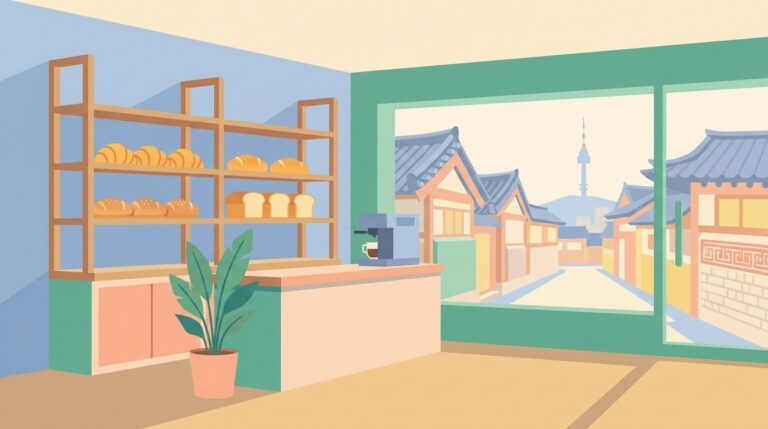
Picture this: you are strolling through a sunlit morning in Seoul’s Yeonnam-dong neighborhood. The irresistible aroma of toasted butter, caramelized sugar, and warm dough gently pulls you toward a cute bakery with warm glowing lights. You step inside, your eyes sparkling at rows of golden, flaky pastries and pillowy buns. You grab a shiny metal tray and tongs, feeling ready to conquer breakfast like a true K-drama main character.
Then, your gaze drops to the little display cards. Instead of English, it is all in Hangul: 크로와상, 바게트, 베이글! Your mind goes blank. A sudden wave of panic hits—What if I accidentally pick red bean paste when I wanted chocolate? What do I say to the cashier?
Take a deep breath! Here is a secret: most Korean bakery menus are actually English words disguised in Hangul. Once you unlock the simple sound rules of Korean loanwords, you can read almost the entire display in seconds! Based on real classroom feedback from hundreds of our beginner students, this guide will transform your bakery anxiety into effortless pastry joy.
Phase 2: Top 3 Core Expressions In-Depth
1. 샌드위치 (Saendeuwichi)
- Pronunciation: [Saen-deu-wi-chi] (Sounds like saying “Sand-which” slowly, giving a gentle extra breath to the ‘d’: San-deu-witch-ee)
- Meaning: Literal: Sandwich | Real Nuance: Any fresh grab-and-go sandwich, sub, or egg salad toast in a refrigerated bakery case.
- K-Culture Moment: The iconic breakfast scene where a busy young doctor or office worker in a drama grabs an egg-mayo 샌드위치 and an iced Americano while rushing to work.
- Editor’s Insight: Korean phonetics doesn’t like combining ‘nd’ and ‘w’ without a vowel cushion, so Korean inserts the subtle vowel ㅡ (eu). Whenever you see ㅡ in foreign words, treat it as a gentle stepping stone!
- Situation Spectrum: Casual: ✅ | Semi-formal: ✅ | Formal: ✅
- 🤔 Think About It: Notice how English sounds get rearranged into Hangul blocks. Why do you think Korean phonetics adds soft vowels instead of harsh consonant stops?
2. 크림빵 (Keurim-ppang)
- Pronunciation: [Keu-rim-ppang] (Sounds like “Cream” followed by a snappy, popped “Pang!”)
- Meaning: Literal: Cream + Bread | Real Nuance: Soft, sweet custard or whipped cream-filled bread bun—Korea’s ultimate nostalgic comfort food.
- K-Culture Moment: In nostalgic series like Reply 1988, friends share sweet 크림빵 at retro neighborhood bakeries on rainy afternoons.
- Editor’s Insight: Look closely at the word: 크림 (keu-rim = cream) is a modern loanword, while 빵 (ppang = bread) entered Korean centuries ago via Portuguese pão! It is literally history on a plate.
- Situation Spectrum: Casual: ✅ | Semi-formal: ✅ | Formal: ✅
- 🤔 Think About It: Has your native language borrowed food words from other countries so deeply that people forget where they originally came from?
3. 이거 주세요 (Igeo juseyo)
- Pronunciation: [I-geo ju-se-yo] (Sounds like “E-gear jew-say-yo”)
- Meaning: Literal: “This, please give” | Real Nuance: “I’ll take this one, please!”
- K-Culture Moment: The golden phrase whispered by travel vloggers and K-Pop stars pointing through glass display cases at boutique bakeries.
- Editor’s Insight: As an A1 beginner, you don’t need complex grammar particles. Just point your index finger at any pastry on your tray or behind the glass and say 이거 주세요 with a bright smile. It works in 100% of Korean shops!
- Situation Spectrum: Casual: ⚠️ (too formal for close peers) | Semi-formal: ✅ (perfect for bakeries and cafes) | Formal: ✅
- 🤔 Think About It: English speakers often say “Could I please have…?” while Koreans say “Please give this.” Does asking directly feel impolite or refreshing to you?
Phase 3: Textbook Korean vs. Real Korean
Situation 1: Confirming what a pastry is at the counter
- 📖 교과서 한국어 (Textbook Korean): 이것은 베이글입니까? (Igeoseun beigeurimnikka? / Is this a bagel?)
- 🗣️ 진짜 한국어 (Real Korean): 이거 베이글이에요? (Igeo beigeurieyo? / Is this a bagel?)
- 💡 왜 다를까? (Why is it different?): Textbook -입니까 is stiff and sounds like an official military inspection. Real everyday Koreans use the polite, melodic -이에요? to sound warm, natural, and friendly.
Situation 2: Asking for your baked goods to go
- 📖 교과서 한국어 (Textbook Korean): 빵을 포장하여 주시기 바랍니다. (Ppang-eul pojanghayeo jusigi baramnida. / Please package the bread.)
- 🗣️ 진짜 한국어 (Real Korean): 포장해 주세요! (Pojanghae juseyo! / To go, please!)
- 💡 왜 다를까? (Why is it different?): Seoul checkout counters move at lightning speed. 포장해 주세요 is short, friendly, and gets your treats wrapped before you even tuck your card back into your wallet.
Phase 4: K-Culture Deep Dive & Non-Verbal Manners
4-1. 눈치 (Nunchi) & Gestures: The Bakery Tray Dance
When you enter a Korean bakery, do not reach for bread with your bare hands! Look immediately near the entrance for two things: a 쟁반 (jaengban – tray) and 집게 (jipge – tongs).
- The Wax Paper Rule: Grab one sheet of clean wax paper (유산지) and line your tray before picking up any tongs.
- Two-Handed Etiquette: When presenting your payment card or phone to the staff at the register, hold it with both hands, or support your right forearm lightly with your left hand. This shows deep respect and instant Korean nunchi (social intuition)!
4-2. Culture Code: Sweet Garlic & The ‘Salt Bread’ Craze
Korean bakeries are famous for blending Western baking with sweet, savory Korean flavor profiles. Don’t be surprised when you bite into garlic bread and discover sweet condensed milk cream cheese inside! Recently, Korea has been obsessed with 소금빵 (sogeum-ppang / salt bread)—a Japanese-inspired butter roll topped with flaky rock salt that strikes a balance between rich butter and sharp savory crunch.
Phase 5: Real-Life Roleplay Scenario
Setting: Warm golden sunlight pours into 봄날 베이커리 (Spring Day Bakery) in Mapo-gu. The smell of freshly baked butter rolls fills the air. Minji, a smiling baker in a linen apron, stands behind the wooden counter.
- Turn 1 (Minji): 안녕하세요! 트레이 여기에 올려주세요. (Annyeonghaseyo! Teurei yeogie ollyeojuseyo. / Hello! Please put your tray up here.)
🎭 두 손으로 카운터 위 고무 매트를 가리키며 활짝 웃는다. - Turn 2 (You): 네, 여기요! (Ne, yeogiyo! / Yes, here you go!)
🎭 빵이 담긴 트레이를 조심스레 올려놓는다. - Turn 3 (Minji): 크로와상 하나랑 소금빵 두 개 맞으시죠? (Keurowasang hanarang sogeum-ppang du gae majeosijo? / One croissant and two salt breads, correct?)
🎭 집게로 빵을 확인하며 포스기 화면을 터치한다. - Turn 4 (You): 네, 맞아요! 혹시 이거 스콘도 맛있어요? (Ne, majayo! Hoksi igeo seukondo masisseoyo? / Yes, that’s right! By the way, is this scone delicious too?)
🎭 쇼케이스 안의 초코 스콘을 가리킨다. - Turn 5 (Minji): 아, 초코 스콘 진짜 인기 많아요! (A, choko seukon jinjja ingi manayo! / Ah, the chocolate scone is super popular!)
🎭 엄지손가락을 살짝 들어 보이며 미소 짓는다. - Turn 6 (You): 그럼 스콘도 하나 추가해 주세요. (Geureom seukondo hana chugahae juseyo. / Then please add one scone too.)
🎭 손가락 하나를 펴 보이며 끄덕인다. - Turn 7 (Minji): 네! 드시고 가세요, 포장해 드릴까요? (Ne! Deusigo gaseyo, pojanghae deurilkkayo? / Sure! Will you eat here, or shall I pack it to go?)
🎭 종이 포장지를 꺼내며 상냥하게 묻는다. - Turn 8 (You): 포장해 주세요! 카드로 결제할게요. (Pojanghae juseyo! Kadeuro gyeoljehalgeyo. / Please pack it to go! I will pay by card.)
🎭 두 손으로 신용카드를 공손하게 건넨다.
🔀 Interactive Decision Point
Minji looks up as she bags your warm pastries and asks: “봉투 필요하세요? (Bongtu piryohaseyo? / Do you need a shopping bag?)” (Bags usually cost 100 to 200 KRW by law).
- Option A: “네, 봉투 하나 주세요!” (Ne, bongtu hana juseyo! / Yes, please give me one bag!)
- Feedback: [Best! ⭐⭐⭐] Super polite and practical. If you have multiple items, paying the tiny fee keeps your pastries safe.
- Option B: “아니요, 그냥 들고 갈게요!” (Aniyo, geunyang deulgo galgeyo! / No, I’ll just carry them as is!)
- Feedback: [Good! ⭐⭐] Very eco-friendly! Great choice if you already have a tote bag or backpack ready.
- Option C: “봉투 공짜 아니에요?” (Bongtu gongjja anieyo? / Aren’t bags free?)
- Feedback: [Risk! ⚠️] Under Korean environmental regulations, businesses are legally required to charge for single-use bags. Asking this can sound confrontational.
Phase 6: 10-Second Emotion Shadowing Drill
Read these sentences aloud matching the emotional tone and natural pauses indicated by the / marks!
[😊 Bright and excited]안녕하세요! / 이거 / 크로와상 맞아요? (Annyeonghaseyo! / Igeo / keurowasang majayo? / Hello! Is this a croissant?)[🍞 Hungry and enthusiastic]이거 두 개 / 포장해 주세요! (Igeo du gae / pojanghae juseyo! / Please pack two of these to go!)[🥺 Disappointed and cute]아, / 소금빵이 / 다 나갔어요? (A, / sogeum-ppangi / da nagasseoyo? / Oh, is the salt bread completely sold out?)[🙏 Polite and breezy]영수증은 / 버려주세요! / 감사합니다! (Yeongsujeungeun / beoryeojuseyo! / Please discard the receipt! Thank you!)
Phase 7: K-Culture Mini Dictionary
- 소금빵 (Sogeum-ppang): Salt Bread. A buttery crescent roll sprinkled with coarse sea salt, famous for its crispy bottom and airy center.
- 단팥빵 (Danpat-ppang): Sweet Red Bean Bread. The traditional granddaddy of Korean bakeries, stuffed with sweet boiled red bean paste and walnuts.
- 토스트 (To-seu-teu): Toast. In Korea, this often refers to grilled cabbage, egg, and ham street sandwiches topped with sweet sugar and ketchup.
- 포장 (Pojang): Takeout / Packaging. The essential survival keyword when you want food packed up rather than dining inside the cafe.
Phase 8: Traveler’s Survival Kit
Top 3 Survival Phrases
- 덜 달콤한 빵 있어요? (Deol dalkomhan ppang isseoyo?)
- Meaning: Do you have bread that is less sweet?
- Pro Tip: Korean bakeries love sweetness. If you want savory bread without sugar glaze, ask this!
- 데워 주실 수 있나요? (Deweoju sil su innayo?)
- Meaning: Could you warm this up for me?
- Pro Tip: Bakery staff will happily microwave or toast your savory ham rolls or garlic bread for 20 seconds.
- 영수증 버려주세요 (Yeongsujeung beoryeojuseyo)
- Meaning: Please discard the receipt.
- Pro Tip: Very common in fast-paced Korean payment counters when you don’t need paper clutter.
Editor’s Travel Note
- Find Hidden Bakeries: Don’t just stick to big chains. Open your smartphone, navigate to 네이버 지도 앱 다운로드 (Naver Map App Download), and search for ‘베이커리’ (Bakery) or ‘빵집’ (Bread Shop) to find incredible artisanal bakeries in small alleys!
- Card-Only Culture: Most indie bakeries in Seoul are completely cashless now. Always have an international debit/credit card or a reloadable Korean transit card (WOWPASS/T-Money) ready.
Phase 9: “One Step Deeper” (Reflective Essay)
When foreign words land in Korea, Hangul gives them a second life. The way words like Croissant turn into 크로와상 (Keu-ro-wa-sang) or Cake turns into 케이크 (Ke-i-keu) is not a phonetic limitation—it is a cultural bridge. Hangul’s block-syllable architecture adapts foreign sounds so naturally that they become part of everyday Korean conversations. When you read a bakery sign, you aren’t just deciphering syllables; you are experiencing how Korean society actively invites global flavors into its own culinary soul.
💬 Your Turn: What is the most surprising English loanword you have spotted in Korean so far? Have you ever tasted Korean garlic bread? Let me know in the comments below!
Phase 10: FAQ & Common Mistakes
Q: Why do English words have extra ‘eu’ (ㅡ) sounds in Hangul?
A: In English, consonants like ‘s’, ‘t’, and ‘k’ often end syllables abruptly (like toast). Hangul syllables require a vowel with consonants, so the neutral vowel ㅡ (eu) acts as a phonological cushion, turning toast into 토스트 (to-seu-teu).
Q: Can I sit at a bakery table if I only buy bread and no drinks?
A: Many trendy bakery-cafes in Korea have a strict policy: if you use a dine-in table, you must order at least one beverage per person. If you only want to eat bread, taking it out (포장) to a nearby park bench is often the safest bet!
Q: What should I do with my empty tray and trash after eating?
A: Never leave dirty trays on your table. Look for the return station sign labeled 퇴식구 (Toesikgu / Tray Return) and return your tray and tongs neatly there.
🚨 흔한 실수 (Common Mistakes) Warning Board
- Mistake: Touching pastries with your hands before buying.
- Correct Action: Always pick up tray and tongs with wax paper right at the entrance before browsing.
- Mistake: Putting a pastry back onto the shelf after placing it on your tray.
- Correct Action: Due to hygiene customs, once an item touches your tray, it is considered yours. Choose with your eyes first!
- Mistake: Saying “Hello” or “Excuse me” in English when entering.
- Correct Action: Greet the staff with a friendly head nod and say 안녕하세요! (Annyeonghaseyo!) to immediately set a warm tone.
Phase 11: Action Missions
- 🥉 Bronze Mission (Solo Practice): Read these 4 bakery loanwords out loud 3 times right now: 베이글 (Bagel), 크로와상 (Croissant), 머핀 (Muffin), 도넛 (Donut).
- 🥈 Silver Mission (Social Connection): Take a photo of any baked treat today, post it to your Instagram story or Threads, and write: “오늘의 빵! (Bread of the day!)”.
- 🥇 Gold Mission (Real-Life Mastery): Walk into a local Korean bakery or cafe and order entirely in Korean using: “이거 하나 포장해 주세요! (Please pack one of this to go!)”.
- 🎮 K-Culture Mission: Watch an episode of a slice-of-life K-drama (like Hospital Playlist) and spot what bakery snacks the characters bring to share in their break room!
Phase 12: Interactive Quiz Challenge
Test your new K-bakery skills below! Can you get a perfect score?
Question 1 (Situation Judgment)
You picked two salt breads and want to take them back to your hotel room. What should you say to the cashier?
* A) 여기서 먹고 갈게요. (Yeogiseo meokgo galgeyo.)
* B) 포장해 주세요. (Pojanghae juseyo.)
* C) 빵을 환불해 주세요. (Ppang-eul hwanbulhae juseyo.)
Question 2 (Fill-in-the-Blank)
Complete the sentence to ask for this pastry:
“이 빵 ________ 주세요.” (Please give me this bread.)
* A) 어디 (eodi)
* B) 하나 (hana)
* C) 누구 (nugu)
Question 3 (True or False: Cultural Manners)
In Korean bakeries, it is considered polite and normal to return a pastry from your tray back to the display case if you change your mind.
* (True / False)
👉 Click here to check the Answers & Explanations!
- Q1 Answer: B) 포장해 주세요 (Pojanghae juseyo).
Explanation: “포장해 주세요” means “Please pack it to go!” Option A means you will eat inside, and Option C means asking for a refund. - Q2 Answer: B) 하나 (hana).
Explanation: “하나 (hana)” means “one”. The full sentence reads: 이 빵 하나 주세요 (I ppang hana juseyo / Please give me one of this bread). - Q3 Answer: False.
Explanation: Once food touches your personal tray, returning it to open displays violates food hygiene etiquette. Always decide before picking it up!







