

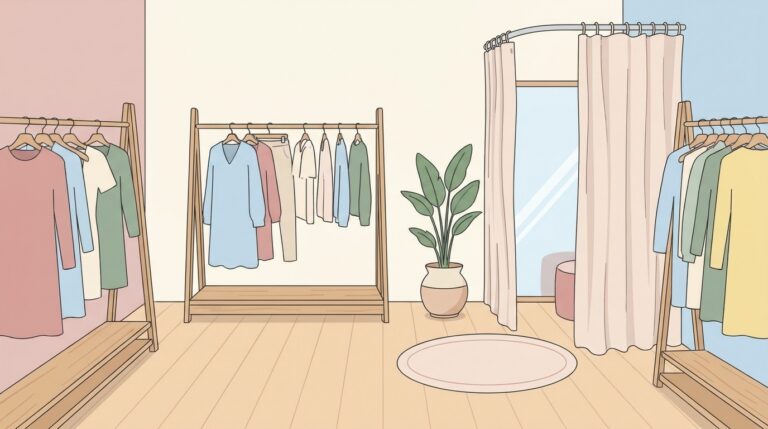
Shopping for Clothes in Korea: May I Try This On?
Phase 1: Empathy & Storytelling Opening
안녕하세요! 매일한글 에디터입니다. (Hello! I am your Daily Hangul editor.)
Picture this: You are strolling through the bustling streets of Hongdae or Seongsu-dong, surrounded by indie boutiques displaying the aesthetic oversized T-shirts you’ve seen your favorite K-pop idols rock during dance rehearsals. You pick up a gorgeous cream-white graphic tee. Your heart races—you want to try it on to see if the drop-shoulder silhouette actually looks good on you. But as you look toward the curtained corner, sudden panic sets in: Can I just walk in? Do I need permission? What if white tops aren’t allowed in fitting rooms here?
You stand frozen, awkwardly clutching the hanger, worrying that the fashionable staff might scold you in lightning-fast Korean. Don’t worry! This is the single most common worry shared by hundreds of our beginner students. By mastering just one polite, natural phrase, you will transform this nerve-wracking moment into a smooth, stylish shopping victory. Let’s make sure you never leave Seoul with ill-fitting clothes again!
Phase 2: Top 3 Core Expressions Deep-Dive
1. 이 티셔츠 입어 봐도 돼요? (I tisyeocheu ibeo bwado dwaeyo?)
- Pronunciation: [I ti-syeo-cheu i-beo bwa-do dwae-yo?] (Sound analogy: Think of saying “ee tee-shurt ee-buh bwah-doh dweh-yo”. The ending “dwaeyo” rhymes with “way-oh”!)
- Meaning: Literal: “Even if I try wearing this T-shirt, is it okay?” | Natural: “May I try on this T-shirt?”
- K-Culture Moment: Seen in almost every K-drama makeover scene where the lead tries on new trendy clothes before an important party!
- Editor’s Insight: The ending grammar -아/어도 돼요? (-a/eodo dwaeyo?) is your ultimate superpower in Korea. It politely asks for permission for anything. Combine it with the verb 입다 (ipda, to wear) + 보다 (boda, to see/try) to create “try wearing.”
- Situation Spectrum:
- Casual (Friends only): 이거 입어 봐도 돼? (Igeo ibeo bwado dwae?) ⚠️
- Semi-formal (Polite retail standard): 이 티셔츠 입어 봐도 돼요? (I tisyeocheu ibeo bwado dwaeyo?) ✅
- Formal (High-end luxury department stores): 입어 보아도 되겠습니까? (Ibeo boado doegesseumnikka?) 🚫 (Too stiff for street boutiques)
- 🤔 Think About It: In Korean, testing an action uses the verb “to see” (보다), such as “eat and see” (먹어 보다) or “wear and see” (입어 보다). How does your native language express the concept of “trying something out”?
2. 피팅룸이 어디예요? (Pitingrum-i eodieyo?)
- Pronunciation: [Pi-ting-rum-i eo-di-ye-yo?] (Sound analogy: “pea-ting-room-ee uh-dee-yay-yo?”)
- Meaning: Literal: “Fitting room where is it?” | Natural: “Where is the fitting room?”
- K-Culture Moment: Pop-up stores in Seongsu often hide fitting rooms behind quirky artistic curtains or mirrored doors.
- Editor’s Insight: While traditional Korean has the word 탈의실 (tal-ui-sil), nearly all modern youth fashion shops simply use the Konglish loanword 피팅룸 (pitingrum). Using “피팅룸” will instantly make you sound like a local shopper.
- Situation Spectrum:
- Casual: 피팅룸 어디야? (Pitingrum eodiya?) ⚠️
- Polite Daily: 피팅룸이 어디예요? (Pitingrum-i eodieyo?) ✅
- 🤔 Think About It: English loanwords are everywhere in modern Seoul. Why do you think young retail culture adopts words like “fitting room” instead of older Sino-Korean terms?
3. 다른 색상 있어요? (Dareun saeksang isseoyo?)
- Pronunciation: [Da-reun saek-sang is-seo-yo?] (Sound analogy: “tah-reun sek-sang ees-suh-yo?”)
- Meaning: Literal: “Different color exists?” | Natural: “Do you have this in other colors?”
- K-Culture Moment: When shopping in Dongdaemun late-night markets, popular basics are displayed in one shade, but vendors keep multiple colorways stashed beneath the racks.
- Editor’s Insight: 색상 (saeksang) refers to color options, but you can also simply say 다른 색 있어요? (Dareun saek isseoyo?). If you want a specific tone, Korean stores frequently use terms like 블랙 (beullaek – black), 화이트 (hwaiteu – white), or 베이지 (be-i-ji – beige).
- Situation Spectrum:
- Polite Daily: 다른 색상 있어요? (Dareun saeksang isseoyo?) ✅
- Short & Quick: 다른 색도 있어요? (Dareun saek-do isseoyo?) ✅
- 🤔 Think About It: Korean separates native words for colors from Sino-Korean categories. Notice how polite and efficient retail phrases tend to be in compact spaces.
Phase 3: Textbook Korean vs. Real Korean
Situation 1: Asking to try clothes on
- 📖 교과서 한국어 (Textbook Korean): 탈의실에서 의류를 착용해 봐도 되겠습니까? (Taruisireseo uiryureul chagyonghae bwado doegesseumnikka? / May I wear the apparel in the changing room?)
- 🗣️ 진짜 한국어 (Real Korean): 저기요, 이거 입어 봐도 돼요? (Jeogiyo, igeo ibeo bwado dwaeyo? / Excuse me, can I try this on?)
- 💡 왜 다를까? (Why is it different?): Textbook phrases rely on formal Sino-Korean vocabulary like “의류 (apparel)” and “착용 (donning/wearing)”, which sounds like a legal contract! Real Koreans use the everyday verb “입다” with the casual call-out “저기요 (excuse me)”.
Situation 2: Asking for a different size
- 📖 교과서 한국어 (Textbook Korean): 더 큰 치수의 치수를 제시해 주시겠습니까? (Deo keun chisuye chisureul jesihae jusigesseumnikka? / Would you present me with a larger dimension size?)
- 🗣️ 진짜 한국어 (Real Korean): 이거 한 사이즈 큰 거 있어요? (Igeo han sa-i-jeu keun geo isseoyo? / Do you have this one size bigger?)
- 💡 왜 다를까? (Why is it different?): Koreans rarely use the traditional word “치수 (dimension/measurement)” in casual boutique shops. They use the English word “사이즈 (size)” combined with “큰 거 (bigger one)” or “작은 거 (smaller one)”.
Phase 4: K-Culture Deep Dive & Non-Verbal Manners
4-1. 눈치 (Nunchi) & Gestures: The Magic Face Cover
When entering a Korean fitting room, there are two golden non-verbal etiquette rules you must remember:
1. Shoes off on the mat: Most fitting rooms have a raised wooden floor or a clean carpet mat. Take off your outdoor shoes and step onto the mat or use the slippers provided inside.
2. The “Face Cover” (페이스 커버): If you are trying on tops, the staff will often hand you a soft, non-woven white bag that looks like a shower cap or veil. Do not throw it away! To prevent makeup, sunscreen, and lip tint from staining white or tight garments, you slip this breathable cover over your head before pulling the shirt over your face. Using it without being asked shows top-tier cultural manners (눈치, nunchi)!
4-2. Cultural Code: The “Free Size” & White Shirt Restrictions
In Seoul’s fast-fashion underground stations (like Gangnam or Express Bus Terminal), you will often notice little signs that read “흰색 옷 착용 불가” (White clothes cannot be tried on). Because white fabrics easily get spoiled, many stores only allow you to try on dark colors, jackets, or pants. Furthermore, many boutique clothes are marked as 프리사이즈 (Free size). Don’t be fooled by the word “free”—it means “one size fits most” (usually equivalent to US Small to Medium). Always ask before entering the fitting room!
Phase 5: Real-Life Roleplay Scenario
- Setting: A trendy minimalist boutique along the cafe street in Seongsu-dong.
- Character: Min-ji (Staff) – A kind and stylish store associate wearing an oversized blazer and silver spectacles.
-
Turn 1 (Shopper): 저기요, 이 티셔츠 입어 봐도 돼요? (Jeogiyo, i tisyeocheu ibeo bwado dwaeyo?)
🎭 Politely holding up an oversized beige T-shirt, making gentle eye contact with Min-ji. -
Turn 2 (Min-ji): 네, 고객님! 저쪽 피팅룸 이용하시면 돼요. (Ne, gogaengnim! Jeojjok pitingrum iyonghasimyeon dwaeyo.)
🎭 Smiling warmly and pointing toward the linen curtains at the rear corner. -
Turn 3 (Shopper): 피팅룸에 신발 벗고 들어가요? (Pitingrume sinbal beotgo deureogayo?)
🎭 Pointing downward at sneakers with a slightly curious expression. -
Turn 4 (Min-ji): 네, 신발 벗고 슬리퍼 신어 주세요! 페이스 커버도 챙겨 드릴게요. (Ne, sinbal beotgo seullipeo sineo juseyo! Pe-i-seu keobeodo chaenggyeo deurilgeyo.)
🎭 Hands over a lightweight non-woven white face hood with both hands. -
Turn 5 (Shopper): 감사합니다. 혹시 이거 다른 색상도 있어요? (Gamsahamnida. Hoksi igeo dareun saeksangdo isseoyo?)
🎭 Bowing head slightly while taking the face cover with two hands. -
Turn 6 (Min-ji): 네, 블랙이랑 차콜 색상도 있어요. 피팅 후에 말씀해 주세요! (Ne, beullaegirang chakol saeksangdo isseoyo. Piting hue malsseumhae juseyo!)
🎭 Gently nod and step aside so you have plenty of room to enter. -
Turn 7 (Shopper): 네, 입어 보고 올게요! (Ne, ibeo bogo olgeyo!)
🎭 Smiling and sliding the curtain closed. -
Turn 8 (Min-ji): 네, 편하게 입어 보세요~ (Ne, pyeonhage ibeo boseyo~)
🔀 Interactive Decision Point: What do you say if you want to try on a white shirt next?
- Choice A (Best): “이 흰색 셔츠도 페이스 커버 쓰고 입어 봐도 돼요?” (I heunsaek syeocheudo peiseu keobeo sseugo ibeo bwado dwaeyo?)
Feedback: Best! You show proactive respect for their garments by mentioning the face cover first. The clerk will gladly approve! - Choice B (Risk): “이거 그냥 입어 볼게요!” (Igeo geunyang ibeo bolgeyo!)
Feedback: Risk! Saying you will “just try it” without checking white shirt policies might lead to an awkward stop from the clerk. - Choice C (Bad): “흰색 주세요.” (Huinsaek juseyo.)
Feedback: Bad! Too abrupt. It sounds like you are ordering food at a restaurant rather than asking for fitting room permission.
Phase 6: 10-Second Emotion Shadowing Drill
Practice these lines with exaggerated rhythm and emotion to build authentic muscle memory!
[😊 Bright & Friendly]
저기요! / 이 티셔츠 / 입어 봐도 돼요?
(Jeogiyo! / I tisyeocheu / ibeo bwado dwaeyo?)
(Excuse me! / This T-shirt / may I try on?)-
[🤔 Curious & Polite]
혹시 / 다른 색상도 / 있어요?
(Hoksi / dareun saeksangdo / isseoyo?)
(By any chance / different colors / do you have?) -
[🥺 Slightly Hesitant & Sweet]
이거 / 한 사이즈 큰 거 / 있어요?
(Igeo / han sa-i-jeu keun geo / isseoyo?)
(This / one size bigger / do you have?)
Phase 7: K-Culture Mini Dictionary
- 프리사이즈 (Peuri-sai-jeu) | Noun | One-size-fits-all. Common in Korean youth boutiques; typically equivalent to an Asian standard S/M.
- 페이스 커버 (Pe-i-seu Keo-beo) | Noun | A disposable thin fabric hood provided in clothing stores to prevent facial makeup from rubbing off onto collars.
- 품절 (Pum-jeol) | Noun | Sold out / Out of stock. Often announced with a sad sigh: “죄송해요, 품절이에요! (Sorry, it’s sold out!)”
- 착샷 (Chak-syat) | Noun | Portmanteau of 착용 (wearing) + 샷 (shot/photo). A “fit check” or selfie taken in the dressing room mirror to post on Instagram.
Phase 8: Survival Kit for Travelers
Top 3 Survival Phrases
- 이거 새 제품으로 있어요? (Igeo sae jepumeuro isseoyo?)
[Pronunciation: I-geo sae je-pum-eu-ro is-seo-yo?]
Pro Tip: The shirt on the hanger is often handled by dozens of people. Ask this at checkout to receive a pristine, packaged item from back storage! - 거울 어디 있어요? (Geoul eodi isseoyo?)
[Pronunciation: Geo-ul eo-di is-seo-yo?]
Pro Tip: Boutiques often place flattering full-body mirrors outside the fitting stalls in the hallway. - 계산해 주세요. (Gyesan-hae juseyo.)
[Pronunciation: Gye-san-hae ju-se-yo?]
Pro Tip: Use this when you are ready to pay at the counter.
Editor’s Travel Note: Smooth Shopping in Korea
To easily find the trendiest boutique clusters in Seongsu and Hannam-dong, open your Naver Map app download instead of Western map apps, which often lack accurate pedestrian walking routes in Korea. Most fashion stores seamlessly accept international Visa and Mastercard, Apple Pay, or T-money cards. Always remember to ask for 택스 리펀 (Taekseu ripeon – Tax Refund) receipts if you spend over 15,000 KRW!
Phase 9: Think Deeper
In many Western fashion stores, customers are encouraged to grab five items off the rack and stroll straight into the dressing room unassisted. In Korea, however, retail spaces are communal environments built around mutual consideration (배려, baeryeo). Because shopkeepers maintain limited stock of delicate garments, asking permission before putting your body into clothing is seen as an essential marker of mutual respect.
Language reflects this communal mindset: you don’t merely state your right to try something on; you ask “Is it okay for everyone involved if I wear this and see?” (-아/어도 돼요?).
💬 Your Turn: Have you ever encountered unique fitting room rules while traveling abroad? Share your funny shopping stories in the comments below!
Phase 10: FAQ & Common Mistakes
Q: Can I try on white T-shirts or knitwear in Korean stores?
A: In larger international chain stores (like SPAO, Zara, or Musinsa Standard), yes—provided you use a face cover. However, in small independent boutiques or underground street stalls, white tops and delicate knitwear are strictly off-limits for try-ons to protect stock from makeup and collar stretching.
Q: What should I do if the clerk stands right outside the curtain while I’m changing?
A: Don’t feel pressured! Korean retail staff are trained to wait nearby to retrieve different sizes or take unwanted clothes so you don’t have to carry them around. When you step out, they will simply inspect the fit and say “잘 어울리세요! (It suits you well!)”.
Q: How do Korean clothing sizes work compared to US/EU sizes?
A: Korean clothes run noticeably smaller. A Korean “M” is often comparable to an American “S”. Pants sizes are measured in inches or numbers (e.g., 26, 28, 30), but hip cuts tend to be narrower.
🚨 Common Mistakes Warning Board
- Mistake 1: Walking into the fitting stall with your dusty street shoes on the dressing carpet.
Correct Action: Always leave your shoes on the floor border outside the mat or change into the provided slippers. - Mistake 2: Tossing the face cover on the floor after trying on your shirt.
Correct Action: Dispose of it in the small trash bin inside the booth or bring it back out to the counter trash can. - Mistake 3: Forgetting to say “저기요 (Jeogiyo)” before talking to staff.
Correct Action: Don’t snap your fingers or yell “Hey!”; a soft “저기요~” with a slight nod gets immediate, friendly service.
Phase 11: Action Mission & Engagement
- 🥉 Bronze Level: Stand in front of your own closet mirror, hold a shirt, and speak out loud 5 times: “이 티셔츠 입어 봐도 돼요?”
- 🥈 Silver Level: Record a short 10-second voice memo practicing the 3 core phrases from Phase 2 and share it with your study buddy or language exchange partner.
- 🥇 Gold Level: Visit a Korean brand store (or local boutique) and ask the staff for permission to try on an item using natural Korean pronunciation!
- 🎮 K-Culture Mission: Watch an episode of a Korean shopping vlog or fashion makeover show on YouTube, spot the moment they enter a fitting room, and see if you can spot the “페이스 커버 (face cover)”!
Phase 12: Interactive Quiz Challenge
Quiz 1. Situational Judgment
You find a pretty oversized shirt at an underground boutique in Gangnam. You want to try it on. Which is the most natural and polite thing to say to the staff nearby?
* A) 이거 입어! (Igeo ibeo!)
* B) 저기요, 이거 입어 봐도 돼요? (Jeogiyo, igeo ibeo bwado dwaeyo?)
* C) 피팅룸 어디야? (Pitingrum eodiya?)
👉 Click here for Answer & Explanation
Correct Answer: B
Explanation: Option B uses the respectful calling phrase “저기요 (excuse me)” together with the polite permission grammar “-아/어도 돼요?”. Options A and C are informal (반말, banmal) and would sound impolite to a store clerk.
Quiz 2. Fill-in-the-Blank
Complete the sentence to ask if they have this shirt in a different color:
“혹시 다른 _________ 있어요?” (By any chance, do you have a different _________?)
👉 Click here for Answer & Explanation
Correct Answer: 색상 (saeksang) or 색 (saek)
Explanation: Both “색상” (color shade) and “색” (color) correctly complete this essential retail sentence.
Quiz 3. True or False Cultural Quiz
True or False: In Korea, you can wear your street shoes straight onto the carpeted fitting room floor without taking them off.
👉 Click here for Answer & Explanation
Correct Answer: False!
Explanation: You should always step out of your shoes before stepping onto the fitting booth mat or slip into the indoor slippers provided by the shop.







