

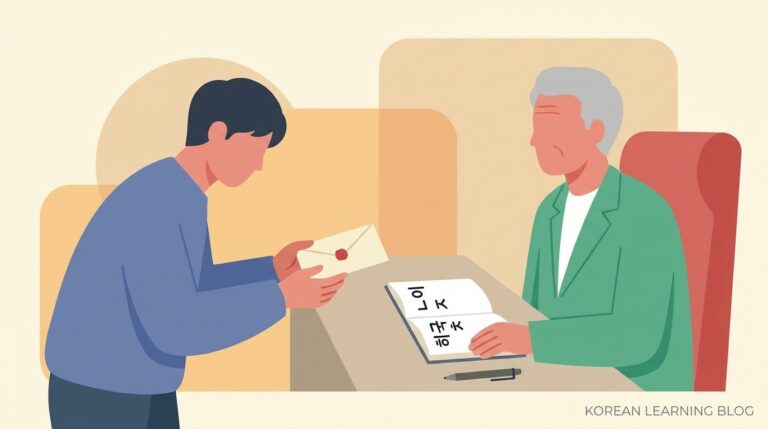
Phase 1: Empathy (Story-Driven Opening)
안녕하세요! 매일한글 에디터입니다. (Hello! This is your Daily Hangul editor.)
Have you ever watched a heartfelt Korean drama like Crash Course in Romance or Master in the House and seen the moment when a student hands a carefully sealed envelope to their revered mentor? There is a quiet pause, a deep bow, and an unmistakable aura of profound respect.
Now, imagine you want to write a thank-you note to your Korean language professor, a university advisor, or a team lead who mentored you. You pick up your pen, stare at the crisp stationery, and suddenly your mind goes blank. You ask yourself: “Is ‘감사합니다 (Gamsahamnida)’ enough, or does it sound like a sterile grocery store receipt?” “Can I write ‘다음에 봐요 (Da-eume bwayo)’ to say see you later?” (Spoiler: Please don’t—one of our intermediate learners, Sarah from Canada, once wrote that on her professor’s retirement card, accidentally sounding like she was waving goodbye to a college roommate at a bar!)
In Korean culture, expressing gratitude to a mentor isn’t just about saying “thank you.” It is an emotional contract where you acknowledge their guidance and promise to honor their effort through your own personal growth. Today, based on feedback from hundreds of intermediate learners who felt terrified of making an honorific misstep, we are breaking down the exact formulas to close your letter with poise, warmth, and native-level grace.
Phase 2: Deep Dive into 3 Core Expressions
1. 조만간 더 성장한 모습으로 찾아뵙고 인사드리겠습니다 ( 한글: 조만간 더 성장한 모습으로 찾아뵙고 인사드리겠습니다 )
- Pronunciation: Joman-gan deo seong-jang-han mo-seub-eu-ro cha-ja-boep-go in-sa-deu-ri-get-seum-ni-da (Sound analogy: Think of “cha-ja-boep-go” like clicking two smooth stones together—crisp and resolute).
- Meaning: Literal: “Soon, in a more grown appearance, I will come see you and offer greetings.” / Real Nuance: “I promise to keep striving, and I look forward to paying you a visit soon to share my progress with deep gratitude.”
- K-Culture Moment: In coming-of-age films, when an apprentice finishes their training under a seasoned artisan or master chef, they recite this exact line to show that their mentor’s time was not wasted.
- Editor’s Insight: Koreans value the concept of 성장 (seongjang – growth) above simple success. Telling an elder that you will return “as a more grown person” conveys that you take their lessons to heart.
- Situation Spectrum: Casual: 🚫 | Semi-formal: ⚠️ | Formal: ✅
- 🤔 Think About It: In English, we often say “Let’s catch up soon!” Why does Korean frame catching up with an elder as “paying a visit to greet you” (찾아뵙다) rather than simply hanging out?
2. 다시 한번 머리 숙여 감사드립니다 ( 한글: 다시 한번 머리 숙여 감사드립니다 )
- Pronunciation: Da-si han-beon meo-ri su-gyeo gam-sa-deu-rim-ni-da (Sound analogy: Let “meo-ri su-gyeo” flow smoothly like a deliberate, slow exhalation).
- Meaning: Literal: “Once again, bowing my head, I offer thanks.” / Real Nuance: “From the very bottom of my heart, I bow my head in utmost reverence and gratitude.”
- K-Culture Moment: Often written on handwritten plaques or at the conclusion of retirement and graduation speeches to convey an emotion words alone cannot hold.
- Editor’s Insight: When Koreans say “머리 숙여 (meori sugyeo)”, it evokes the physical act of jeol (a deep bow). It turns an otherwise standard written line into a physical, humble gesture right on the page.
- Situation Spectrum: Casual: 🚫 | Semi-formal: ⚠️ | Formal: ✅
- 🤔 Think About It: Why does Korean verbalize the physical body posture (bowing the head) in a written letter instead of keeping feelings abstract?
3. 제자 올림 ( 한글: 제자 올림 )
- Pronunciation: Je-ja ol-lim (Sound analogy: “Ol-lim” lifts upward, mimicking the action of lifting something up to an elder).
- Meaning: Literal: “Disciple/Student raised up.” / Real Nuance: “Respectfully offered by your student.”
- K-Culture Moment: Used exclusively as the final sign-off below your name in traditional letters, academic cards, or master-pupil messages.
- Editor’s Insight: Never sign a letter to an elder with “[Name] 씀 (sseum)” or “[Name] 보냄 (bonaem)”—those imply you are at the same level or looking down on the recipient! “올림 (ollim)” or “드림 (deurim)” symbolically raises the letter upward with both hands.
- Situation Spectrum: Casual: 🚫 | Semi-formal: ⚠️ | Formal: ✅
- 🤔 Think About It: How does changing the sign-off from “From, [Name]” to “Your student, presented upward” reflect social hierarchy and care in Korea?
Phase 3: Textbook Korean vs. Real Native Korean
Situation 1: Promising to Visit Later
- 📖 교과서 한국어 (Textbook): 나중에 선생님을 만날 거예요. (Najunge seonsaengnimeul mannal geoyeyo.) — “I will meet the teacher later.”
- 🗣️ 진짜 한국어 (Real Native): 조만간 꼭 찾아뵙겠습니다! (Joman-gan kkok chajabwepgetseumnida!) — “I will make sure to pay you a visit soon!”
- 💡 왜 다를까?: The verb 만나다 (to meet) treats both people as horizontal equals. To an esteemed teacher, native speakers always replace it with the humble verb 찾아뵙다 (to seek out and pay respects).
Situation 2: The Sign-off at the End of a Card
- 📖 교과서 한국어 (Textbook): 안녕히 계세요, 마이클 씀. (Annyeonghi gyeseyo, Maikeul sseum.) — “Stay well, written by Michael.”
- 🗣️ 진짜 한국어 (Real Native): 늘 건강하세요. 제자 마이클 올림. (Neul geonganghaseyo. Jeja Maikeul ollim.) — “Wishing you lasting health. Respectfully presented by your student, Michael.”
- 💡 왜 다를까?: Ending with “씀 (sseum)” or basic goodbyes sounds like a quick memo left for a younger sibling. Adding a blessing for their health followed by 제자 [Name] 올림 demonstrates polished cultural refinement.
Phase 4: K-Culture Deep Dive & Non-Verbal Manners
4-1. 눈치 (Nunchi) & Physical Delivery Etiquette
If you hand your letter over in person, your non-verbal cues carry as much weight as your grammar:
* Two-Hand Delivery: Never pass the envelope with one hand like a restaurant check. Support your right wrist or forearm with your left hand, holding the envelope with both hands.
* The Slight Bow: Lower your head by roughly 30 to 45 degrees as you offer it. Do not lock intense eye contact; keep your gaze softly focused on the envelope or slightly downward.
* Stationery Selection: Avoid neon pinks or gimmicky cartoon stickers unless the mentor has a very playful relationship with you. High-grade mulberry paper (hanji) or simple, muted pastels show seriousness and taste.
4-2. The Cultural Archetype: 은사님 (Eunsanim) & Teachers’ Day
In Korea, May 15th is 스승의 날 (Seuseung-ui Nal – Teachers’ Day). Historically, a teacher was viewed alongside one’s parents and king (군사부일체 – Gun-sa-bu-il-che). While modern corporate life is more egalitarian, someone who guides your career or life path is designated an 은사님 (eunsanim)—a mentor who granted you 은혜 (eunhye), an unpayable debt of kindness and wisdom. A letter written with these phrases is an enduring keepsake they often save for years.
Phase 5: Real-Life Roleplay Scenario
Setting: Alex is visiting Professor Park’s sunlit university office in Seoul on a breezy afternoon right before completing his exchange program. Warm barley tea steams on the low wooden table.
- Turn 1 (Alex): 교수님, 지난 학기 동안 귀한 가르침을 주셔서 정말 감사했습니다. (Gyosunim, jinan hakgi dongan gwihan gareuchimeul jusyeoseo jeongmal gamsahaetseumnida.)
🎭 Gently sets his teacup down and straightens his posture.
Translation: Professor, thank you so much for your precious guidance during this past semester. -
Turn 2 (Prof. Park): 알렉스 군이 워낙 열심히 따라와 준 덕분이지. 타지에서 공부하느라 고생 많았어요. (Alex-guni wonak yeolsimhi ttarawa jun deokbuniji. Taji-eseo gongbuhanheura gosaeng manasseoyo.)
🎭 Smiles warmly, nudging a plate of rice cakes toward Alex.
Translation: It’s because you worked so diligently, Alex. It must have been tough studying abroad in an unfamiliar country. -
Turn 3 (Alex): 아닙니다. 교수님의 조언이 없었다면 논문을 끝마치지 못했을 겁니다. (Animnida. Gyosunim-ui joeoni eopseotdamyeon nonmuneul kkeunmachiji motaesseul geomnida.)
🎭 Shakes his hands modestly with a humble smile.
Translation: Not at all. If it weren’t for your advice, I couldn’t have finished my thesis. -
Turn 4 (Prof. Park): 이제 본국으로 돌아가면 새 연구소로 출근한다고 들었는데, 긴장되지는 않나? (Ije bonguk-euro doragamyeon sae yeon-guso-ro chulgeunhandago deureonneunde, ginjangdoejineun anna?)
🎭 Looks at Alex with fatherly interest.
Translation: I heard you’re starting at a new research institute when you return home. Are you feeling nervous? -
Turn 5 (Alex): 조금 떨리지만, 교수님께서 가르쳐 주신 연구 태도를 잊지 않고 최선을 다하겠습니다. (Jogeum tteollijiman, gyosunimkkeseo gareuchyeo jusin yeon-gu taedoreul itji anko choeseoneul dahagetseumnida.)
🎭 Nods firmly with a look of determination.
Translation: A little nervous, but I will do my best without forgetting the research mindset you taught me. -
Turn 6 (Prof. Park): 든든하구먼. 알렉스는 어디서든 훌륭한 연구자가 될 걸세. (Deundeonhagumeon. Alex-neun eodiseodeun hullyunghan yeon-gujaga doel geolse.)
🎭 Nods approvingly, patting the table.
Translation: That is reassuring to hear. Alex, you will become a wonderful researcher anywhere. -
Turn 7 (Alex): 감사한 마음을 담아 작은 편지를 준비했습니다. (Gamsahan ma-eumeul dama jageun pyeonjireul junbihaetseumnida.)
🎭 Takes a sleek cream envelope from his bag with both hands.
Translation: I prepared a small letter to express my gratitude. -
Turn 8 (Prof. Park): 허허, 이런 것까지 챙기다니 고마워요. 잘 읽어볼게요. (Heoheo, ireon geotkkaji chaenggidani gomawoyo. Jal ilgeobolgeyo.)
🎭 Receives the envelope with both hands, touched.
Translation: Haha, thank you for preparing something like this. I will read it with care.
🔀 Interactive Decision Point
As Alex stands up to leave the office, how should he bid his final farewell while pointing out the closing intention of his card?
- Option A: “조만간 더 성장한 모습으로 찾아뵙겠습니다. 건강히 지내십시오!” (Joman-gan deo seongjanghan moseubeuro chajabwepgetseumnida. Geonganghi jinaesipsio!)
Feedback: [BEST] Flawless! Combines the promise of personal growth, the humble verb 찾아뵙다, and an honorable wish for the mentor’s well-being. - Option B: “다음에 서울 올 때 카톡 드릴게요. 그때 봬요!” (Daeume Seoul ol ttae Katalk deurilgeyo. Geuttae bwaeyo!)
Feedback: [RISK] A bit too casual for a senior professor. Mentioning KakaoTalk directly can feel overly informal in this high-respect context. - Option C: “선생님, 이제 갈게요! 다음에 또 봐요!” (Seonsaengnim, ije galgeyo! Daeume tto bwayo!)
Feedback: [BAD] Major etiquette blunder! Using casual-polite forms like 갈게요 and 또 봐요 sounds like you’re leaving a friend’s house party.
Phase 6: 10-Second Emotion Shadowing Drill
Read these aloud while following the breath slashes (/) and capturing the required emotion:
[🌱 진지하고 결의에 찬 어조로 - Sincere & Determined]
조만간 / 더 성장한 모습으로 / 찾아뵙고 / 인사드리겠습니다.
(Joman-gan / deo seongjanghan moseubeuro / chajabwepgo / insadeurigesseumnida.)-
[🙇 깊은 감동과 고개 숙인 감사 - Deeply Moved & Reverent]
다시 한번 / 머리 숙여 / 깊이 감사드립니다.
(Dasi hanbeon / meori sugyeor / gipi gamsadeurigesseumnida.) -
[✨ 벅찬 헌정의 마음으로 - Devoted & Honored]
선생님의 가르침 덕분에 / 여기까지 / 올 수 있었습니다.
(Seonsaengnim-ui gareuchim deokbune / yeogikkaji / ol su isseotseumnida.)
Phase 7: K-Culture Mini Dictionary
- 은사님 (Eunsanim): Respected teacher/mentor. Combines 은혜 (grace) and 스승 (master/teacher) with the honorific suffix 님. Used for a teacher who left a pivotal mark on your character or life.
- 제자 (Jeja): Disciple/Student. While 학생 (haksaeng) refers to your status as an enrolled student, 제자 reflects your deep personal pupil-mentor bond.
- 찾아뵙다 (Chajabwepda): To visit and pay respect. An ultra-polite compound verb merging 찾다 (to seek) and 뵙다 (humble form of to see/meet). Essential for meeting seniors.
- 올림 (Ollim): Respectfully presented/offered upward. Derived from the verb 올리다 (to raise/lift). Used after your name at the close of formal letters to superiors.
Phase 8: Traveler’s & Expat’s Survival Kit
TOP 3 Survival Phrases
- 그동안 정말 감사했습니다. (Geudongan jeongmal gamsahaetseumnida.)
Meaning: “Thank you sincerely for everything you did during that time.”
Pro Tip: Perfect as your opening line when reminiscing about your study or work term. - 늘 건강하시고 행복하세요. (Neul geonganghasigo haengbokhaseyo.)
Meaning: “Please stay healthy and happy always.”
Pro Tip: The gold-standard well-wishing formula to include right before signing off. - 교수님의 가르침을 잊지 않겠습니다. (Gyosunim-ui gareuchimeul itji anketseumnida.)
Meaning: “I will never forget your teachings, Professor.”
Pro Tip: Guarantees a touched emotional response from any academic or workplace mentor.
Editor’s Travel & Stationery Note
If you want to pick up exquisite traditional stationery sets, visit large bookstores like the Kyobo Bookstore flagship in Gwanghwamun or the art shops along Insa-dong. To easily map out your route to these specialty paper boutiques, use the Naver Map app official download instead of Google Maps, which often lacks detailed pedestrian walking paths in Korean historical alleys.
Phase 9: One Step Deeper (Reflection)
In western individualist cultures, gratitude often functions as a completed transaction: you did something for me, I thank you, and our ledger is balanced. In Korean culture, however, gratitude is embedded in 은혜 (Eunhye)—a lifelong thread of mutual care and human connection (정, Jeong). When you declare “더 성장한 모습으로 찾아뵙겠습니다”, you are reassuring your mentor that their emotional investment in you continues to live and flourish inside your future achievements.
💬 Your Turn: Have you ever had a teacher or mentor who completely changed your perspective? If you wrote them a card in Korean today, which lesson of theirs would you thank them for? Share your thoughts below!
Phase 10: FAQ & Common Mistakes
Q: Can I use “제자 올림” to my corporate boss?
A: Not quite! “제자 (student/disciple)” is specifically for teachers, professors, and spiritual or craft masters. For a corporate boss or industry mentor, sign off as 후배 [Name] 올림 (if they are your school senior), or simply [Name] 올림 / [Name] 드림.
Q: What is the difference between “드림 (deurim)” and “올림 (ollim)”?
A: Both are respectful! “드림” comes from 주다 (to give -> humble: 드리다), meaning “given to you humbly.” “올림” comes from 올리다 (to lift up), meaning “raised up to you.” “올림” is considered slightly more traditional and emotionally deferential, making it ideal for mentors and elders.
Q: Can I type this in an email or KakaoTalk, or must it be handwritten?
A: While a handwritten letter is the absolute pinnacle of sincerity, writing these exact sentences in a formal year-end email or Teacher’s Day message will still place you in the top 1% of polite and thoughtful foreign mentees!
🚨 Common Mistakes Warning Board
- Mistake: Writing “선생님, 고마워요! (Seonsaengnim, gomawoyo!)” in a formal note.
Why It Hurts: While ~요 is polite in casual speech, 고맙다 sounds far too light and informal on paper for an elder.
Correct Action: Always use 머리 숙여 깊이 감사드립니다 (meori sugyeo gipi gamsadeurigesseumnida). - Mistake: Signing your name with “[Name] 씀 (sseum)”.
Why It Hurts: “씀” literally means “written by” and is strictly used downwards (from a teacher to a student, or parent to child).
Correct Action: Replace it with [Name] 올림 (ollim). - Mistake: Translating “See you soon!” directly as “곧 만나요! (Got mannayo!)”.
Why It Hurts: It sounds like you are scheduling a peer-to-peer coffee break.
Correct Action: Use 조만간 찾아뵙겠습니다 (Joman-gan chajabwepgetseumnida).
Phase 11: Action Mission & Engagement
- 🥉 Bronze Mission (Solo Practice): Take a piece of scratch paper and write out the full formula by hand: “조만간 더 성장한 모습으로 찾아뵙고 인사드리겠습니다. 다시 한번 머리 숙여 감사드립니다. 제자 [Your Name] 올림.” Pay attention to the spacing between words!
- 🥈 Silver Mission (Community & Audio): Record your voice reciting the sentence using the Phase 6 shadowing drill, and upload your audio or text to your study journal or Instagram stories tagging #DailyHangul.
- 🥇 Gold Mission (Real-world Delivery): Send a handwritten card or a formal email to your current Korean teacher or tutor using these exact phrases before the current semester or month ends!
- 🎮 K-Culture Mission: Watch the final episode of any school or university-themed K-Drama (like Twenty-Five Twenty-One or Black Dog: Being a Teacher) and see if you can spot someone bowing and saying “찾아뵙겠습니다”.
Phase 12: Interactive Quiz Challenge
1. Situation Judgment
You have just completed an internship under a respected department head, Mr. Kim. You want to write a closing line on a small thank-you card. Which is the most culturally refined choice?
* A) 김 부장님, 나중에 밥 한 끼 사주세요! 마이클 씀.
* B) 부장님, 그동안의 가르침에 머리 숙여 감사드립니다. 마이클 올림.
* C) 부장님, 고마워요. 다음에 회사 근처 오면 만나요. 마이클 드림.
2. Fill-in-the-Blank
Complete the humble promise to visit your mentor:
조만간 더 성장한 모습으로 ______________ 인사드리겠습니다.
* Hint: It combines the idea of looking for them and meeting them with high deference.
3. Cultural True or False
- Statement: It is considered polite and natural in Korea to sign a formal letter to your university professor as “마이클 씀 (Maikeul sseum)” as long as you used honorifics in the body text. (True / False)
👉 Click here to reveal the Answers & Detailed Explanations!
-
Answer: B
Explanation: Option B utilizes the deeply respectful expression 머리 숙여 감사드립니다 alongside the proper humble sign-off 올림. Option A asks for food and uses the downward sign-off 씀, while Option C mixes casual conversational terms (고마워요, 만나요) inappropriately. -
Answer: 찾아뵙고 (chajabwepgo)
Explanation: The verb 찾아뵙다 is the respectful honorific substitute for 만나다, creating the natural flow: 찾아뵙고 인사드리겠습니다 (“I will come visit you and pay my respects”). -
Answer: False
Explanation: Never use “씀” when writing to someone of higher status or age! “씀” is only applied downwards or between very close peer friends. You must use “올림 (ollim)” or “드림 (deurim)”.







