

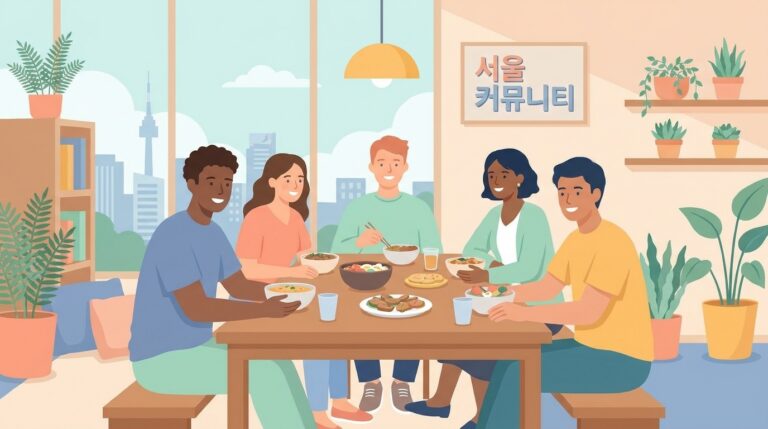
Beyond Bloodlines: How Solo Koreans Are Creating Warm, Loosely Connected Communities
Phase 1: Empathy (Story-Driven Opening)
안녕하세요! 매일한글 에디터입니다. (Hello! This is your Daily Hangul editor.)
If you have ever watched slice-of-life K-dramas like Because This Is My First Life (이번 생은 처음이라) or Age of Youth (청춘시대), you might have felt a unique bittersweet vibe running through modern Korean city life. In Seoul, over 40% of households are now single-person households (1인 가구 – iril gagu). Alongside this independence comes a silent urban apprehension: the risk of isolation and godoksa (고독사 – lonely death), where people slip away without anyone noticing.
Yet, contemporary Koreans are not surrendering to loneliness. Instead, an inspiring cultural evolution is taking place right before our eyes. Stepping far beyond traditional expectations of blood relations (혈연) or marriage (결혼), solo dwellers are pioneering what sociologists and trendsetters call “loosely connected communities” (느슨한 연대). From design-forward co-living houses in Mangwon-dong to casual dining clubs organized on neighborhood apps, young and mature urbanites alike are seeking connection without suffocating pressure.
If you are navigating intermediate Korean (B2), understanding this cultural shift will transform your conversations. You will move past sterile textbook introductions and learn how Koreans genuinely express warmth, define boundaries, and find belonging today. Our international learners living in Seoul frequently tell us: “Once I learned how to express loose connection, my social life stopped feeling intimidating and started feeling cozy!” Let’s dive into the phrases and cultural codes that make this modern camaraderie flourish.
Phase 2: Core Expressions Breakdown
1. 느슨한 연대 (Neuseunhan yeondae)
- Pronunciation: [Neuseunhan yeondae] (Think: nuh-soon-hahn yeon-deh — “neuseun” sounds like a relaxed sigh, “yeondae” like a solid handshake)
- Meaning: Literal: Loose solidarity | Real Nuance: A low-pressure social bond based on mutual respect, where people support each other without invading personal privacy or demanding emotional labor.
- K-Culture Moment: You will hear this phrase frequently in lifestyle vlogs showcasing co-living houses like Mangrove or Epi in Seoul. Residents describe their dynamic as: “우리는 느슨한 연대를 지향해요” (Urineun neuseunhan yeondaereul jihyanghaeyo — “We aim for loosely knit solidarity”).
- Editor’s Insight: Traditional Korean culture prized jeong (정), which was intensely warm but could feel meddlesome. Neuseunhan yeondae is “Jeong 2.0″—caring deeply from a polite arm’s length.
- Situation Spectrum: Casual: ✅ | Semi-formal: ✅ | Formal: ✅
- 🤔 Think About It: In your culture, does being a “good neighbor” require constant social interaction, or is giving space considered the higher form of respect?
2. 밥 한 끼 같이 해요 (Bap han kki gachi haeyo)
- Pronunciation: [Bap han kki gachi haeyo] (Think: bahp hahn kkee gah-chee heh-yo — pronounce “kki” with a crisp, popping tension)
- Meaning: Literal: Let’s have one meal together | Real Nuance: A warm, unburdensome invitation to share a meal, often used by solo dwellers who want food companionship without long-term social obligations.
- K-Culture Moment: On neighborhood community boards like Karrot Market’s Dongne Saenghwal (동네생활), solo residents often post: “엽떡 시켰는데 양이 너무 많아요. 밥 한 끼 같이 해요!” (Yeoptteok sikyeonneunde yangi neomu manayo. Bap han kki gachi haeyo! — “I ordered spicy tteokbokki and it’s too much for one. Let’s share a meal!”).
- Editor’s Insight: While “언제 밥 한번 먹자” is often an empty parting promise, “밥 한 끼 같이 해요” with a specific dish or context is the ultimate currency of everyday urban kindness.
- Situation Spectrum: Casual: ✅ | Semi-formal: ✅ | Formal: ⚠️
- 🤔 Think About It: Why has sharing food remained the ultimate icebreaker in Korea, even in an era of hyper-individualism?
3. 각자 또 같이 (Gakja tto gachi)
- Pronunciation: [Gakja tto gachi] (Think: gahk-jah ttoh gah-chee — sharp cadence on gakja, softening into gachi)
- Meaning: Literal: Individually, yet together | Real Nuance: Parallel coexistence; sharing the same physical or communal space while minding your own business and working on separate goals.
- K-Culture Moment: Seen on banners for co-working lounges in Seongsu-dong or silent reading clubs (buk-keulleob), where attendees sit together in complete silence reading their own books for two hours before sharing a single cup of tea.
- Editor’s Insight: This phrase is the gold standard for navigating modern shared spaces in Korea. It relieves everyone of the pressure to entertain each other.
- Situation Spectrum: Casual: ✅ | Semi-formal: ✅ | Formal: ✅
- 🤔 Think About It: Do you feel comfortable doing your own hobbies right next to someone who is doing theirs, without speaking?
Phase 3: Textbook Korean vs. Real Korean
Scenario 1: Seeking a casual neighborhood buddy
- 📖 교과서 한국어 (Textbook): “저는 지역 사회 공동체 활동에 참여하여 이웃과 친목을 도모하고 싶습니다.” (Jeoneun jiyeok sahoe gongdongche hwaldonge chamyeohayeo i-utgwa chinmogeul domohago sipsumnida.)
- 🗣️ 진짜 한국어 (Real-life): “동네 소모임에서 부담 없는 밥 친구나 산책 메이트 구해요!” (Dongne somoimeseo budam eomneun bap chinguna sanchaek me-iteu guhaeyo!)
- 💡 왜 다를까? (Why the difference?): The textbook version sounds like an official policy document from the Ministry of the Interior! Real solo dwellers in Korea use words like budam eomneun (burden-free) and casual portmanteaus like bap chingu (meal buddy) or mate (산책 메이트) to signal zero emotional demands.
Scenario 2: Establishing boundaries in a shared environment
- 📖 교과서 한국어 (Textbook): “우리는 단체 생활의 규율을 준수하면서 개인주의적 가치를 보존해야 합니다.” (Urineun danche saenghware gyuyureul junsuhamyeonseodo gaeinju-uijeok gachireul bojonhaeya hamnida.)
- 🗣️ 진짜 한국어 (Real-life): “너무 끈끈한 건 부담스러우니까, ‘각자 또 같이’ 편하게 지내요.” (Neomu kkeunkkeunhan geon budamseureo-unikka, ‘gakja tto gachi’ pyeonhage jinaeyo.)
- 💡 왜 다를까? (Why the difference?): While kkeunkkeunhada (끈끈하다 – sticky/tightly bound) historically had a positive communal tone, contemporary urbanites find overly “sticky” relationships exhausting. Gakja tto gachi strikes the perfect intermediate balance between warmth and independence.
Phase 4: K-Culture Deep Dive & Non-Verbal Manners
4-1. Nunchi & Gestures: The Art of the Polite Buffer (적정 거리두기)
When entering new communal spaces in Korea (such as co-living lounges, communal kitchens, or silent book clubs), your non-verbal cues matter as much as your grammar:
* The Soft Nod (목례 – Mokrye): When meeting someone in a shared kitchen or hallway, avoid loud, energetic greetings. A soft 15-degree nod accompanied by a quiet “안녕하세요” (Annyeonghaseyo) acknowledges their presence without demanding a conversation.
* No Invasive Auditing (호구조사 금지): In traditional social circles, elders often asked about marriage status, salary, or university. In modern loosely connected groups, this is considered a major faux pas. Respect people’s privacy; let personal topics unfold naturally over time.
* Earphones as a Social Shield: If someone in a communal living room has headphones or earbuds in, do not initiate small talk unless it is an emergency. This is universally recognized code for “I am enjoying my gakja time.”
4-2. Cultural Code: The Rise of Social Dining & “Co-Living 2.0”
In classic Korean dramas, communal living was dictated by financial desperation or biological families living under one cramped roof. Today, shows like Be Melodramatic (멜로가 체질) celebrate friends who form self-chosen urban micro-communities, processing grief and daily struggles side by side.
South Korea’s modern social experiments are also direct policy responses to godoksa (고독사). Local governments (like Seoul’s 1-Person Household Support Centers) fund communal kitchens where solo dwellers can cook together, take what they need, and check on one another weekly. This is neither cold Western hyper-individualism nor suffocating Joseon collectivism—it is an authentic, third-way Korean solution.
Phase 5: Real-Life Roleplay Scenario
Context & Characters
- Setting: The warm, wooden communal kitchen of a co-living house in Mangwon-dong on a drizzly Friday evening.
- Characters:
- Su-jin (수진): A 32-year-old freelance graphic designer who has lived in the co-living space for a year.
- You (당신): An intermediate Korean learner who recently moved in, craving local connection without overwhelming commitment.
Dialogue
- Su-jin: 혹시 저녁 드셨어요? 김치전 반죽이 좀 남았는데 같이 드실래요? (Hoksi jeonyeok deusyeosseoyo? Gimchijeon banjugi jom namanneunde gachi deusillaeyo?)
[🎭 Holding a spatula with an inviting, gentle smile] - You: 아, 아직 안 먹었어요! 안 그래도 출출했는데 정말 감사해요. (A, ajik an meogeosseoyo! An geuraedo chulchulhaenneunde jeongmal gamsahaeyo.)
[🎭 Bowing politely and taking a seat at the shared kitchen island] - Su-jin: 혼자 살면 이런 전 요리는 양 조절하기가 진짜 힘들잖아요. (Honja salmyeon ireon jeon yorineun yang jojeolhagiga jinjja himdeuljanhayo.)
[🎭 Sliding a crisp, steaming kimchi pancake onto a shared ceramic plate] - You: 맞아요. 혼밥할 땐 재료 남기는 게 골치인데, 이렇게 나눠 먹으니까 참 좋네요. (Majayo. Honbaphal ttaen jaeryo namgineun ge golchinde, ireoke nanwo meogeunikka cham jonneyo.)
[🎭 Picking up chopsticks and taking a bite with appreciative eyes] - Su-jin: 여기 사람들은 다들 ‘각자 또 같이’ 스타일이라 서로 부담을 안 줘서 편해요. (Yeogi saramdeureun dadeul ‘gakja tto gachi’ seutairira seoro budameul an jwoseo pyeonhaeyo.)
[🎭 Pouring two cups of cold roasted barley tea] - You: 저도 그런 느슨한 연대가 딱 원하던 분위기예요. 너무 참견하지 않으면서도 온기가 있잖아요. (Jeodo geureon neuseunhan yeondaega ttak wonhadeon bunwigiyeyo. Neomu chamgyeonhaji aneumyeonseodo ongiga itjanhayo.)
[🎭 Nodding warmly while accepting the tea with both hands] - Su-jin: 맞아요! 일요일 아침에 동네 플로깅 모임 가는데, 시간 되시면 언제든 편하게 나오세요. (Majayo! Ilyoil achime dongne peulloging moim ganeunde, sigan doesimyeon eonjedeun pyeonhage naoseyo.)
[🎭 Pointing casually to a mini flyer on the communal bulletin board] - You: 오, 좋네요! 일정 확인해 보고 가볍게 나가볼게요. 오늘 전 정말 맛있었어요! (O, jonneyo! Iljeong hwaginhae bogo gabyeopge nagabolgeyo. Oneul jeon jeongmal masisseosseoyo!)
[🎭 Standing up to rinse your plate in the sink immediately]
🔀 Interactive Decision Branch
What should you say next as Su-jin finishes her tea?
- Option A: “수진 씨는 실례지만 나이가 어떻게 되세요? 결혼은 왜 아직 안 하셨어요?” (Excuse me Su-jin, how old are you? Why aren’t you married yet?)
- Feedback: 🚫 Bad / Cultural Penalty! This is hogu-josa (invasive interrogation). In modern Korean community hubs, grilling someone on their age and marital status creates instant discomfort.
- Option B: “제가 설거지 다 할게요! 앞으로 매일 저녁마다 여기서 요리 같이 해 먹어요!” (I’ll do all the dishes! Let’s cook dinner together here every single night from now on!)
- Feedback: ⚠️ Risk! While polite on the surface, proposing a daily dinner commitment violates the principle of loose solidarity. It risks overwhelming the other person.
- Option C: “김치전 정말 잘 먹었습니다! 설거지는 제가 해둘 테니 편하게 쉬세요.” (Thank you so much for the pancake! I will take care of the dishes, so please go rest comfortably.)
- Feedback: ✅ Best! Perfect etiquette. It expresses gratitude, respects personal space, and pulls your weight in a shared setting without attaching high-maintenance social expectations.
Phase 6: 10-Second Emotion Shadowing Drill
Practice matching your vocal melody to the real social feeling of modern Seoul.
- Drill 1:
[😊 따뜻하고 정중하게 / Warmly and courteously]
“혼자 살다 보면 / 끼니 챙기기가 힘든데 / 같이 먹으니까 / 참 좋네요.”
(Honja salda bomyeon / kkini chaenggigiga himdeunde / gachi meogeunikka / cham jonneyo.)
Meaning: Living alone makes it hard to eat properly, so sharing a meal like this is truly wonderful. -
Drill 2:
[🤝 부담 없이 경쾌하게 / Casual, lighthearted, zero pressure]
“시간 되실 때 / 가볍게 차 한잔해요. / 부담은 절대 / 갖지 마시고요!”
(Sigan doesil ttae / gabyeopge cha hanjanhaeyo. / Budameun jeoldae / gatji masigoyo!)
Meaning: Let’s grab a cup of tea whenever you have time. Absolutely no pressure at all! -
Drill 3:
[🌱 차분하고 진솔하게 / Calm, introspective, reassuring]
“서로의 일상을 존중하면서도 / 이렇게 느슨하게 연결되어 있으면 / 참 든든해요.”
(Seoroui ilsangeul jonjunghamyeonseodo / ireoke neuseunhage yeongyeoldoeeo isseumyeon / cham deundeunhaeyo.)
Meaning: Respecting each other’s daily lives while remaining loosely connected brings so much comfort.
Phase 7: K-Culture Mini Dictionary
- 1인 가구 (Iril gagu) | Noun | Single-person household. Widely used in media, sociology, real estate, and everyday chat to describe the dominant demographic shaping South Korea today.
- 밥 친구 (Bap chingu) | Noun | Meal buddy. A companion with whom you grab food—frequently paired with specific cuisines (like Korean BBQ or Hotpot) that are awkward or costly to eat completely alone.
- 번개 모임 (Beongae moim) | Noun | Lightning / Flash meetup. An impromptu, spontaneous get-together organized a few hours or a day in advance, requiring zero recurring commitment.
- 소셜 다이닝 (Sosyeol daining) | Noun | Social dining. The contemporary Korean practice where strangers meet up at shared kitchens, pop-ups, or community centers to prepare meals and dine together.
Phase 8: Traveler & Resident Survival Kit
Top 3 Survival Phrases
- “혹시 남은 음식 나눠 드실래요?” (Hoksi nameun eumsik nanwo deusillaeyo?)
- Romanization: Hok-si nah-meun eum-sik nah-nwo deu-sil-lae-yo?
- Pro Tip: When you order delivery chicken or cook stew that yields four portions, offering half to your housemate or neighbor with this phrase builds instant, gentle goodwill.
- “편하실 때 언제든 말씀해 주세요.” (Pyeonhasil ttae eonjedeun malsseumhae juseyo.)
- Romanization: Pyeon-ha-sil ttae eon-je-deun mal-sseum-hae ju-se-yo.
- Pro Tip: Use this after extending any invitation. It signals that you value their comfort and will not take offense if they decline.
- “개인 시간 방해해서 죄송해요.” (Gaein sigan banghaehaeseo joesonghaeyo.)
- Romanization: Gae-in si-gan bang-hae-hae-seo joe-song-hae-yo.
- Pro Tip: Say this before knocking on a housemate’s door or asking a quick question when they are engrossed in work in a common lounge.
Editor’s Travel Note: Living Local
To plug into modern loose communities during an extended stay or working holiday in Korea, check out these local digital platforms:
* Download the 당근 (Karrot Market) 앱 and explore the 동네생활 (Neighborhood Life) tab. It is full of local running crews, board game nights, and requests for lunch buddies.
* Browse the 소모임 (Somoim) 취미 앱 to discover interest-based weekend hobby clubs that welcome newcomers without demanding lifetime allegiance.
Phase 9: “One Step Deeper” (Reflective Essay)
Historically, Korean survival depended on the tight knit of the clan (munjung) and the agricultural cooperative (ture). While this collectivism built incredible industrial resilience, it also generated intense conformity and social pressure. The modern movement toward loosely connected communities is not the collapse of Korean society; it is its maturation. Solo dwellers are proving that human beings can refuse both lonely alienation and smothering obligation. They choose to stand separately—like trees in a forest whose roots touch underground, keeping each other steady through the storm.
💬 Your Turn: In your home country, what does a healthy balance between individual independence and community support look like? Share your perspective in the comments below!
Phase 10: FAQ & Common Mistakes
Q: Does living in a “loosely connected community” mean Koreans don’t want to make real, deep friends?
A: Not at all! It simply means that deep trust takes time and should develop organically. In high-density cities, starting with low-pressure expectations (loose solidarity) creates a safe container where genuine long-term friendships can blossom without fear of early burnout.
Q: Is it considered rude to eat alone (혼밥) in Korea nowadays?
A: No! Honbap (혼밥) has become completely normalized over the past decade, with many restaurants offering solo seating booths and automated kiosks. Seeking a bap chingu is an optional joy, not a requirement to avoid social stigma.
Q: What should I bring if I attend a local neighborhood meetup or potluck?
A: Keep it modest and practical. Packaged fruit (like cut melon or strawberries from a local mart), bakery treats, or a 4-pack of barley tea or canned seltzer are standard favorites. Avoid extravagant gifts, as they can inadvertently make others feel indebted.
🚨 흔한 실수 (Common Mistakes) Top 3
- Mistake: Calling someone Unnie, Oppa, Nuna, or Hyeong right away in a casual community group.
- Correct Action: Stick to name + ssi (e.g., “수진 씨”) until the other person explicitly suggests dropping titles. Preserving mutual respect keeps interactions comfortable.
- Mistake: Interpreting a polite invitation decline as permanent rejection.
- Correct Action: If someone says “오늘은 좀 피곤해서요” (I’m a bit tired today), reply cheerfully with “푹 쉬세요!” (Rest well!). Respect their personal boundary without overanalyzing.
- Mistake: Over-promising recurring participation.
- Correct Action: Don’t say “앞으로 매주 꼭 올게요!” (I will definitely come every week!) unless you truly mean it. Phrases like “기회 될 때 또 올게요” (I’ll drop by again when the opportunity arises) match the natural rhythm of loose communities.
Phase 11: Action Missions & K-Culture Hunt
Your 3-Step Action Mission
- 🥉 Bronze Mission (Solo Practice): Stand before a mirror and practice Shadowing Drill 2 three times with a bright, welcoming face and relaxed shoulders.
- 🥈 Silver Mission (Social Sharing): Write a sentence on your social media or study journal using the phrase 각자 또 같이 to describe your ideal study group or work environment.
- 🥇 Gold Mission (Real-Life Application): Next time you meet a Korean neighbor, co-worker, or study partner, initiate a low-stress interaction using: “시간 되실 때 가볍게 차 한잔해요. 부담 갖지는 마시고요!”
🎮 K-Culture Mission
Watch an episode of the modern slice-of-life drama Because This Is My First Life (이번 생은 처음이라) or Daily Dose of Sunshine (정신병동에도 아침이 와요). Spot one scene where characters share a quiet, everyday meal without dramatic conversation, and identify how their body language communicates support!
Phase 12: Interactive Quiz Challenge
Test your grasp of modern Korean community concepts with these three quick scenarios:
Q1. Situation Judgment
You have moved into a new shared house in Seoul. You meet your housemate Min-ho in the kitchen at 8 PM. Which of the following responses best embodies the spirit of 느슨한 연대 (loose solidarity)?
* A) “민호 씨, 매일 아침 7시에 같이 일어나서 조깅하고 아침 먹어요!”
* B) “민호 씨, 과일 좀 깎았는데 편하시면 나와서 조금 드실래요?”
* C) “민호 씨는 월급이 얼마예요? 회사 생활은 할 만해요?”
Q2. Fill-in-the-Blank
Complete the sentence to express modern adult coexistence:
“우리는 서로의 생활을 간섭하지 않고, ( ) 편안하게 지내고 있어요.”
* A) 앞뒤 안 가리고 (without thinking)
* B) 각자 또 같이 (separately yet together)
* C) 죽고 못 살게 (madly in love/inseparable)
Q3. True or False
In contemporary Korean community spaces, asking personal questions about someone’s relationship status and educational background during the first interaction is appreciated as an expression of traditional Jeong (정).
* True or False?
🔍 Click here to reveal the Answers & Explanations!
- Q1 Answer: B! Offering cut fruit without demanding an immediate conversation lets your housemate accept or decline based on their energy levels. (Option A is overly demanding; Option C is intrusive hogu-josa).
- Q2 Answer: B (각자 또 같이)! This is the quintessential phrase for balanced, independent coexistence in modern Korea.
- Q3 Answer: False! While older generations may have viewed this as personal warmth, modern Koreans value privacy and consider invasive questioning to be uncomfortable and boundary-crossing.







