

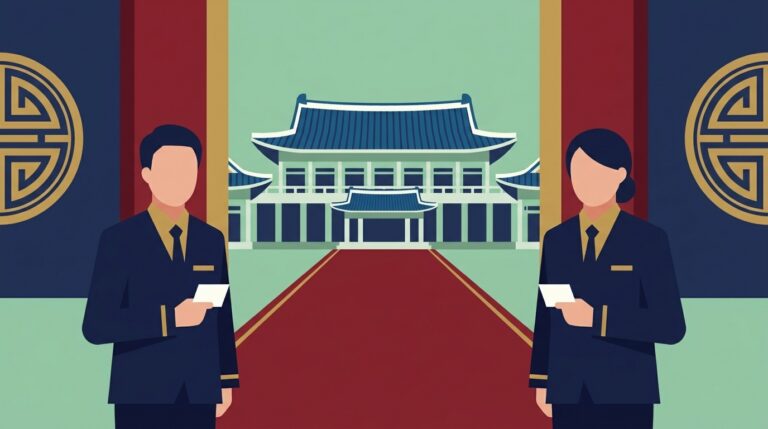
Mastering Korean Diplomatic Protocol: The High-Stakes Etiquette of State Visits
Phase 1: Empathy (Story-Driven Opening)
안녕하세요! 매일한글 에디터입니다. (Annyeonghaseyo! It’s your Daily Hangul editor.)
Picture this: You are standing inside the Grand Reception Hall of the State Guest House in Seoul. Tomorrow, a visiting head of state will walk across this exact carpet. The chandeliers are gleaming, and fifty advance protocol officers from both countries are pacing the room with tape measures, laser levels, and detailed dossiers. Suddenly, someone freezes. An advance officer notices that a place card for a deputy prime minister is positioned two inches to the left of where the official order of precedence mandates. To an untrained bystander, it is a harmless slip of paper. To a seasoned diplomat, however, that slight shift can be interpreted as a deliberate slight—a subtle, calculated political chill signals across borders.
In international protocol (국제 의전), there is no such thing as an honest accident. A flag displayed upside down, an incorrect honorific title, or a seating arrangement that defies precedence can trigger an immediate diplomatic protest. That is why protocol teams conduct meticulous, exhaustive advance walkthroughs (사전 답사) multiple times before the official motorcade even starts its engine. If you operate at the C2 level—whether you are working in diplomacy, multinational executive management, translation, or international relations—mastering these high-register protocols and institutional terms will elevate your Korean from merely fluent to undeniably authoritative. Based on actual training feedback from bilingual diplomats and international protocol officers, let’s step behind the velvet ropes and decode the nuanced world of Korean state etiquette.
Phase 2: Core Expressions (3 In-Depth Analyses)
1. 의전상의 결례 (Uijeonsang-ui gyeol-lye)
- Pronunciation: [의전상의 결례] / Ui-jeon-sang-ui gyeol-lye (Sounds like “wee-jeon-sang-wee gyul-ryeh” with a flowing ‘L’ link between gyeol and rye).
- Meaning: Literal: A discourtesy within protocol / Nuanced: A diplomatic snub or breach of official protocol that risks international tension.
- K-Culture Moment: Seen in political dramas like Designated Survivor: 60 Days (60일, 지정생존자), when the protocol secretary furiously re-checks the roster to avoid any 의전상의 결례 that could stall bilateral treaty negotiations.
- Editor’s Insight: The word 결례 (缺禮) combines ‘deficiency/lack’ (결) and ‘propriety/rite’ (례). In regular business, it means being impolite; in state diplomacy, it is official terminology for a protocol violation that demands an explanation or formal apology.
- Situation Spectrum:
- Casual: 🚫 (Sounds excessively pompous)
- Semi-formal: ⚠️ (Only applicable when discussing formal corporate hierarchy)
- Formal / Diplomatic: ✅ (The standard, indispensable term)
- 🤔 Think About It: Does your native language distinguish an everyday “social mistake” from an institutional “breach of protocol”? In Korean, elevating 실수 (mistake) to 결례 (breach of rites) implies an infringement upon moral and diplomatic order.
2. 만전을 기하다 (Manjeon-eul gihada)
- Pronunciation: [만저늘 기하다] / Man-jeon-eul gi-ha-da (Sounds like “Mahn-juh-neul gee-hah-dah”).
- Meaning: Literal: To strive for 10,000% perfection / Nuanced: To take every conceivable precaution; to leave absolutely nothing to chance.
- K-Culture Moment: In news broadcasts covering presidential overseas summits, you will invariably hear the spokesperson declare: “정부는 국빈 맞이에 만전을 기하고 있습니다.” (The administration is leaving no stone unturned in welcoming the state guest.)
- Editor’s Insight: Derived from the Hanja 萬全 (ten thousand parts complete). It is stronger than 최선을 다하다 (to do one’s best). It implies a systemic, foolproof operational setup where failure is not an option.
- Situation Spectrum:
- Casual: 🚫 (Too bureaucratic)
- Semi-formal: ⚠️ (Acceptable in high-stakes quarterly shareholder meetings)
- Formal: ✅ (Classic official administrative phrasing)
- 🤔 Think About It: Notice how Korean administrative language leans heavily on totalizing numerical Hanja (like 萬, ten thousand) to convey ultimate thoroughness.
3. 사전 답사 (Sajeon dapsa)
- Pronunciation: [사전 답사] / Sa-jeon dap-sa (Sounds like “Sah-jeon dahp-sah”).
- Meaning: Literal: Prior field survey / Nuanced: Comprehensive advance walkthrough; protocol dry run on-site.
- K-Culture Moment: In variety shows like Infinite Challenge or K-Pop world tour documentaries, production crews do a 답사, but in a diplomatic setting, 사전 답사단 (advance delegation team) inspects everything down to millimeter measurements and security choke points.
- Editor’s Insight: 답사 (踏査) literally means “to step and inspect.” Adding 사전 (preliminary/advance) turns it into an operational procedure where officials walk every step the VIP will take to identify blind spots.
- Situation Spectrum:
- Casual: ⚠️ (Can refer to scouting a location for a university MT or retreat)
- Semi-formal: ✅ (Venue inspection for corporate summits)
- Formal: ✅ (Official diplomatic advance team reconnaissance)
- 🤔 Think About It: Why does Korean retain physical movement words like 밟을 답 (踏) for intellectual inspections? It emphasizes that true verification cannot happen behind a desk.
Phase 3: Textbook Korean vs. Real Diplomatic Korean
Situation 1: Reporting that the banquet preparations are thoroughly checked
- 📖 교과서 한국어 (Textbook): 모든 준비를 꼼꼼하게 다 확인했습니다. (Modeun junbireul kkomkkomhage da hwaginhaesseumnida. – I checked all preparations meticulously.)
- 🗣️ 진짜 한국어 (Authentic Bureaucratic): 한 치의 오차도 없도록 만전을 기하여 현장 실사를 마쳤습니다. (Han chi-ui ochado eopdorok manjeoneul gihayeo hyeonjang silsareul machyeosseumnida. – We completed the on-site walkthrough with absolute thoroughness, leaving no margin for error.)
- 💡 왜 다를까? (Why the difference?): In elite Korean institutional registers, colloquial adverbs like 꼼꼼하게 are replaced by idiomatic measures of precision (한 치의 오차도 없이 – without an error of even an inch) and formal nominalized compounds (실사, 만전).
Situation 2: Warning a colleague that seating someone incorrectly will cause offense
- 📖 교과서 한국어 (Textbook): 자리를 잘못 정하면 손님이 기분 나빠할 수 있어요. (Jarireul jalmot jeonghamyeon sonnimi gibun nappahal su isseoyo. – If you arrange the seats wrongly, the guest might feel bad.)
- 🗣️ 진짜 한국어 (Authentic Bureaucratic): 의전 서열을 간과한 배석은 자칫 중대한 외교적 결례로 비화될 수 있습니다. (Uijeon seoyeoreul gangwahan baeseog-eun jachit jungdaehan oegyojeok gyeol-lyero bihwadoel su itseumnida. – Seating that neglects protocol precedence may inadvertently escalate into a grave diplomatic breach.)
- 💡 왜 다를까? (Why the difference?): In high-stakes diplomacy, personal emotions (기분 나쁘다) are never cited directly; instead, outcomes are articulated in terms of political impact (외교적 결례로 비화되다 – to ignite/escalate into an official snub).
Phase 4: K-Culture Deep Dive & Non-Verbal Etiquette
4-1. 눈치 (Nunchi) & Physical Protocol in Korean Statecraft
Diplomatic protocol in Korea is Neo-Confucian etiquette (예법, Ye-beop) elevated to state machinery. Non-verbal decorum carries as much weight as spoken vows:
* The Two-Step Distance (두 걸음의 미학): When escorting a visiting VIP, protocol officers never walk parallel. They maintain a position exactly one to two paces behind at a 45-degree angle. Walking shoulder-to-shoulder with a principal unless you are of equal head-of-state rank is considered an intrusion.
* Eye-Line Management (시선 처리): Direct, unwavering eye contact can easily be misread as defiance or confrontation in high-context Korean protocol. Officials practice an attentive “triangular gaze”—focusing between the bridge of the nose and the chest level, projecting absolute deference without appearing insecure.
* The Two-Handed Document Transfer: Even when handling small place cards or bilateral folders, officers hold items with both hands, thumbs parallel, elbows slightly tucked into the torso. Dropping a hand shows haste and casualness, both of which are fatal in protocol.
4-2. Cultural Code: State Banquets (국빈 만찬) and Gastro-Diplomacy
In Korean state banquets, every dish serves as an ideological statement. When world leaders visit Seoul, the menu is curated using ingredients from regions that symbolize political harmony, peace initiatives, or shared historical alliances. A misstep—such as serving seafood from a contested marine zone or failing to cross-check dietary prohibitions months prior during the 사전 답사—is never treated as an innocent culinary mishap; it becomes front-page political news.
Phase 5: Real-World Roleplay Scenario
Setting: Inside the State Banquet Room at Yeongbin-gwan. The state visit begins tomorrow at 10:00 AM. Senior Protocol Officer Min-woo Kim and Advance Team Liaison Chris are conducting their fifth and final walk-through.
- 민우 (Min-woo): 크리스 씨, 만찬장 좌석 배치표 최종안 나왔습니까? (Keuriseu ssi, manchanjang jwaseok baechipyo choejongan nawasseumnikka? / “Chris, has the final layout for the banquet seating chart arrived?”)
- 크리스 (Chris): 🎭 [서류철을 양손으로 공손히 건네며] 네, 서열에 맞춰 1차 조정을 마친 상태입니다. (Ne, seoyeore matchwo il-cha jojeong-eul machin sangtae-imnida. / 🎭 [Politely handing over the dossier with both hands] “Yes, we have completed the primary adjustments according to the order of precedence.”)
- 민우 (Min-woo): 🎭 [배치표를 매의 눈으로 살피며 미간을 찌푸린다] 잠깐만요. 상공회의소 회장 배석이 특사단보다 상석으로 잡혀 있네요? (Jamkkanmanyo. Sanggonghoeuiso hoejang baeseog-i teuksadanboda sangseog-euro japhyeo itneyo? / 🎭 [Examining the layout with hawk-like scrutiny, furrowing his brow] “Hold on. Why is the Chamber of Commerce Chairman seated above the Special Envoy delegation?”)
- 크리스 (Chris): 경제 협력이 핵심 의제라 배려 차원에서 앞당겼습니다만, 문제될까요? (Gyeongje hyeomnyeog-i haeksim uijera baeryeo cha-woneseo apdanggyeosseumnidaman, munjedoelkkayo? / “Economic cooperation is the core agenda, so we moved him forward as a courtesy. Could that be an issue?”)
- 민우 (Min-woo): 아무리 경제가 중요해도 공식 의전 서열은 불변입니다. 자칫 특사단을 홀대했다는 외교적 결례로 비화될 수 있어요. (Amuri gyeongjega jung-yohaedo gongsik uijeon seoyeor-eun bulbyeon-imnida. Jachit teuksadaneul holdaehaetdaneun oegyojeok gyeol-lyero bihwadoel su isseoyo. / “Regardless of economic weight, official protocol precedence is immutable. This could easily spark a diplomatic incident, being read as a deliberate snub to the Envoys.”)
- 크리스 (Chris): 🎭 [즉시 메모패드를 꺼내 적으며] 아, 제 불찰입니다. 즉시 원칙대로 서열을 재조정하겠습니다. (A, je bulchal-imnida. Jeuksi wonchikdaero seoyeoreul jaejojeonghagetseumnida. / 🎭 [Instantly pulling out a notepad and writing] “Ah, that was an oversight on my part. I will rectify the seating according to official precedence immediately.”)
- 민우 (Min-woo): 그리고 영빈관 입구 동선 사전 답사는 몇 시에 재개합니까? (Geurigo yeongbin-gwan ipgu dongseon sajeon dapsaneun myeot sie jaegaehamnikka? / “And what time do we resume the walkthrough for the entrance movement line?”)
- 크리스 (Chris): 경호처와 조율하여 14시에 한 치의 오차도 없도록 완벽히 시뮬레이션하겠습니다. (Gyeonghocheowa joyulhayeo yeolsisie han chi-ui ochado eopdorok wanbyeokhi simyulleisyeonhagetseumnida. / “We have coordinated with Presidential Security; we will run a flawless simulation at 14:00 without an inch of error.”)
🔀 Interactive Branching Point
If the visiting side’s advance team insists on breaking precedence to seat a non-official donor next to the President, how should you respond?
- Option A: “그쪽 사정이 그러시다면 이번만 특별히 그렇게 해 드리겠습니다.” (Accept the request to be agreeable.)
- Option B: “국가 간 공식 의전 원칙상 서열 변경은 불가함을 정중히 양해 바랍니다. 대안으로 리셉션에서 단독 환담 기회를 마련하겠습니다.” (Uphold precedence firmly while proposing an alternative bilateral greeting.)
- Option C: “그런 무리한 요구는 외교 관례에 어긋나니 즉각 철회하십시오.” (Bluntly reject their request as improper.)
Feedback:
* Option A (Risk): Terrible blunder. Deviating from standard protocol creates severe domestic and international precedent vulnerabilities.
* Option B (Best!): Flawless diplomatic execution. You anchor yourself in formal protocol (의전 원칙) while offering an honorable face-saving alternative (환담 기회).
* Option C (Bad): Excessive confrontation. Even when denying a request, aggressive language (철회하십시오) burns diplomatic goodwill before talks begin.
Phase 6: 10-Second Emotion Shadowing Drill
Practice these lines using the slash marks / as pause indicators. Embody the required emotional demeanor.
- [🧐 극도로 신중하고 단호하게 – Highly cautious, resolute]
사소한 의전 결례 하나가 / 양국 관계에 / 심각한 냉각 기류를 / 불러올 수 있습니다.
(Sasohan uijeon gyeol-lye hanaga / yangguk gwangyee / simgakan naeng-gak giryureul / bulleool su isseumnida.)
“A single minor protocol lapse / can bring about / a severe chill / in bilateral ties.” -
[🫡 철저하고 빈틈없이 – Meticulous and unwavering]
경호선과 의전 동선 모두 / 한 치의 오차도 없도록 / 만전을 기해 주십시오.
(Gyeonghoseon-gwa uijeon dongseon modu / han chi-ui ochado eopdorok / manjeoneul gihae jusipsio.)
“Ensure both security perimeters and movement lines / are prepared to absolute perfection / without an inch of deviation.” -
[🤝 정중하지만 흔들림 없이 – Courteous yet uncompromising]
의전 서열상 / 해당 배석은 재검토가 불가피함을 / 너그러이 양해해 주시기 바랍니다.
(Uijeon seoyeolsang / haedang baeseog-eun jaegeomtoga bulgapihameul / neogeureoi yanghaehae jusigi baramnida.)
“Due to protocol precedence / a reconsideration of this seating is inevitable; / we ask for your generous understanding.”
Phase 7: K-Culture Mini Dictionary
- 국빈 방문 (Gukbin bangmun – State Visit): The highest diplomatic category of foreign visits. Entails a 21-gun salute, full guard of honor, official state banquet, and sovereign-level ceremonial treatment.
- 예포 (Yepo – Gun Salute): Artillery fired as an act of ceremonial respect. Heads of state receive 21 rounds (21발); heads of government (prime ministers) receive 19 rounds.
- 의전 서열 (Uijeon seoyeol – Order of Precedence): The formalized rank hierarchy governing who enters, sits, speaks, and exits first at official state functions.
- 좌석 배치표 (Jwaseok baechipyo – Seating Protocol Chart / Place Layout): The diagram detailing guest seat allocation based strictly on political and diplomatic rank to prevent inadvertent slights.
Phase 8: Traveler’s & Professional’s Survival Kit
Survival Expressions for High-Stakes Formal Engagements
- 의전 절차에 따라 진행하겠습니다.
- Uijeon jeolchae ttara jinhaenghagetseumnida. (We will proceed in accordance with standard protocol procedures.)
- Pro Tip: Use this phrase to neutralize unreasonable seating or scheduling demands politely.
- 귀국의 대표단을 정중히 영접합니다.
- Gwiguk-ui daepyodaneul jeongjung-hi yeongjeophamnida. (We respectfully receive and welcome your nation’s esteemed delegation.)
- Pro Tip: The verb 영접하다 (to formally receive a dignitary) signals elite ceremonial fluency.
- 사전에 조율된 동선으로 안내해 드리겠습니다.
- Sajeone joyuldoen dongseon-euro annaehae deurigetseumnida. (Allow me to guide you along the pre-coordinated route.)
- Pro Tip: Essential for keeping foreign partners within security-cleared perimeters.
Editor’s Travel & Protocol Note
- When managing delegations or attending formal governmental venues in Seoul (such as the National Assembly in Yeouido or the Government Complex in Gwanghwamun), real-time public access rules change dynamically during high-level summits. Download the official 정부24 포털 앱 다운로드 for immediate civil access notifications and use verified domestic maps such as 네이버 지도 앱 다운로드 to cross-check security-cleared zones and traffic blockades during state motorcades.
Phase 9: “One Step Deeper” (Critical Thinking)
In Western diplomacy, protocol is often viewed as a functional checklist designed to minimize friction. In Korea, however, protocol (의전) is rooted in the centuries-old Neo-Confucian doctrine of Ye (예/禮)—the cosmic and social manifestation of moral order. To disrupt the order of precedence (서열) is not merely an operational error; it implies that the host does not recognize the cosmic, institutional legitimacy of the guest. When a Korean protocol official walks a banquet floor three days in advance with a ruler, they are not obsessed with furniture—they are actively safeguarding the delicate equilibrium of mutual sovereignty.
💬 Your Turn: In your home country or profession, what is the most sensitive “unspoken protocol error” that can instantly ruin a relationship? Share your stories below!
Phase 10: FAQ & Common Mistakes
Q: Why are state visit advance walkthroughs repeated so many times?
A: Advance teams simulate scenarios at the identical time of day when the actual visit will occur to account for sun angles during outdoor honor guards, vehicular transit times under varying Seoul traffic congestion, and security transition delays.
Q: What is the difference between 국빈 방문 (State Visit) and 공식 방문 (Official Visit)?
A: A State Visit (국빈 방문) involves the maximum ceremonial honors, restricted to reigning monarchs or heads of state, usually held only once per foreign head of state’s term. An Official Visit (공식 방문) includes working high-level bilateral summits but with fewer ceremonial rituals (such as an abbreviated honor guard or non-state dinner).
Q: How should I address a foreign ambassador in formal Korean?
A: Use their country name followed by their official title and the high-honorific suffix: 대사님 (Daesa-nim) or in third-person diplomatic address: 주한 [국가명] 대사 각하 (Ju-han [Country Name] Daesa Gakha).
🚨 흔한 실수 (Common Mistakes) Noticeboard
- Mistake: Using 축하합니다 (Congratulations) generically at formal welcome receptions.
- Correct Action: Use 방한을 진심으로 환영합니다 (Banghaneul jinsim-euro hwanyeonghamnida – We warmly welcome your visit to Korea).
- Mistake: Assuming the most central seat is always reserved for the host.
- Correct Action: In diplomatic protocol, the guest of honor occupies the seat of honor (상석, typically facing the entrance or on the host’s right).
- Mistake: Pointing with an index finger to guide a delegation’s movement line.
- Correct Action: Keep all four fingers unified, palm angled upward at 45 degrees, gesturing gracefully while saying 이쪽으로 모시겠습니다 (Ijjog-euro mosigetseumnida).
Phase 11: Action Missions & Community
- 🥉 Bronze Mission (Solo Practice): Read the Phase 6 Shadowing Drill aloud three times. Focus on keeping your vocal pitch even, controlled, and free of colloquial vocal fry.
- 🥈 Silver Mission (Social / Reflection): Record yourself explaining the distinction between 의전상의 결례 and 단순한 실수 in Korean and share it in your study journal.
- 🥇 Gold Mission (Real-world Execution): Watch a press briefing of a Korea-foreign summit on YouTube. Identify three protocol terms used by the spokesperson (e.g., 의전, 환송, 환담).
- 🎮 K-Culture Mission: Watch Episode 1 of Designated Survivor: 60 Days and spot how the presidential protocol team reacts to unexpected overseas VIP interactions.
Phase 12: Interactive Quiz Challenge
Quiz 1. Situation Judgment
An advance officer discovers that a visiting delegate’s national flag is hung at a 2-degree slant during a formal bilateral treaty signing. What is the immediate correct action?
A. Leave it alone because no one notices two degrees.
B. Wait until the ceremony starts and adjust it quickly.
C. Alert the advance protocol marshal and realign it immediately before principals enter.
Click to view the Answer & Explanation
Correct Answer: C
In state protocol, even a millimeter distortion of a national symbol can be captured by press cameras and interpreted as intentional disrespect or poor administrative competence. Adjustments must always be executed prior to the principals’ entrance.
Quiz 2. Fill in the Blank
공식 외교 행사에서 손님의 위치를 정할 때는 반드시 (_______)을 준수하여 좌석을 배치해야 합니다.
(Hint: Order of precedence)
Click to view the Answer & Explanation
Correct Answer: 의전 서열 (Uijeon seoyeol)
Explanation: 의전 서열 dictates the precise ranking hierarchy of public and diplomatic figures.
Quiz 3. True / False Cultural Check
True or False? In Korean diplomatic banquets, moving a private corporate executive closer to the head of state at the expense of an official government envoy is considered good business sense.
Click to view the Answer & Explanation
Correct Answer: False
Explanation: Regardless of the economic topic, official state precedence is unyielding. Subordinating an accredited envoy to a private business figure constitutes a serious protocol infraction (의전상의 결례).







