

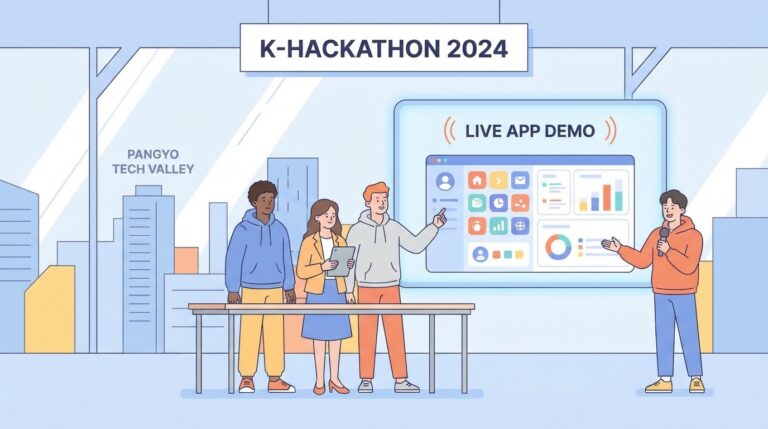
Phase 1: Empathy (Story-Driven Opening)
안녕하세요! 매일한글 에디터입니다.
Picture this: It’s 2:30 AM in a glass-walled conference room in Pangyo, South Korea’s vibrant Silicon Valley. The floor is lined with empty cups from Mega Coffee, laptop fans are humming at full throttle, and your team is locked in a fierce battle against compiler errors. You are competing in an internal company hackathon (사내 해커톤), racing to verify open-source license compliance (오픈소스 라이선스 준수) before the final pitch.
Then comes the organizer’s announcement: “Forget 50-slide PowerPoint presentations. If your team cannot show a live, clickable demo directly in the browser, your submission will not be scored.”
Instantly, the entire room lights up with hyper-focus. It feels less like an ordinary corporate workshop and more like a pivotal, high-stakes scene from the K-drama Start-Up. When everyone is forced to produce real, working code rather than theoretical bullet points, the collective energy hits the roof.
If you work with Korean colleagues or plan to join an IT sprint in Korea, describing this thrilling atmosphere accurately is a game-changer. Our intermediate (B2) learners often tell us: “I know how to say ‘the project was fun,’ but how do I express that strict practical rules drove our team’s laser focus?” Today, we are unlocking natural, professional Korean expressions that will make you sound like a seasoned tech insider.
Phase 2: Core Expressions Deep Dive
1. 실제로 작동하는 결과물 (Silje-ro jak-dong-ha-neun gyeol-gwa-mul)
- Pronunciation: [Sil-je-ro jak-dong-ha-neun gyeol-gwa-mul] (Sounds like “seal-jay-ro jahk-dong-ha-noon gyul-gwa-mool”)
- Meaning: Literal: “An actually operating deliverable” | Nuance: “A live, functioning prototype or clickable end-product”
- K-Culture Moment: Seen in tech startup dramas when developers bypass theoretical pitch decks to place an interactive smartphone app directly into the hands of venture capital judges.
- Editor’s Insight: In Korean tech teams, “작동하다” implies that the build executes without fatal errors. Pairing it with “결과물” (deliverable/outcome) shows that you value tangible execution over vague concepts.
- Situation Spectrum: Casual: ✅ | Semi-formal: ✅ | Formal: ✅
- 🤔 Think About It: Why does Korean workplace culture place such immense pride on visible, touchable artifacts (결과물) rather than abstract speculation?
2. ~ㄴ/은 규칙 덕분에 (~n/eun gyu-chik deok-bu-ne)
- Pronunciation: [Gyu-chik deok-bu-ne] (Sounds like “gyoo-cheek duck-boo-neh”)
- Meaning: Literal: “Thanks to the rule of…” | Nuance: Attributing positive motivation or outstanding efficiency directly to a well-designed constraint.
- K-Culture Moment: Team leaders at agile Korean tech giants like Naver or Kakao reviewing sprint retrospectives and praising constructive hackathon guidelines.
- Editor’s Insight: Be careful! “~덕분에” is strictly reserved for positive outcomes. If a rule caused trouble or delays, native speakers switch to “~탓에” (tas-e). Confusing the two might accidentally turn your compliment into biting sarcasm!
- Situation Spectrum: Casual: ✅ | Semi-formal: ✅ | Formal: ✅
- 🤔 Think About It: How does your native language grammatically distinguish between grateful attribution and blame when evaluating project regulations?
3. 몰입도가 엄청나다 (Mo-rip-do-ga eom-cheong-na-da)
- Pronunciation: [Mo-rip-do-ga eom-cheong-na-da] (Sounds like “mo-reep-doh-gah um-chung-nah-dah”)
- Meaning: Literal: “The degree of immersion is immense” | Nuance: “The electric focus in the room was unbelievable / Everyone was completely hooked”
- K-Culture Moment: Frequently used by Korean e-sports (LCK) casters to describe an arena captivated by a clutch play, and by binge-watchers describing an unpausable thriller series.
- Editor’s Insight: Originally popularized in media critiques, “몰입도” (level of immersion) has become standard corporate parlance in Korea for describing productive deep work and flow states.
- Situation Spectrum: Casual: ✅ | Semi-formal: ✅ | Formal: ⚠️ (In formal board reports, use ‘몰입도가 대단히 높았습니다’)
- 🤔 Think About It: What does the tech industry’s celebration of intense “몰입” (immersion) reveal about modern Korean collaborative dynamics?
Phase 3: Textbook Korean vs. Real Korean
Situation 1: Explaining that your team prepared a live demo instead of slides
- 📖 교과서 한국어 (Textbook): “우리는 슬라이드 발표 대신에 실제로 작동하는 프로그램을 준비했습니다.” (Urineun seullaideu balpyo daesine siljero jakdonghaneun peurogeuraemeul junbihaessseumnida.)
- 🗣️ 진짜 한국어 (Real-World): “말만 많은 피피티(PPT) 대신 바로 클릭해 볼 수 있는 라이브 데모를 뽑아냈어요!” (Malman maneun pi-pi-ti daesin baro keullikhae bol su inneun ra-i-beu demoreul ppobanaesseoyo!)
- 💡 왜 다를까? Korean developers often contract PowerPoint to “피피티” (PPT) and naturally use expressive verbs like “뽑아내다” (to churn out / build against the clock) to showcase agility and hustle.
Situation 2: Checking open-source licenses before deployment
- 📖 교과서 한국어 (Textbook): “우리는 오픈소스의 법적 라이선스 규정을 철저히 검토해야 합니다.” (Urineun opeunsoseuuibeopjeok raiseonseu gyujeongeul cheoljeohi geomtohaeya hamnida.)
- 🗣️ 진짜 한국어 (Real-World): “배포 나가기 전에 라이선스 충돌 없는지 핏(fit) 체크 한 번 싹 돌려야 돼요.” (Baepo nagagi jeone raiseonseu chungdol eomneunji pit chekeu han beon ssak dollyeoya dwaeyo.)
- 💡 왜 다를까? Modern Korean tech offices freely incorporate English loanwords like “라이선스 핏” (license fit) along with adverbs like “싹” (thoroughly / all in one sweep) to sound crisp and pragmatic.
Phase 4: K-Culture Deep Dive & Non-verbal Manners
4-1. Nunchi (눈치) & Demo Day Stage Etiquette
When doing a live demo in Korea, eye contact and non-verbal pacing mean everything:
* The Humble Click: When presenting to evaluators, never cross your arms or stare rigidly at the ceiling. Position your laptop so judges can see your fingers actively interacting with the interface. Before clicking a primary feature, pause for half a second, look at the judges with a subtle nod, and say, “직접 보여드리겠습니다” (Let me show you firsthand).
* Handling the Unexpected Bug: If your code throws a surprise error during the demo, keep your cool. Maintain a warm smile, bow your head slightly, and say with composure: “아, 라이브 데모의 묘미네요. 바로 예외 처리 확인하겠습니다!” (Ah, the thrill of a live demo! Let me inspect the exception handling right away!). Self-aware humor paired with calm problem-solving commands high respect.
4-2. Cultural Code Analysis: The Pangyo Sprint Culture
In Pangyo and Gangnam tech clusters, a hackathon is seen as a rite of passage. It blends Korea’s celebrated “Ppal-li Ppal-li” (빨리빨리 – fast and decisive) execution speed with a modern dedication to software craftsmanship. Late-night team delivery food—such as fried chicken, spicy tteokbokki, and endless cups of iced Americano (아아)—creates a shared sense of jeon-u-ae (전우애 – camaraderie formed through shared challenges). Demonstrating a functioning build proves that your team spent the night writing solid code rather than simply polishing fancy presentation rhetoric.
Phase 5: Real-World Roleplay Scenario
Setting: Hackathon presentation stage at an IT company in Pangyo.
Characters:
* Jina (지나): Team Leader & Lead Engineer. Sharp, supportive, and keen on software compliance.
* Alex (알렉스 – You): Full-stack developer handling the frontend demo and open-source verification.
- Jina: 🎭 (Checking the projector cable and whispering with anticipation)
알렉스 씨, 오픈소스 라이선스 검증 다 끝났죠? 혹시 GPL 충돌 이슈 없나요?
(Alex-ssi, opeunsoseu raiseonseu geomjeung da kkeutnatjyo? Hoksi GPL chungdol issu eomnayo?)
“Alex, did we wrap up the open-source license verification? No GPL conflict issues, right?” -
Alex: 🎭 (Nodding with a confident smile, pointing at the license report)
네! 아파치랑 MIT 라이선스 호환성 전부 확인해서 전혀 문제없습니다!
(Ne! Apachirang MIT raiseonseu hohwanseong jeonbu hwaginhaeseo jeonhyeo munjeeopsseumnida!)
“Yes! I verified all Apache and MIT compatibility, so we are completely clear!” -
Jina: 🎭 (Sighing in relief while looking at the judges taking their seats)
다행이에요. 다들 슬라이드 대신 라이브 데모만 본다고 벼르고 있거든요.
(Dahaeng-ieyo. Dadeul seullaideu daesin ra-i-beu demo-man bondago byeoreugo itgeodeunyo.)
“Thank goodness. The judges have been saying they will only judge live demos instead of slides.” -
Alex: 🎭 (Adjusting the demo screen so the main action button is front and center)
단순한 슬라이드 발표가 아니라 실제로 클릭하고 작동하는 결과물을 보여 주어야 한다는 규칙 덕분에 몰입도가 엄청났어요.
(Dansunhan seullaideu balpyoga anira siljelo keullikhago jakdonghaneun gyeolgwamureul boyeo jueoya handaneun gyuchik deokbune molipdoga eomcheongnasseoyo.)
“The rule requiring a live, clickable demo rather than slide decks created electric focus across the room.” -
Jina: 🎭 (Chuckling softly, giving a warm thumbs up)
맞아요. 덕분에 다른 팀원들도 밤새 코딩에 완전 몰입하더라고요.
(Majayo. Deokbune dareun timwondeuldo bamsae koding-e wanjeon moliphadeoragoyo.)
“Exactly. Thanks to that rule, the whole team was totally immersed in coding all night long.” -
Alex: 🎭 (Noticing the head evaluator leaning forward with keen interest)
심사위원분들도 벌써 화면 보시면서 직접 클릭해보려고 대기 중이세요.
(Simsawiwonbundeuldo beolsseo hwamyeon bosimyeonseo jikjeop keullikhaeboryeogo daegi jung-iseyo.)
“The judges are already looking at our screen, waiting to click and test it themselves.” -
Jina: 🎭 (Turning on her microphone and introducing the team with confidence)
자, 그럼 우리 프로토타입 직접 시연해 볼까요? 알렉스 씨, 시작해 주세요!
(Ja, geureom uri peurototaip jikjeop siyeonhae bolkkayo? Alex-ssi, sijakhae juseyo!)
“Well then, shall we demonstrate our prototype live? Alex, take it away!” -
Alex: 🎭 (Clicking the live preview button with smooth precision)
네, 브라우저에서 바로 구동되는 모습 보여드리겠습니다!
(Ne, beuraujeo-eseo baro gudongdoeneun moseup boyeodeurigessseumnida!)
“Yes, let me show you the service running live right in the browser!”
🔀 Interactive Decision Branch
The head judge suddenly clicks an edge-case button that triggers an unstyled data modal. How do you respond?
- Option A: “아, 그 부분은 오픈소스 라이선스 정책 때문에 의도된 예외 처리입니다. 바로 메인 결제 플로우 클릭해 보시겠어요?”
Feedback: Best! You remain poised, address license compliance smoothly, and guide the judge back to the core clickable demo. - Option B: “어라? 이거 새벽까지는 잘 됐는데 왜 이러지? 망했다…”
Feedback: Bad. Saying “망했다” (We’re doomed) destroys confidence in your technical stability. - Option C: “그 버튼은 아직 누르시면 안 되는 미완성 영역인데요.”
Feedback: Risk. Sounding defensive alienates evaluators. Reframe incomplete areas as experimental modules instead.
Phase 6: 10-Second Emotion Shadowing Drill
Practice reading these sentences aloud! Focus on pauses marked with / and internalize the emotion tag.
- [🔥 넘치는 열정으로 – With burning passion]
단순한 슬라이드 발표가 아니라 / 실제로 클릭하고 작동하는 결과물을 / 보여 주어야 한다는 규칙 덕분에 / 몰입도가 엄청났어요!
(Dansunhan seullaideu balpyoga anira / siljelo keullikhago jakdonghaneun gyeolgwamureul / boyeo jueoya handaneun gyuchik deokbune / molipdoga eomcheongnasseoyo!) -
[😎 뿌듯하고 당당하게 – Confident and proud]
오픈소스 라이선스 검증까지 / 완벽하게 마쳐서 / 심사위원분들도 / 바로 인정해 주셨어요!
(Opeunsoseu raiseonseu geomjeungkkaji / wanbyeokhage machyeoseo / simsawiwonbundeuldo / baro injeonghae jusyeosseoyo!) -
[🤩 감탄하며 – Filled with admiration]
말로만 듣는 것보다 / 직접 눌러보고 테스트하니까 / 체감되는 완성도가 / 완전히 다르네요!
(Malloman deunneun geotboda / jikjeop nulleobogo teseuteuhanikka / chegamdoeneun wanseongdoga / wanjeonhi dareuneyo!)
Phase 7: K-Culture Mini Dictionary
-
라이선스 컴플라이언스 (Ra-i-seon-seu keom-peul-ra-i-eon-seu) | Software License Compliance
Ensuring that open-source software libraries meet legal distribution obligations. In Korean tech giants like Samsung, LG, and Line, compliance review is a mandatory gateway before any production launch. -
빡집중 (Ppak-jip-jung) | Extreme Deep Work / Locked-In Focus
Colloquial term used by modern Korean professionals when entering an uninterrupted, high-productivity coding sprint before deadlines. -
데모데이 (De-mo-de-i) | Demo Day
The culminating showcase where hackathon participants demonstrate running software directly to stakeholders, executives, and peer engineers. -
밤샘 (Bam-saem) | All-Nighter Session
A celebrated badge of team grit during Korean hackathons, accompanied by midnight convenience store runs and shared stories over ramen.
Phase 8: Survival Kit for Tech Travelers & Expats
Top 3 Tech Pitch Survival Phrases:
- “라이브 데모 링크 QR 코드로 띄워드렸습니다.”
(Ra-i-beu demo ringkeu QR kodeuro ttuiwodeuryeossseumnida.)
“I have displayed the live demo link via QR code.”
Pro Tip: Korean judges love testing mobile web prototypes immediately on their own smartphones via on-screen QR codes. - “오픈소스 라이선스 출처는 리드미(README)에 모두 명시했습니다.”
(Opeunsoseu raiseonseu chulcheoneun rideumie modu myeongsihaessseumnida.)
“All open-source attributions have been transparently documented in the README file.”
Pro Tip: Proactive compliance documentation shows seasoned maturity. - “직접 클릭해서 테스트해 보실 수 있습니다.”
(Jikjeop keullikhaeseo teseuteuhae bosil su isseumnida.)
“You can click and test it out directly.”
Pro Tip: Present your device using both hands to show respect.
Editor’s Travel Note: Navigating Korean Tech Hubs
Visiting Seoul or Pangyo for an accelerator event, meetup, or hackathon? Make sure you check out 네이버 지도 앱 다운로드 to locate premier co-working hubs such as Maru180 in Yeoksam, Front1 in Gongdeok, or the Pangyo Startup Campus. Unlike many Western venues, Korean corporate campus facilities require visitor check-ins via local mobile messenger QR systems, so have your credentials configured ahead of time!
Phase 9: One Step Deeper
Korean tech innovation represents a fascinating synthesis of speed and collective accountability. The famous phrase “덕분에” (thanks to) highlights a fundamental cultural reality: triumph is never celebrated as an isolated individual feat. Instead, breakthrough results are credited to harmonious collaboration, supportive colleagues, and thoughtful rules that enable focused effort. By requiring a live, interactive demo instead of slides, the hackathon organizers respected the developers’ true talent—allowing pure code to speak louder than superficial bullet points.
💬 Your Turn: Have you ever attended a hackathon or technical sprint? What ground rules helped your team achieve genuine, uninterrupted focus? Tell us your story in the comments below!
Phase 10: FAQ & Common Mistakes
Q: Can I use “덕분에” when presenting to executive leadership?
A: Absolutely! “덕분에” (or in formal honorifics, “덕분입니다 / 덕분이었습니다”) is exceptionally courteous and shows humility. Saying “팀장님과 팀원들의 지원 덕분에 프로젝트를 완주할 수 있었습니다” (Thanks to the support of our team lead and members, we completed the project) leaves a glowing impression.
Q: How do I politely point out that someone’s live demo is glitching?
A: Avoid blunt negative declarations like “작동 안 하는데요” (It’s not working). Instead, frame it gently: “혹시 특정 브라우저에서 약간 딜레이가 발생하는 것 같은데 확인 가능할까요?” (It seems there might be a slight delay on specific browsers; could we check that?).
Q: Is “몰입도” only used in tech and business environments?
A: Not at all! You will hear it constantly when Koreans review movies, K-Dramas, immersive art exhibits, or quiet study cafes: “이 영화 몰입도 진짜 대박이에요!” (This movie’s level of immersion is phenomenal!).
🚨 Common Mistakes (흔한 실수)
- Using ‘탓에’ for positive outcomes:
Incorrect: 규칙 탓에 몰입도가 엄청났어요. (Sounds like you are complaining that the rule annoyed you!)
Correct: 규칙 덕분에 몰입도가 엄청났어요. - Confusing ‘작동’ with ‘작업’:
Incorrect: 웹사이트가 잘 작업해요.
Correct: 웹사이트가 잘 작동해요 (작동 refers to functional mechanics of code/machines; 작업 refers to human work tasks). - Overusing passive slide phrases:
Avoid: “그냥 피피티 보고 말씀드리겠습니다.”
Upgrade: “직접 클릭하고 체험할 수 있는 라이브 화면으로 보여드리겠습니다.”
Phase 11: Action Missions
- Bronze Mission (Solo Mastery): Read our core sentence aloud three times, emphasizing the pitch cadence on “규칙 덕분에”:
“단순한 슬라이드 발표가 아니라 실제로 클릭하고 작동하는 결과물을 보여 주어야 한다는 규칙 덕분에 몰입도가 엄청났어요.” - Silver Mission (Community Engagement): Share a 10-second story or post on your social media about your favorite productive tool or rule using the phrase ~덕분에, tagging
#DailyHangul! - Gold Mission (Real-World Application): During your next Korean conversation or sprint retrospective, describe a working tool with: “실제로 작동하는 라이브 데모를 확인해 보세요!”
- 🎮 K-Culture Mission: Watch Episode 5 of the drama Start-Up (스타트업). Observe how Dal-mi and Do-san pitch their live handwritten text recognition model under high time pressure during Sandbox Hackathon Demo Day!
Phase 12: Interactive Quiz Challenge
1. Situational Judgment
Which phrase correctly expresses gratitude toward clear guidelines that produced a superior hackathon prototype?
* A) 까다로운 규칙 탓에 데모가 잘 돌아갔어요.
* B) 엄격한 규칙 덕분에 몰입도 높은 결과물이 완성되었어요.
* C) 규칙 때문에 데모데이 발표를 완전히 망쳤어요.
Click to view Answer & Explanation
Answer: B
Explanation: “덕분에” expresses genuine appreciation for positive outcomes. “탓에” is used to attribute blame, while “때문에” is neutral causality.
2. Fill-in-the-Blank
“피피티 슬라이드만 보는 것보다 브라우저에서 실제로 [ ]하는 결과물을 직접 눌러보니 훨씬 이해가 잘 돼요.”
(Seeing a deliverable actually [ ] in the browser and clicking it firsthand makes it so much easier to understand than just slides.)
Click to view Answer & Explanation
Answer: 작동 (Jak-dong)
Explanation: “작동하다” is the precise technical verb meaning to run, operate, or function properly in software and hardware contexts.
3. True / False Cultural Fact
“In Korean corporate hackathons, using lively terms like ‘몰입도가 엄청났다’ during team retrospectives is viewed as offensive and rude.”
Click to view Answer & Explanation
Answer: False
Explanation: While written formal audit reports might use ‘몰입도가 대단히 높았습니다’, expressing ‘몰입도가 엄청났다’ during hackathons, demos, and agile retrospectives is celebrated as spirited, natural team camaraderie!







