

Surviving Your Korean Thesis Proposal: How to Prove Your Research Gap Like a Pro
Phase 1: 공감 (Story-Driven Opening)
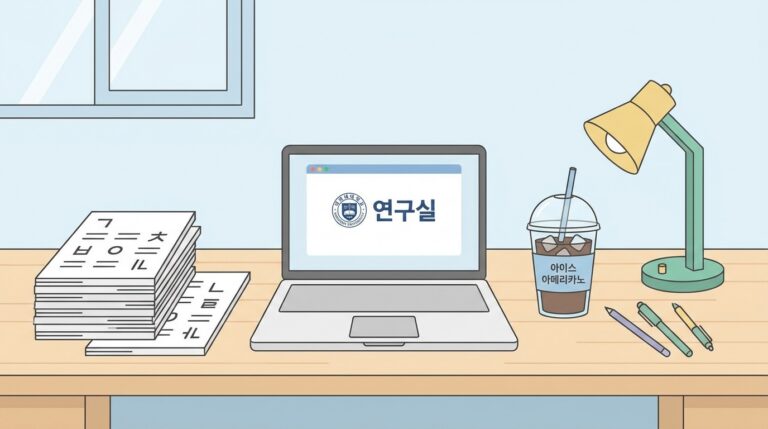
안녕하세요! 매일한글 에디터입니다. Picture this: It is 2:00 AM in a dimly lit Korean university graduate lab (랩실, raepsil). Empty paper cups of iced Americano and towers of freshly printed research papers from RISS and DBpia cover your desk. You have spent an exhausting semester analyzing hundreds of Korean and international studies, highlighting every paragraph in yellow and pastel pink. Tomorrow morning is the decisive proposal meeting with your academic advisor (지도교수님, jidogyosunim), and you have to deliver that one defining statement: “I have discovered a crucial research gap.” But how do you say that without sounding overly arrogant or clumsily informal? Korean academia values a delicate balance of deep respect and razor-sharp critical thinking. Drawing from authentic feedback of international graduate students in Korea, this practical B2-level guide gives you the academic polish and cultural diplomacy to pass your proposal defense with flying colors!
Phase 2: 핵심 표현 3선 심층 분석 (Top 3 Core Expressions)
1. 선행 연구를 다각도로 검토하다 (Seonhaeng yeon-gureul dagakdoro geomtohada)
- Pronunciation: [Seon-haeng yeon-gu-reul da-gak-do-ro geom-to-ha-da] (Sounds like: sun-heng yun-goo-ruel dah-gahk-doh-roh gum-toh-hah-dah)
- Meaning:
- Literal: To inspect preceding research from many angles.
- Nuance: A sophisticated, scholarly way to say “I read and synthesized a ton of literature from multiple perspectives.”
- K-Culture Moment: Seen in campus academic dramas like Law School or Start-Up when ambitious researchers present their literature review slide during group seminars.
- Editor’s Insight: Avoid simple verbs like 많이 읽었어요 (I read a lot) in formal defenses. 검토하다 (to examine/review) instantly elevates your tone to graduate-school caliber.
- Situation Spectrum: Casual 🚫 | Semi-formal ⚠️ | Formal ✅
- 🤔 Think About It: Why does Korean academia favor multi-angle (다각도) references over solitary personal opinions during presentations?
2. 기존 연구의 공백을 발견하다 (Gijon yeon-gu-ui gongbaegeul balgyeonhada)
- Pronunciation: [Gi-jon yeon-gu-ui gong-bae-geul bal-gyeon-ha-da] (Sounds like: gee-john yun-goo-eui gong-beck-uel bahl-gyun-hah-dah)
- Meaning:
- Literal: To find the blank space (vacuum) of existing studies.
- Nuance: The exact academic translation for “identifying a research gap.”
- K-Culture Moment: In graduate lab meetings, when the professor stops flipping slides, leans forward, and asks: “그래서 자네 논문의 독창성이 뭔가? (So, what is the originality of your thesis?)”, this is the magic phrase to reply with.
- Editor’s Insight: 공백 (gongbaek) literally means “empty white space.” Using it shows you understand that academic research is a collaborative puzzle where you are filling one tiny missing tile.
- Situation Spectrum: Casual 🚫 | Semi-formal ⚠️ | Formal ✅
- 🤔 Think About It: In your native language, do you say “hole”, “gap”, or “shortcoming”? Notice how Korean calls it a serene “white space” (공백) rather than a flaw.
3. 본 연구의 학문적 차별성을 확보하다 (Bon yeon-gu-ui hangmunjeok chabyeolseong-eul hwakbohada)
- Pronunciation: [Bon yeon-gu-ui hang-mun-jeok cha-byeol-seong-eul hwak-bo-ha-da] (Sounds like: bone yun-goo-eui hahng-moon-juck chah-byul-sung-eul hwahk-boh-hah-dah)
- Meaning:
- Literal: To secure the academic distinctiveness of this present study.
- Nuance: Proving why your paper is not a redundant carbon copy of what scholars have already published.
- K-Culture Moment: The final slide of a research proposal defense before the evaluation committee starts asking their grilling questions.
- Editor’s Insight: Always refer to your own thesis as 본 연구 (this study) rather than 내 논문 (my paper) to maintain objective academic distance.
- Situation Spectrum: Casual 🚫 | Semi-formal ⚠️ | Formal ✅
- 🤔 Think About It: How does shifting from “I” to “this study” change the listener’s perception of your academic authority?
Phase 3: 교과서 한국어 vs 진짜 한국어 (Textbook vs. Real Academic Korean)
Situation 1: Explaining your massive literature review
- 📖 교과서 한국어 (Textbook Korean):
- 저는 지난 학기 동안 수백 편의 논문을 열심히 읽었습니다. (Jeoneun jinan hakgi dongan subaek pyeon-ui nonmuneul yeolsimhi ilgeosseumnida.) — “I diligently read hundreds of papers over the last semester.”
- 🗣️ 진짜 한국어 (Real Academic Korean):
- 지난 학기 동안 국내외 선행 연구를 중점적으로 팔로업하며 연구 흐름을 정리했습니다. (Jinan hakgi dongan gungnae-oe seonhaeng yeon-gureul jungjeomjeog-euro pallo-eophamyeonseo yeon-gu heureumeul jeongnihaesseumnida.) — “I focused on following up on domestic and international prior studies to chart the prevailing research stream.”
- 💡 왜 다를까? (Why the difference?): Graduate research is not a high school reading competition; saying you “read diligently” sounds juvenile. Real researchers speak of tracking thematic streams and synthesizing trends.
Situation 2: Pointing out the research gap without offending prior scholars
- 📖 교과서 한국어 (Textbook Korean):
- 다른 논문들은 이 점을 전혀 몰랐습니다. (Dareun nonmundeureun i jeomeul jeonhyeo mollasseumnida.) — “Other papers completely did not know this point.”
- 🗣️ 진짜 한국어 (Real Academic Korean):
- 기존 논의들이 심도 있게 다루지 못했던 미개척 영역에 주목했습니다. (Gijon non-uideuri simdo itge daruji mothaetteon migaecheok yeong-yeoge jumokhaesseumnida.) — “I paid attention to an unexplored territory that existing discussions had not addressed in depth.”
- 💡 왜 다를까? (Why the difference?): Direct criticism (they did not know) violates Korean academic etiquette. In Korea, senior researchers are respected elders; frame their omission gently as an “unexplored territory” awaiting your flashlight.
Phase 4: K-Culture 딥다이브 & 비언어적 매너 (Deep Dive & Academic Etiquette)
4-1. 눈치 (Nunchi) & Body Language in the Professor’s Office
- The Two-Hand Handover: When presenting your printed proposal drafts (프로포절 기획서, peuropojeol gihoekseo), hold the document with both hands, lightly supporting the edge with your left hand while gently bowing your head (about 15 degrees).
- The Active Note-Taking Gesture: Even if you disagree with an advisor’s harsh comment, never cross your arms or stare blankly. Immediately write down notes on your pad with a nod. In Korean lab culture, writing down feedback is a physical display of intellectual humility (경청의 미덕).
4-2. The Culture Code: Graduate Lab Fuel & The “After-Defense Dinner”
Korean graduate school life revolves around two sacred rituals: the 1,500 KRW Mega Coffee Iced Americano (아아, aa-aa) that sustains 16-hour research marathons, and the tense yet heartwarming post-proposal dinner (종강 모임 / 회식). Korean labs operate like tight-knit extended families (선후배 문화). Understanding that your advisor’s severe questioning is intended to protect you from public humiliation during the university-wide committee defense is key to mastering the Korean academic mindset.
Phase 5: 실전 롤플레이 시나리오 (Interactive Defense Roleplay)
- Setting: Professor Park’s office (박 교수님 연구실). Stacks of hardbound theses line the wooden shelves.
- Characters:
- 지도교수 박 교수님 (Advisor Professor Park): Highly respected, meticulous, wearing round horn-rimmed glasses.
- 알렉스 (Alex): Master’s candidate who has synthesized 150 papers over vacation.
[Turn 1] 박 교수님: 🎭 (안경을 고쳐 쓰며 서류를 넘긴다 / Adjusting his glasses and flipping through the papers) 알렉스 학생, 지난 방학 동안 연구 주제 구체화하느라 고생 많았어요. 어디 찾은 내용 브리핑해 봐요. (Alex, you worked hard refining your thesis topic over vacation. Go ahead and brief me on what you found.)
[Turn 2] 알렉스: 🎭 (공손하게 두 손을 모으고 명확한 어조로 / Clasping hands politely and speaking in a clear tone) 네, 교수님. 지난 한 학기 동안 국내외 선행 연구 150여 편을 다각도로 검토했습니다. (Yes, Professor. Over the past semester, I examined over 150 domestic and international studies from various perspectives.)
[Turn 3] 박 교수님: 🎭 (고개를 끄덕이며 펜을 든다 / Nodding and picking up his pen) 선행 연구는 많이 본 것 같네. 그런데 기존 이론들과 자네 연구의 차별성이 뭔가? (It seems you read a lot of prior studies. But what is the distinctiveness of your study compared to existing theories?)
[Turn 4] 알렉스: 🎭 (슬라이드 표를 가리키며 / Pointing to a table on the slide) 기존 연구들은 주로 양적 지표에만 집중하여 실무자들의 심층적 반응을 규명하는 데 공백이 있었습니다. (Existing research focused mainly on quantitative indicators, leaving a gap in clarifying practitioners’ in-depth responses.)
[Turn 5] 박 교수님: 🎭 (살짝 미소를 띠며 눈을 맞춘다 / Smiling faintly and making eye contact) 흠, 선행 연구의 틈새를 짚어냈다는 뜻이군. 접근법이 꽤 설득력 있어요. (Hmm, you mean you have pinpointed the niche of previous studies. Your approach is quite persuasive.)
[Turn 6] 알렉스: 🎭 (자신감 있지만 겸손하게 / Confidently yet modestly) 감사합니다. 바로 그 미개척 영역을 질적 연구 방법론으로 보완하고자 본 연구를 기획했습니다. (Thank you. I planned this study to supplement that very unexplored area using qualitative research methodologies.)
[Turn 7] 박 교수님: 🎭 (연구계획서 첫 장에 ‘승인’ 서명을 하며 / Signing ‘Approved’ on the proposal cover) 좋아. 이 방향으로 다음 주 랩 세미나에서 프로포절 발표 준비해 봐요. (Great. Prepare your proposal presentation along this line for next week’s lab seminar.)
[Turn 8] 알렉스: 🎭 (정중하게 90도로 인사하며 / Bowing courteously at 90 degrees) 교수님 피드백을 충실히 반영하여 철저히 준비해 오겠습니다! (I will faithfully incorporate your feedback and prepare thoroughly!)
🔀 인스턴트 분기점 (Interactive Choice)
If Professor Park asked: “기존 연구와 뭐가 다른가? (How is this different from existing studies?)”, how would you answer?
- Option A: “제가 다 찾아봤는데 기존 연구들은 다 틀렸습니다.” (I checked everything, and previous studies were all wrong.)
- ❌ Bad: Fatal mistake! Invalidating senior scholars makes you appear ungrounded and academically disrespectful.
- Option B: “선행 연구들이 훌륭하지만, 특정 변인을 다루지 못한 공백이 있어 이를 보완하고자 합니다.” (While prior studies are outstanding, there is a gap regarding specific variables which this study aims to supplement.)
- 🏆 Best: Perfect! Honors previous achievements while sharply claiming an unoccupied scientific niche.
- Option C: “글쎄요… 사실 저도 읽다 보니 다 비슷한 것 같아서 고민입니다.” (Well… frankly, as I read them, they all seemed similar, so I am worried.)
- ⚠️ Risk: Shows honesty, but signals complete lack of readiness for a proposal defense.
Phase 6: 10초 감정 섀도잉 드릴 (Shadowing Drills)
- Drill 1
[🧐 진지하고 논리적으로 / Seriously and logically]- 지난 한 학기 동안 / 국내외 선행 연구를 검토하여 / 명확한 연구 공백을 도출했습니다.
- (Jinan han hakgi dongan / gungnae-oe seonhaeng yeon-gureul geomtohayeo / myeonghwakhan yeon-gu gongbaegeul dochulhaesseumnida.)
- “Over the past semester / by reviewing domestic and international prior studies / I deduced a clear research gap.”
- Drill 2
[🥺 겸손하지만 당당하게 / Modestly yet with poised confidence]- 기존 연구의 한계점을 딛고, / 본 연구만의 학문적 기여도를 / 입증해 보이겠습니다.
- (Gijon yeon-gu-ui hangyejeomeul ditgo, / bon yeon-guman-ui hangmunjeok giyeodoreul / ipjeonghae boigesseumnida.)
- “Stepping beyond the limitations of existing research, / I will demonstrate / this study’s unique academic contribution.”
Phase 7: K-Culture 미니 사전 (Academic Keywords)
- 선행 연구 (Seonhaeng yeon-gu) | Literature Review / Preceding Studies
- The indispensable foundation of any Korean thesis; every proposal defense begins by summarizing these.
- 연구 공백 (Yeon-gu gongbaek) | Research Gap
- The holy grail phrase in graduate school proving why your upcoming master’s degree deserves to exist.
- 디벨롭하다 (Dibeillop-hada) | To Develop / Refine
- Konglish widely used by Korean professors: “이 아이디어 좀 더 디벨롭해 와.” (Go refine and upgrade this idea further.)
- 프로포절 심사 (Peuropojeol simsa) | Thesis Proposal Defense
- The milestone defense presentation before 3 evaluating professors to get formal thesis clearance.
Phase 8: 대학원생 생존 키트 (Academic Survival Kit)
Top 3 Survival Phrases
- 교수님, 피드백 주신 부분 충실히 보완하겠습니다. (Gyosunim, pideubaek jusin bubun chungsilhi bowanhaegesseumnida.)
- Pro Tip: The ultimate phrase to defuse harsh critiques during research meetings.
- 선행 연구 간의 불일치에 주목하여 가설을 세웠습니다. (Seonhaeng yeon-gu gan-ui burilchie jumokhayeo gaseoreul sewosseumnida.)
- Pro Tip: Highly effective when contrasting differing theories between Korean and Western scholars.
- 부족한 연구지만 많은 지도편달 부탁드립니다. (Bujokhan yeon-gujiman maneun jidopyeondal butakdeurimnida.)
- Pro Tip: A classic humble closing remark meaning “Though my study has shortcomings, I ask for your gracious academic guidance.”
Editor’s Academic Note
Make sure to connect your university account directly on the RISS 학술연구정보서비스 포털 to download free domestic master’s and doctoral dissertations without paywalls. When searching for Korean trends, using DBpia 학술 데이터베이스 directly provides citation indices that Korean review committees deeply appreciate.
Phase 9: “한 발 더 깊이” (Cultural Insight Essay)
In Western academia, debate often encourages students to confront prior theories with bold, disruptive statements. However, Korean graduate discourse is steeped in a tradition of scholastic lineage (학맥, hangmaek). Progress is seen not as a revolution destroying the past, but as a respectful brick added upon an ancestral wall. When proposing your research gap, your phrasing must reflect 계승 (inheritance) before asserting 혁신 (innovation). By demonstrating that you have thoroughly absorbed your predecessors’ insights before introducing your new niche, you earn the faculty’s genuine trust.
💬 Your Turn: How does academic critique work in your home country? Do students openly debate professors, or do they adopt cautious diplomacy like in Korea? Share your graduate school memories in the comments below!
Phase 10: FAQ & 흔한 실수 경고판 (FAQ & Common Mistakes)
Q: Can I use the English word “Research Gap” directly with my Korean professor?
A: Yes! Korean professors and researchers frequently use the loanword 갭 (gap) or 연구 갭. However, in your written proposal document and formal oral defense, using 선행 연구의 공백 (seonhaeng yeon-gu-ui gongbaek) or 연구의 차별성 (distinctiveness) reflects superior B2/C1 academic Korean mastery.
Q: How do I address members of my thesis defense evaluation committee?
A: Always call the head evaluator 심사위원장님 (simsawiwonjangnim) and other professors 심사위원 교수님 (simsawiwon gyosunim). Never address them simply as 선생님 (teacher) in a formal review room.
Q: What should I say if an evaluator points out a critical flaw I cannot answer?
A: Never guess or argue defensively. Say: “미처 생각지 못한 예리한 지적 감사드립니다. 심사 후 선행 연구를 보강하여 최종 논문에 반드시 반영하겠습니다.” (Thank you for the sharp insight I had not considered. I will supplement prior studies after the defense and reflect it in the final thesis.)
🚨 흔한 실수 (Common Mistakes) 경고판
- ❌ Mistake 1: Saying “제 생각에는 이전 논문들이 잘못되었습니다.” (In my opinion, previous papers were wrong.)
- 🛠️ Correct Action: Say “기존 연구의 한계점을 극복하기 위해 새로운 관점을 적용했습니다.” (To overcome the limitations of prior research, I applied a new perspective.)
- ❌ Mistake 2: Using informal endings like ~했어요 or ~인 것 같아요 during slide defense.
- 🛠️ Correct Action: End all declarative proposal slides with the formal ~ㅂ니다 / ~습니다 or ~로 사료됩니다 (it is considered that…).
- ❌ Mistake 3: Presenting printed proposal papers single-sided without staple/binding etiquette.
- 🛠️ Correct Action: Prepare 3 clean bound or neatly clipped copies placed precisely on the evaluators’ desks before they enter.
Phase 11: 액션 미션 & 참여 유도 (Action Missions)
- 🥉 Bronze Mission (Solo Practice): Stand before a mirror and pronounce 선행 연구의 공백을 발견했습니다 (I discovered the research gap of prior studies) 5 times with calm eye contact.
- 🥈 Silver Mission (Lab Chat): Next time you speak to your Korean lab mate (랩실 동기), use the word 디벨롭하다 (to develop): “이번 주말에 제 프로포절 초안 좀 디벨롭하려고요!”
- 🥇 Gold Mission (Real Life): During your next seminar or 1-on-1 advisor consultation, replace 많이 읽었어요 with 선행 연구를 다각도로 검토했습니다.
- 🎮 K-Culture Mission: Watch an episode of a Korean legal or medical drama (like Extraordinary Attorney Woo or Hospital Playlist) and listen for how junior researchers frame evidence with humility to their directors!
Phase 12: 인터랙티브 퀴즈 챌린지 (Interactive Quiz Challenge)
Question 1. 상황 판단 (Situational Judgment)
You are defending your research topic. An evaluator asks: “왜 굳이 이 연구를 해야 합니까? (Why must this study be conducted?)” Which response is most professional?
* (A) 제가 이 분야에 관심이 아주 많아서 꼭 해보고 싶었습니다.
* (B) 기존 선행 연구들이 충분히 조명하지 못한 공백을 밝혀 학문적 기여를 하기 위함입니다.
* (C) 다른 대학원생들이 아직 안 쓴 주제라서 쉽게 쓸 수 있을 것 같았습니다.
Question 2. 빈칸 채우기 (Fill in the Blank)
- 지난 한 학기 동안 수백 편의 ( )를 검토하여 기존 연구의 한계를 도출했습니다.
(Hint: The Korean academic term for “preceding/prior research”.)
Question 3. True / False 문화 퀴즈
- In a Korean university proposal defense, saying “제 논문” repeatedly is considered much more professional and objective than saying “본 연구”. (True / False)
👉 Click here to check the answers and explanations!
퀴즈 정답 및 해설 (Answers & Explanations)
- 정답: (B)
- 해설: Academic committees want to hear about academic contribution (학문적 기여) and filling a research gap (연구 공백), not personal hobbies (A) or convenience (C).
- 정답: 선행 연구 (Seonhaeng yeon-gu)
- 해설: Preceding studies / Literature review.
- 정답: False
- 해설: In formal academic presentations, you should refer to your work objectively as 본 연구 (bon yeon-gu, this present study) rather than the subjective 제 논문 (my paper).
- 해설: In formal academic presentations, you should refer to your work objectively as 본 연구 (bon yeon-gu, this present study) rather than the subjective 제 논문 (my paper).







