

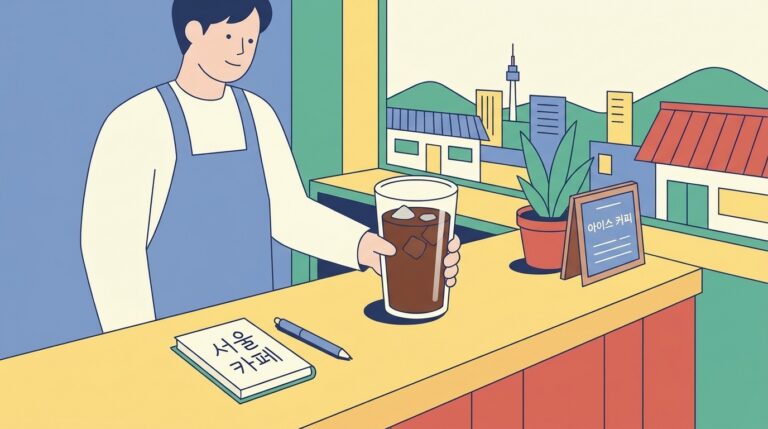
Order Coffee in Korea Like a Pro: How to Confidently Ask for a Large Cup
Phase 1: Empathy (Real-Life Opening)
안녕하세요! 매일한글 에디터입니다. (Annyeonghaseyo! This is your Daily Hangul editor and your personal Korean cultural navigator.)
Picture this: you have walked over 15,000 steps exploring the historic palaces and trendy alleyways of Seoul. Your feet are aching, the afternoon humidity is setting in, and all your brain desires is a tall, frosty cup of iced Americano to recharge your batteries. You spot a sleek, aesthetic cafe with warm jazz playing in the background. Smiling, you step up to the counter, feeling ready.
Then, reality hits. The barista looks up with lightning-fast professional speed and rattles off: “주문 도와드릴까요? 드시고 가세요? 사이즈는 뭘로 하시겠어요?” (May I help you order? Having it here? What size would you like?)
Suddenly, your mind freezes. You wanted a giant, thirst-quenching iced coffee, but your tongue gets tangled in the sudden rush of Korean. You end up mumbling, nodding frantically, and walking away with a standard tiny paper cup that vanishes in three sips!
Don’t worry—you are certainly not alone. Hundreds of our beginner students have told us about this exact “cafe panic” moment in Korea. In a country that operates on high efficiency and lightning-fast customer service, ordering can feel intimidating for beginners. But once you master just one simple, high-impact phrase, you will walk into any cafe from Hongdae to Gangnam and order exactly what you want with effortless poise. Let’s make sure you never end up with the wrong drink size again!
Phase 2: Top 3 Core Expressions (Deep Dive)
1. 라지 사이즈로 주세요 (Laji saijeuro juseyo)
- Pronunciation: [Laji sa-i-jeu-ro ju-se-yo] (Sounds like: “La-jee” + English word “size” stretched into three soft beats “sah-ee-jeu” + “ro” like the start of “robot” + “joo-seh-yo”)
- Meaning:
- Literal: “To large size, please give.”
- Real Nuance: “Please make it a large size.” This is the most universally understood, foolproof way to request a large cup anywhere in South Korea.
- K-Culture Moment: In modern K-Dramas like Business Proposal or Work Later, Drink Women, you constantly see overworked office workers marching into local cafes during lunch hour saying this briskly to get their daily fuel.
- Editor’s Insight: The particle ~로 (~ro) means “towards” or “into the state of.” So you are literally telling the barista, “Transform my order into a large, please!”
- Situation Spectrum:
- Casual (Friends): ⚠️ (A bit too polite for close friends, but completely natural in shops)
- Semi-formal (Counter staff, Cafe baristas): ✅ (Absolute perfection)
- Formal (Official business): ✅
- 🤔 Think About It: In English, we often just say “Large, please.” In Korean, using the polite ending 주세요 (juseyo) is a warm social cushion that instantly shows respect to the person preparing your drink.
2. 큰 걸로 주세요 (Keun geollo juseyo)
- Pronunciation: [Keun geol-lo ju-se-yo] (Sounds like: “Kun” with a clean ‘u’ like in ‘put’ + “gull-law” + “joo-seh-yo”)
- Meaning:
- Literal: “Please give me the big thing.”
- Real Nuance: “Please give me the large one.” This is native Korean vocabulary (크다 – to be big) rather than a loanword.
- K-Culture Moment: Watch any slice-of-life YouTube vlog of a student studying at a 24-hour study cafe—when ordering a drink to survive all-night cramming, they’ll casually say, “아이스 아메리카노 큰 걸로 주세요!” (One iced Americano, the big one please!)
- Editor’s Insight: If you freeze and can’t recall whether a cafe uses “Tall/Grande/Venti” or “Regular/Large,” this phrase is your magical universal lifesaver. It works for coffee, boba, juices, and even popcorn at the cinema!
- Situation Spectrum:
- Casual (Friends): ⚠️ (Use ‘큰 걸로 줘’ with peers)
- Semi-formal (Cafe staff): ✅ (Extremely natural and friendly)
- Formal (Boardroom): 🚫
- 🤔 Think About It: Notice how English separates “large” as a fixed technical size, whereas Korean allows you to simply point out “the bigger one.” How does your native language handle size distinctions?
3. 사이즈 업 해주세요 (Saijeu eop haejuseyo)
- Pronunciation: [Sa-i-jeu eop hae-ju-se-yo] (Sounds like: “Size” pronounced “sah-ee-jeu” + “up” pronounced “eop” + “hae-joo-seh-yo”)
- Meaning:
- Literal: “Please do a size up for me.”
- Real Nuance: “Please upgrade my drink to a larger size.”
- K-Culture Moment: Seen frequently at Korean takeout coffee chains like Mega Coffee, Compose, or Paik’s Coffee, where customers love to upgrade to jumbo monster sizes for just a few hundred extra won.
- Editor’s Insight: Use this when you have already said your drink name, or when using a telecom discount / stamp card promotion that offers a free size upgrade!
- Situation Spectrum:
- Casual (Friends): ⚠️
- Semi-formal (Baristas): ✅
- Formal (Official): ✅
- 🤔 Think About It: Korean absorbs English loanwords (“Size up”) and smoothly integrates them with native verbs (하다 – to do). It shows how dynamic modern spoken Korean truly is!
Phase 3: Textbook Korean vs. Real Korean
Scenario 1: Specifying the large cup size
- 📖 교과서 한국어 (Textbook Korean): 큰 컵으로 주십시오. (Keun keobeuro jusipsio. – “Please provide the large vessel.”)
- 🗣️ 진짜 한국어 (Real-Life Korean): 라지 사이즈로 주세요! (Laji saijeuro juseyo! – “Large size, please!”)
- 💡 왜 다를까? (Why the difference?): While “-십시오” is grammatically polite, it sounds like an announcement made by a subway conductor or a military officer! Modern baristas expect friendly everyday politeness using ~요 (~yo).
Scenario 2: Responding when the barista asks what size you want
- 📖 교과서 한국어 (Textbook Korean): 저는 가장 큰 용량을 원합니다. (Jeoneun gajang keun yongnyang-eul wonhamnida. – “I desire the greatest volume capacity.”)
- 🗣️ 진짜 한국어 (Real-Life Korean): 제일 큰 걸로 주세요. (Jeil keun geollo juseyo. – “The biggest one, please.”)
- 💡 왜 다를까? (Why the difference?): Nobody uses the word “용량 (volume/capacity)” when buying coffee unless you are buying motor oil for your scooter! Keep it snappy with 제일 큰 것 (the biggest one).
Phase 4: K-Culture Deep Dive & Non-Verbal Manners
4-1. 눈치 (Nunchi) & Polite Counter Etiquette
In Korea, ordering coffee is an art of mutual efficiency and polite awareness. Here is how to look like an experienced Seoulite:
1. Card Handling with Respect: When paying, never flick or toss your payment card onto the counter. Hand it over holding it with both hands, or support your right wrist lightly with your left hand. This small gesture demonstrates genuine manners.
2. The Cup Display Glance: Look near the cash register before opening your mouth. Almost every Korean cafe displays actual empty plastic and paper cups labeled Regular / Large or M / L. Pointing gently toward the large cup while saying “라지 사이즈로 주세요” eliminates 100% of potential miscommunications!
3. Eye Contact & Nod: When the staff hands you the vibrating buzzer (진동벨 – jindongbel), accept it with both hands and give a slight 15-degree head nod while saying “감사합니다” (Gamsahamnida – Thank you).
4-2. The Korean Caffeine Phenomenon: 얼죽아 (Eol-juk-ah)
Have you ever heard of the Korean cultural acronym 얼죽아 (Eol-juk-ah)? It stands for:
얼어 죽어도 아이스 아메리카노 (Eol-eo jugeodo a-i-seu a-me-ri-ka-no) — “Even if I freeze to death, I’m drinking Iced Americano!”
Even in the dead of winter with snow piling up on the streets of Seoul, you will spot people bundled in long puffer jackets clutching oversized plastic cups packed with ice. Koreans value speed, crisp refreshment, and efficient wake-up power. When you ask for a 라지 사이즈 (large size) iced drink, the barista will completely understand your thirst for energy!
Phase 5: Real-Life Roleplay Scenario
- Location: Café Lucid, a bustling cafe in the hip Seongsu-dong district.
- Character: Min-woo (민우), a friendly, attentive barista wearing a canvas apron.
- Turn 1 (Barista Min-woo):
안녕하세요! 주문 도와드릴까요?
(Annyeonghaseyo! Jumun dowadeurilkkayo?)
“Hello! May I help you order?”
🎭 Action: Greets with a warm smile and taps the POS touch screen. -
Turn 2 (You / Traveler):
네, 아이스 아메리카노 한 잔 주세요.
(Ne, a-i-seu a-me-ri-ka-no han jan juseyo.)
“Yes, one iced Americano, please.”
🎭 Action: Looking at the menu, speaking clearly. -
Turn 3 (Barista Min-woo):
드시고 가세요, 아니면 테이크아웃이세요?
(Deusigo gaseyo, animyeon teikeu-auti-seyo?)
“For here, or to go?”
🎭 Action: Pauses with his hand hovering over the order options. -
Turn 4 (You / Traveler):
테이크아웃이요!
(Teikeu-auti-yo!)
“To go, please!”
🎭 Action: Making a gentle gesture pointing toward the exit door. -
Turn 5 (Barista Min-woo):
네, 사이즈는 레귤러랑 라지 중에 뭘로 하시겠어요?
(Ne, sa-i-jeu-neun regyulleo-rang laji jung-e mwollo hasigesseoyo?)
“Sure, between regular and large, which size would you like?”
🎭 Action: Points towards the two sample display cups beside the register. -
Turn 6 (You / Traveler):
라지 사이즈로 주세요!
(Laji sa-i-jeu-ro juseyo!)
“Large size, please!”
🎭 Action: Confidently smiling and nodding toward the bigger cup. -
Turn 7 (Barista Min-woo):
네, 결제 도와드리겠습니다. 카드 꽂아주세요.
(Ne, gyeolje dowadeurigesseumnida. Kadeu kkojajuseyo.)
“Got it, I will help you pay. Please insert your card here.”
🎭 Action: Points to the chip reader on the small card machine. -
Turn 8 (You / Traveler):
네, 감사합니다!
(Ne, gamsahamnida!)
“Yes, thank you!”
🎭 Action: Inserts card with two hands and receives the buzzer with a slight bow.
🔀 Interactive Decision Point
Imagine the barista suddenly asks you: “혹시 연하게 해드릴까요?” (Hoksi yeonhage haedeurilkkayo? – “Would you like your coffee made mild/weak?”)
How do you respond?
- Choice A: “아니요, 기본으로 해주세요!” (Aniyo, giboneuro haejuseyo! – “No, standard/regular strength please!”)
👉 Feedback [Best]: Excellent! 기본 (gibon) means basic/default. This tells the barista you want the full caffeine punch exactly as crafted. -
Choice B: “라지 사이즈 주세요!” (Laji saijeuro juseyo!)
👉 Feedback [Risk]: Repeating the size doesn’t answer whether you want light shots or standard shots. The barista might pause and ask again slower. -
Choice C: “몰라요.” (Mollayo – “I don’t know.”)
👉 Feedback [Bad]: Saying “몰라요” sounds slightly blunt or annoyed in Korean. If you don’t understand, a gentle “네?” (Ne? – Pardon?) is much friendlier!
Phase 6: 10-Second Emotion Shadowing Drill
Practice reading these out loud! Follow the slashes / for natural breathing pauses:
[😊 Confidently and brightly]
아이스 아메리카노 / 라지 사이즈로 주세요!
(A-i-seu a-me-ri-ka-no / la-ji sa-i-jeu-ro ju-se-yo!)
“One iced Americano / large size, please!”-
[☕ Friendly and natural]
테이크아웃 할게요 / 큰 걸로 주세요.
(Te-i-keu-a-ut hal-ge-yo / keun geol-lo ju-se-yo.)
“I will take it to go / make it the big one, please.” -
[💡 Quick and decisive]
사이즈 업 / 해주실 수 있나요?
(Sa-i-jeu eop / hae-ju-sil su in-na-yo?)
“Could you do / a size upgrade for me?”
Phase 7: K-Culture Mini Dictionary
| # | Term (Hangul + Romanization) | Translation | Real-World Context & Usage |
|---|---|---|---|
| 1 | 아아 (Ah-Ah) | Iced Americano (Abbreviation) | The unofficial national drink of South Korea. You will hear locals simply order “아아 두 잔이요!” (Two Ah-Ahs, please!). |
| 2 | 뜨아 (Ddeu-Ah) | Hot Americano (Abbreviation) | The hot counterpart to Ah-Ah (from 뜨거운 아메리카노). Used especially during chilly autumn and winter mornings. |
| 3 | 진동벨 (Jindongbel) | Pager / Buzzer | The vibrating coaster puck given at counters. When it flashes red and rattles, your beverage is ready at the pick-up counter. |
| 4 | 텀블러 할인 (Teombeulleo Harin) | Tumbler / Reusable Cup Discount | Many Korean cafes offer a 100 to 500 won discount if you bring your own travel mug to support eco-friendly initiatives! |
Phase 8: Traveler’s Survival Kit
Top 3 Survival Phrases
- 얼음 많이 넣어주세요 (Eoreum mani neoeojuseyo)
Meaning: “Please add lots of ice.”
Pro Tip: Perfect on scorching summer afternoons when you want your drink extra cold. - 영수증 버려주세요 (Yeongsujeung beoryeojuseyo)
Meaning: “Please throw away the receipt.”
Pro Tip: The cashier will usually ask if you need a receipt (영수증 필요하세요?). This phrase saves paper effortlessly. - 빨대는 어디에 있어요? (Ppaldaeneun eodie isseoyo?)
Meaning: “Where are the straws?”
Pro Tip: Most cafes keep straws, napkins, and syrup at a self-service counter called the 서비스 테이블 (Service Table).
Editor’s Travel Note
- App Recommendation: Google Maps has limited walking functionality in Korea due to national data regulations. Make sure to download the Naver Map app for seamless cafe navigation to find hidden rooftop cafes and check their opening hours.
- Cashless Culture: Korea is nearly 100% cashless. Small cafes prefer international credit cards (Visa, Mastercard) or mobile contactless payments over paper bills. Keep your card handy!
Phase 9: “One Step Deeper” (Reflective Thought)
In many Western cultures, a cafe visit is a slow, leisurely ritual meant for reading a book or chatting for hours without interruption. In Korea, while cafe aesthetics are stunning, counter service is engineered for remarkable speed and clarity. Asking for a drink size in Korean using polite suffixes reflects a cultural philosophy called 상호존중 (mutual respect): honoring the worker’s effort while keeping the flow seamless for everyone waiting behind you.
💬 Your Turn: What is the standard coffee size you usually drink in your home country? Have you ever experienced a funny mix-up when ordering drinks abroad? Share your story in the comments below!
Phase 10: FAQ & Avoiding Misunderstandings
Q: Can I use Starbucks cup terms like “Tall” or “Venti” in regular Korean cafes?
A: Only at Starbucks! Independent Korean cafes and domestic franchises (like Ediya, Mega Coffee, Twosome Place) typically use 레귤러 (Regular) and 라지 (Large), or simply 작은 것 (small one) and 큰 것 (big one). Sticking to 라지 사이즈로 주세요 works everywhere.
Q: Why did the barista ask me where I am drinking my coffee?
A: By Korean environmental law, single-use disposable plastic cups are strictly prohibited for customers drinking inside the cafe. If you answer “먹고 갈게요” (Having it here), you will receive a glass or mug. If you choose “테이크아웃” (Takeout), you get a disposable cup, but you must drink it outside!
Q: Is there an extra charge for a large size?
A: Yes, generally between 500 KRW to 1,500 KRW (roughly $0.40 – $1.10 USD), depending on whether it adds extra espresso shots.
🚨 흔한 실수 (Common Mistakes) Warning Board
- Mistake 1: Saying “빅 사이즈 주세요” (Big size juseyo).
Why: While understood, “Big size” is rarely used on Korean cafe menus.
Correct Action: Say 라지 사이즈로 주세요 or 큰 걸로 주세요. - Mistake 2: Dropping the polite ending and just shouting “라지!” (Laji!).
Why: Saying just the noun sounds demanding to local staff.
Correct Action: Always attach ~로 주세요 (~ro juseyo). - Mistake 3: Sitting down at an indoor table with a takeout plastic cup.
Why: Cafe owners can actually be fined by local city inspectors if customers use takeout cups inside!
Correct Action: If your plans change and you want to sit down, tell the staff: “매장 잔으로 바꿔주세요” (Please switch this to an in-store cup).
Phase 11: Action Missions
- 🥉 Bronze Mission (Solo Practice): Stand in front of your mirror and say “아이스 아메리카노, 라지 사이즈로 주세요!” three times with a bright smile until it rolls off your tongue in under 3 seconds.
- 🥈 Silver Mission (Social Audio): Record your voice saying the phrase on your Instagram Story or language exchange app, tagging your favorite Korean cafe spot!
- 🥇 Gold Mission (Real Life / K-Town): Visit a local Korean bakery or cafe in your city (or in Korea!), place your entire drink and size order 100% in Korean, and collect your drink triumphantly!
- 🎮 K-Culture Mission: Watch the first episode of any contemporary K-drama and spot how many times the characters are holding an iced drink cup. Notice what size they chose!
Phase 12: Interactive Quiz Challenge
Question 1: Situational Judgment
You are at a coffee shop counter in Myeongdong. You want to order a hot latte in the biggest cup available. What is the most natural sentence?
* (A) 라떼 큰 걸로 주세요. (Latte keun geollo juseyo.)
* (B) 라떼 컵을 큰 것으로 주십시오. (Latte keobeul keun geoseuro jusipsio.)
* (C) 라떼 크게 원해요. (Latte keuge wonhaeyo.)
Question 2: Fill-in-the-Blank
Complete the order request with the correct particle meaning “into/as”:
“아메리카노 라지 사이즈(____) 주세요!”
Question 3: Cultural True or False
True or False: If you order a drink in a disposable takeout plastic cup in Seoul, you are legally permitted to sit at a cafe table for several hours as long as you bought the drink there.
👉 Click here to reveal answers & explanations!
Quiz Answers & Explanations
-
Answer: (A) 라떼 큰 걸로 주세요.
Explanation: (A) is completely natural, warm, and native. (B) is stiff textbook speech that sounds robotic, and (C) is an awkward word-for-word translation of “I want it big.” -
Answer: 로 (ro)
Explanation: After words ending without a final consonant (받침) like 사이즈 (sa-i-jeu), we attach ~로 to indicate selection: 라지 사이즈로 주세요. -
Answer: False!
Explanation: Under Korean eco-protection regulations, single-use takeout cups are banned for in-store seating. If you wish to sit and relax, ask for a mug using “마시고 갈게요” (Having it here)!







