

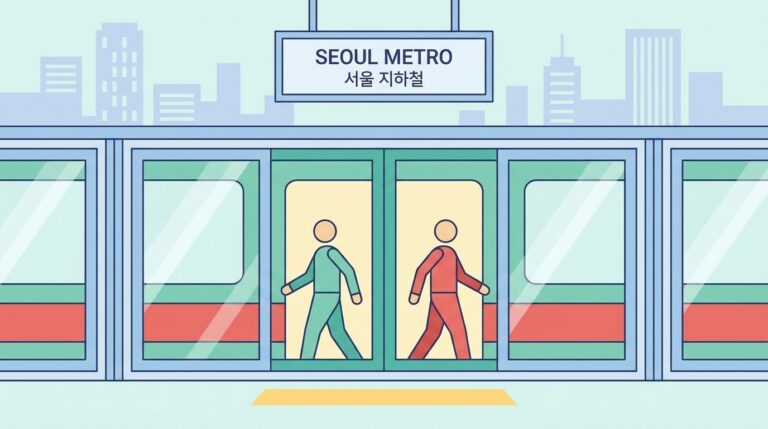
Master Korean Public Signs: Entrance, Exit, and Essential Etiquette
Phase 1: Empathy (Real-World Opening)
안녕하세요! 매일한글 에디터입니다. (Hello! This is your editor from Daily Hangul.)
Picture this: You have just landed at Incheon International Airport and hopped on the all-stop train heading toward Hongdae. Your phone battery is hovering at 12%, your wheeled suitcase weighs a ton, and you step off into a sea of commuters moving with laser-focused speed. You look up at the massive glass doors ahead. Both look identical, but each bears a different two-character Korean sign glowing overhead: one says 입구 and the other says 출구.
You freeze for two seconds. You choose the left door, push with all your strength, but it will not budge. A commuter hurrying behind you has to swerve to avoid a collision, offering a surprised little sigh. We have all been there! In fact, over 80% of our beginner students tell us that navigating public entryways and reading basic signs is their very first real-world cultural hurdle in South Korea.
Knowing how to instantly read and react to these entrance and exit signs will save you from awkward doorway collisions, help you navigate Seoul’s sprawling underground subway labyrinths like a local, and give you the confidence to explore quaint neighborhood cafes. Based on real feedback and battle-tested advice from hundreds of Daily Hangul learners, this guide will turn those confusing Korean door signs into your easiest daily victory!
Phase 2: Core Expressions (The Essential 3 Signs)
1. 입구 (Ip-gu)
- Pronunciation: [Ip-gu] (Sounds like: “Eep-goo” — say a quick, crisp “eep!” like a tiny squeak, followed by a smooth “goo”).
- Meaning: Direct: “Entering mouth/portal” | Actual Nuance: Standard “Entrance” or “Way In”.
- K-Culture Moment: Seen on bright signs outside trendy pop-up stores in Seongsu-dong, or marking the designated start of the red carpet at K-pop music award venues.
- Editor’s Insight: The character 입 (ip) comes from the Hanja character meaning ‘enter’ (入), and 구 (gu) represents ‘mouth’ or ‘opening’ (口). Whenever you see 구 (gu) at the end of a location sign, remember it means an opening or doorway!
- Situation Spectrum: Casual: ✅ | Semi-formal: ✅ | Formal: ✅ (Universal signpost word)
- 🤔 Think About It: In English, we say “entrance” (related to entering), while Korean visualizes the building as having a “mouth” that welcomes people in. How does your language personify buildings?
2. 출구 (Chul-gu)
- Pronunciation: [Chul-gu] (Sounds like: “Chool-goo” — start with “cool” but with a punchy ‘ch’ sound at the front, finishing with “goo”).
- Meaning: Direct: “Exiting mouth” | Actual Nuance: “Exit” or “Way Out”.
- K-Culture Moment: Every memorable K-drama meetup always begins with a text message like: “Meet me at Gangnam Station, Exit 11!” The big yellow subway signs always read [Number]번 출구.
- Editor’s Insight: Just like 입 (ip) means enter, 출 (chul) comes from the Hanja meaning ‘to go out’ (出). If you ever feel lost inside a giant Korean department store or underground transit hub, look up at the ceiling signs and follow the arrows pointing to 출구.
- Situation Spectrum: Casual: ✅ | Semi-formal: ✅ | Formal: ✅ (Universal signpost word)
- 🤔 Think About It: Why do you think Seoulites almost always name a specific numbered exit (출구) instead of a street corner when setting up a first date or friend gathering?
3. 당기세요 (Dang-gi-se-yo) / 미세요 (Mi-se-yo)
- Pronunciation: [Dang-gi-se-yo / Mi-se-yo] (“Dahng-ghee-seh-yoh” / “Me-seh-yoh” — me like “myself”, followed by “say-yo”).
- Meaning: Direct: “Please pull” / “Please push” | Actual Nuance: Door action instructions.
- K-Culture Moment: On variety shows like Running Man, cast members in a high-stakes chase frequently push against doors clearly labeled 당기세요 (Pull) while screaming in panic!
- Editor’s Insight: Even native Koreans get this wrong when in a rush! But here is an easy memory hook: 미세요 (Mi-se-yo) starts with M—think of Moving an object away from your body (push). 당기세요 (Dang-gi-se-yo) starts with D—think of Drawing it toward you (pull).
- Situation Spectrum: Casual: ✅ | Semi-formal: ✅ | Formal: ✅
- 🤔 Think About It: Notice the polite honorific ending -세요 (-se-yo) even on a door sticker! Why do you think Korean public signs speak so politely to readers?
Phase 3: Textbook Korean vs Real Korean
Situation 1: Asking a passerby where the entrance is
- 📖 교과서 한국어 (Textbook): “입구가 어디에 있습니까?” (Ip-gu-ga eo-di-e it-seum-ni-kka? / Where is the entrance?)
- 🗣️ 진짜 한국어 (Real-life): “저기요, 입구 어디예요?” (Jeo-gi-yo, ip-gu eo-di-ye-yo? / Excuse me, where is the entrance?)
- 💡 왜 다를까?: The formal -습니까 (-seum-ni-kka) ending can sound stiff and robotic in casual street settings. Real locals start with a soft, polite “저기요” (excuse me) and use the friendly, natural standard polite ending “-어디예요?” (where is it?).
Situation 2: Trying to get through a crowded exit door
- 📖 교과서 한국어 (Textbook): “실례합니다, 지나가겠습니다.” (Sil-lye-ham-ni-da, ji-na-ga-get-seum-ni-da. / Excuse me, I will pass through.)
- 🗣️ 진짜 한국어 (Real-life): “잠시만요~” (Jam-si-man-yo~ / Just a moment, please~)
- 💡 왜 다를까?: In fast-paced Korean public spaces, long sentences cause physical bottlenecks. “잠시만요” functions like a magical social wand—it instantly signals that you need someone to let you squeeze through without sounding abrupt or rude.
Phase 4: K-Culture Deep Dive & Non-Verbal Manners
4-1. 눈치 (Nunchi) & Entryway Etiquette
In Korea, doorways are communal transit zones where 눈치 (Nunchi – situational awareness) shines brightest:
* The Golden Rule (하차 우선 – Ha-cha u-seon): Always let people inside exit before you step through the entrance. Whether boarding a subway, an elevator, or entering a small convenience store, step 45 degrees to the side and wait.
* The Two-Hand Door Courtesy: If someone holds a heavy glass door for you at an entrance marked 당기세요, do not just walk through. Make brief eye contact, give a tiny 15-degree head nod, and touch the edge of the door with one hand as you pass to share the weight.
* Subway Floor Arrows: On subway platforms, look down at your feet. You will see yellow triangles pointing outward from the train doors (exit lane) and two diagonal arrows on the left and right pointing inward (entrance lanes). Stand strictly behind the lines on the sides!
4-2. Cultural Code: The Labyrinth of Seoul’s Transit Hubs
If you have watched K-dramas like My Liberation Notes, you know the Korean commute is practically a sacred daily ritual. Stations like Express Bus Terminal or Gangnam have over a dozen exits connected to massive underground shopping arcades. Numbered exits (출구) are so critical that local navigation apps pinpoint exactly which subway car door you should stand in front of (e.g., “Car 4-2”) to step right onto the staircase leading to your exit!
Phase 5: Real-Life Roleplay Scenario
- Setting: The underground exit corridor of Hongik University (Hongdae) Station on a rainy Friday evening.
- Characters: You (Alex, traveling in Korea) and Minji (a stylish local carrying an iced Americano and an umbrella).
-
Minji: 🎭 (Stands to the side of the door, glancing at her watch) “비가 많이 오네요.” (Bi-ga ma-ni o-ne-yo. / It is raining a lot.)
- Alex: 🎭 (Looking confused at two sets of heavy double doors) “저기요… 입구 어디예요?” (Jeo-gi-yo… ip-gu eo-di-ye-yo? / Excuse me… where is the entrance?)
- Minji: 🎭 (Smiles warmly and points toward the glass door on the right) “아, 저쪽 초록색 표시가 입구예요!” (A, jeo-jjok cho-rok-saek pyo-si-ga ip-gu-ye-yo! / Oh, that green sign over there is the entrance!)
- Alex: 🎭 (Walking to the door, hands hesitating on the bar) “이거… 밀어야 돼요?” (I-geo… mi-reo-ya dwae-yo? / Do I… have to push this?)
- Minji: 🎭 (Giggles slightly and points to the circular sticker) “거기 ‘당기세요’라고 써 있어요. 당기시면 돼요!” (Geo-gi ‘dang-gi-se-yo’-ra-go sseo it-seo-yo. Dang-gi-si-myeon dwae-yo! / It says ‘Pull’ right there. You can just pull it!)
- Alex: 🎭 (Pulls the door smoothly and holds it open with one hand) “아, 감사합니다! 먼저 가세요.” (A, gam-sa-ham-ni-da! Meon-jeo ga-se-yo. / Ah, thank you! Please go ahead first.)
- Minji: 🎭 (Nods politely as she walks through) “고마워요! 좋은 하루 보내세요!” (Go-ma-wo-yo! Jo-eun ha-ru bo-nae-se-yo! / Thank you! Have a nice day!)
- Alex: 🎭 (Beams with pride) “네, 감사합니다!” (Ne, gam-sa-ham-ni-da! / Yes, thank you!)
🔀 Interactive Branching Point
You are now trying to leave the subway station through a narrow revolving exit gate, but someone dropped their umbrella right in front of you. What do you say?
- Option A: “저리 가세요!” (Jeo-ri ga-se-yo!)
- Option B: “잠시만요, 지나갈게요~” (Jam-si-man-yo, ji-na-gal-ge-yo~)
- Option C: “출구가 어디입니까?” (Chul-gu-ga eo-di-im-ni-kka?)
Feedback:
* Option A (Bad): 저리 가세요 means “Go away!” or “Get out of my way!” It sounds aggressive and confrontational. Avoid this!
* Option B (Best!): 잠시만요, 지나갈게요~ translates to “Excuse me for a second, I will pass through.” It is ultra-natural, polite, and instantly gets people to clear the path with a smile.
* Option C (Risk): 출구가 어디입니까? asks “Where is the exit?” even though you are already standing right in the exit gate. The person will just look confused!
Phase 6: 10-Second Emotional Shadowing Drill
Practice these lines out loud! Use the emotional tags and slash marks (/) for natural rhythm and breathing.
[😊 Confident & Polite]
“저기요, / 입구 / 어디예요?”
(Jeo-gi-yo, / ip-gu / eo-di-ye-yo?)
(Excuse me, / where is / the entrance?)-
[🏃 Quick & Courteous in a crowd]
“잠시만요, / 먼저 / 나갈게요!”
(Jam-si-man-yo, / meon-jeo / na-gal-ge-yo!)
(Excuse me for a moment, / I will step out / first!) -
[💡 Realizing with a grin]
“아! / 미는 게 아니라 / 당기는 문이구나!”
(A! / mi-neun ge a-ni-ra / dang-gi-neun mun-i-gu-na!)
(Ah! / It is not a push door, / it is a pull door!)
Phase 7: K-Culture Mini Dictionary
-
비상구 (Bi-sang-gu) | Emergency Exit
Usage: Made of 비상 (emergency) + 구 (opening). Look for the green illuminated silhouette of a running person in theaters, shopping malls, and subway stations. -
당기세요 (Dang-gi-se-yo) | Pull
Usage: Found on vertical metal door handles across restaurants and retail stores. Always pull the handle toward yourself. -
미세요 (Mi-se-yo) | Push
Usage: Commonly printed on flat metal push-plates on glass doors. Gently push outward to enter or exit. -
관계자 외 출입금지 (Gwan-gye-ja oe chul-ip-geum-ji) | Authorized Personnel Only / Staff Only
Usage: Literally means “No entering or exiting for anyone outside related personnel.” You will spot this on backdoors of cafes, K-pop broadcast studios, and airport security doors.
Phase 8: Survival Kit for Travelers
Top 3 Survival Phrases
- “여기 출구 맞아요?” (Yeo-gi chul-gu ma-ja-yo?)
Meaning: Is this the right exit?
Pro Tip: Use this when staring at multiple underground staircases and you want to be 100% sure before climbing 50 steps. - “입구는 반대쪽이에요.” (Ip-gu-neun ban-dae-jjok-i-e-yo.)
Meaning: The entrance is on the opposite side.
Pro Tip: A phrase security staff or shop clerks often say if you accidentally try to enter through an automatic exit door. - “문 열어 주세요.” (Mun yeo-reo ju-se-yo.)
Meaning: Please open the door.
Pro Tip: Helpful if an automatic sliding door sensor fails to detect you or if a bus driver closes the door early.
Editor’s Travel Note
When navigating Korean transit systems, do not rely on standard Western map apps—they often lack detailed underground maps! Instead, download the KakaoMetro app for real-time station maps and install Naver Map for Seoul navigation. Both apps display exact exit numbers (출구 번호) and tell you which exit has escalators or elevators so you don’t have to carry your luggage up massive staircases!
Phase 9: “One Step Deeper” (Reflective Question)
Korean public infrastructure is designed around the concept of collective harmony and smooth social flow. In dense cities like Seoul, clear signboards like 입구 and 출구 are not just directional markers; they are silent community agreements that prevent chaos during the morning rush hour. When everyone honors the flow—entering through the designated entrance and stepping aside for those exiting—the entire city breathes in unison.
💬 Your Turn: In your home country, do people strictly separate entrances and exits in public buildings, or is it more flexible? Have you ever had a funny door mishap while traveling abroad? Share your story in the comments below!
Phase 10: FAQ & Avoiding Misunderstandings
Q: Why do some doors have both ‘입구’ and ‘출구’ written on them?
A: In smaller convenience stores or independent cafes with only a single door, that door serves as both the entrance and exit. In this case, you will see both signs or simply an automatic open button labeled 누르세요 (Nu-reu-se-yo – Please press).
Q: What is the difference between ‘출구’ (Chul-gu) and ‘나가는 곳’ (Na-ga-neun got)?
A: They mean the exact same thing! 출구 is the Sino-Korean noun (Hanja origin) seen on signs and maps. 나가는 곳 is pure Korean, literally meaning “the place where you go out,” frequently used on overhead signs in subway stations alongside the English word “Way Out.”
Q: What should I do if an automatic glass door doesn’t slide open?
A: Look closely at the center seam of the glass doors. Most modern Korean sliding doors have a small vertical wireless touchpad that says 터치하세요 (Touch-ha-se-yo – Please touch) or 누르세요 (Nu-reu-se-yo – Please press). Simply tap that pad!
🚨 Common Mistakes (Top 3)
- Trying to push when the sticker says ‘당기세요’ (Pull):
Correct Action: Pause for half a second. Remember 당 (Dang) = Draw toward you (Pull), and 미 (Mi) = Move away (Push). - Rushing into a train the moment the doors open:
Correct Action: Step completely outside the yellow doorway guidelines. Let passengers exit completely before you cross the threshold. - Walking into a door marked ‘관계자 외 출입금지’:
Correct Action: If a sign contains the characters 출입금지 (Chul-ip-geum-ji – No Entry) in red, do not open it. It is strictly reserved for employees.
Phase 11: Action Mission & Engagement
- 🥉 Bronze Mission (Solo Practice): Look around your room right now. Point to your room’s doorway and say out loud three times: “여기가 입구예요!” (Yeo-gi-ga ip-gu-ye-yo! / This is the entrance!) and “여기가 출구예요!” (Yeo-gi-ga chul-gu-ye-yo! / This is the exit!).
- 🥈 Silver Mission (Social Share): Snap a photo of a door you walk through today. Post it on your Instagram Story or favorite language learning app and label it with the Korean words 입구 or 출구.
- 🥇 Gold Mission (Real-World Challenge): The next time you visit a local Korean grocery store, Korean BBQ restaurant, or K-town plaza, locate the 당기세요 or 미세요 sticker on the door and follow the action correctly without hesitating!
🎮 K-Culture Mission: Fire up an episode of any current K-drama on Netflix (like King the Land or Crash Landing on You). Watch carefully during any scene set in an airport, subway station, or office lobby. Can you spot the green running-man sign (비상구) or an exit sign (출구)?
Phase 12: Interactive Quiz Challenge
Test your new skills! Read each question and try to answer before clicking to reveal the solutions.
1. Situation Decision:
You are standing in a crowded Seoul subway station looking for Exit 7 to meet a friend. You see an overhead sign that says “7번 입구” and another that says “7번 출구”. Which staircase should you take?
2. Fill in the Blank:
When entering a cozy bakery in Yeonnam-dong, the door has a vertical handle and a sticker that says “_______” (meaning: please pull).
3. True or False:
In Korea, it is polite to quickly slip onto the subway car while passengers are still stepping out so that you can secure an empty seat.
👉 Click to reveal answers & explanations!
-
Answer: “7번 출구” (Exit 7)
Explanation: 출구 (Chul-gu) means exit/way out, and 번 (beon) means number. 7번 출구 is Exit 7! -
Answer: 당기세요 (Dang-gi-se-yo)
Explanation: 당기세요 means “Please pull.” If it said push, it would be 미세요 (Mi-se-yo). -
Answer: False!
Explanation: Boarding etiquette in Korea strictly follows 하차 우선 (passengers exiting first). Always stand to the side of the door and wait until everyone has disembarked!







