

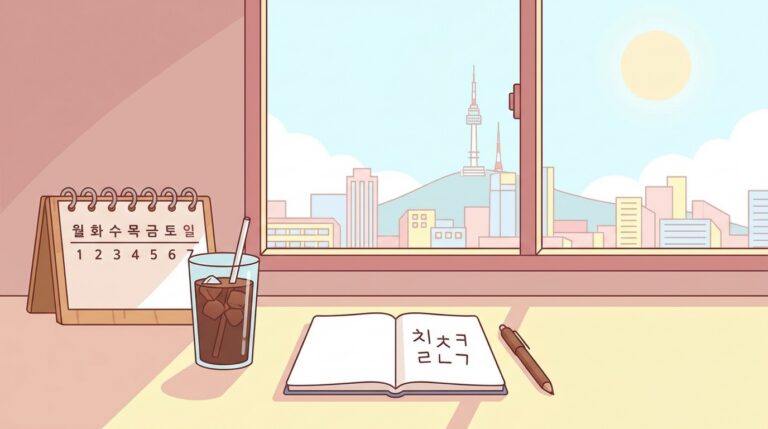
Master Your Weekly Schedule in Korean: How to Say You Have a Meeting on Monday
Phase 1: Empathy & Story Hook
안녕하세요! 매일한글 (Daily Hangul) 에디터입니다.
Picture this: You are watching a scene from a relatable workplace K-Drama like Misaeng or Business Proposal. The team is huddled around a whiteboard, iced Americanos in hand, groaning over the dread of the upcoming week. Suddenly, your Korean coworker or language partner turns to you and asks: “우리 월요일에 만날까요?” (Shall we meet on Monday?) You immediately freeze. You know what you want to say—“I’m so sorry, I already have a meeting on Monday!”—but the days of the week swirl around your head like alphabet soup. Did Monday start with a ‘W’ sound or an ‘H’ sound? Where does the particle go?
If you have ever felt your brain short-circuit when juggling Korean calendars, you are definitely not alone. When I first began mentoring Korean language learners a decade ago, mixing up days like 월요일 (Monday) and 목요일 (Thursday) was easily the #1 scheduling slip-up. But here is the secret: once you crack the rhythmic code of the Korean calendar and pair it with one versatile sentence formula, coordinating coffee dates, study sessions, and work syncs becomes effortless second nature. In this guide, tailored specifically for A1 absolute beginners, we will break down real-world weekly planning so you never have to panic over a double-booked Monday again!
Phase 2: Top 3 Core Expressions
1. 월요일에는 회의가 있어요
- Pronunciation: [Woryoir-eneun hoe-uiga isseoyo] (Sounds like: Wah-ryo-il-eh-noon hweh-ee-ga ee-ssuh-yo)
- Meaning: Literal: “On Monday, a meeting exists.” / Real: “I have a meeting on Monday.”
- K-Culture Moment: The classic Monday morning stand-up sync in Korean office dramas where employees organize their weekly deadlines before their first team lunch.
- Editor’s Insight: Look at the particle -에는 (-eneun). It attaches to 월요일 (Monday) to highlight it: “As for Monday, I have a meeting (other days might be free!)”.
- Situation Spectrum: Casual: ⚠️ (월요일에 회의 있어) | Semi-formal: ✅ | Formal: ✅
- 🤔 Think About It: In English, you say “I have a meeting”, putting the focus firmly on “I”. In Korean, “I” disappears completely—the focus is simply on the fact that a meeting exists on Monday! Why do you think Korean often leaves out “I”?
2. 무슨 요일에 시간 돼요?
- Pronunciation: [Museun yoire sigan dwaeyo?] (Sounds like: Moo-seun yo-il-eh shi-gahn dweh-yo?)
- Meaning: Literal: “On what day of the week does time become possible?” / Real: “What day works for you? / What day are you free?”
- K-Culture Moment: Two university friends standing outside a Hongdae photo booth trying to pick a day to grab Korean barbecue together.
- Editor’s Insight: 무슨 (museun) means “what kind of / which”, and 시간 돼요? (sigan dwaeyo?) is the golden Korean expression to ask if someone has free time without sounding interrogative.
- Situation Spectrum: Casual: ⚠️ (무슨 요일에 시간 돼?) | Semi-formal: ✅ | Formal: ⚠️ (어느 요일이 편하십니까?)
- 🤔 Think About It: Instead of asking “Do you have time?”, Korean asks if time becomes possible. Notice how gentle and non-demanding that sounds!
3. 주말에 뭐 해요?
- Pronunciation: [Jumare mwo haeyo?] (Sounds like: Joo-mahl-eh mwo hae-yo?)
- Meaning: Literal: “At weekend, what do?” / Real: “What are you doing this weekend?”
- K-Culture Moment: Friendly small talk exchanged by the office water cooler on a Friday afternoon right before heading out for fried chicken and beer.
- Editor’s Insight: 주말 (jumal) combines 주 (ju, week) and 말 (mal, end). Pairing it with 뭐 해요? (mwo haeyo?, “what are you doing?”) creates the quintessential conversation starter across Korea.
- Situation Spectrum: Casual: ⚠️ (주말에 뭐 해?) | Semi-formal: ✅ | Formal: ⚠️ (주말에 어떤 계획이 있으십니까?)
- 🤔 Think About It: In Korea, asking about someone’s weekend plans is a warm sign of building jeong (relational warmth), not nosiness!
Phase 3: Textbook Korean vs. Real Korean
Situation 1: Declining a plan because you are already busy
- 📖 교과서 한국어: 수요일에는 개인 일정이 존재합니다. (Suyoireneun gaein iljeongi jonjaehamnida. / A personal schedule exists on Wednesday.)
- 🗣️ 진짜 한국어: 수요일에 선약이 있어요! (Suyoire seonyagi isseoyo! / I already have plans on Wednesday!)
- 💡 왜 다를까?: Textbook Korean uses overly formal words like 존재합니다 (to exist). Real native speakers casually use 선약 (seonyak, prior engagement) or simply 약속 (yaksok, plan/promise) when apologizing for a conflicting date.
Situation 2: Asking if a coworker wants to grab dinner on Friday
- 📖 교과서 한국어: 금요일 저녁 시간에 약속 일정이 비어 있습니까? (Geumyoir jeonyeok sigane yaksok iljeongi bieo isseumnikka? / Is your appointment schedule empty on Friday evening?)
- 🗣️ 진짜 한국어: 이번 주 불금에 시간 돼요? (Ibeon ju bulgeume sigan dwaeyo? / Are you free this ‘Fire Friday’?)
- 💡 왜 다를까?: Nobody asks if your calendar is “empty.” Instead, Koreans love using the vibrant slang 불금 (Bulgeum, Fire Friday / TGIF) to capture the celebratory vibe of the weekend kickoff.
Phase 4: K-Culture Deep Dive & Non-Verbal Manners
4-1. Nunchi & Polite Gestures
When saying 월요일에는 회의가 있어요 to turn down or reschedule an invitation, body language is everything. In Korean social dynamics (눈치, Nunchi), a flat, direct “No” (아니요) can feel cold and jarring.
* The Tilt & Glance: Tilt your head slightly to a 45-degree angle, squint gently, and glance down toward your phone calendar or notebook as if double-checking. This non-verbally signals: “I truly wish I could, but my calendar is holding me back!”
* Two-Handed Softener: If someone suggests a date and you must decline, hold your hands loosely together in front of your stomach or touch your chest lightly with an apologetic smile.
4-2. The 7 Elements: The Secret Behind Korean Days
Did you know the Korean days of the week correspond to the seven ancient celestial elements?
* 월 (Wol) = Moon (Monday)
* 화 (Hwa) = Fire (Tuesday)
* 수 (Su) = Water (Wednesday)
* 목 (Mok) = Wood/Tree (Thursday)
* 금 (Geum) = Gold/Metal (Friday)
* 토 (To) = Earth/Soil (Saturday)
* 일 (Il) = Sun (Sunday)
Korean workers jokingly say Tuesday (화요일) is called “Fire Day” because work piles up like a raging fire, while Friday (금요일) shines like precious gold!
Phase 5: Real-Life Roleplay Scenario
Setting: A cozy boutique cafe in Seongsu-dong. You and your Korean project teammate, Minji (민지), are sitting across from each other with iced lattes, figuring out this week’s project sync.
- 민지 (Minji): 우리 이번 주에 같이 점심 먹을까요? (Uri ibeon jue gachi jeomsim meogeulkkayo? / Shall we have lunch together this week?) [🎭 눈을 반짝이며 다정하게 묻는다 / Eyes sparkling, asking warmly]
- You: 좋아요! 언제 시간 돼요? (Joayo! Eonje sigan dwaeyo? / Sounds great! When are you free?) [🎭 활짝 웃으며 다이어리를 펼친다 / Smiling broadly while opening your planner]
- 민지 (Minji): 월요일 어때요? 월요일 12시! (Woryoil eottaeyo? Woryoil yeol-dusi! / How about Monday? Monday at 12:00!) [🎭 달력의 월요일 칸을 톡톡 두드린다 / Tapping the Monday box on the calendar]
- You: 아, 월요일에는 회의가 있어요. (A, woryoir-eneun hoe-uiga isseoyo. / Ah, I have a meeting on Monday.) [🎭 아쉬운 표정으로 머리를 살짝 긁적인다 / Scratching your head lightly with a regretful look]
- 민지 (Minji): 그래요? 그럼 화요일은 어때요? (Geuraeyo? Geureom hwayoireun eottaeyo? / Really? Then how about Tuesday?) [🎭 고개를 끄덕이며 다음 칸을 가리킨다 / Nodding and pointing to the next day]
- You: 화요일은 괜찮아요! 시간 있어요. (Hwayoireun gwaenchanayo! Sigan isseoyo. / Tuesday is good! I have time.) [🎭 안도하며 고개를 끄덕인다 / Nodding with relief]
- 민지 (Minji): 좋아요, 화요일에 맛있는 비빔밥 먹으러 가요! (Joayo, hwayoire masinneun bibimbap meogeureo gayo! / Awesome, let’s go eat delicious bibimbap on Tuesday!) [🎭 두 손을 모아 손뼉을 짝 친다 / Clapping both hands together enthusiastically]
- You: 네, 화요일에 만나요! (Ne, hwayoire mannayo! / Yes, see you on Tuesday!) [🎭 가볍게 목례하며 미소 짓는다 / Bowing lightly from the neck with a smile]
🔀 Interactive Decision Branch
Suddenly, Minji adds: “혹시 수요일 저녁에는 뭐 해요?” (By any chance, what are you doing on Wednesday evening?)
How do you respond?
* Choice A: “수요일에는 한국어 수업이 있어요.” (Suyoireneun hangugeo sueobi isseoyo. / I have Korean class on Wednesday.)
* 👉 Feedback [Best]: Perfect! Clear, polite, and uses the contrasting topic marker -에는 naturally.
* Choice B: “안 돼요. 싫어요.” (An dwaeyo. Sireoyo. / Cannot. I hate/dislike it.)
* 👉 Feedback [Bad]: Ouch! This sounds like you personally dislike Minji or the idea of meeting her. Way too blunt!
* Choice C: “수요일 몰라요.” (Suyeoil mollayo. / Wednesday, don’t know.)
* 👉 Feedback [Risk]: Grammatically incomplete and sounds unenthusiastic or aloof. Better to say: “아직 계획 없어요” (I don’t have plans yet).
Phase 6: 10-Second Emotion Shadowing Drill
Say these aloud, paying attention to the / pauses and matching the target emotion!
[🥺 아쉽고 미안한 톤으로 / Regretful and apologetic tone]
아, / 월요일에는 / 회의가 있어요.
(A, / woryoir-eneun / hoe-uiga isseoyo.)-
[🤔 호기심 가득하고 친근하게 / Curious and friendly tone]
무슨 요일에 / 시간 돼요?
(Museun yoire / sigan dwaeyo?) -
[😊 신나고 밝은 목소리로 / Bright and energetic tone]
화요일은 / 괜찮아요! / 화요일에 만나요!
(Hwayoireun / gwaenchanayo! / Hwayoire mannayo!)
Phase 7: K-Culture Mini Dictionary
-
월요병 (Wolyobyeong)
Literal: Monday Sickness | Real Meaning: Monday Blues.
Usage: Heavily used every Sunday night and Monday morning by students and office workers complaining about starting a new week. -
불금 (Bulgeum)
Literal: Fire Friday | Real Meaning: TGIF / Friday night fever.
Usage: The standard excuse to unwind, head to a pocha (street pub), and stay out late with friends. -
선약 (Seonyak)
Literal: First/prior promise | Real Meaning: Previous engagement.
Usage: The ultimate polite shield when you cannot accept an invite: “선약이 있어요” (I have a previous plan). -
휴무 (Hyumu)
Literal: Resting from work | Real Meaning: Closed / Day off.
Usage: Look for this word on cafe and restaurant doors. Many Seoul independent shops post: “매주 월요일 휴무” (Closed every Monday).
Phase 8: Survival Kit for Travelers
Top 3 Schedule Survival Phrases
- 오늘 쉬는 날이에요? (Oneul swineun narieyo?)
Pronunciation: Oh-neul shi-neun nah-ri-eh-yo?
Pro Tip: Use this when arriving at a boutique store or cafe that looks quiet to ask: “Are you closed today?” - 주말에도 문 열어요? (Jumaredo mun yeoreoyo?)
Pronunciation: Joo-mahl-eh-doh moon yeo-reo-yo?
Pro Tip: Crucial for weekend travel planning: “Are you open on weekends too?” - 몇 시에 시작해요? (Myeot sie sijakhaeyo?)
Pronunciation: Myeot shi-eh shi-jahk-hae-yo?
Pro Tip: Essential for guided tours, pop-up stores, or bus schedules: “What time does it start?”
Editor’s Travel Note
Before heading to trendy neighborhoods like Ikseon-dong or Yeonnam-dong on Mondays, always verify store hours! Many indie museums, art galleries, and hip cafes take their rest day on Monday. Save time and heartbreak by checking weekly opening hours directly through the official 네이버 지도 앱 다운로드 search guide.
Phase 9: A Step Deeper (한 발 더 깊이)
In Western languages, scheduling is often seen as a transaction of independent personal agendas. But in Korean society, sharing your weekly rhythm is deeply tied to group harmony and consideration. When you say “월요일에는 회의가 있어요”, providing a clear reason for your unavailability isn’t viewed as an excuse—it is considered a polite gesture showing that you respect the other person’s proposal and genuinely care to explain why you cannot be present. Language in Korea is not just information delivery; it is relational glue.
💬 Your Turn: Which day of the week is your busiest, and what is your favorite day to recharge? Leave a comment below trying out the Korean day name (e.g., “토요일 좋아해요!”)!
Phase 10: FAQ & Common Mistakes
Q: Why do we say ‘월요일에는’ instead of just ‘월요일에’?
A: While -에 simply means “on/at” (e.g., 월요일에 = on Monday), adding -는 turns it into a topic/contrast marker. It subtly conveys: “As for Monday, I’m busy (implying other days might be totally fine!)”
Q: Is there an easy memory hack for remembering the 7 days?
A: Memorize the rhythm like a song: “월-화-수-목-금-토-일” (Wol-Hwa-Su-Mok-Geum-To-Il). Think of the middle of the week as elements fighting: 화 (Fire / Tue) meets 수 (Water / Wed), cooled down by 목 (Trees / Thu)!
Q: What is the difference between ‘일정’ (iljeong) and ‘약속’ (yaksok)?
A: 일정 refers to official schedules, agendas, or business itineraries. 약속 refers to social promises, plans with friends, or personal appointments.
🚨 Common Mistakes Warning Board
- Dropping the time marker ‘에’: Saying “월요일 회의 있어요” (X) instead of “월요일에 회의가 있어요” (O). Always attach -에 to days of the week when pinpointing time!
- Translating ‘I have’ literally as ‘가지다’ (gajida): Saying “나는 회의를 가져요” (X). Koreans do not “physically possess” meetings; meetings simply exist using 있어요 (isseoyo)!
- Mixing up Thursday (목요일) and Saturday (토요일): Remember 목 (Mok) sounds like “oak” tree in the middle of the week, while 토 (To) is earthy Saturday rest.
Phase 11: Action Mission
- 🥉 Bronze Mission (Solo): Stand in front of your mirror and chant the 7 days of the week (월, 화, 수, 목, 금, 토, 일) in under 5 seconds without pausing.
- 🥈 Silver Mission (Community): Open your phone’s calendar or memo app and write out your 3 main activities this week entirely in Korean (e.g., 월요일: 회의 / 수요일: 한국어 / 금요일: 파티!).
- 🥇 Gold Mission (Real World): Next time your tutor, friend, or coworker asks when you are available, reply using the formula: “[Day of the week]에는 [Event]가 있어요.”
- 🎮 K-Culture Mission: In the next K-Drama episode you watch, listen closely for whenever a character mentions 월요일 (Monday) or 불금 (TGIF). Give yourself a high-five when you spot it!
Phase 12: Interactive Quiz Challenge
1. [Situation Judgment] Your friend asks you out for tteokbokki on Thursday, but you have a gym workout. What is the most natural A1 sentence?
* (A) 목요일은 싫어요.
* (B) 목요일에는 운동이 있어요.
* (C) 목요일 존재합니다.
2. [Fill in the Blank] Fill in the missing time particle:
* “화요일______ 회의가 있어요.” (I have a meeting on Tuesday.)
3. [True or False] The Korean slang word 불금 (Bulgeum) literally translates to “Water Wednesday” and means taking a relaxing mid-week bath.
* (A) True
* (B) False
👉 Click here to reveal the answers and explanations!
- 1. Answer: (B) 목요일에는 운동이 있어요.
Explanation: (A) is rude (“I dislike Thursday”), and (C) is ungrammatical. (B) politely explains your schedule! - 2. Answer: -에 (or -에는)
Explanation: Both 화요일에 (on Tuesday) and 화요일에는 (as for Tuesday) are completely natural. - 3. Answer: (B) False.
Explanation: 불금 (Bulgeum) stands for “Fire Friday” (불타는 금요일), celebrating the fiery fun of Friday night!






