

Phase 1: Empathy & Story Opening
안녕하세요! 매일한글 에디터입니다. (Hello! I’m your Daily Hangul editor.)
Picture this: You are sitting at a bustling Korean barbecue restaurant in Hongdae with your Korean friends. Sizzling pork belly fills the table, wrapped in crisp lettuce. Everything is going great until the classic finale arrives. Someone smiles and says, “여기 볶음밥 두 개 비벼주세요!” (Please stir-fry two portions of rice here!). Suddenly, the entire table looks at you expectantly. But you’ve been working hard on your fitness routine, trying your best to avoid heavy late-night carbohydrates and prioritize protein like chicken breast or tofu.
In Korea, rice isn’t just food—it is practically synonymous with warmth, greeting, and vitality (we literally ask “밥 먹었어요?” as a casual hello!). Politely saying you want to skip carbs without sounding like a party pooper or offending the cook can feel like walking on eggshells. Many of our A2 learners tell us, “I know how to say I’m on a diet, but I sound like a robotic medical pamphlet when I order salad or refuse rice!”
Don’t worry! Today, based on real feedback from dozens of our learners living and traveling in Seoul, we’re going to give you natural, practical phrases to talk about your healthy habits. By the end of this guide, you’ll comfortably navigate Korean convenience stores, dining tables, and gyms while confidently sharing how you manage your carbs and protein intake!
Phase 2: Core Expressions Deep Dive
1. 탄수화물은 줄이고 있어요 (Tansuhwamul-eun jurigo isseoyo)
- Pronunciation: [Tan-soo-hwa-mool-eun joo-ri-go ee-sseo-yo] (Sounds like tahn-soo-hwa-mool, rhyming with ‘cool’ for mool)
- Meaning: Literal: “As for carbohydrates, I am reducing them.” / Real Nuance: “I’m currently cutting back on carbs.”
- K-Culture Moment: You see this phrase on fitness vlogs where K-pop idols prepare for comebacks, showing their lunchboxes with sweet potatoes instead of white rice.
- Editor’s Insight: The topic marker -은 (-eun) highlights contrast. It subtly implies: “I might still eat delicious proteins or veggies, but as for carbs, I’m cutting back!”
- Situation Spectrum:
- Casual (to close friends): 탄수화물 줄이는 중이야 (Tansuhwamul jurineun jung-iya) ✅
- Semi-formal (Polite standard): 탄수화물은 줄이고 있어요 (Tansuhwamul-eun jurigo isseoyo) ✅
- Formal (Job interview / Gym consultation): 탄수화물 섭취를 줄이고 있습니다 (Tansuhwamul seopchwireul jurigo itseumnida) ✅
- 🤔 Think About It: In English, we simply say “I’m low-carb.” Why do you think Korean often specifies the ongoing action verb “줄이다” (to reduce/cut down)? It highlights effort rather than a static state!
2. 단백질을 챙겨 먹어요 (Danbaekjil-eul chaenggyeo meogeoyo)
- Pronunciation: [Dan-baek-jil-eul chaeng-gyeo meo-geo-yo] (Think of chaeng like ‘change’ without the ‘ge’ sound)
- Meaning: Literal: “I pack/take care to eat protein.” / Real Nuance: “I make sure to get enough protein in my diet.”
- K-Culture Moment: Heard constantly among Korean gym-goers (“헬스인”, Health-in) after intense workouts, holding shaker bottles outside the gym.
- Editor’s Insight: The magic verb here is 챙기다 (chaenggida). It means to look after, pack, or never miss out on something valuable. Combining it with 먹다 (to eat) shows mindful, deliberate nutrition.
- Situation Spectrum:
- Casual: 단백질 챙겨 먹어야지! (Danbaekjil chaenggyeo meogeoyaji!) ✅
- Semi-formal: 단백질을 챙겨 먹어요 (Danbaekjil-eul chaenggyeo meogeoyo) ✅
- Formal: 단백질 위주로 챙겨 먹습니다 (Danbaekjil wijuro chaenggyeo meokseumnida) ✅
- 🤔 Think About It: Notice how Korean attaches “챙기다” to health foods and vitamins (비타민 챙겨 먹어!). What does this reveal about Korean culture’s proactive approach to daily self-care?
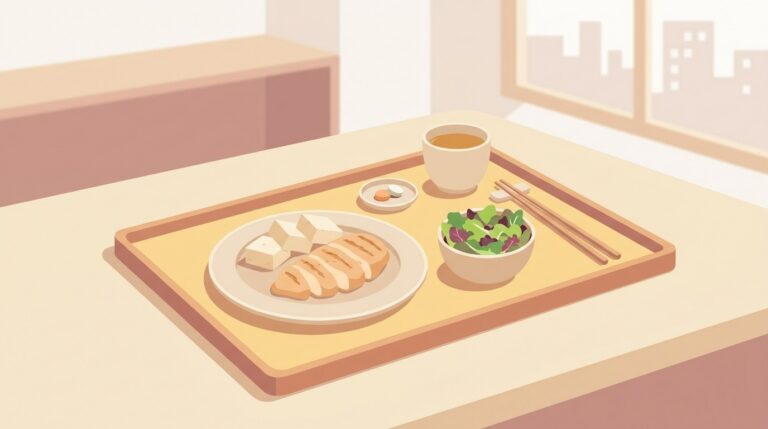
3. 닭가슴살이나 두부 같은 거 먹어요 (Dalgaseumsal-ina dubu gateun geo meogeoyo)
- Pronunciation: [Dak-gah-seum-sal-ee-nah doo-boo gah-teun geo meo-geo-yo]
- Meaning: Literal: “I eat things like chicken breast or tofu.” / Real Nuance: “I stick to lean proteins like chicken breast or tofu.”
- K-Culture Moment: Seen on variety shows when celebrities open their refrigerators to reveal shelves stocked with vacuum-packed marinated chicken breasts.
- Editor’s Insight: ~(이)나 means “or”, and ~같은 거 means “things like~”. Using “같은 거” softens the tone, making you sound conversational and modest rather than overly strict or demanding.
- Situation Spectrum:
- Casual: 닭가슴살이나 두부 같은 거 먹어 (Dalgaseumsal-ina dubu gateun geo meogeo) ✅
- Semi-formal: 닭가슴살이나 두부 같은 거 먹어요 (Dalgaseumsal-ina dubu gateun geo meogeoyo) ✅
- Formal: 닭가슴살이나 두부 위주로 식사합니다 (Dalgaseumsal-ina dubu wijuro siksamnida) ⚠️ (Omit ‘같은 거’ in formal contexts)
- 🤔 Think About It: Tofu (두부) has historically been an affordable staple in Korean cuisine. How has modern wellness transformed traditional humble ingredients into trending fitness superfoods?
Phase 3: Textbook Korean vs. Real Korean
Situation 1: Explaining your meal preferences at lunch with coworkers
- 📖 교과서 한국어 (Textbook Korean): 저는 탄수화물 섭취를 제한하고 있습니다. (Jeoneun tansuhwamul seopchwireul jehanhago itseumnida. / “I am restricting my carbohydrate ingestion.”)
- 🗣️ 진짜 한국어 (Real Korean): 요즘 밥이랑 면 좀 줄이고 있어요! (Yojeum bap-irang myeon jom jurigo isseoyo! / “I’m cutting back on rice and noodles these days!”)
- 💡 왜 다를까? (Why is it different?): Koreans rarely use clinical terms like “탄수화물 섭취 제한” (carbohydrate ingestion restriction) in everyday conversation. Instead, they substitute technical words with tangible everyday foods like 밥 (rice) and 면 (noodles).
Situation 2: Explaining what you buy at the convenience store
- 📖 교과서 한국어 (Textbook Korean): 저는 단백질 식품을 규칙적으로 소비합니다. (Jeoneun danbaekjil sikpumeul gyuchikjeogeuro sobihamnida. / “I consume protein foods on a regular basis.”)
- 🗣️ 진짜 한국어 (Real Korean): 닭가슴살이랑 달걀 위주로 챙겨 먹어요. (Dalgaseumsal-irang dalgyal wijuro chaenggyeo meogeoyo. / “I make sure to eat mainly chicken breast and eggs.”)
- 💡 왜 다를까? (Why is it different?): Native speakers use ~위주로 (~wijuro, focusing mainly on) and 챙겨 먹다 (chaenggyeo meokda) to create a proactive, natural rhythm instead of dry corporate verbs like “소비하다” (to consume).
Phase 4: K-Culture Deep Dive & Non-Verbal Manners
4-1. 눈치 (Nunchi) & Table Manners: Declining Carbs Politely
In Korea, food is deeply tied to hospitality and community. When dining out as a group, someone might push an extra bowl of rice your way or order post-meal noodles (hu-sik naengmyeon). If you abruptly say “안 먹어요” (I don’t eat it), it can sound harsh and kill the lively group mood.
- The Soft Hands Wave: Gently hold both hands up at chest level, palms facing outward, giving a slight, apologetic head tilt while smiling.
- The Tone: Use a soft, self-deprecating vocal tone: “제가 요즘 건강 관리 중이라서요~” (Je-ga yojeum geongang gwan-ri jung-i-ra-seo-yo~ / “It’s just that I’m managing my health these days~”). This shifts the focus from rejecting their gesture to your personal personal wellness journey.
4-2. Cultural Code: The Rise of “Sikdan Gwanli” (식단 관리) & O-Un-Wan
Korean society has embraced the wellness revolution. Walk into any GS25 or CU convenience store, and you won’t just find chips and ramyeon; you’ll discover an entire dedicated refrigerator section filled with sous-vide chicken breast (수비드 닭가슴살), smoked eggs (훈제란), and protein drinks (단백질 쉐이크).
Sharing your “식단” (diet meal plan) alongside the trending hashtag #오운완 (Oneul Undong Wanseong — Today’s Workout Complete) is a major social bonding ritual among young Koreans in their twenties and thirties. Managing your diet is no longer seen as extreme; it is celebrated as self-respect and discipline!
Phase 5: Real-Life Roleplay Scenario
Setting: You are at a neighborhood bistro near Gangnam with your Korean fitness buddy, Minho. The waiter just dropped off the menu.
- Minho: 여기 파스타랑 피자 진짜 맛있어! 뭐 먹을래? (Yeogi paseuta-rang pija jinjja masisseo! Mwo meogeullae?)
🎭 Tapping the menu with an excited grin.
(“The pasta and pizza here are amazing! What do you want to eat?”) -
Learner: 음… 저는 요즘 탄수화물은 좀 줄이고 있어요. (Eum… jeoneun yojeum tansuhwamul-eun jom jurigo isseoyo.)
🎭 Looking at the menu thoughtfully, touching stomach slightly.
(“Um… I’m cutting down on carbs a bit these days.”) -
Minho: 아, 진짜? 식단 관리 중이야? 대단한데! (A, jinjja? Sikdan gwanli jung-iya? Daedanhande!)
🎭 Eyes widening in respectful surprise.
(“Oh, really? Are you doing meal management? Impressive!”) -
Learner: 네, 그래서 단백질을 챙겨 먹으려고요. (Ne, geuraeseo danbaekjil-eul chaenggyeo meogeuryeogoyo.)
🎭 Smiling confidently with good eye contact.
(“Yes, so I’m trying to make sure I eat protein.”) -
Minho: 그럼 여기 닭가슴살 샐러드나 두부 스테이크 어때? (Geureom yeogi dalgaseumsal saelleodeu-na dubu seuteikeu eottae?)
🎭 Pointing his finger at the healthy side options.
(“Then how about the chicken breast salad or the tofu steak here?”) -
Learner: 오, 좋아요! 닭가슴살이나 두부 같은 거 먹으면 딱 맞겠네요. (O, jo-ayo! Dalgaseumsal-ina dubu gateun geo meogeumyeon ttak matgenneyo.)
🎭 Nodding gratefully.
(“Oh, great! Eating things like chicken breast or tofu would be perfect.”) -
Minho: 오케이! 그럼 샐러드 하나 시키고, 나도 탄수화물 좀 줄여볼까? (Okei! Geureom saelleodeu hana sikigo, nado tansuhwamul jom juryeobolkka?)
🎭 Laughing lightly as he calls the waiter over.
(“Okay! Let’s order one salad, and maybe I should cut down on carbs a bit too?”) -
Learner: 같이 건강하게 먹어요! (Gachi geonganghage meogeoyo!)
🎭 Giving a light thumbs up.
(“Let’s eat healthily together!”)
🔀 Interactive Branching Choice
Minho suddenly asks: “그런데 샐러드만 먹으면 배고프지 않아?” (Geureonde saelleodeuman meogeumyeon baegopeuji ana? / “By the way, won’t you be hungry just eating salad?”) How do you respond?
- Choice A: “네, 배고파 죽겠어요. 그냥 라면 시켜주세요.” (Ne, baegopa jukgesseoyo. Geunyang ramyeon sikyeojuseyo.)
- Feedback (Risk): While funny and very honest, you give up on your diet instantly! Your friend might get confused about whether you’re actually managing your health.
- Choice B: “괜찮아요! 단백질이랑 달걀도 챙겨 먹어서 든든해요.” (Gwaenchanayo! Danbaekjil-irang dalgyaldo chaenggyeo meogeoseo deundeunhaeyo.)
- Feedback (Best ⭐): Perfect! “든든해요” (deundeunhaeyo) means feeling hearty and satisfied. It reassures your friend politely and displays advanced A2 vocabulary naturally.
- Choice C: “저는 음식을 안 먹을 겁니다.” (Jeoneun eumsik-eul an meogeul geomnida.)
- Feedback (Bad ❌): Way too rigid and alarming! It sounds like you are declaring a hunger strike.
Phase 6: 10-Second Emotional Shadowing Drill
Read each sentence out loud. Match the emotional tone tag, and pause briefly at each slash mark (/)!
[💪 결의에 찬 목소리로 / With firm determination]
요즘 / 탄수화물은 줄이고 / 단백질을 챙겨 먹어요!
(Yojeum / tansuhwamul-eun jurigo / danbaekjil-eul chaenggyeo meogeoyo!)
“Lately / I cut down on carbs / and make sure to eat protein!”-
[😊 다정하고 부드럽게 / Warm and gently explaining]
밥 대신 / 닭가슴살이나 두부 같은 거 / 먹고 있어요.
(Bap daesin / dalgaseumsal-ina dubu gateun geo / meokgo isseoyo.)
“Instead of rice / things like chicken breast or tofu / I’m eating.” -
[🥺 애교 섞인 부탁으로 / Playfully asking a favor]
이모님, / 밥은 조금만 주시고 / 두부 많이 주세요!
(Imo-nim, / babeun jogeumman jusigo / dubu mani juseyo!)
“Auntie, / please give me just a little rice / and lots of tofu!”
Phase 7: K-Culture Mini Dictionary
- 닭가슴살 (Dalgaseumsal) | Chicken breast
Usage: The quintessential health food in Korea. Often shortened casually to “닭가” (dak-ga) among gym enthusiasts when shopping at Korean online health markets. - 챙겨 먹다 (Chaenggyeo meokda) | To make sure to eat regularly / To take diligently
Usage: Used for essential nutrients, meals, and supplements. e.g., “비타민 꼭 챙겨 먹어!” (Make sure to take your vitamins!). - 탄단지 (Tandanji) | Carbs, Protein, Fat (Macronutrients)
Usage: An acronym formed from 탄수화물 (Carbs), 단백질 (Protein), and 지방 (Fat). Extremely common in fitness apps and diet vlogs. - 식단 (Sikdan) | Meal plan / Diet regimen
Usage: Rather than saying “다이어트” (diet), Koreans often say “식단 하다” (to do meal management) when watching calories and macros.
Phase 8: Traveler’s Survival Kit
Top 3 Survival Lines for Restaurants & Cafes
- “밥은 반 공기만 주세요.” (Babeun ban gong-giman juseyo.)
Meaning: “Please give me just half a bowl of rice.”
Pro Tip: Prevents food waste and avoids carbohydrate overload at traditional restaurants! - “소스는 따로 담아주실 수 있나요?” (Soseuneun ttaro dam-ajusil su innayo?)
Meaning: “Could you put the dressing/sauce on the side?”
Pro Tip: Essential when ordering Korean salads, which can sometimes come heavily drenched in sweet mayo dressings. - “단백질 음료 어디에 있어요?” (Danbaekjil eumryo eodie isseoyo?)
Meaning: “Where are the protein drinks?”
Pro Tip: Show this phrase to any convenience store clerk for instant direction to RTD protein shakes.
Editor’s Travel Note
When looking for clean, healthy meal options in Seoul, use the Naver Map app to search for Salad and Poke. Simply type “샐러디” (Salady – Korea’s most popular fast-healthy chain) or “포케” (Poke) to find quick protein bowls with brown rice and tofu near any subway station. At convenience stores, look for the microwave next to the counter: microwave your packaged chicken breast for 40–50 seconds for the juiciest texture!
Phase 9: “One Step Deeper” (Reflective Humanities Essay)
In traditional Korean culture, offering food is the purest expression of 정 (Jeong, affection and warmth). Historically, enduring harsh winters and periods of scarcity meant that carbohydrates—white polished rice in particular—symbolized prosperity, survival, and love. That is why maternal affection is so frequently expressed by continuously heaping warm rice into a guest’s bowl.
Today, Korea’s rapid lifestyle shift toward fitness and holistic self-care has reshaped this landscape. Saying no to extra carbohydrates is no longer seen as rejecting someone’s love, but as an expression of personal wellness. Yet, the underlying spirit of care remains: we still tell our friends, “단백질 꼭 챙겨 먹어!” (Make sure you eat your protein!). The vocabulary evolves, but the warmth of Korean dining culture endures.
💬 Your Turn: How do people in your home country view cutting carbs or packing protein? Is it easy to find healthy options when eating out? Share your thoughts in the comments below!
Phase 10: FAQ & Avoiding Misunderstandings
Q: Can I just say “다이어트 중이에요” (I’m on a diet)?
A: Yes, absolutely! However, “다이어트” in Korea often implies weight loss specifically. If you are eating healthy to gain muscle or maintain energy, saying “건강 관리하고 있어요” (I’m managing my health) or “단백질 챙겨 먹고 있어요” (I’m making sure to get protein) conveys a much more positive and accurate lifestyle nuance.
Q: What is the difference between “고기” (meat) and “단백질” (protein)?
A: “고기” (gogi) specifically refers to meat products like beef, pork, and chicken. “단백질” (danbaekjil) is the nutritional category, which includes tofu, beans, eggs, and protein shakes. Use 단백질 when you want to highlight nutritional balance!
Q: How do I ask if an item contains sugar or syrup at a cafe?
A: You can ask: “시럽 빼주실 수 있나요?” (Sireop bbae-jusil su innayo? / “Could you leave out the syrup?”). Most Korean cafes will gladly accommodate zero-sugar requests.
🚨 Common Mistakes Alert
- Mistake: Saying “저는 탄수화물을 싫어해요” (I hate carbs).
- Correct Action: Use “탄수화물은 줄이고 있어요” (I’m cutting down on carbs). Saying you ‘hate’ a food group sounds childish; saying you ‘reduce’ it shows healthy maturity.
- Mistake: Saying “단백질을 사 먹어요” when you mean you eat it for your health.
- Correct Action: Use “단백질을 챙겨 먹어요”. “챙겨 먹다” implies healthy mindfulness, whereas “사 먹다” simply means buying ready-made food.
- Mistake: Demanding custom substitutions aggressively at busy traditional eateries.
- Correct Action: Always add a polite ending like “~줄 수 있으세요?” or stick to simple requests like reducing rice portion size (“밥 적게 주세요”).
Phase 11: Action Mission & Engagement
Put your learning to work with our 3-step challenge:
- 🥉 Bronze Level (Solo Practice): Stand in front of your mirror and practice the 10-Second Shadowing Drill from Phase 6 three times with full gestures.
- 🥈 Silver Level (Social Share): Take a photo of your healthy meal today (whether it’s chicken, tofu, or a salad), post it on your Instagram Story or study journal, and caption it in Korean: “오늘도 단백질 챙겨 먹기! 💪” (Getting my protein today too!).
- 🥇 Gold Level (Real-World Test): At your next visit to a Korean restaurant or mart, ask for half a portion of rice (밥 반 공기만 주세요) or locate a high-protein item using the phrase “닭가슴살이나 두부 있어요?”.
🎮 K-Culture Mission: Watch an episode of I Live Alone (나 혼자 산다) or an idol vlog. Listen carefully for when they eat meals after working out. Can you spot the word “단백질” or “식단”? Write it down whenever you hear it!
Phase 12: Interactive Quiz Challenge
Test your knowledge with these three quick checks!
- Situational Decision: You are at a restaurant, and the staff brings a huge bowl of white rice. You want to politely say you are limiting carbs and eating protein like tofu instead. Which sentence is best?
- A) 밥 먹기 싫어요. 두부만 가져오세요.
- B) 탄수화물은 줄이고 있어서요, 두부 같은 단백질 위주로 먹고 있어요.
- C) 저는 탄수화물 중독 환자입니다.
- Fill-in-the-Blank: Complete the natural phrase for making sure you take your vitamins or eat your protein:
- 건강을 위해서 단백질을 ________ 먹어요. (I make sure to eat protein for my health.)
- True or False: In modern Korea, using the word “식단 관리” (sikdan gwanli) means you are being punished with hospital food. (True / False)
👉 Click to view answers and explanations!
- Answer: B
Explanation: Option B is polite, natural, and accurately communicates your healthy lifestyle choice. Option A is rude, and Option C is an awkward medical exaggeration! - Answer: 챙겨 (chaenggyeo)
Explanation: The verb combination 챙겨 먹다 is the gold-standard phrase for consistently taking vitamins or prioritizing healthy nutrients. - Answer: False
Explanation: “식단 관리” is a very trendy, positive phrase representing conscious healthy meal planning, fitness discipline, and proactive self-care!







