

Phase 1: Empathy & Story Opening
안녕하세요! This is your Daily Hangul editor, your personal cultural navigator. Have you ever tuned into a gripping Korean political drama like Chief of Staff (보좌관) or caught an intense broadcast of MBC’s 100-Minute Debate (100분 토론), only to feel totally lost the second lawmakers started firing economic jargon at each other? Or perhaps you were having dinner with Korean colleagues in Yeouido, the political and financial heartbeat of Seoul, when the conversation shifted to whether the government should issue an emergency supplementary budget or tighten its fiscal belt. You understood individual words like ‘돈’ (money) or ‘나라’ (country), yet the sophisticated, high-stakes nuance completely flew over your head.
Mastering advanced socioeconomic discourse is the definitive threshold that elevates you from an intermediate learner into an articulate C1 speaker. When you can effortlessly discuss how fiscal flexibility balances against long-term sustainability, Korean professionals, researchers, and friends will instantly see you as an intellectual equal. Drawing from years of coaching foreign analysts and diplomats preparing for high-level negotiations in Seoul, this guide breaks down the exact rhetorical strategies, culturally resonant phrases, and collaborative mindset you need to navigate Korea’s fiscal debates with confidence and grace.
Phase 2: Core Expressions Deep Dive
1. 초당적 합의를 이끌어내야 합니다
- Pronunciation: [Chodangjeok hab-uileul ikkeul-eonaeya hamnida] (Think: Cho-dahng-jeok hahb-wee-reul ee-kool-uh-nae-yah hahm-nee-dah)
- Meaning: Literal: “We must draw out a supra-party agreement.” | Actual Nuance: “We must forge a bipartisan consensus that transcends partisan squabbles for the public good.”
- K-Culture Moment: In political thrillers and news broadcasts alike, whenever national crises strike—be it a global supply chain shock or a demographic decline—editorial boards demand ‘초당적 협력’ (bipartisan cooperation) rather than gridlock.
- Editor’s Insight: The prefix ‘초-‘ (transcending/super) attached to ‘당’ (party) elevates the conversation beyond petty squabbles. Using ‘이끌어내다’ (to draw out through painstaking effort) emphasizes that consensus is not easy, but an earned diplomatic achievement.
- Situation Spectrum: Casual: 🚫 | Semi-formal: ⚠️ | Formal: ✅
- 🤔 Think About It: Why does Korean political discourse emphasize ‘합의’ (harmonious consensus) over simple majority voting? Consider how the cultural desire for collective unity shapes policymaking.
2. 단기 경기 대응과 재정 건전성 사이의 균형을 잡아야 해요
- Pronunciation: [Dangigi gyeonggi dae-eung-gwa jaejeong geonjeonseong sai-ui gyunhyeong-eul jab-aya haeyo] (Think: Dahn-gee gyeong-gee dae-oong-gwah jae-jung gun-jun-sung sah-ee-wee gyoon-hyung-eul jahb-ah-yah hae-yo)
- Meaning: Literal: “We must hold the balance between short-term economic response and fiscal soundness.” | Actual Nuance: “We need to strike a delicate equilibrium between immediate stimulus flexibility and long-term fiscal discipline.”
- K-Culture Moment: Seen on nightly economic news panels when experts debate whether to stimulate the domestic market through discount coupons or maintain sovereign credit ratings.
- Editor’s Insight: ‘균형을 잡다’ (to strike a balance) is your best rhetorical asset. It prevents you from sounding dogmatic or rigidly ideological, portraying you instead as an even-handed, pragmatic thinker.
- Situation Spectrum: Casual: ⚠️ | Semi-formal: ✅ | Formal: ✅
- 🤔 Think About It: In your home country, is public debt viewed primarily as a moral hazard or an investment vehicle? Notice how Korea’s collective memory of the 1997 Asian Financial Crisis prioritizes ‘건전성’ (soundness/health).
3. 중장기적인 지속가능성을 담보할 장치가 필요합니다
- Pronunciation: [Jungjanggijeog-in jisokganeungseong-eul dambohal jangchiga piryohamnida] (Think: Joong-jahng-gee-juhg-een jee-sohk-gah-noong-sung-eul dahm-boh-hahl jahng-chee-gah pee-ryo-hahm-nee-dah)
- Meaning: Literal: “A device guaranteeing mid-to-long-term sustainability is necessary.” | Actual Nuance: “We need an institutional safeguard to guarantee our fiscal policies remain viable for future generations.”
- K-Culture Moment: A staple argument presented by think-tank fellows on economic podcasts like Sampro TV (삼프로TV) when discussing national pension reforms and national fiscal rules.
- Editor’s Insight: ‘담보하다’ is often translated as ‘to mortgage’ in legal contexts, but in policy rhetoric, it means to firmly safeguard or guarantee an outcome against systemic risks.
- Situation Spectrum: Casual: 🚫 | Semi-formal: ⚠️ | Formal: ✅
- 🤔 Think About It: How does the concept of ‘장치’ (mechanism/device) depersonalize political debates by shifting the focus from individual blame to systemic reform?
Phase 3: Textbook Korean vs. Real Korean
Situation 1: Describing a political gridlock over next year’s budget
- 📖 교과서 한국어: 정당들이 예산안에 대해 의견이 일치하지 않아 결정이 늦어지고 있습니다. (Jeongdangdeul-i yesanan-e daehae uigyeon-i ilchihaji ana gyeoljeong-i neujeojigo itseumnida. / “The political parties do not agree on the budget bill, so the decision is delayed.”)
- 🗣️ 진짜 한국어: 여야가 예산안 처리를 두고 한 치의 양보도 없이 팽팽하게 줄다리기 중이에요. (Yeoyaga yesanan cheorireul dugo han chiui yangbodo eopsi paengpaenghage juldarigi jung-ieyo. / “The ruling and opposition parties are engaged in a tense tug-of-war over the budget bill without giving an inch.”)
- 💡 왜 다를까? Native speakers rely on vivid idiomatic metaphors like ‘줄다리기’ (tug-of-war) and concise political terms like ‘여야’ (ruling and opposition parties) instead of dry, literal phrasing.
Situation 2: Proposing a pragmatic compromise on fiscal spending
- 📖 교과서 한국어: 우리는 단기적인 소비도 늘리고 나중에 쓸 돈도 저축해야 합니다. (Urineun dangijeog-in sobido neulligo najung-e sseul dondo jeochukhaeya hamnida. / “We must increase short-term consumption and save money to spend later.”)
- 🗣️ 진짜 한국어: 당장의 민생 안정도 급하지만, 중장기 재정 준칙을 세워 투트랙으로 가야 맞죠. (Dangjang-ui minsaeng anjeongdo geubhaji-man, jungjanggi jaejeong junchig-eul seowo tu-teuraeg-euro gaya matjyo. / “Stabilizing immediate public welfare is urgent, but adopting fiscal rules to run a two-track strategy is the right way forward.”)
- 💡 왜 다를까? C1 speakers naturally integrate high-level vocabulary like ‘민생 안정’ (stabilizing public livelihood) alongside modern policy terms like ‘투트랙’ (two-track approach) to demonstrate practical realism.
Phase 4: K-Culture Deep Dive & Non-Verbal Manners
4-1. 눈치 (Nunchi) & Debate Body Language
When engaging in high-level policy discussions in Korea, non-verbal delivery carries as much weight as factual rigor. Direct contradiction is considered abrasive, even in intense academic forums.
* The Open-Palm Cushion: Never point a finger or pen toward an opponent when refuting fiscal figures. Instead, turn your palm slightly upward toward the table and deliver your counterargument.
* The Validating Nod: Before delivering a sharp counterargument, nod once or twice and start with “물론 위원님의 말씀도 십분 이해합니다만…” (Of course, I fully understand the member’s perspective, but…). This displays high-level social maturity and respect.
* Softened Eye Contact: In Korean public debates, holding a fiery, unbroken gaze while attacking an economic stance is viewed as aggressive. Maintain steady eye contact while listening, but soften your gaze toward collective notes or presentation slides when countering.
4-2. Cultural Code Analysis: The Yeouido Consensus Culture
South Korea’s modern fiscal history is uniquely defined by rapid postwar industrialization and the trauma of the 1997 IMF bailout. Because of this historical memory, ‘재정 건전성’ (fiscal health) is not just a conservative policy talking point; it is perceived as the ultimate national defense shield against external economic tremors. However, Korea’s recent challenges—such as low birth rates and rapidly aging demographics—have triggered immense pressure for expansionary spending (‘확장 재정’).
In series like Chief of Staff, you often see advisors struggling behind closed doors in the National Assembly to find ‘협치’ (cooperative governance). Policy compromises are rarely won by pure public showdowns; they are hashed out in small conference rooms over tea, where both sides frame concessions as an act of patriotism for ‘미래 세대’ (future generations).
Phase 5: Real-World Roleplay Scenario
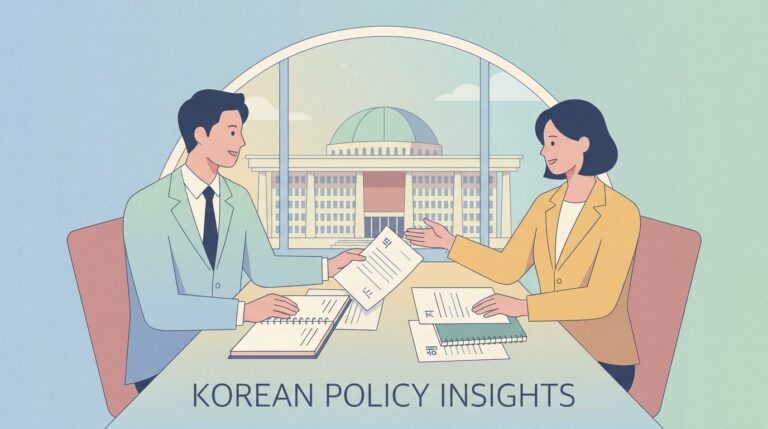
Setting: A private dining room at a traditional restaurant near Yeouido. Senior Policy Advisor Park (박 수석) and Foreign Economic Analyst Elena (엘레나) are discussing the upcoming fiscal framework over barley tea.
- 박 수석: 이번 추경안 편성을 두고 당내에서도 의견이 아주 첨예하게 갈리고 있어요. (Ibeon chugyeong-an pyeonseong-eul dugo dangnae-eseodo uigyeon-i aju cheom-yehage galligo isseoyo.)
🎭 He places his teacup down with a weary sigh, pressing his temples.
“Opinions are sharply divided even within our own party regarding the formulation of this supplementary budget.” -
엘레나: 네, 경기 침체 국면에서 재정의 적극적 역할도 필요하지만, 국가채무비율도 무시할 수 없으니까요. (Ne, gyeonggi chimche gungmyeon-eseo jaejeong-ui jeokgeukjeok yeokhaldo piryohajiman, gukkachaemubiyuldo musihal su eopseunikkayo.)
🎭 She nods respectfully, reviewing the fiscal projection charts on her tablet.
“Indeed, while fiscal policy must play an active role during economic downturns, the sovereign debt-to-GDP ratio cannot be overlooked.” -
박 수석: 맞습니다. 당장 소상공인과 취약계층의 숨통을 틔워주는 게 급선무라는 목소리가 커요. (Matseumnida. Dangjang sosang-gong-ingwa chwi-yak-gyecheung-ui sumtong-eul tiwojuneun ge geubseonmura-neun moksoriga keoyo.)
🎭 He leans forward, speaking with earnest urgency.
“Exactly. Voices arguing that our first priority is giving small business owners and vulnerable groups breathing room are very loud.” -
엘레나: 일리 있는 지적입니다. 다만, 단기 처방에 매몰되면 재정의 지속가능성이 흔들릴 수 있습니다. (Illi inneun jijeog-imnida. Daman, dangi cheobang-e maemoldoemyeon jaejeong-ui jisokganeungseong-i heundeullil su itseumnida.)
🎭 She keeps her tone measured, tilting her head slightly with an understanding expression.
“That is a valid point. However, if we become absorbed only in short-term fixes, our fiscal sustainability could be jeopardized.” -
박 수석: 그렇다고 허리띠만 졸라매다가는 내수 경제가 완전히 얼어붙을 위험이 있습니다. (Geureotdago heorittiman jollamaedaganeun naesu gyeong-jega wanjeonhi eor-eobut-eul wiheom-i itseumnida.)
🎭 He taps his index finger softly on the table to emphasize his concern.
“Yet, if we do nothing but tighten our belts, domestic consumption risks freezing over completely.” -
엘레나: 그렇기 때문에 단기적 유연성과 중장기 건전성을 아우르는 초당적 합의가 절실합니다. (Geureotgi ttaemune dangijeok yuyeonseong-gwa jungjanggi geonjeonseong-eul aureoneun chodangjeok hab-uiga jeolsilhamnida.)
🎭 She maintains an open posture, looking directly into his eyes with calm confidence.
“That is precisely why a bipartisan consensus that embraces both short-term flexibility and long-term health is imperative.” -
박 수석: 과연 여야가 정쟁을 멈추고 그런 대승적 결단을 내릴 수 있을까요? (Gwayeon yeoyaga jeongjaeng-eul meomchugo geureon daeseungjeok gyeoldan-eul naeril su isseulkkayo.)
🎭 He raises an eyebrow, genuinely curious about her strategic perspective.
“Do you truly think both parties can stop political bickering and make such a broad-minded decision?” -
엘레나: [Your Turn to Respond! See Interactive Branch below.]
🔀 Interactive Decision Point
How should Elena answer to build diplomatic rapport while demonstrating profound policy acumen?
- Option A: “정치인들이 자기 이익만 챙기지 말고 양보하면 금방 해결될 문제입니다.” (If politicians just gave up their self-interest and compromised, it would be solved easily.)
- Feedback [Bad]: Overly simplistic and judgmental. Dismissing political realities as mere greed undermines your credibility in high-level policy settings.
- Option B: “재정 준칙 도입을 전제로 한 단계적 경기 부양책을 제시한다면, 충분히 돌파구를 찾을 수 있습니다.” (If we present a phased stimulus contingent on adopting fiscal spending rules, we can certainly find a breakthrough.)
- Feedback [Best]: Flawless C1 policy response! Proposing conditional mechanisms (‘재정 준칙’ and ‘단계적 부양책’) shows systemic vision and bridges the ideological divide.
- Option C: “건전 재정이 우선이니, 이번 추경안 편성은 전면 철회하는 것이 옳습니다.” (Sound finance takes absolute priority, so the supplementary budget should be withdrawn completely.)
- Feedback [Risk]: Rigid and dismissive of urgent social needs (‘민생’). It alienates the counterpart and closes the door to collaborative dialogue.
Phase 6: 10-Second Emotion Shadowing Drill
Train your intonation and rhythm. The / marks natural breathing pauses and rhetorical cadence.
[🏛️ 단호하고 설득력 있게 / Firm and Persuasive]
“단기 경기 대응의 유연성과 / 중장기 재정 건전성은 / 결코 양립 불가능한 가치가 아닙니다.”
(Dangigi gyeonggi dae-eung-ui yuyeonseong-gwa / jungjanggi jaejeong geonjeonseong-eun / gyeolko yangnip bulganeunghan gachiga animnida.)
“Flexibility in responding to short-term economic cycles / and mid-to-long-term fiscal soundness / are by no means mutually incompatible values.”-
[🤝 공감하며 절충안을 제시하듯 / Empathetic and Conciliatory]
“취약계층 지원의 시급성을 인정하되, / 미래 세대의 부담을 덜어주는 / 초당적 합의가 뒷받침되어야 해요.”
(Chwi-yak-gyecheung jiwon-ui sigeubseong-eul injeonghadae, / mirae sedae-ui budam-eul deor-eojuneun / chodangjeok hab-uiga dwitbatchimdoe-eoya haeyo.)
“While recognizing the urgency of supporting vulnerable populations, / a bipartisan consensus / that lightens the burden on future generations must support it.” -
[📊 객관적이고 신중한 분석관처럼 / Analytical and Objective]
“무분별한 확장 재정보다는 / 재정 지출의 구조조정을 통한 / 정밀한 핀셋 지원이 필요한 시점입니다.”
(Mubunbyeolhan hwakjang jaejeong-bodaneun / jaejeong jichul-ui gujojojeong-eul tonghan / jeongmilhan pinset jiwon-i piryohan sijeom-imnida.)
“Rather than indiscriminate expansionary spending, / this is the moment when precise, targeted support / achieved through structural restructuring of expenditures is needed.”
Phase 7: K-Culture Mini Dictionary
-
여야 (Yeo-ya)
- Literal: Ruling and opposition parties.
- Usage: Combines ‘여당’ (ruling party) and ‘야당’ (opposition party). Essential for discussing National Assembly dynamics without sounding like a detached outsider.
- 추경 [추가경정예산] (Chugyeong [Chuga-gyeongjeong-yesan])
- Literal: Supplementary budget.
- Usage: Formulated when unexpected events (recessions, pandemics, natural disasters) occur after the annual national budget has already passed.
- 협치 (Hyeopchi)
- Literal: Cooperative governance / bipartisan statecraft.
- Usage: The holy grail of Korean politics. Used whenever politicians or media commentators urge both sides of the aisle to cooperate rather than stall governance.
- 미래 세대 부담 (Mirae sedae budam)
- Literal: Burden on future generations.
- Usage: The core ethical argument used by fiscal conservatives when warning against unchecked national debt issuance and unchecked welfare commitments.
Phase 8: Traveler & Professional Survival Kit
Top 3 Elite Discussion Phrases
- “대승적 차원에서 양보가 필요합니다.” (Daeseungjeok cha-won-eseo yangboga piryohamnida.)
- Pro Tip: Use this to call for compromise. ‘대승적’ (for the greater cause) frames yielding not as a defeat, but as a dignified, heroic contribution.
- “재정 건전성의 마지노선을 설정해야 해요.” (Jaejeong geonjeonseong-ui majinoseon-eul seoljeonghaeya haeyo.)
- Pro Tip: ‘마지노선’ (Maginot Line) is universally understood in Korea as an uncrossable red line or baseline defense.
- “선심성 예산이라는 비판을 피하기 어렵습니다.” (Seonsimseong yesan-iraneun bipan-eul pihagi eoryeopseumnida.)
- Pro Tip: ‘선심성 예산’ refers to pork-barrel or populist spending designed solely to win votes before an election.
Editor’s Travel & Practical Note
If you want to observe Korea’s high-level fiscal debate in person, book a public tour through the National Assembly Tour Reservation System in Yeouido. Take Subway Line 9 to National Assembly Station (국회의사당역), Exit 6. After immersing yourself in legislative history, walk across the street to try the famous noodle soup at Jinju Jip (진주집), where lawmakers and journalists regularly dine while talking politics. Carry a T-Money card or pay with domestic credit cards like Shinhan or Hyundai, as foreign cards occasionally fail at automated subway kiosk terminals.
Phase 9: Going One Step Deeper
In Western economic traditions, debates between Keynesian stimulus and fiscal austerity often boil down to ideological views on the size of the state versus individual liberty. In Korea, however, fiscal policy discourse is deeply infused with Confucian ethics regarding generational responsibility and filial piety in reverse—known as ‘백년대계’ (a plan for a hundred years).
When Korean intellectuals debate fiscal health, they are not merely tallying numbers; they are wrestling with ancestral stewardship and the collective duty owed to descendants. To run an unsustainable deficit is culturally perceived not just as poor accounting, but as an abdication of elder responsibility toward the youth. Keep this moral dimension in mind whenever you enter policy discussions in Seoul.
💬 Your Turn: In your home country, is public debt primarily seen as an economic tool or a moral dilemma for future generations? How does your cultural background shape that view? Leave your thoughts below!
Phase 10: FAQ & Avoiding Misunderstandings
Q: Does ‘초당적’ have anything to do with sugar (‘당’) or seconds (‘초’)?
A: No! While ‘초’ can mean second and ‘당’ can mean sugar, in political contexts ‘초’ means ‘to transcend’ (超) and ‘당’ means ‘political party’ (黨). Hence, ‘초당적’ means transcending partisan boundaries.
Q: Can I use the phrase ‘허리띠를 졸라매다’ in an official briefing?
A: Absolutely. While it originates as an everyday idiom (“tightening one’s belt”), it is frequently used by Korea’s Finance Ministers and corporate CEOs during formal press conferences to signify fiscal austerity.
Q: How do I express disagreement with a senior Korean colleague’s economic opinion without causing offense?
A: Always sandwich your counterargument. Open with agreement on their values (“그 점은 매우 중요한 통찰이십니다”), follow with a softening transitional particle (“다만 실무적인 관점에서는…”), and conclude with a question (“어떻게 생각하시는지요?”).
🚨 Common Mistakes Board
- ❌ Mistake 1: Using ‘싸우지 마세요’ (Please don’t fight) when talking to politicians or executives.
- Correct Action: Say ‘정쟁을 지양하고 협치해야 합니다’ (We must refrain from political conflict and engage in cooperative governance).
- ❌ Mistake 2: Assuming ‘건전’ only refers to moral purity (like ‘건전한 취미’).
- Correct Action: Remember that ‘재정 건전성’ is the standard, technical terminology for ‘fiscal soundness/health’.
- ❌ Mistake 3: Saying ‘우리 생각이 맞아요’ (Our idea is right) in a formal seminar.
- Correct Action: Frame it diplomatically: ‘이러한 접근법이 보다 설득력을 얻고 있습니다’ (This approach is gaining broader persuasiveness).
Phase 11: Action Mission & Engagement
- 🥉 Bronze Mission (Solo Mastery): Record yourself reading the 3 sentences in Phase 6. Focus on pausing precisely at the
/marks to sound thoughtful and controlled. - 🥈 Silver Mission (Social Share): Pick one current economic headline from a Korean news outlet (like Chosun Ilbo or Hankyoreh) and summarize the conflict in your study notes using ‘초당적 합의’ and ‘재정 건전성’.
- 🥇 Gold Mission (Real-World Application): The next time you speak with a Korean language exchange partner or colleague, ask: “요즘 한국 경제 상황에서 확장 재정과 재정 건전성 중 어느 쪽이 더 시급하다고 보시나요?” (In Korea’s current economic climate, do you think expansionary fiscal policy or fiscal soundness is more urgent?)
- 🎮 K-Culture Mission: Watch Episode 1 of Chief of Staff (보좌관) on Netflix. Jot down every time characters use ‘법안’ (bill), ‘합의’ (agreement), or ‘예산’ (budget).
Phase 12: Interactive Quiz Challenge
Question 1 (Situational Judgment)
You are attending a policy forum. A speaker argues that the government should quadruple cash handouts without establishing any tax funding plans. You want to point out the risk of public debt politely. What should you say?
* A) “완전히 비논리적이고 말도 안 되는 주장입니다.”
* B) “서민 지원의 취지에는 공감하나, 중장기적 재정 건전성을 담보할 대책도 병행되어야 합니다.”
* C) “당장 돈을 풀면 물가가 폭등해서 다 망할 겁니다.”
Question 2 (Fill-in-the-Blank)
여야가 정쟁을 멈추고 국가적 위기를 극복하기 위해 [ ] 합의를 이루어냈습니다.
(Hint: An adjective meaning “transcending partisan lines”)
Question 3 (True or False Cultural Trivia)
In Korean economic parlance, ‘추경’ refers to the regular annual budget submitted every autumn before the fiscal year begins. (True / False)
Click here to reveal the answers and explanations
- Q1 Answer: B
Explanation: Option B balances empathy for the underlying social goal (‘서민 지원 취지 공감’) with sharp structural caution (‘재정 건전성 담보 대책 병행’), which is the hallmark of sophisticated C1 Korean. Options A and C are far too crude for formal settings. - Q2 Answer: 초당적 (Chodangjeok)
Explanation: ‘초당적’ (bipartisan/supra-partisan) modifies ‘합의’ (consensus) to denote an agreement made across party lines for the greater public good. - Q3 Answer: False
Explanation: ‘추경’ is short for ‘추가경정예산’ (supplementary / revised supplementary budget), which is formulated ad-hoc during crises, separate from the standard annual budget (‘본예산’).






