

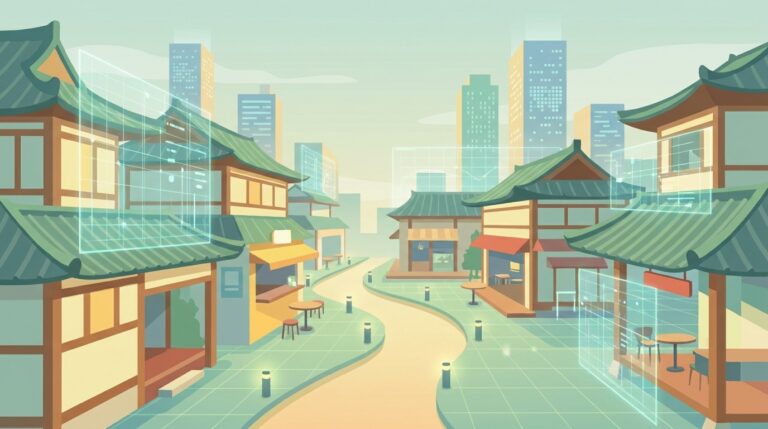
Phase 1: 공감 (A City Built for Algorithms, or for People?)
안녕하세요! 매일한글 에디터입니다.
Imagine stepping out of the ultra-sleek subway terminal in Pangyo Techno Valley or Songdo International City. Glass towers pierce the sky, autonomous shuttles glide along algorithm-optimized asphalt, and sensors calibrate streetlights to the microsecond. On paper, it is a masterclass in modern engineering: a fully synchronized digital twin simulating urban metabolism in real time. Yet, as you stand at a wind-swept crosswalk eight lanes wide, looking for a welcoming bench or a cozy café awning, a sudden chill creeps in. Where are the gathering spots? Where is the communal heartbeat?
If you have ever participated in an urban design symposium, an architectural review, or even a late-night cafe debate in Korea, you have probably felt this linguistic impasse. At the C2 level, your challenge is no longer describing a city as simply ‘현대적이다 (modern)’ or ‘편리하다 (convenient).’ The real nuance lies in interrogating the dialectic between hyper-efficiency and spatial humanity. How do native intellectuals articulate that a digital twin is only half of the equation without walkability and human warmth?
This guide was forged from real discussions with foreign architects, policy analysts, and advanced Korean learners who hit a wall when attempting to weave philosophical depth into technocratic topics. By mastering the discourse in this unit, you will gain the vocabulary and cultural fluency to navigate elite urban planning seminars, cultural critiques, and high-level business forums without sounding like an algorithmic translation tool.
Phase 2: 핵심 표현 3선 심층 분석 (Core Expressions)
1. 보행자의 눈높이 (Bohaengja-ui nunnop-i)
- Pronunciation: [Bohaengja-ui nunnop-i] (Sounds like bo-hang-ja-eui noon-nop-ee, resembling the gentle glide of ‘noong’ followed by the soft pop of ‘nop-ee’)
- Meaning: Literal: ‘Pedestrian’s eye level’ | Real Nuance: Human-scale urban design; prioritizing the tactile, street-level human experience over monumental, bird’s-eye architectural vanity.
- K-Culture Moment: Seen frequently on public architecture panels such as tvN’s Shift: Spatial Renaissance or architectural documentaries where critics lament massive high-rise complexes that alienate ground-level flâneurs.
- Editor’s Insight: ‘눈높이 (nunnop-i)’ literally means eye level, but philosophically represents empathy and perspective. Shifting the urban frame to ‘보행자의 눈높이’ implies de-centering motorized transit and computational abstractions to center the fragile human body.
- Situation Spectrum: Casual ⚠️ | Semi-formal ✅ | Formal ✅
- 🤔 Think About It: Does your native language distinguish between physical ‘human scale’ and the moral stance of viewing society from the ‘pedestrian’s eye level’?
2. 사람 냄새가 나다 (Saram naemsaega nada)
- Pronunciation: [Saram naemsaega nada] (Pronounced like sa-ram nam-seh-ga na-da, where ‘saram’ carries a crisp cadence)
- Meaning: Literal: ‘Smell of human comes forth’ | Real Nuance: Radiating human warmth, vibrant community intimacy, and lived-in authenticity rather than sterile perfection.
- K-Culture Moment: Remember the iconic neighborhood of Huam-dong in My Mister (나의 아저씨) or the bustling communal corridors in Reply 1988? The characters find solace not in pristine smart districts, but in streets where ‘사람 냄새가 난다.’
- Editor’s Insight: Never use this literally to describe body odor! At the advanced C2 register, it evokes socio-emotional vitality. When an intellectual remarks that a new compact city lacks ‘사람 냄새’, it is a cutting cultural critique of gentrified, sanitized emptiness.
- Situation Spectrum: Casual ✅ | Semi-formal ✅ | Formal ⚠️ (Preferred in speeches or essayistic discourse; avoid in dry statutory filings)
- 🤔 Think About It: Why does Korean culture associate olfactory imagery (‘냄새’ – scent/smell) with emotional warmth and neighborhood safety rather than a visual metaphor?
3. 입체 복합 개발 (Ipche bokhap gaebal)
- Pronunciation: [Ipche bokhap gaebal] (ip-che bok-hap gae-bal, crisp plosives with a clear cadence)
- Meaning: Literal: ‘Multi-dimensional complex development’ | Real Nuance: Multi-layered, multi-use vertical zoning where commercial, transit, cultural, and residential ecosystems converge seamlessly.
- K-Culture Moment: Frequently featured in urban design briefings on major projects like the Yeongdong-daero Underground Complex or Yongsan International Business District revitalization specials on KBS News.
- Editor’s Insight: This is the antidote to horizontal sprawl. In high-level policy papers, combining ‘입체 복합 개발’ with ‘보행권 (pedestrian rights)’ signifies that smart infrastructure goes deep underground or skyward specifically to liberate the ground surface for public parks and community squares.
- Situation Spectrum: Casual 🚫 | Semi-formal ✅ | Formal ✅
- 🤔 Think About It: How does your home country’s regulatory culture view the vertical integration of public transit, retail, and open green spaces?
Phase 3: 교과서 한국어 vs 진짜 한국어 (Textbook vs. Real Native C2)
Situation 1: Praising a vibrant, highly walk-friendly smart district
- 📖 교과서 한국어:
이 구역은 데이터 기반 동선 설계로 보행자의 이동이 매우 최적화되어 있습니다.
(I guyeog-eun deiteo giban dongseon seolgyero bohaengja-ui idong-i maeu choejeokhwa-doeeo itseumnida. / In this zone, pedestrian movement is highly optimized through data-driven route planning.) - 🗣️ 진짜 한국어:
빌딩 숲 사이로 보행자 눈높이에 맞춘 가로망이 촘촘해서, 도시의 온기가 고스란히 전해지네요.
(Billing sup sairo bohaengja nunnopi-e matchun garomang-i chomchomhaeseo, dosi-ui ongiga goseuranhi jeonhaejineyo. / The street grid weaves at a pedestrian eye level amidst the forest of towers, letting the city’s warmth resonate effortlessly.) - 💡 왜 다를까?
Textbook Korean sounds like a municipal transit report. Native urban critics and connoisseurs blend structural terms (‘가로망’, ‘촘촘하다’) with emotional resonance (‘온기가 고스란히 전해지다’) to celebrate livable design.
Situation 2: Critiquing a technologically impressive yet soulless new development
- 📖 교과서 한국어:
스마트 인프라는 고도화되었으나 주민 간의 사회적 상호작용은 부족한 편입니다.
(Seumateu impeuraneun godohwa-doe-eosseuna jumin gan-ui sahoejeok sanghojag-yong-eun bujokhan pyeon-imnida. / While the smart infrastructure is advanced, social interactions among residents are somewhat deficient.) - 🗣️ 진짜 한국어:
기술적 완성도는 압도적이지만, 솔직히 골목길 특유의 사람 냄새와 공동체적 활기는 겉돌고 있어요.
(Gisuljeok wanseongdoneun apdojeog-ijiman, soljikhi golmokgil teug-yu-ui saram naemsaewa gongdongchejeok hwalgineun geotdolgo isseoyo. / The technical sophistication is overwhelming, but honestly, the organic human warmth and communal vitality typical of old alleyways fall completely flat.) - 💡 왜 다를까?
C2 speakers avoid clinical assessments like ‘사회적 상호작용 부족’. Instead, they employ poignant cultural markers (‘골목길 특유의 사람 냄새’) and precise dynamic idioms (‘겉돌다’ – to skim the surface without integrating).
Phase 4: K-Culture 딥다이브 & 비언어적 매너 (Context & Non-Verbal Codes)
4-1. 눈치(Nunchi) & Professional Body Language in Urban Forums
When critiquing smart city initiatives in Korean academic, corporate, or governmental settings, directly attacking a project’s algorithmic efficiency will immediately brand you as contrarian or unpragmatic. The secret lies in nunchi-guided framing:
1. The Affirmative Cushion: Always nod deliberately with an open posture, murmuring “기술적 타당성과 효율성은 충분히 입증되었습니다만… (While the technical feasibility and efficiency have been well demonstrated…)”.
2. The Humanistic Pivot: Slightly lower your pitch, soften your gaze, and gesture toward floor plans with an open palm rather than a pointed finger when introducing ‘보행자 눈높이’ (pedestrian scale). This visually signals that you are not rejecting modern data, but elevating its philosophical soul.
4-2. The Cultural Battleground: ‘Geumga Plaza’ vs. ‘DDP’
In Korean popular culture, hyper-modern development constantly collides with neighborhood nostalgia. Consider the narrative tension in Vincenzo regarding Geumga Plaza, or the real-world historical debates surrounding the Dongdaemun Design Plaza (DDP). While global architects celebrated DDP’s parametric, futuristic curves, citizens and local merchants initially grieved the loss of the historic Dongdaemun Stadium and traditional flea markets. Korea’s urban consciousness is characterized by this acute tension: the collective memory of the golmok (골목, narrow alleyways steeped in jeong) versus the aspiration for world-leading smart city supremacy. Expressing fluency in this tension marks the difference between an intermediate speaker and a genuine cultural insider.
Phase 5: 실전 롤플레이 시나리오 (Real-Life Boardroom Scenario)
Setting: A steering committee meeting for the ‘Seoul Metropolitan 3D Digital Twin Masterplan’.
NPC: Director Park Min-woo (박민우 도시계획과장), a pragmatic tech-optimist passionate about compact city data modeling.
Turn 1: Director Park
이번 디지털 트윈 시뮬레이션 덕분에 용적률과 일조권 계산을 단 10분 만에 끝냈습니다. 이 복합 공간 설계, 정말 빈틈없이 스마트하지 않습니까?
(Ibeon dijiteol teuwin simyulleisyeon deogbune yongjeongnyulgwa iljogwon gyesan-eul dan sipbun mane kkeunnaessumnida. I bokhap gonggan seolgye, jeongmal binteum-eopsi seumateuhaji anseumnikka? / Thanks to this digital twin simulation, we calculated the floor area ratio and sunlight exposure in just ten minutes. Isn’t this mixed-use design completely airtight and smart?)
Turn 2: You
🎭 Nodding thoughtfully while examining the virtual 3D hologram screen
네, 과장님. 연산 속도와 공간 압축률 면에서는 그야말로 혁신적입니다.
(Ne, gwajangnim. Yeonsan sokdowa gonggan apchungnyul myeoneseoneun geuyamallo hyeoksinjeog-imnida. / Yes, Director. In terms of computational speed and spatial compactness, it is truly groundbreaking.)
Turn 3: Director Park
그렇죠? 이대로 착공에 들어가면 국내 최초의 무인 스마트 압축도시 랜드마크가 될 겁니다.
(Geureochyo? Idaero chakgong-e deureogamyeon guknae choecho-ui mu-in seumateu apchukdosi raendeumakeuga doel geomnida. / Right? If we break ground as planned, it will become Korea’s first unmanned smart compact city landmark.)
Turn 4: You
🎭 Leaning slightly forward with an empathetic tone, placing a finger on the ground-level pathway
다만, 시뮬레이션 상공에서 내려다보는 효율성에 비해 보행자의 눈높이에서 느껴지는 개방감은 다소 경직된 듯합니다.
(Daman, simyulleisyeon sanggong-eseo naeryeodaboneun hyoyulseong-e bihae bohaengja-ui nunnopi-eseo neukkyeojineun gaebanggam-eun daso gyeongjikdoen deuthamnida. / However, compared to the efficiency seen from the high simulation vantage, the sense of openness at the pedestrian’s eye level feels somewhat rigid.)
Turn 5: Director Park
경직되었다고요? 지하와 지상을 망라한 입체 복합 개발이라 보행 동선 자체는 최단거리로 맞춰져 있는데요.
(Gyeongjikdoe-eotdagoyo? Jihawa jisang-eul mangnahan ipche bokhap gaebar-ira bohaeng dongseon jache-neun choedangeoriro matchwojyeo inneundeyo. / Rigid? It is a multi-dimensional development bridging underground and surface layers, so the walking paths are optimized for the absolute shortest distance.)
Turn 6: You
동선의 최적화도 중요하지만, 도시민들이 발걸음을 멈추고 온기를 나눌 수 있는 포켓 공원이나 쌈지마당이 결합되어야 합니다.
(Dongseon-ui choejeokhwado jung-yohajiman, dosimindeur-i balgeoreum-eul meomchugo ongireul nanul su inneun poket gong-won-ina ssamjimadang-i gyeolhabdoe-eo-ya hamnida. / Optimizing pathways is crucial, but it must be coupled with pocket parks or miniature plazas where citizens can pause their steps and share communal warmth.)
Turn 7: Director Park
🎭 Adjusting his glasses, pondering your point as he zooms into the ground plane
듣고 보니 그렇네요. 디지털 트윈의 수치에 매몰되어 사람 냄새가 머물 공간을 간과할 뻔했습니다.
(Deutgo boni geureonneyo. Dijiteol teuwin-ui suchie maemoldoe-eo saram naemsaega meomul gonggan-eul gangwahal ppeonhaessumnida. / Hearing your perspective, you are right. Trapped inside the digital twin’s metrics, we almost overlooked space where the scent of humanity can linger.)
Turn 8: You
기술의 효율성 위에 공동체의 온기를 덧입힐 때, 비로소 시민들이 자발적으로 머무는 진정한 스마트시티가 완성될 테니까요.
(Gisul-ui hyoyulseong wie gongdongche-ui ongireul deos-iphil ttae, biroso simindeur-i jabaljeog-euro meomuneun jinjeonghan seumateusitiga wanseongdoel tenikkayo. / Because only when technological efficiency is enriched with communal warmth will a true smart city emerge where citizens willingly linger.)
🔀 인터랙티브 분기점 (Interactive Fork)
How would you formulate your rebuttal if Director Park pushed back on budget restrictions for pedestrian parks?
- Option A: “돈이 좀 더 들더라도 스마트 센서 몇 개 빼고 공원을 크게 늘려야 사람들이 살기 좋습니다.”
- Option B: “공간의 효율성과 자본 회수율도 중요하지만, 공공 보행로의 쾌적성이 결여된 도시는 장기적으로 자산 가치가 급락할 위험이 큽니다.”
- Option C: “기술 중심 도시는 결국 실패하게 마련이니, 과거의 전통 골목 방식을 무조건 보존해야 합니다.”
Detailed Feedback:
* Option A (Risk): Too blunt and informal for a C2 executive context. Phrases like “돈이 좀 더 들더라도” and “빼고” sound unrefined and confrontational.
* Option B (Best): Brilliant C2 strategy! Connects pedestrian walkability directly with sustainable asset appreciation (“자산 가치”) and long-term livability, speaking the language of urban investors and humanists simultaneously.
* Option C (Bad): Technophobic and nostalgic. Completely dismisses technological utility, which alienates planners who work with digital twins.
Phase 6: 10초 감정 섀도잉 드릴 (Emotional Shadowing Drill)
Practice reading these sentences aloud, respecting pause markers (/) and channeling the psychological intent of each emotional tag.
[🧐 사색적이고 차분하게 / Thoughtfully and measured]
기술이 구현하는 / 압축도시의 정밀함 뒤편에는 / 반드시 / 보행자의 눈높이를 배려한 / 쉼표가 있어야 합니다.
(Gisur-i guhyeonhaneun / apchukdosi-ui jeongmilham dwipyeon-eneun / bandeusi / bohaengja-ui nunnopi-reul baeryeohan / swimpyoga isseoya hamnida. / Behind the precision of a compact city / manifested by technology / there must invariably exist / a pause / mindful of the pedestrian’s eye level.)-
[💡 확신에 차고 설득력 있게 / Confidently and persuasively]
디지털 트윈의 가치는 / 데이터의 집적에 그치는 것이 아니라, / 사람 냄새 나는 공간을 / 얼마나 입체적으로 지켜내는가에 달렸습니다.
(Dijiteol teuwin-ui gachineun / deiteo-ui jipjeog-e geuchineun geos-i anira, / saram naemsae naneun gonggan-eul / eolmana ipchejeog-euro jikyeonaeneungae dallyeotsumnida. / The true worth of a digital twin / does not end at data aggregation / but rests upon how multi-dimensionally / it preserves spaces brimming with human warmth.) -
[🤝 온화하면서도 단호하게 / Warmly yet resolutely]
차가운 알고리즘의 뼈대 위에 / 공동체의 따뜻한 온기가 스며들 때, / 비로소 살고 싶은 도시가 태어납니다.
(Chagaun algorijeum-ui ppyodae wie / gongdongche-ui ttatteukhan ongiga seomyeodeul ttae, / biroso salgo sipeun dosiga tae-eonamnida. / When the warmth of community permeates / the rigid skeleton of cold algorithms, / only then is an authentic, livable city born.)
Phase 7: K-Culture 미니 사전 (Urban Planning Mini-Dictionary)
-
압축도시 (Apchuk Dosi) | Compact City
Definition & Usage: An urban design model emphasizing high residential density, short travel distances, and integrated public transit to reduce carbon footprint and urban sprawl. In professional Korean discourse, it often pairs with ‘직주근접 (residential-workplace proximity)’ and requires careful zoning so that high density does not compromise quality of life. -
디지털 트윈 (Dijiteol Teuwin) | Digital Twin
Definition & Usage: A virtual clone of physical city assets updated via real-time IoT feeds. In Korean planning debates, it is referred to as both an infrastructural miracle (“가상 세계를 통한 실시간 도시 관제”) and a cautionary technocratic hazard when citizen perspectives are omitted. -
온기 (Ongi) | Communal Warmth / Thermal Humanity
Definition & Usage: Literal warmth, but socially emblematic of mutual care, informal neighborly safety nets, and vitality. Used in urban critiques such as “도시의 온기를 회복하다 (restoring the warmth of the city)” to counter antiseptic architectural modernism. -
입체 보행 데크 (Ipche Bohaeng Dekeu) | Multi-Dimensional Pedestrian Deck
Definition & Usage: Elevated or subterranean public corridors that separate walking humans from vehicle highways, commonly seen in complex urban regeneration hubs like Seoul Station’s ‘Seoullo 7017’ or Jamsil Lotte World Tower vicinity.
Phase 8: 여행자를 위한 생존 키트 (Traveler’s Survival Kit)
Survival Expressions TOP 3
-
“여기 근처에 걷기 좋은 산책로나 쌈지공원이 있나요?”
(Yeogi geuncheo-e geotgi joeun sanchaengrona ssamjigong-won-i innayo?)
Meaning: Is there a walkable path or a small pocket park around here?
Pro Tip: Use ‘쌈지공원 (pocket park)’ to impress Korean urban explorers and local baristas—it reveals an appreciation for subtle public breathing spaces. -
“이 빌딩 지하 통로가 지하철역이랑 바로 연결되나요?”
(I billing jiha tongroga jihacheollyeog-irang baro yeongyeoldoenayo?)
Meaning: Does this building’s underground concourse connect directly to the subway station?
Pro Tip: Essential for navigating Seoul’s massive ‘입체 복합’ subterranean networks during wet monsoon seasons or freezing sub-zero winters. -
“스마트 안내 키오스크 대신 주민들이 자주 모이는 광장이 어디예요?”
(Seumateu annae kioseukeu daesin jumindeur-i jaju mo-ineun gwangjang-i eodiyeyo?)
Meaning: Instead of the smart information kiosks, where is the plaza where locals actually gather?
Pro Tip: A sophisticated way to escape digital tourist loops and find organic street life.
Editor’s Travel Note
- App Exploration: Download the Seoul Smart City 3D S-Map Platform to explore how the city simulates shadows, wind corridors, and pedestrian sightlines. For street navigation, ditch generic tools and rely on Naver Map pedestrian AR navigation to experience real-time walking guidance tailored to Korea’s intricate multileveled terrain.
- Field Trip Recommendation: Stroll from the hyper-futuristic glass facades of Yongsan Station into the preserved railroad alleyways (Baekbin Railroad Crossing). Notice how spatial tension shapes Seoul’s multifaceted soul.
Phase 9: “한 발 더 깊이” (Cultural Philosophical Essay)
Korea experienced compressed modernization (‘압축성장’) unmatched anywhere in 20th-century history. In a single generation, mud roads gave way to the world’s most hyper-connected smart metropolises. However, this hyper-acceleration left architectural scars: the abrupt eradication of historic alleyways where jeong (정, emotional bond) flourished organically. Today’s younger planners and intellectuals are not technophobes; rather, they demand that digital twin innovations and compact urbanism serve the human spirit rather than corporate logistics. To speak of ‘보행자의 눈높이’ in modern Korea is not merely to discuss spatial geometry—it is an ethical claim defending the right to unhurried, collective humanity amid an ocean of algorithms.
💬 Your Turn: Does your home country prioritize technological optimization over pedestrian walkability, or does street-level human connection remain at the center of planning? Share your thoughts below in Korean!
Phase 10: FAQ & 흔한 실수 (FAQ & Common Mistakes)
Q: Can ‘사람 냄새’ be used in official urban planning documentation?
A: In legal statutes or environmental impact statements, stick to formal formulations such as ‘주민 간 유대감 (inter-resident solidarity)’ or ‘공동체적 활력 (communal vitality).’ However, in public mayoral addresses, design vision statements, and architectural reviews, ‘사람 냄새 나는 도시’ is frequently employed to evoke deep emotional resonance.
Q: What is the exact difference between ‘입체 복합 개발’ and traditional ‘재개발’?
A: ‘재개발 (redevelopment)’ generally refers to demolishing aging residential zones to build new apartment towers. In contrast, ‘입체 복합 개발 (multi-dimensional mixed-use development)’ rethinks three-dimensional urban volumes—stacking subterranean transit centers, green surface promenades, and elevated sky-bridges in high-density nodes without displacing human transit.
Q: How do I criticize a smart city concept politely without sounding outdated?
A: Frame your critique around the synthesis of tech and community. Use phrases like “스마트 기술의 고도화 못지않게 시민의 체감 행복과 보행권 역시 중요합니다 (Along with upgrading smart technology, citizens’ perceived happiness and walking rights are just as vital).”
🚨 흔한 실수 (Common Mistakes) 경고판
- Mistake: Using ‘사람 냄새가 난다’ literally to mean somebody needs a shower.
Correct Action: Use ‘땀 냄새 (sweat smell)’ or ‘체취 (body scent)’ for actual scents. Keep ‘사람 냄새’ exclusively for heartwarming communal atmosphere! - Mistake: Confusing ‘눈높이 (eye level / perspective)’ with ‘시각 (angle / viewpoint)’.
Correct Action: While ‘시각’ refers to an intellectual stance, ‘눈높이’ implies emotional grounding and meeting someone on their level (e.g., ‘아이의 눈높이’, ‘보행자의 눈높이’). - Mistake: Overusing ‘최적화 (optimization)’ as an inherently positive term.
Correct Action: In advanced C2 discourse, excessive optimization is often critiqued as ‘지나친 수치화 (excessive quantification)’. Balance it with qualitative human factors.
Phase 11: 액션 미션 & 참여 유도 (Action Missions)
- Bronze Mission (Solo Mastery): Record yourself reading the 3 core sentences from Phase 6, maintaining accurate pauses at the
/marks. - Silver Mission (Social Engagement): Find an architectural photo of your favorite street. Write a 2-sentence critique in Korean utilizing ‘보행자의 눈높이’ and post it on your social channels or community forum tagging Daily Hangul.
- Gold Mission (Debate Stage): In your next Korean language exchange or class, spend 5 minutes arguing whether high-density compact cities diminish or enhance ‘사람 냄새’.
- 🎮 K-Culture Mission: Watch an episode of an urban regeneration variety show (like Dongne Hanbakwi – 동네 한 바퀴) and spot how the host describes the balance between modern facilities and preserved street warmth.
Phase 12: 인터랙티브 퀴즈 챌린지 (Interactive Quiz Challenge)
Quiz 1: Situational Vocabulary
Which phrase best fills in the blank for a sophisticated, human-centered architectural critique?
“이 신도시는 모든 것이 자동화되어 있어 편리하지만, 정작 시민들이 서로 마주치고 소통할 수 있는 (________)이 결여되어 삭막하다.”
* A) 연산 속도 (Computational speed)
* B) 사람 냄새 (Human warmth / communal presence)
* C) 용적률 (Floor area ratio)
👉 정답 및 해설 확인하기 (Click to reveal answer)
정답: B) 사람 냄새
해설: The context discusses a sterile environment (‘삭막하다’) resulting from a lack of human interaction despite automation. ‘사람 냄새’ captures the missing emotional vitality perfectly. ‘연산 속도’ and ‘용적률’ are technical engineering parameters that do not fit the affective tone.
Quiz 2: True or False Cultural Nuance
Statement: In Korean, the expression ‘보행자의 눈높이’ can only be applied to physical eye-level measurements in centimeters and cannot be used metaphorically in social policy.
* True
* False
👉 정답 및 해설 확인하기 (Click to reveal answer)
정답: False
해설: ‘보행자의 눈높이’ is extensively utilized metaphorically in urban planning, political discourse, and sociology to describe empathetic, human-centered approaches that respect ground-level citizen realities.
Quiz 3: Sentence Formulation Fill-in-the-Blank
Complete the sentence using the correct form of ‘입체 복합 개발’:
“도심부 토지 부족 문제를 해결하기 위해 지하철 환승센터와 상업 시설, 녹지 공간을 하나로 묶는 (___________)이 활발히 추진되고 있습니다.”
👉 정답 및 해설 확인하기 (Click to reveal answer)
정답: 입체 복합 개발
해설: Vertically integrating transit hubs, commercial centers, and public parks to solve space constraints is the classic definition of ‘입체 복합 개발 (multi-dimensional mixed-use development)’.







