

Phase 1: 공감 (Story-Immersive Opening)
안녕하세요! 매일한글 에디터입니다.
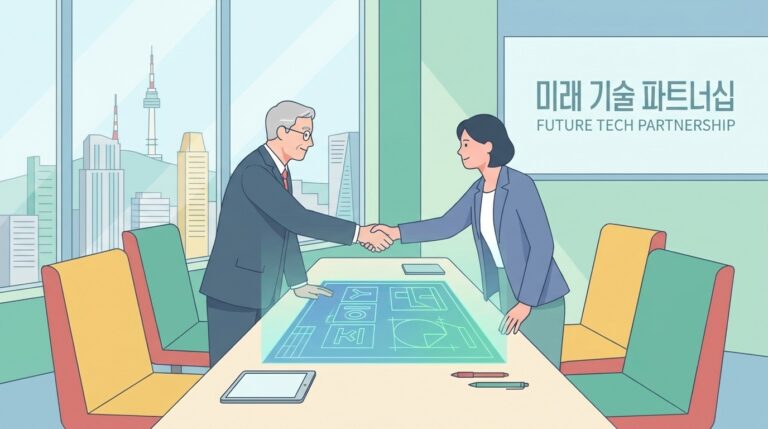
Imagine this scene: You are sitting in an ultra-sleek, glass-walled conference room overlooking the Pangyo Techno Valley—South Korea’s answer to Silicon Valley. On one side of the mahogany table sits a distinguished senior engineering professor from a prestigious university (SKY), adorned with decades of theoretical prestige; on the other side sits a sharp, pragmatic Vice President of Corporate R&D from a multinational conglomerate. The stakes couldn’t be higher. You are negotiating a multimillion-dollar joint research agreement and intellectual property (IP) transfer.
You cleared your TOPIK II Level 6 exam with flying colors, but suddenly your throat dries up. You hear rapid-fire industry idioms: 원천 기술 (fundamental technology), 상아탑 (ivory tower), 사업화 로드맵 (commercialization roadmap), and 특허 지분율 (patent equity ratio). When it is your turn to speak, you realize that textbook phrases like “우리는 함께 연구하고 싶습니다” (We want to research together) sound painfully simplistic, almost amateurish, in this elite arena where academic gravitas meets corporate agility.
Navigating industry-academia collaboration (산학협력, Sanhak-hyeop-ryeok) in Korea requires far more than generic polite speech. It demands an appreciation of how the ivory tower’s deep intellectual assets are synthesized with the fierce commercial drive of Korean industry. Today, drawn from a decade of coaching global tech executives and university liaisons, I’m unpacking the exact C1-level discourse markers, negotiation strategies, and nuanced etiquette you need to orchestrate high-level tech transfers with authority and cultural finesse.
Phase 2: 핵심 표현 3선 심층 분석 (Deep Dive into Top 3 Expressions)
1. 상아탑의 연구 성과를 산업 현장에 접목하다 (Sang-a-tap-ui yeon-gu seong-gwa-reul san-eop hyeon-jang-e jeop-mok-ha-da)
- Pronunciation: [Sang-ah-tahp-eui yeon-goo seong-gwah-reul sahn-eop hyeon-jahng-eh jeop-mohk-hah-dah] (Sound metaphor: Imagine saying ‘Sang’ like a choir song, ‘tap’ like a light fingertip tap, and ‘jeop-mok’ with a crisp, decisive snap like interlocking Lego bricks.)
- Meaning: Literally “To graft the research achievements of the ivory tower onto the industrial field.” In nuance, it means translating cutting-edge academic discoveries into market-ready, practical commercial applications.
- K-Culture Moment: Seen in the high-stakes tech-politics drama Agency or the university-startup battleground in Start-Up, where an idealistic laboratory researcher must pitch their patented deep-learning algorithm to ruthless venture capitalists.
- Editor’s Insight: 접목하다 (jeop-mok-ha-da) originates from horticulture (grafting a branch onto a tree). In corporate Korean, it signals a sophisticated, organic integration rather than a forced, mechanical combination (결합하다).
- Situation Spectrum: Casual 🚫 | Semi-formal ⚠️ | Formal ✅
- 🤔 Think About It: In your home country, do people call universities “ivory towers” with a tone of isolation or reverence? In Korea, 상아탑 evokes deep classical scholarship, yet modern society demands that this pure wisdom yield tangible value for national competitiveness.
2. 원천 기술 이전을 통한 시너지 창출 (Won-cheon gi-sul i-jeon-eul tong-han si-neo-ji chang-chul)
- Pronunciation: [Won-cheon gee-sool ee-jeon-eul tong-hahn see-nuh-jee chahng-chool] (Sound metaphor: ‘Won-cheon’ flows softly like water from a mountain spring, while ‘chang-chul’ ends with an assertive, explosive ‘chul’ sound.)
- Meaning: Literally “Synergy creation through core/originating technology transfer.” It conveys driving exponential, mutual growth by licensing fundamental, foundational patents from academia into scalable corporate infrastructure.
- K-Culture Moment: Think of corporate briefings in Search: WWW or Midas, where tech strategists present transformative M&A and licensing deals to the board of directors.
- Editor’s Insight: Do not confuse 원천 기술 (fundamental/seed technology) with 응용 기술 (applied technology). Korean research institutes take immense pride in discovering 원천 기술. By highlighting 시너지 창출 (synergy creation), you reassure the academic side that their proprietary discovery won’t just be exploited, but multiplied in societal impact.
- Situation Spectrum: Casual 🚫 | Semi-formal ⚠️ | Formal ✅
- 🤔 Think About It: Notice the Sino-Korean compound 창출 (chang-chul – to invent/produce from nothing). Why choose 창출 instead of simply 만들기 (man-deul-gi)? The former implies high-order strategic value creation.
3. 산학협력 협약 체결 및 사업화 로드맵 구축 (San-hak-hyeop-ryeok hyeop-yak che-gyeol mit sa-eop-hwa ro-deu-maep gu-chuk)
- Pronunciation: [Sahn-hahk-hyeop-ryeok hyeop-yahk che-gyeol meet sah-eop-hwah roh-deu-maep goo-chook] (Sound metaphor: Rhythmic and crisp, with each syllable distinct like legal stamps clicking onto official parchment.)
- Meaning: Literally “Executing the industry-academia collaboration agreement and establishing the commercialization roadmap.”
- K-Culture Moment: The ceremonial climax seen in news clips and business dramas where a University President and a Chaebol CEO sign memorandums of understanding (MOUs) holding sleek leather folders in front of flash photography.
- Editor’s Insight: 체결 (che-gyeol) is exclusively reserved for formal contracts, pacts, and treaties. 구축 (gu-chuk) implies building a structural framework from the ground up. Combining these shows your counterparty that you respect bureaucratic thoroughness while championing milestone-driven execution.
- Situation Spectrum: Casual 🚫 | Semi-formal ⚠️ | Formal ✅
- 🤔 Think About It: Why is English loanword “로드맵” (roadmap) preferred here over pure Korean? Modern Korean corporate strategy integrates global tech terminology to signal global scalability.
Phase 3: 교과서 한국어 vs 진짜 한국어 (Textbook vs. Boardroom Real Talk)
Situation 1: Discussing Research Scope & Patent Value
- 📖 교과서 한국어 (Textbook):
“이 기술은 매우 좋아서 시장에서 팔릴 수 있습니다. 같이 계약합시다.”
(I gi-sul-eun mae-u joh-a-seo si-jang-e-seo pal-ril su it-seum-ni-da. Gat-i gye-yak-hap-si-da.)
“This technology is very good, so it can be sold in the market. Let’s contract together.” - 🗣️ 진짜 한국어 (Real-World Boardroom C1):
“교수님 연구팀의 원천 특허를 기반으로 실증 연구를 거친다면, 조기 사업화 가능성이 매우 높다고 판단됩니다.”
(Gyo-su-nim yeon-gu-tim-ui won-cheon teuk-heo-reul gi-ban-eu-ro sil-jeung yeon-gu-reul geo-chin-da-myeon, jo-gi sa-eop-hwa ga-neung-seong-i mae-u nop-da-go pan-dan-doem-ni-da.)
“If we conduct empirical validation based on your research team’s foundational patent, we assess a very high probability of early commercialization.” - 💡 왜 다를까? (Why the divergence?): High-level Korean professionals rarely use subjective adjectives like “좋다” (good). They deploy analytical nouns such as 실증 연구 (empirical validation) and probabilistic assessments (가능성이 높다고 판단됩니다), showing academic respect to the professor while demonstrating market feasibility.
Situation 2: Addressing Potential IP Ownership Friction
- 📖 교과서 한국어 (Textbook):
“특허를 누가 가질지 이야기해야 합니다.”
(Teuk-heo-reul nu-ga ga-jil-ji i-ya-gi-hae-ya ham-ni-da.)
“We need to talk about who will own the patent.” - 🗣️ 진짜 한국어 (Real-World Boardroom C1):
“공동 연구에 따른 지식재산권 귀속 및 기술료 배분 문제는 상호 호혜적인 관점에서 조율해 나가고자 합니다.”
(Gong-dong yeon-gu-e tta-reun ji-sik-jae-san-gwon gwi-sok mit gi-sul-ryo bae-bun mun-je-neun sang-ho ho-hye-jeok-in gwan-jeom-e-seo jo-yul-hae na-ga-go-ja ham-ni-da.)
“Regarding intellectual property attribution and royalty distribution resulting from the joint R&D, we intend to calibrate terms from a mutually beneficial perspective.” - 💡 왜 다를까? (Why the divergence?): Ownership disputes can sound blunt or predatory if translated literally. Using diplomatic euphemisms like 귀속 (attribution), 조율 (fine-tuning/orchestrating), and 상호 호혜적 (mutually beneficial) safeguards relational trust (정/의리) while handling sensitive financial matters.
Phase 4: K-Culture 딥다이브 & 비언어적 매너 (Deep Dive & Non-Verbal Manners)
4-1. 눈치(Nunchi) & Non-Verbal Protocol in Industry-Academia Summits
In a Korean industry-academia negotiation, the room is charged with two distinct hierarchical currencies: Academic Pedigree and Corporate Capital.
* The Honorific Eye-Contact Balance: When addressing the chief academic investigator (연구책임자/교수님), never look down at your notes while they are explaining their scientific breakthroughs. Maintain attentive eye contact, accompanied by slow, measured nodding (고개를 끄덕이며 경청). In Korea, interrupting a senior scholar is perceived as a critical breach of decorum.
* Seating Dynamics (상석 – Sangseok): The seat farthest from the entrance door, typically facing the view or the presentation screen, is reserved for the most senior person (usually the University Dean or the Chief Executive). Enter the conference room, stand near the perimeter, and wait to be guided to your seat by the host protocol officer.
* The Two-Handed Business Card (명함) Exchange: Present your card with both hands, thumbs holding the top corners so the text faces the recipient. When receiving the professor’s card, spend at least three full seconds reading their laboratory affiliation and title before placing it meticulously on the table to your top-left.
4-2. Cultural Code Analysis: The “Pangyo-Daedeok Axis” and National Tech Bids
South Korea’s economic miracle (한강의 기적) was propelled by government-orchestrated research initiatives (국책 과제). Unlike Western ecosystems where universities and corporations often operate as detached contracting entities, Korea operates under the tight-knit 산·학·연 (Industry-Academia-Research Institute) tripartite model.
In hit dramas like Start-Up, you witness startups clawing their way into national sandboxes. Behind every tech breakthrough in Korea lies a rigorous government grant and commercialization blueprint. Acknowledging this collective mission—that your collaboration contributes to national technological competitiveness (국가 기술 경쟁력 제고)—instantly elevates your standing from an opportunistic vendor to a visionary national partner.
Phase 5: 실전 롤플레이 시나리오 (Interactive Strategic Roleplay)
Setting: A panoramic conference suite at Seoul National University’s R&D Innovation Campus.
Characters:
* Dr. Park (박 교수님): Renowned lead researcher in solid-state battery electrolytes; highly principled, cautious about IP dilution.
* Alex / Min-woo (당신): Global Business Development Director representing a multinational automotive tech consortium.
Turn 1
박 교수: 우리 연구실에서 5년간 개발한 고체 전해질 원천 기술은 해외 저널에도 게재된 검증된 성과입니다.
(Uri yeon-gu-sil-e-seo o-nyeon-gan gae-bal-han go-che jeon-hae-jil won-cheon gi-sul-eun hae-oe jeo-neol-e-do gae-jae-doen geom-jeung-doen seong-gwa-im-ni-da.)
“The solid-state electrolyte core technology developed by our lab over the past five years is an empirically verified achievement published in top international journals.”
🎭 안경을 고쳐 쓰며 특허 자료를 정중히 내민다. (Straightens his glasses and formally slides the patent dossier forward.)
Turn 2
당신: 네, 교수님. 논문과 특허 지표를 면밀히 검토했으며, 기술의 독보적인 안정성에 깊은 인상을 받았습니다.
(Ne, gyo-su-nim. Non-mun-gwa teuk-heo ji-pyo-reul myeon-mil-hi geom-to-haess-eu-myeo, gi-sul-ui dok-bo-jeok-in an-jeong-seong-e gip-eun in-sang-eul bat-at-seum-ni-da.)
“Indeed, Professor. We have closely examined your papers and patent metrics, and were deeply impressed by the unmatched stability of this technology.”
🎭 양손을 가지런히 모으고 진지한 눈빛으로 경청하며 화답한다. (Folds hands neatly and responds with focused, earnest engagement.)
Turn 3
박 교수: 다만 기업 측에서 상용화 일정만 너무 재촉하다 보면, 연구의 학문적 완성도가 훼손될까 우려스럽습니다.
(Da-man gi-eop cheuk-e-seo sang-yong-hwa il-jeong-man neo-mu jae-chok-ha-da bo-myeon, yeon-gu-ui hak-mun-jeok wan-seong-do-ga hwe-son-doel-kka u-ryeo-seu-reop-seum-ni-da.)
“However, I am concerned that if the corporate side rushes the commercialization schedule excessively, the academic integrity of the research might be compromised.”
🎭 찻잔을 천천히 내려놓으며 조심스러운 표정을 짓는다. (Slowly places the teacup down with an apprehensive expression.)
Turn 4
당신: 충분히 공감하는 바입니다. 저희는 단기적 성과보다 스케일업(Scale-up) 단계에서의 공정 최적화에 주력하고자 합니다.
(Chung-bun-hi gong-gam-ha-neun ba-im-ni-da. Jeo-hui-neun dan-gi-jeok seong-gwa-bo-da seu-ke-il-eop dan-gye-e-seo-ui gong-jeong choe-jeok-hwa-e ju-ryeok-ha-go-ja ham-ni-da.)
“We empathize completely. Rather than short-term gains, our primary focus is on process optimization during the scale-up phase.”
🎭 끄덕이며 상대방의 학술적 자부심을 지지해 준다. (Nods to affirm and validate the professor’s academic pride.)
Turn 5
박 교수: 그렇다면 이번 산학협력 프로젝트를 진행할 때, 기술이전 방식과 전용실시권 부여 범위는 어떻게 구상 중이신지요?
(Geu-reoh-ta-myeon i-beon san-hak-hyeop-ryeok peu-ro-jek-teu-reul jin-haeng-hal ttae, gi-sul-i-jeon bang-sik-gwa jeon-yong-sil-si-gwon bu-yeo beom-wi-neun eo-tteoh-ge gu-sang jung-i-sin-ji-yo?)
“In that case, how are you conceptualizing the technology transfer mechanism and the scope of granting exclusive licensing rights for this collaborative project?”
🎭 펜을 쥐며 당신의 대답을 메모할 준비를 한다. (Holds his pen, preparing to take notes on your response.)
Turn 6
당신: 단계별 마일스톤 달성에 따른 기술료 지급과 국내외 전용실시권 설정을 제안드리고자 합니다.
(Dan-gye-byeol ma-il-seu-ton dal-seong-e tta-reun gi-sul-ryo ji-geup-gwa guk-nae-oe jeon-yong-sil-si-gwon seol-jeong-eul je-an-deu-ri-go-ja ham-ni-da.)
“We would like to propose milestone-contingent royalty disbursements alongside domestic and global exclusive licensing rights.”
🎭 사업화 로드맵 슬라이드를 리모컨으로 넘긴다. (Advances to the commercialization roadmap slide via remote control.)
Turn 7
박 교수: 공동 특허 출원에 대한 권리 지분도 명확히 정리되어야 연구진들의 동기부여가 지속될 수 있습니다.
(Gong-dong teuk-heo chul-won-e dae-han gwon-ri ji-bun-do myeong-hwak-hi jeong-ri-doe-eo-ya yeon-gu-jin-deul-ui dong-gi-bu-yeo-ga ji-sok-doel su it-seum-ni-da.)
“The ownership equity regarding joint patent applications must also be unequivocally defined for our research team to remain motivated.”
🎭 팔짱을 살짝 풀며 협상의 핵심 쟁점을 짚는다. (Uncrosses arms slightly, pinpointing the crux of the negotiation.)
Turn 8
(Now, it is your turn to steer the negotiation to a win-win conclusion!)
🔀 인터랙티브 분기점 (Choose Your Response)
- Choice A: “연구진의 기여도를 100% 반영하여, 특허 지분과 경상기술료(Running Royalty) 배분률을 상생 모델로 구성하겠습니다.”
(Yeon-gu-jin-ui gi-yeo-do-reul baek-peo-sen-teu ban-yeong-ha-yeo, teuk-heo ji-bun-gwa gyeong-sang-gi-sul-ryo bae-bun-ryul-eul sang-saeng mo-del-ro gu-seong-ha-get-seum-ni-da.)
Translation: “Reflecting the research team’s contribution 100%, we will structure patent equity and running royalty distribution around a win-win mutual growth model.” -
Choice B: “저희가 막대한 자금을 투자하므로 특허 지분은 기업이 독점해야 상용화 속도가 빨라집니다.”
(Jeo-hui-ga mak-dae-han ja-geum-eul tu-ja-ha-meu-ro teuk-heo ji-bun-eun gi-eop-i dok-jeom-hae-ya sang-yong-hwa sok-do-ga ppal-ra-jim-ni-da.)
Translation: “Since we are investing immense capital, our company must monopolize the patent equity to accelerate commercialization.” -
Choice C: “특허 문제는 법무팀 소관이니 나중에 논의하고, 일단 정부 지원금 신청서부터 빨리 접수합시다.”
(Teuk-heo mun-je-neun beop-mu-tim so-gwan-i-ni na-jung-e non-ui-ha-go, il-dan jeong-bu ji-won-geum sin-cheong-seo-bu-teo ppal-ri jeop-su-hap-si-da.)
Translation: “Patent matters belong to the legal team so let’s discuss them later, and just submit the government subsidy application first.”
💡 Selection Feedback
- If you chose A (Best Choice – Masterful C1 Negotiator): 🌟 Excellent! You invoked 기여도 반영 (reflecting contribution) and 상생 모델 (mutual co-prosperity model). Dr. Park feels intellectually honored and institutionally protected. The negotiation proceeds smoothly to the formal MOU drafting stage.
- If you chose B (Bad Choice – Relationship Rupture): ❌ Warning! Claiming corporate monopoly (독점) based strictly on capital investment triggers intense academic hostility in Korea. Dr. Park will perceive you as predatory and will likely terminate partnership discussions.
- If you chose C (Risk Choice – Bureaucratic Red Flag): ⚠️ Dangerous! Dismissing patent equity to prioritize government subsidies (정부 지원금) makes your consortium look like an opportunist chasing state grants without committing to intellectual property integrity.
Phase 6: 10초 감정 섀도잉 드릴 (10-Second Emotional Shadowing Drill)
Master the dynamic pitch and pause of an elite corporate negotiator. Practice these three essential cadence lines aloud:
Sentence 1: Pitching the Vision
[🔥 단호하고 자신감 넘치게 - Firm & Confident]
“상아탑의 독보적인 원천 기술과 / 산업 현장의 양산 능력이 결합할 때, / 글로벌 초격차를 / 달성할 수 있습니다.”
(Sang-a-tap-ui dok-bo-jeok-in won-cheon gi-sul-gwa / san-eop hyeon-jang-ui yang-san neung-ryeok-i gyeol-hap-hal ttae, / geul-ro-beol cho-gyeok-cha-reul / dal-seong-hal su it-seum-ni-da.)
“When the unmatched core technology of academia / combines with industry’s mass-production capabilities, / we can achieve / global super-gap dominance.”
Sentence 2: Establishing Trust
[🤝 신뢰감을 주며 진중하게 - Trustworthy & Earnest]
“단기적인 상업적 이익에 매몰되지 않고, / 지속 가능한 연구 개발 생태계를 / 함께 구축해 나가겠습니다.”
(Dan-gi-jeok-in sang-eop-jeok i-ik-e mae-mol-doe-ji an-go, / ji-sok ga-neung-han yeon-gu gae-bal saeng-tae-gye-reul / ham-kke gu-chuk-hae na-ga-get-seum-ni-da.)
“Without getting trapped in short-term commercial gains, / we will build together / a sustainable R&D ecosystem.”
Sentence 3: Proposing Balanced Terms
[⚖️ 균형 잡히고 차분하게 - Balanced & Diplomatic]
“산학 공동 출원에 따른 지분율은 / 상호 기여도에 비례하여 / 투명하게 책정할 것을 약속드립니다.”
(San-hak gong-dong chul-won-e tta-reun ji-bun-ryul-eun / sang-ho gi-yeo-do-e bi-rye-ha-yeo / tu-myeong-ha-ge chaek-jeong-hal geos-eul yak-sok-deu-rim-ni-da.)
“We promise that patent equity ratios from joint industry-academia applications / will be transparently determined / in direct proportion to mutual contributions.”
Phase 7: K-Culture 미니 사전 (Mini Dictionary: 4 Essential Terms)
- 산·학·연 (San-Hak-Yeon)
Meaning: Industry-Academia-Research Institute Triad.
Context: The holy trinity of South Korean tech policy: corporations (산업체), universities (대학), and government-funded institutes (국책연구원 like KIST or ETRI). Use it when addressing public-private consortia. -
기술이전 (Tech Transfer / Gi-sul-i-jeon)
Meaning: Technology Licensing & IP Transfer.
Context: The legal assignment or licensing of university-held patents to commercial enterprises for commercial exploitation. Handled by the university’s 산학협력단 (IACF – Industry-Academic Cooperation Foundation). -
전용실시권 vs 통상실시권 (Jeon-yong-sil-si-gwon vs Tong-sang-sil-si-gwon)
Meaning: Exclusive License vs. Non-Exclusive License.
Context: In Korean patent negotiations, securing 전용실시권 gives your firm monopoly commercialization rights within a defined jurisdiction, whereas 통상실시권 permits multiple licensees. -
교원 창업 & 스핀오프 (Gyo-won Chang-eop & Seupin-o-peu)
Meaning: Faculty Spin-off / Professor-led Startups.
Context: South Korean legislation actively incentivizes university professors to launch commercial startups based on laboratory patents while keeping their tenure, creating high-tech spin-offs across Pangyo and Gangnam.
Phase 8: 여행자 & 비즈니스맨을 위한 생존 키트 (Survival Kit)
Survival Expressions TOP 3
-
“산학협력단 담당자님 미팅 차 방문했습니다.”
(San-hak-hyeop-ryeok-dan dam-dang-ja-nim mi-ting cha bang-mun-haess-eum-ni-da.)
“I am here for a scheduled meeting with the Industry-Academic Cooperation Foundation manager.”
Pro Tip: Memorize this when arriving at university administration buildings to breeze through campus security checkpoints. -
“본 협약안의 법률 검토본을 이번 주 내로 송부해 드리겠습니다.”
(Bon hyeop-yak-an-ui beop-ryul geom-to-bon-eul i-beon ju nae-ro song-bu-hae deu-ri-get-seum-ni-da.)
“We will transmit the legal review draft of this agreement within this week.”
Pro Tip: Use 송부하다 (song-bu-ha-da) instead of the casual 보내다 (bo-nae-da) to convey executive polish. -
“기술성 평가 및 시장성 검증 자료를 공유해 주실 수 있습니까?”
(Gi-sul-seong pyeong-ga mit si-jang-seong geom-jeung ja-ryo-reul gong-yu-hae ju-sil su it-seum-ni-kka?)
“Could you share the technical feasibility evaluation and marketability verification data?”
Pro Tip: A refined question that validates both scientific and commercial due diligence.
Editor’s Travel & Tech Hub Navigation Note
- Tech Hub Geography: Major university R&D clusters are distributed across specific hubs: Seoul National University Gwanak Campus (deep tech), KAIST Munji & Main Campus in Daejeon (aerospace, AI, materials), and Pangyo Techno Valley (bio-pharma, software).
- Digital Logistics: To navigate these massive university research parks seamlessly, download the official campus maps or use 네이버 지도 앱 다운로드 (Naver Map app) which provides precise floor-by-floor indoor building indexes that Google Maps cannot display in Korea. For government-backed tech transfer databases, explore the K-Startup 포털 바로가기 or the Korea Technology Finance Corporation portal.
Phase 9: “한 발 더 깊이” (Deep Cultural Reflection)
In Western corporate models, university tech transfer often boils down to transactional licensing: legal terms, indemnities, and valuation multipliers. In South Korea, however, industry-academia partnerships reflect a deep, enduring Confucian heritage fused with high-velocity industrial capitalism. The university professor is honored not merely as an IP vendor, but as a 스승 (mentor and scholar-statesman) who nurtures the nation’s human capital. Concurrently, Korean conglomerates provide the financial and industrial machinery that transforms that raw academic brilliance into global market leadership. When you negotiate in this space, you are not simply buying a patent; you are forging an alliance of intellect and enterprise that underpins the country’s economic sovereignty.
💬 Your Turn: Have you ever noticed how negotiations in your country treat academic researchers compared to corporate executives? Do you prioritize legal ownership or long-term relational synergy? Let’s dissect your thoughts in the comments below!
Phase 10: FAQ & 흔한 실수 방지 (FAQ & Common Mistakes)
Q: Can I use informal honorifics (해요체) during official R&D agreement meetings?
A: While 해요체 (e.g., “이 기술 참 좋아요”) is polite in everyday social interactions, formal industry-academia summits strictly demand 하십시오체 (e.g., “검토해 주시기 바랍니다”, “제안드리고자 합니다”). Using 해요체 during contract term deliberations can unintentionally signal a lack of executive gravitas.
Q: What is the exact role of the 산학협력단 (IACF) in Korean universities?
A: The 산학협력단 (Industry-Academic Cooperation Foundation) is a legally separate corporate entity within Korean universities that legally owns all patents developed by faculty members and handles tech transfer agreements, patent maintenance, and licensing fee collection. You negotiate technical parameters with the professor, but legal execution is signed with the IACF.
Q: How should I address a university professor who also serves as the CEO of a startup spin-off?
A: In academic settings or when discussing the foundational science, use 교수님 (Gyo-su-nim). In pure commercial pitch meetings or when signing financial shareholder sheets, 대표님 (Dae-pyo-nim) is acceptable. However, Korean culture places such high prestige on professorship that “교수님” remains the safest, most complimentary title in all dual-context settings.
🚨 흔한 실수 (Common Mistakes) 경고판
- Mistake 1: Confusing “특허 출원” (Patent Application) with “특허 등록” (Patent Registration).
Wrong: “이미 특허 등록된 기술 맞죠?” (asking when the tech has merely been applied for).
Correct Action: Inquire precisely: “현재 출원(Pending) 상태입니까, 아니면 등록(Registered) 완료된 상태입니까?” -
Mistake 2: Addressing the Research Lead simply as “선생님” (Teacher) in Boardrooms.
Wrong: “김 선생님, 계약서를 확인해 주세요.”
Correct Action: Always use their designated institutional honorific: “김 교수님, 협약안 최종 검토를 부탁드립니다.” -
Mistake 3: Overlooking the “기술료” (Technology Licensing Fee) Vocabulary.
Wrong: Using 로열티 (Royalty) or 돈 (Money) indiscriminately.
Correct Action: Distinguish between 선급기술료 (Upfront licensing fee) and 경상기술료 (Running royalties based on sales percentage).
Phase 11: 액션 미션 & 참여 유도 (Action Missions)
-
🥉 Bronze Level (Solo Shadowing):
Practice reciting Expression 1 (상아탑의 연구 성과를 산업 현장에 접목하다) three times in front of the mirror with crisp diction, maintaining an upright posture and confident eye contact. -
🥈 Silver Level (Social Sharing):
Write a 2-sentence post on LinkedIn or Instagram summarizing why 산학협력 (Industry-Academia collaboration) is vital for high-tech innovation, tagging@DailyHangulusing the phrase 시너지 창출. -
🥇 Gold Level (Real-World Application):
In your next academic seminar, professional email, or Korean business meeting, replace “우리는 같이 일하고 싶습니다” with: “상호 호혜적인 관점에서 산학협력 모델을 구축하고자 합니다.” -
🎮 K-Culture Mission:
Watch an episode of the Korean drama Start-Up (스타트업) or Search: WWW (검색어를 입력하세요 WWW). Spot the moments where characters present pitches or negotiate equity, and note down how many times words like 원천 기술, 특허, or 투자 유치 appear!
Phase 12: 인터랙티브 퀴즈 챌린지 (Interactive Quiz Challenge)
Test your mastery of Korean R&D and tech-transfer discourse!
Question 1: Situational Judgment
During a formal tech-transfer summit, Dr. Lee expresses worry that corporate manufacturing deadlines will force his lab to rush clinical trials. Which of the following responses reflects the most culturally refined C1 leadership approach?
* (A) “시간이 없으니 임상 일정을 단축해서 내년 1분기까지 상용화합시다.”
* (B) “교수님의 학문적 기준을 존중하며, 연구 완성도와 공정 최적화가 조화를 이루도록 단계별 마일스톤을 재설계하겠습니다.”
* (C) “계약서에 서명하셨으니 모든 일정 권한은 기업 법무팀에 있습니다.”
정답 및 해설 보기 (Click to reveal answer)
정답: (B)
해설: Option (B) affirms the professor’s academic pride (학문적 기준을 존중하며) while proposing a balanced milestone restructure (단계별 마일스톤 재설계). Option (A) is recklessly pushy, and Option (C) is aggressively adversarial.
Question 2: Fill-in-the-Blank
Complete the following formal sentence:
“대학의 우수한 [ ] 기술을 조기에 발굴하여 산업 현장에 적용하는 것이 산학협력의 핵심 목표입니다.”
* (A) 원천 (Won-cheon – Foundational/Core)
* (B) 기초 (Gi-cho – Basic/Elementary)
* (C) 보통 (Bo-tong – Ordinary)
정답 및 해설 보기 (Click to reveal answer)
정답: (A) 원천
해설: In high-level research and tech-transfer contracts, foundational breakthrough technologies are universally referred to as 원천 기술 (Core/Foundational Technology).
Question 3: True or False Cultural Quiz
In Korean universities, individual researchers can personally sell and assign university laboratory patents directly to private companies without going through the 산학협력단 (IACF).
* True (참)
* False (거짓)
정답 및 해설 보기 (Click to reveal answer)
정답: False (거짓)
해설: Under South Korea’s Invention Promotion Act and university governance, all research patents generated through institutional facilities belong legally to the university’s 산학협력단 (Industry-Academic Cooperation Foundation), which manages formal licensing, ownership attribution, and official contracting.






