

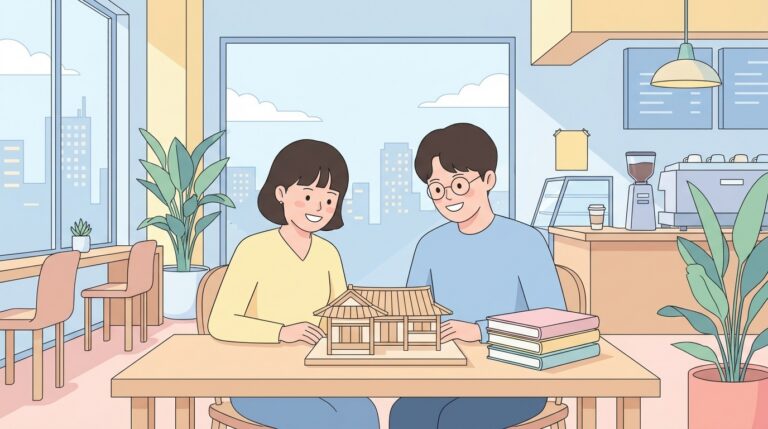
Phase 1: Empathy (Real Talk Over Chimaek)
안녕하세요! 매일한글 에디터입니다.
Picture this: It is a Friday evening in a cozy Hongdae pocha. The aroma of crispy fried chicken fills the air, and glasses of cold beer clink together. But instead of laughing about office gossip, your Korean friends in their late twenties lean in close over an open smartphone screen. On the screen isn’t a social media feed—it is a real estate app showing sky-high studio apartment deposit prices in Seoul, followed by news clips about astronomical private academy (hagwon) fees.
One friend sighs deeply, rubs their temples, and says: “결혼? 집값 생각하면 엄두도 안 나 (Gyeolhon? Jip-gap saenggakhamyeon eomdudo an na – Marriage? Considering housing prices, I can’t even dream of it).” If you follow K-Dramas like Because This Is My First Life or watch Korean lifestyle vlogs, you have likely noticed this recurring dilemma. Korea’s ultra-low birthrate and aging society are not abstract government statistics; they represent daily financial anxieties felt by every young adult.
Understanding these realities transforms how you communicate. Instead of asking surface-level questions that might cause unintended awkwardness, you will learn to navigate these delicate topics with natural empathy, just like a true local insider.
Phase 2: Core Expressions Deep Dive
1. 집값이 너무 비싸요 (Jipgabi neomu bissayo)
- Pronunciation: [Jip-ga-bi neo-mu bis-sa-yo] (Sounds like “Jeep-gah-bee nuh-moo bee-ssah-yo”)
- Meaning: Literal: “House prices are too expensive.” | Real Nuance: “Finding an affordable place to live feels nearly impossible right now.”
- K-Culture Moment: Seen in nearly every modern slice-of-life drama where characters review their monthly budget or sigh outside real estate agencies (b不動san).
- Editor’s Insight: Jip means house/home, and gap means price. Koreans use this as an immediate shorthand to explain why settling down or getting married feels out of reach.
- Situation Spectrum: Casual ✅ | Semi-formal ✅ | Formal ✅
- 🤔 Think About It: In many Western countries, renting long-term is common and socially accepted. In Korea, having stable housing (often through the unique Jeonse lump-sum deposit system) is traditionally viewed as a prerequisite for marriage. How does housing shape adult milestones in your home country?
2. 사교육비가 부담돼요 (Sagoyukbiga budamdoeyo)
- Pronunciation: [Sa-gyo-yuk-bi-ga bu-dam-dwae-yo] (Sounds like “Sah-gyo-yook-bee-gah boo-dahm-dweh-yo”)
- Meaning: Literal: “Private education expenses are burdensome.” | Real Nuance: “The financial pressure to pay for after-school academies (hagwons) to keep up is overwhelming.”
- K-Culture Moment: Think of dramas like Sky Castle or Crash Course in Romance, where parents spend a huge fraction of household income on cram schools.
- Editor’s Insight: Sagoyuk refers to private tutoring/cram schools, contrasting with gong-gyoyuk (public education). The verb budamdoeda reflects mental and financial pressure carrying heavy emotional weight.
- Situation Spectrum: Casual ✅ | Semi-formal ✅ | Formal ✅
- 🤔 Think About It: Does your society place hyper-focus on standardized competition from childhood, or is extracurricular learning considered an optional hobby?
3. 결혼은 아직 엄두가 안 나요 (Gyeolhoneun ajik eomduga an nayo)
- Pronunciation: [Gyeol-ho-neun a-jik eom-du-ga an na-yo] (Sounds like “Gyul-ho-noon ah-jeek um-doo-gah ahn nah-yo”)
- Meaning: Literal: “I cannot bring myself to think of marriage yet.” | Real Nuance: “I can’t even dare to fathom marriage given my current reality.”
- K-Culture Moment: Often heard on variety shows like I Live Alone when guests are asked about future family plans.
- Editor’s Insight: Eomdu-reul naeda means gathering the mental courage or capacity to even consider undertaking something daunting. Adding an nayo shows emotional self-protection against unattainable pressure.
- Situation Spectrum: Casual ✅ | Semi-formal ✅ | Formal ⚠️
- 🤔 Think About It: Notice how Korean expresses feeling overwhelmed not by saying “I refuse,” but rather by stating that the circumstance does not allow one to even conceive the possibility.
Phase 3: Textbook Korean vs. Real Korean
Scenario 1: Talking About Seoul Rent & Housing
- 📖 교과서 한국어: 주택 가격이 상승하여 살 집을 구하기 어렵습니다. (Jutaek gagyeogi sangseunghayeo sal jibeul guhagi eoryeopseumnida. – Housing prices have increased, making it difficult to find a home.)
- 🗣️ 진짜 한국어: 집값이 미쳐서 서울에 내 집 마련은 꿈도 못 꿔요. (Jipgabi michyeoseo Seoure nae jip maryeoneun kkumdo mot kkwoyo. – Housing prices are crazy, so buying my own home in Seoul is beyond my wildest dreams.)
- 💡 왜 다를까?: In real conversations, young Koreans use figurative words like michyeotta (it is insane/crazy) and idioms like kkumdo mot kkwoda (can’t even dream of it) to vent shared social helplessness.
Scenario 2: Explaining Why People Postpone Children
- 📖 교과서 한국어: 자녀 교육비 지출이 경제적으로 큰 부담이 됩니다. (Janyeo gyoyukbi jichuri gyeongjejeogeuro keun budami doemnida. – Expenditures on children’s education are a significant economic burden.)
- 🗣️ 진짜 한국어: 애 하나 키우는 데 학원비가 너무 깨져요. (Ae hana kiuneun de hagwonbiga neomu kkaejyeoyo. – Raising just one kid drains so much cash on cram schools.)
- 💡 왜 다를까?: Native speakers favor vivid verbs like kkaejida (literally ‘to break/shatter’, meaning money flies out uncontrollably) instead of formal bureaucratic nouns like jichul (expenditures).
Phase 4: K-Culture Deep Dive & Non-Verbal Manners
4-1. Nunchi & Mindful Gestures
When discussing marriage or children with Koreans in their 20s and 30s:
* The Empathetic Sigh (Hansum): When someone brings up rent or living costs, never dismiss it with “It’s tough everywhere.” Instead, let out a soft nod and small sigh (aigo… geureochyo), signaling solidarity.
* Avoid Direct Inquiries: Never open with “Why aren’t you married yet?” (Wae gyeolhon an haeyo?). This triggers intense marital stress (myeongjeol stress). Instead, ask neutrally: “요즘 일은 어때요? (Yojeum ireun eottaeyo? – How are things with work these days?)”.
* The Two-Hand Drink Pour: If someone opens up about their financial pressures over dinner, pour their drink using both hands to show respect and attentive listening.
4-2. Cultural Code: The ‘N-Po Generation’ & ‘Yeong-Kkeul’
Young Koreans coined the term N-po sedae (N-giving-up generation), reflecting how young adults have historically had to give up dating (yeonae), marriage (gyeolhon), and childbirth (chulsan). Those who did buy homes often had to resort to Yeong-kkeul (pulling together every ounce of soul and debt). In K-Pop and indie music, lyrics increasingly celebrate personal survival and smaller daily joys (sohwakhaeng) over traditional family milestones.
Phase 5: Real Roleplay Scenario
Setting: A quiet café in Euljiro after work. You are sharing coffee with Minji (30, UX designer) who recently attended a college friend’s wedding.
- Minji: 오늘 친구 결혼식 다녀왔는데, 기분이 좀 묘하더라고요. (Oneul chingu gyeolhonsik danyeowanneunde, gibuni jom myohadeoragoyo.)
🎭 Sighs gently while stirring her iced Americano.
“I went to a friend’s wedding today, and I felt kind of conflicted.” - You: 왜요? 결혼식 보니까 이런저런 생각이 들었어요? (Waeyo? Gyeolhonsik bonikka ireonjeoreon saenggagi deureosseoyo?)
🎭 Leaning forward with a comforting, interested gaze.
“Why? Did seeing the wedding make you think about various things?” - Minji: 네. 축하하는 마음 반, 현실적인 걱정 반이에요. 서울 집값 보면 막막하잖아요. (Ne. Chukahaneun maeum ban, hyeonsiljeogin geokjeong banieyo. Seoul jipgap bomyeon mangmakajanayo.)
🎭 Smiles wryly, touching her forehead.
“Yeah. Half happy for them, half practical worry. Looking at Seoul housing prices, it feels so hopeless.” - You: 맞아요. 요즘 내 집 마련하는 게 진짜 쉽지 않죠. (Majayo. Yojeum nae jip maryeonhaneun ge jinjja swipji anchyo.)
🎭 Nodding slowly in agreement.
“Right. Securing a home of one’s own these days is really not easy.” - Minji: 게다가 나중에 아이 낳으면 사교육비도 만만치 않잖아요. (Gedaga najunge ai naeumyeon sagoyukbido manmanchi anchanayo.)
🎭 Gazing out the window thoughtfully.
“Besides, if you have a child later, private education expenses are no joke either.” - You: 다들 그 부담 때문에 결혼을 망설이는 것 같아요. (Dadeul geu budam ttaemune gyeolhoneul mangseorineun geot gatayo.)
🎭 Speaking in a calm, validating tone.
“It seems everyone hesitates to marry because of that very burden.” - Minji: 맞아요. 그래서 저도 결혼은 아직 엄두가 안 나요. (Majayo. Geuraeseo jeodo gyeolhoneun ajik eomduga an nayo.)
🎭 Taking a slow sip of coffee and giving a faint smile.
“Exactly. That’s why I can’t even fathom marriage just yet.” - You: 충분히 이해해요. 우선 내 생활을 지키는 게 먼저니까요. (Chungbunhi ihaehaeyo. Useon nae saenghwareul jikineun ge meonjeonikkayo.)
🎭 Offering a warm, reassuring smile.
“I totally understand. Protecting your own well-being comes first.”
🔀 Interactive Decision Point
How would you respond if Minji asks: “Do you think people in your country also worry this much about having children?”
- Option A: “당연하죠! 어디나 집값과 사교육비 문제는 다 심각해요. (Dangyeonhajyo! Eodina jipgapgwa sagoyukbi munjeneun da simgakaeyo. – Of course! Housing and education are serious everywhere.)”
- Feedback (Risk): While true, it can unintentionally brush aside Korea’s distinct, hyper-competitive pressure on childhood academies.
- Option B: “부담은 비슷하지만, 한국처럼 사교육 경쟁이 치열하진 않은 것 같아요. (Budameun biseuthajiman, hangukcheoreom sagoyuk gyeongjaengi chiyeolhajin aneun geot gatayo. – The burden is similar, but private tutoring competition doesn’t seem quite as fierce as in Korea.)”
- Feedback (Best): Thoughtful and balanced! It acknowledges universal struggles while showing deep empathy for Korean structural pressures.
- Option C: “그냥 걱정하지 말고 일단 결혼해서 낳으면 다 키워져요! (Geunyang geokjeonghaji malgo ildan gyeolhonhaeseo naeumyeon da kiwojyeoyo! – Just don’t worry, once you get married and have kids, it all works out!)”
- Feedback (Bad): Known in Korea as kkondae (out-of-touch boomer) advice. It completely invalidates the speaker’s practical anxieties.
Phase 6: 10-Second Emotion Shadowing Drill
Practice matching the cadence and emotion using the breath pauses (/):
[😮💨 한숨 쉬며 씁쓸하게 - Sighing with mild resignation]
솔직히 / 서울 집값 생각하면 / 결혼은 꿈도 못 꿔요.
(Soljiki / Seoul jipgap saenggakhamyeon / gyeolhoneun kkumdo mot kkwoyo.)
“Honestly / when I think of Seoul house prices / marriage is impossible to dream of.”-
[🥺 공감하며 조심스럽게 - Deeply empathetic and gentle]
아이 키우는 데 / 사교육비 부담이 / 정말 크죠.
(Ai kiuneun de / sagoyukbi budami / jeongmal keujyo.)
“When raising a kid / the burden of academy costs / is truly massive, right?” -
[💪 담담하지만 현실적으로 - Calm yet grounded in reality]
지금은 / 제 삶 하나 챙기기도 / 벅찬 것 같아요.
(Jigeumeun / je sam hana chaenggigido / beokchan geot gatayo.)
“Right now / just taking care of my own single life / feels overwhelming.”
Phase 7: K-Culture Mini Dictionary
-
내 집 마련 (Nae jip maryeon)
Translation: Securing one’s own home / Becoming a homeowner.
Usage: Considered one of the highest socio-economic milestones in Korean adult life. Often used in sentences like: 내 집 마련의 꿈 (The dream of owning one’s home). -
사교육비 (Sagoyukbi)
Translation: Private education / cram school expenses.
Usage: Refers to tuition for math academies, English kindergartens, and essay coaching. A staple subject in economic news and dinner table debates. -
딩크족 (Dingkeujok)
Translation: DINK (Dual Income, No Kids) couple.
Usage: Widely used in modern Korean urban slang to describe married couples who deliberately choose financial stability and personal freedom over having children. -
갓생 (Gatsaeng)
Translation: Living an exemplary, diligent life (God + Saeng [Life]).
Usage: Rather than saving for an unattainable house, many Korean twenty-somethings focus on “God-saeng”—building daily micro-routines, fitness, certifications, and personal hobbies.
Phase 8: Traveler & Expat Survival Kit
Top 3 Practical Phrases
- 요즘 방값이 많이 올랐어요? (Yojeum banggabi mani ollasseoyo?)
Romanization: Yojeum banggabi mani ollasseoyo?
Pro Tip: Use this when casually chatting with your local real estate agent (budeongsan) or Airbnb host to break the ice about neighborhood vibes. - 물가가 진짜 많이 올랐네요. (Mulgaga jinjja mani ollanneyo.)
Romanization: Mulgaga jinjja mani ollanneyo.
Pro Tip: A universal bonding phrase when seeing prices at supermarkets or traditional markets. - 무리하지 마세요. (Murihaji maseyo.)
Romanization: Murihaji maseyo.
Pro Tip: Means “Don’t overwork/overextend yourself.” Perfect when a Korean friend looks exhausted from juggling job hunting and financial stress.
Editor’s Travel Note
Curious about why housing dominates Korean headlines? While traveling in Seoul, you can look up real-time apartment purchase and lease values yourself. Check out 네이버 부동산 웹사이트 to view district-by-district deposits in Gangnam vs. Mapo. To navigate local neighborhoods and spot apartment complexes firsthand, install and explore the 네이버 지도 앱.
Phase 9: “One Step Deeper” (Societal Insight)
In traditional Korea, family lineage and communal responsibility were paramount; reaching adulthood without marriage was historically viewed as incomplete. However, contemporary Korean youth live in a hyper-dense society shaped by intense educational credentialism and steep asset divergence. Choosing not to marry or have children is rarely an act of rebellion—rather, it is a calculated, rational decision by young people who want to avoid passing financial instability down to the next generation.
💬 Your Turn: In your home country, what is the #1 reason young people hesitate to start a family or buy a home? Drop your perspective in the comments below!
Phase 10: FAQ & Avoiding Misunderstandings
Q: Is it considered rude to ask someone in their 20s or 30s why they aren’t married?
A: Yes, in modern Korean social etiquette, asking directly about marriage status (Wae gyeolhon an haeyo?) is considered intrusive unless you are intimate friends. Stick to asking about their current hobbies, work projects, or travel plans.
Q: What is the difference between 사교육 (sagoyuk) and 공교육 (gonggyoyuk)?
A: Gonggyoyuk refers to government-funded public school education. Sagoyuk refers strictly to paid private education such as after-school cram schools (hagwon), online lecture packages (in-gang), and private tutors (gwa-oe).
Q: Does the word 엄두가 안 나다 (eomduga an nada) only apply to marriage?
A: Not at all! You can use it whenever any task feels psychologically overwhelming. For example: “할 일이 너무 많아서 시작할 엄두가 안 나요 (Hal iri neomu manhaseo sijakhal eomduga an nayo – I have so much work that I can’t even fathom starting).”
🚨 Common Mistakes Board
- Mistake 1: Translating “house” always as jip without particles, saying Jip bissayo instead of Jipgabi bissayo (It’s the housing price that is high).
- Mistake 2: Using Bansanghoe (neighborhood tenant meeting) terms in casual talks. Keep it simple: use hagwonbi (cram school fees) instead of overly bureaucratic policy jargon.
- Mistake 3: Assuming someone without kids is looking for advice. Young Koreans appreciate commiseration (Matjyo, hyeonsiri manmanchi anchyo), not unsolicited motivational lectures!
Phase 11: Action Mission & Engagement
- 🥉 Bronze Mission (Solo Practice): Stand in front of your mirror and practice the emotion shadowing sentence: 결혼은 아직 엄두가 안 나요 (Gyeolhoneun ajik eomduga an nayo) with genuine vocal restraint.
- 🥈 Silver Mission (Social Share): Share a short Instagram Story or language journal entry using the word 내 집 마련 (Nae jip maryeon) in a simple sentence.
- 🥇 Gold Mission (Live Conversation): Next time you talk with a Korean language exchange partner, gently ask: 요즘 한국 청년들 사이에서 집값이나 사교육비 부담 이야기가 많이 나오던데, 어떻게 생각하세요? (I hear young Koreans talk a lot about housing and education costs these days; what are your thoughts?)
🎮 K-Culture Mission: Watch an episode of a recent slice-of-life K-Drama (such as My Liberation Notes or Our Blues). Spot at least one moment where characters talk about commuting from satellite cities or saving money, and note the expressions they use!
Phase 12: Interactive Quiz Challenge
1. Situation Judgment: Your coworker mentions they are working overtime every weekend to save for an apartment deposit. Which response displays the best cultural empathy?
* A) 왜 그렇게 돈만 모아요? 여행이나 가세요! (Why only save money? Go travel!)
* B) 내 집 마련하기가 정말 쉽지 않죠. 건강 챙기면서 무리하지 마세요. (Buying a home is really not easy. Please take care of your health and don’t overdo it.)
* C) 집은 나중에 사도 돼요. (You can just buy a house later.)
2. Fill in the Blank: “서울에서는 집값이 너무 비싸서 혼자 살 집을 구할 ( ______ ) 안 나요.”
* A) 엄두가 (eomduga)
* B) 인심이 (insimi)
* C) 핑계가 (pinggyega)
3. True or False: In Korea, Sagoyukbi refers solely to college university tuition fees paid to the state.
* [True / False]
Click to reveal answers & explanations!
- Answer: B. Validating how difficult nae jip maryeon is while telling them not to overwork (murihaji maseyo) is the most thoughtful, culturally attuned response.
- Answer: A (엄두가). The phrase 엄두가 안 나다 (eomduga an nada) means to not even be able to fathom or muster the courage to attempt something due to overwhelming circumstances.
- Answer: False. Sagoyukbi refers to private education and cram schools (hagwons), whereas official public school tuition falls under gonggyoyuk.







