

안녕하세요! 매일한글 에디터입니다.
Have you ever walked into a high-stakes board meeting in Seoul where the air felt so cold you could cut it with a knife? Picture this: An ambitious quarterly review at a top-tier Pangyo tech firm. An experimental AI feature launch misses its initial KPI by 15%. In traditional corporate dramas like Misaeng (미생), this moment would trigger a storm of table-slamming, bowed heads, and executives asking, “누가 책임질 거야?” (Who is going to take responsibility for this?). But today’s innovative Korean enterprises are undergoing a tectonic cultural shift. Progressive HR leaders are actively dismantling the toxic blame game to install 심리적 안전감 (psychological safety)—creating spaces where teams pivot from asking “Who screwed up?” to “What did we learn?”
If you are an executive, HR strategist, or ambitious professional working with Korean teams, mastering this transition is not just about vocabulary; it is about establishing executive credibility. Navigating this delicate balance between traditional Korean hierarchical respect and modern agility requires high-precision, C1-level Korean. Today’s guide is crafted directly from field interviews with HR directors in Pangyo and Yeouido who transformed risk-averse teams into creative powerhouses. Let’s explore how to lead this cultural revolution fluently.
Phase 2: Core Expressions in Depth
1. 실패를 문책하기보다는 배움의 기회로 삼아야 합니다.
- Pronunciation: Silpaereul munchaekhagibodaneun baeumui gihoero sam-aya hamnida (Think of ‘mun-chaek’ sounding crisp like a judge’s gavel strike: MOON-check).
- Meaning: Rather than penalizing or censuring failure, we must treat it as an opportunity for learning.
- K-Culture Moment: In the startup drama Start-Up, Sandbox CEO Yoon Seon-hak reassures young entrepreneurs that stumbling early in an incubator is not an offense, but the very prerequisite for breakthrough innovation.
- Editor’s Insight: While everyday language uses “혼내다” (to scold) or “탓하다” (to blame), the C1 executive term is 문책하다 (問責하다)—formally holding someone accountable and imposing censure. Pairing it with “~기보다는” creates an authoritative yet enlightened leadership posture.
- Situation Spectrum: Casual 🚫 | Semi-formal ⚠️ | Formal ✅
- 🤔 Think About It: In your native workplace culture, does admitting an error signal transparency or incompetence? How does the formal Korean structure of “배움의 기회로 삼다” shift the ownership from an individual flaw to an organizational asset?
2. 조직 내 심리적 안전감을 구축하는 것이 혁신의 전제조건입니다.
- Pronunciation: Jojik nae simrijeok anjeongameul guchukhaneun geosi hyeoksinui jeonjejogeonimnida (Flow ‘sim-ri’ softly like SHIM-ree, contrasting with the punchy, resolute JEON-JE-JO-GEON).
- Meaning: Establishing psychological safety within the organization is an absolute prerequisite for innovation.
- K-Culture Moment: Think of the boardroom turning points in corporate series like Agency (대행사), where the forward-thinking creative director dismantles stifling silences to let unconventional copy ideas breathe.
- Editor’s Insight: 전제조건 (Prerequisite) is a powerhouse word in executive Korean. It signals strategic foresight. Instead of treating psychological safety as a fluffy HR perk, this phrasing frames it as the foundational infrastructure without which business growth cannot occur.
- Situation Spectrum: Casual 🚫 | Semi-formal ⚠️ | Formal ✅
- 🤔 Think About It: Why do you think modern Korean enterprises have borrowed the academic concept of ‘심리적 안전감’ directly into executive HR strategy instead of using a purely traditional idiom?
3. 두려움 없이 과감하게 도전할 수 있는 문화를 조성합시다.
- Pronunciation: Duryeoum eopsi gwagamhage dojeonhal su inneun munhwareul joseonghapsida (Emphasize the bold cadence of GWA-GAM-HA-GE, rhyming with assertive decision-making).
- Meaning: Let us foster an organizational culture where people can undertake bold challenges without fear.
- K-Culture Moment: Heard during strategic town halls at Korea’s agile giants like Toss or Kakao, urging engineers to deploy experimental features without fear of administrative reprimands.
- Editor’s Insight: 조성하다 (To foster/curate) denotes deliberate, systemic cultivation rather than passive hope. Combining it with 과감하게 (audaciously/boldly) provides an inspiring, visionary close to any organizational change proposal.
- Situation Spectrum: Casual 🚫 | Semi-formal ✅ | Formal ✅
- 🤔 Think About It: Compare the English phrase “fail fast” with the Korean executive preference for “과감한 도전” (bold challenge). Notice how Korean corporate discourse tends to elevate the honor of the attempt rather than celebrating the word ‘failure’ itself.
Phase 3: Textbook Korean vs. Real Korean
Situation 1: Responding to a Missed Target in a Strategy Review
- 📖 교과서 한국어: 우리는 직원의 실수를 비판하지 않고 용서합니다. (Uri-neun jigwon-ui silsu-reul bipanhaji anko yongseohamnida. / “We do not criticize our employees’ mistakes and forgive them.”)
- 🗣️ 진짜 한국어: 시도 과정에서의 시행착오는 자산으로 삼고, 철저한 복기를 통해 레슨을 도출합시다. (Sido gwajeong-eseoui sihaengchago-neun jasan-euro samgo, cheoljeohan bokgi-reul tonghae reseun-eul dochulhapsida. / “Let’s treat trial-and-error in the experimental process as an organizational asset and extract lessons through a thorough post-mortem.”)
- 💡 왜 다를까? Executive business Korean never uses “용서하다” (to forgive), which sounds patronizing and paternalistic. Instead, C1 leaders use technical terms like 시행착오 (trial and error) and borrow the Go (바둑) term 복기 (reviewing every move step-by-step).
Situation 2: Encouraging Unfiltered Feedback in Team Workshops
- 📖 교과서 한국어: 여러분의 솔직한 생각을 자유롭게 말해 보세요. (Yeoreobun-ui soljikhan saenggak-eul jayurobge malhae boseyo. / “Please freely state your honest thoughts.”)
- 🗣️ 진짜 한국어: 정답이 아니어도 좋으니, 날것의 아이디어라도 편하게 던져주세요. (Jeongdabi anieodo joeuni, nalgeot-ui aidieorado pyeonhage deonjyeojuseyo. / “It doesn’t have to be the definitive right answer; please feel free to toss out raw, unpolished ideas.”)
- 💡 왜 다를까? Saying “자유롭게 말하세요” often paralyzes junior Korean team members due to deep-seated hierarchical conditioning. Specifying that ideas can be 날것 (raw/unfiltered) instantly disarms the fear of looking unprepared.
Phase 4: K-Culture Deep Dive & Non-Verbal Manners
4-1. Executive Nunchi & Physical Presence
When cultivating psychological safety, your non-verbal cues hold more weight than your slide deck. In traditional Korean hierarchy, an executive leaning back with crossed arms while saying “편하게 말씀하세요” (Speak comfortably) creates acute cognitive dissonance—your team’s 눈치 (Nunchi) radar will register high alert, and silence will follow.
* The Head Tilt and Open Posture: When a junior employee shares an experimental, imperfect proposal, lean slightly forward, rest your hands loosely open on the desk (never clenched or holding a pointed pen), and nod slowly (끄덕임).
* Gaze Leveling: Avoid staring intensely into their eyes without blinking, which can feel like an interrogation (심문). Soften your eye contact, shifting momentarily to their slides or notes to let them articulate difficult technical roadblocks without feeling cornered.
4-2. The Pangyo Shift: From Sincerity-Based Hierarchy to Agile Psychological Safety
For decades, the standard Korean chaebol ethos rested on Gunggi (군기, military-like discipline) and flawless execution. However, the rise of South Korea’s tech ecosystem in Pangyo (판교)—often dubbed Korea’s Silicon Valley—has forced traditional giants to overhaul their compensation and corporate governance models.
In modern Korean agile teams, psychological safety is systematically reinforced by eliminating corporate titles (switching to English names or appending ‘님’ equally to interns and VPs) and replacing seniority-based pay with 직무·성과 중심 보상 (job- and performance-based compensation). In this new paradigm, hoarding information out of fear of punishment is penalized, while documenting and sharing a failed launch retrospective is celebrated as institutional knowledge.
Phase 5: Real-World Roleplay Scenario
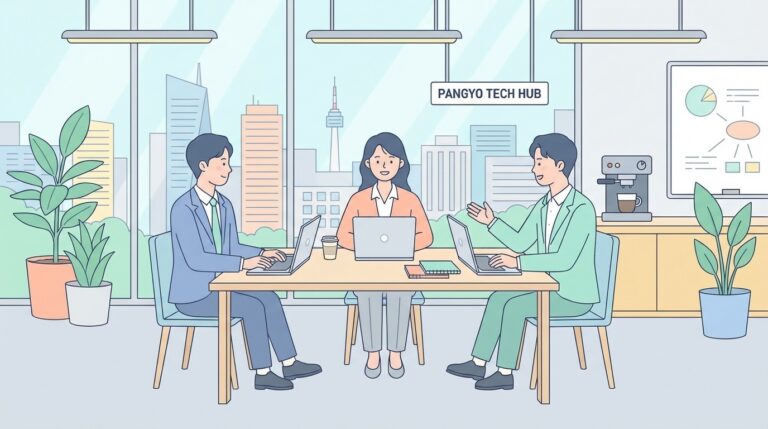
Setting: A sunlit strategy room in Pangyo. Sarah (Global Chief People Officer) meets with Min-jun (Head of Engineering Strategy) after an innovative algorithm test failed to meet user retention metrics.
- Sarah: 민준 님, 이번 파일럿 프로젝트 결과 보고서 확인했습니다. 팀 분위기는 좀 어떤가요? (Min-jun nim, ibeon pailleot peurojekteu gyeolgwa bogoseo hwaginhaetseumnida. Tim bunwigineun jom eotteongayo? / “Min-jun, I reviewed the pilot project results report. How is the team atmosphere holding up?”)
- Min-jun: 🎭 긴장된 표정으로 서류를 매만지며 (Ginjangdoen pyojeong-euro seoryureul maemanjimyeo / Fingering the documents with a tense expression) 솔직히 말씀드리면, 팀원들이 목표치를 달성하지 못해 문책을 당할까 봐 많이 위축되어 있습니다. (Soljikhi malsseumdeurimyeon, timwondeuri mokpyochireul dalseonghaji mothae munchaegeul danghalgga bwa mani wichukdoeeo itsseumnida. / “To be frank, the team is quite intimidated, fearing they might be reprimanded for missing our targets.”)
- Sarah: 🎭 따뜻하고 단호한 미소를 지으며 고개를 젓는다 (Ttatteuthago danhohan misoreul jieumyeo gogaereul jeotneunda / Shakes head gently with a warm yet resolute smile) 전혀 그럴 필요 없습니다. 실패를 문책하기보다는 배움의 기회로 삼아야죠. (Jeonhyeo geureol piryo eopsseumnida. Silpaereul munchaekhagibodaneun baeumui gihoero sam-ayajo. / “There is absolutely no need for that. Rather than blaming failure, we must turn it into a learning opportunity.”)
- Min-jun: 그렇게 말씀해 주시니 다행입니다만, 경영진 보고 자리에서 비판을 피하기 어려울 것 같습니다. (Geureoke malsseumhae jusini dahaeng-imnidaman, gyeong-yeongjin bogo jarieseo bipaneul pihagi eoryeoul geot gatseumnida. / “I am relieved to hear you say that, but I worry it will be hard to avoid harsh criticism during the executive board briefing.”)
- Sarah: 제가 방패가 되어 드릴게요. 조직 내 심리적 안전감을 구축하는 것이 우리 혁신의 전제조건입니다. (Jega bangpaega doeeo deurilgeyo. Jojik nae simrijeok anjeongameul guchukhaneun geosi uri hyeoksinui jeonjejogeonimnida. / “I will be your shield. Fostering psychological safety across the organization is the prerequisite for our innovation.”)
- Min-jun: 🎭 어깨의 긴장을 풀며 안도하는 눈빛 (Eokkae-ui ginjang-eul pulmyeo andohaneun nunbit / Relaxes shoulders with a visibly relieved gaze) 감사합니다, Sarah 님. 그렇다면 이번 주에 팀 전체와 실패 분석 대신 ‘학습 회고’ 세션을 진행해도 될까요? (Gamsahamnida, Sarah nim. Geureotdamyeon ibeon jue tim jeonchewa silpae bunseok daesin ‘hakseup hoego’ sesyeoneul jinhaenghaedo doelgkayo? / “Thank you, Sarah. In that case, may I run a ‘learning retrospective’ with the whole team this week instead of a failure analysis?”)
- Sarah: 아주 좋습니다! 두려움 없이 과감하게 도전할 수 있는 문화를 함께 조성해 봅시다. (Aju jotseumnida! Duryeoum eopsi gwagamhage dojeonhal su inneun munhwareul hamkke joseonghae bopsida. / “Excellent! Let’s foster a culture together where people can embrace bold challenges without fear.”)
- Min-jun: 네! 이번 시행착오를 밑거름 삼아 다음 스프린트에서 더 정교한 가설로 보답하겠습니다. (Ne! Ibeon sihaengchagoreul mitgeoreum sama daeum seupeurinteueseo deo jeonggyohan gaseollo bodaphagetseumnida. / “Understood! We will use this trial-and-error as fuel to deliver a far more refined hypothesis in the next sprint.”)
🔀 Interactive Decision Point
How should Sarah close the strategic briefing to reassure the wider engineering division?
* Option A: “누가 어떤 실수를 했는지 명확히 짚고 넘어가야 다음에 조심하겠죠.” (Nu-ga eotteon silsu-reul haenneunji myeonghwakhi jipgo neomeogayaji da-eume josimhagyetjyo.)
* Option B: “결과에 상관없이 시도 자체가 위대했으니 아무 분석도 하지 맙시다.” (Gyeolgwa-e sanggwan-eopsi sido jache-ga widaehaesseuni amu bunseokdo haji mapsida.)
* Option C: “과감한 도전 끝의 실패는 성장의 자산입니다. 투명하게 회고하고 다음 도약으로 연결합시다.” (Gwagamhan dojeon kkeut-ui silpae-neun seongjang-ui jasan-imnida. Tumyeonghage hoegohago daeum doyag-euro yeongyeolhapsida.)
Strategic Feedback:
* Selection A (Bad): Reverts immediately to classic punitive management. This destroys psychological safety overnight and guarantees team members will conceal future risks.
* Selection B (Risk): Excessive toxic positivity. Psychological safety does not mean abandoning rigor; without analytical retrospectives, failure becomes chronic negligence.
* Selection C (Best): Balances empathy with executive excellence. It honors the courage of innovation while institutionalizing learning through structured post-mortems.
Phase 6: 10-Second Emotion Shadowing Drill
Practice these high-impact executive cadences. Emphasize pauses at the slashes (/).
[💼 차분하면서도 확신에 차서]
실패를 문책하기보다는 / 배움의 기회로 삼는 것이 / 진정한 리더십입니다.
(Silpaereul munchaekhagibodaneun / baeumui gihoero samneun geosi / jinjeonghan rideosip-imnida.)-
[🤝 포용력 있고 흔들림 없는 어조로]
조직 내 심리적 안전감이 확보되어야 / 구성원들이 과감하게 혁신을 시도합니다.
(Jojik nae simrijeok anjeongam-i hwakbodoeeoya / guseongwondeur-i gwagamhage hyeoksineul sidohamnida.) -
[🚀 팀의 사기를 진작시키는 활기찬 톤으로]
실패를 두려워하지 말고 / 과감하게 도전할 수 있는 환경을 / 함께 만듭시다!
(Silpaereul duryeowohaji malgo / gwagamhage dojeonhal su inneun hwan-gyeong-eul / hamkke mandeupsida!)
Phase 7: K-Culture Mini Dictionary
-
심리적 안전감 (Simrijeok Anjeongam) | Psychological Safety
- Meaning: The shared belief that team members will not be humiliated, marginalized, or penalized for speaking up with ideas, questions, concerns, or mistakes.
- Corporate Context: Used in enterprise culture roadmaps and OKR frameworks to benchmark organizational health.
- 복기 (Bokgi) | Retrospective / Post-Mortem
- Meaning: Derived from Go (바둑), meaning to replay every stone played in a match to understand why the game was won or lost.
- Corporate Context: Widely preferred over “반성” (self-reflection/penance) because it implies clinical, objective data analysis rather than moral guilt.
- 문책 (Munchaek) | Administrative Censure / Blame
- Meaning: The act of interrogating an employee to determine fault and issue formal penalties.
- Corporate Context: Often encountered in expressions like “문책성 인사” (punitive demotion/reassignment).
- 직무급 (Jikmugeup) | Job-Based Compensation
- Meaning: A compensation model determined by the market value and complexity of the role rather than traditional tenure/seniority (호봉제).
- Corporate Context: Central to modern talent retention, aligning directly with performance transparency and psychological safety.
Phase 8: Survival Kit for Business Travelers & Global Executives
Top 3 Survival Expressions for High-Stakes Leadership
- 결과도 중요하지만 과정에서의 배움도 큽니다.
- Gyeolgwa-do jung-yohajiman gwajeong-eseoui baeum-do keumnida.
- Pro Tip: Use this phrase at the start of a tough review to drop everyone’s defensive guard immediately.
- 편안하게 터놓고 논의해 봅시다.
- Pyeon-anhage teonohko non-uihae bopsida.
- Pro Tip: Replaces the awkward “Feel free to talk” with a collaborative invitation to “lay our cards comfortably on the table.”
- 리스크를 감수한 도전은 인사고과에서 불이익을 받지 않습니다.
- Riseukeu-reul gamsuhan dojeon-eun insagogwa-eseo bur-iig-eul batji anseumnida.
- Pro Tip: Direct HR commitment ensuring calculated risk-taking will not hurt formal performance evaluations.
Editor’s Business Travel Note
When leading Korean teams through culture changes, pay close attention to anonymous employee feedback tools. Download the Blind app on the Google Play Store to understand what verified employees at leading Korean companies truly discuss regarding leadership culture and toxic management. If organizing a post-meeting informal dinner (회식), remember that psychological safety extends beyond the conference room: never force anyone to drink alcohol, and wrap up by 9:00 PM to respect personal boundaries.
Phase 9: Deep Cultural Reflection (한 발 더 깊이)
Traditional Korean corporate dynamics were shaped for decades by Chaemyeon (체면, face-saving) and collective cohesion. In that environment, an admitted failure was not seen merely as a failed experiment; it risked causing the entire group to lose face, driving individuals to deflect accountability or remain perpetually silent. What we are witnessing across modern Korean industry is a profound philosophical realignment. Progressive organizations recognize that high-velocity global markets render the old “zero-defect, zero-risk” model obsolete. By cultivating psychological safety, Korean leadership is harmonizing its legendary collective focus with the individual liberty to innovate without dread.
💬 Your Turn: How does your team handle the friction between formal performance reviews and safe-to-fail experimentation? Share your perspective in the comments below!
Phase 10: FAQ & Common Pitfalls
Q: Does cultivating “심리적 안전감” mean leaders cannot hold Korean employees accountable for bad work?
A: Absolutely not. Psychological safety is about creating climate safety for candor, not lowering standards. In executive Korean, you distinguish between 태만 (negligence/slack) and 과감한 시도에 따른 실패 (failure resulting from bold experimentation). Negligence is strictly managed, while experimental failures are analyzed via 복기.
Q: If I say “편하게 이야기하세요” to my Korean team, why does everyone remain silent?
A: Because verbal permission alone cannot override years of hierarchical social conditioning. Instead of a vague invitation, provide structural safety: explicitly solicit divergent opinions (e.g., “이 기획서의 가장 취약한 점 세 가지만 짚어볼까요?”) and warmly acknowledge the first person who voices a concern.
Q: What is the difference between “실수” and “실패” in an HR strategy context?
A: 실수 (Mistake/Slip-up) usually refers to an accidental operational error or oversight (e.g., typos, forgetting an attachment). 실패 (Failure) refers to a strategic hypothesis or project that did not achieve its intended target despite deliberate effort. Praise bold 실패; build systems to catch accidental 실수.
🚨 Common Mistakes Warning Board
- Mistake: Using “당신 생각은 어때요?” (Dangsin saenggak-eun eottaeyo?) to ask a subordinate’s view.
- Why it fails: In spoken Korean, “당신” can sound confrontational, almost like picking a fight.
- Correct Action: Address them by name and honorific title: “[이름] 님 생각은 어떠세요?”
- Mistake: Saying “책임은 제가 집니다” (I take full responsibility) when you have no institutional power to protect them.
- Why it fails: Empty bravado erodes executive trust rapidly.
- Correct Action: Ground your support in process: “과정의 데이터가 명확하다면, 경영진 보고는 제가 책임지고 설득하겠습니다.”
- Mistake: Confusing “자유로운 분위기” (free-wheeling casualness) with psychological safety.
- Why it fails: A team can drink coffee in hoodies and still be terrified of challenging the CEO’s favorite idea.
- Correct Action: Focus on respectful, structured intellectual debate rather than superficial informality.
Phase 11: Action Missions
- Bronze Mission (Solo Practice): Record yourself delivering Expression 1 using the emotional shadowing marks from Phase 6. Listen back to ensure your tone sounds resolute rather than apologetic.
- Silver Mission (Social/Team Practice): Replace the standard phrase “피드백 부탁드립니다” in your next Slack or email with: “날것의 피드백도 좋으니 편하게 의견 던져주세요.”
- Gold Mission (Real-World Strategic Implementation): In your next one-on-one or sprint retrospective, open with: “이번 스프린트에서 우리가 겪은 가장 가치 있는 시행착오는 무엇이었나요?”
- 🎮 K-Culture Mission: Watch an episode of a modern workplace drama (e.g., Start-Up or Agency). Note every instance where a junior character hesitates before speaking. Identify what phrase or body gesture the senior leader uses to break or reinforce that silence.
Phase 12: Interactive Quiz Challenge
1. Contextual Decision
Your software engineer accidentally took down the staging server while testing an unauthorized optimization script. As an HR strategist advocating for psychological safety, what is the best immediate response?
* (A) “시말서 작성하시고, 다음 인사고과 때 감점될 각오 하세요.”
* (B) “괜찮아요, 아무 문제 없으니 팀원들에게는 비밀로 합시다.”
* (C) “시스템 복구에 집중하고, 재발 방지를 위해 어떤 기술적 안전망이 필요한지 함께 복기해 봅시다.”
2. Fill in the Blank
“조직 내 혁신을 촉진하기 위해서는 실패에 대한 ________보다는 체계적인 학습 지원이 선행되어야 합니다.”
* (A) 문책 (Munchaek)
* (B) 보상 (Bosang)
* (C) 칭찬 (Chingchan)
3. Cultural True or False
Statement: In progressive Pangyo tech companies, using the honorific title ‘~님’ completely eliminates all social hierarchy, making psychological safety effortless.
* (True / False)
Click here for answers and explanations
- Answer: (C)
- Explanation: Option (C) models true psychological safety: it prioritizes operational remediation and objective post-mortem learning without humiliating the contributor.
- Answer: (A) 문책
- Explanation: “실패에 대한 문책” (censuring/reprimanding failure) completes the strategic contrast with “체계적인 학습 지원” (systematic learning support).
- Answer: False
- Explanation: While flattening titles to ‘~님’ lowers conversational friction, true psychological safety requires deep behavioral trust, transparent reward systems, and non-punitive executive responses. Language policy is merely the first step!
- Explanation: While flattening titles to ‘~님’ lowers conversational friction, true psychological safety requires deep behavioral trust, transparent reward systems, and non-punitive executive responses. Language policy is merely the first step!







