

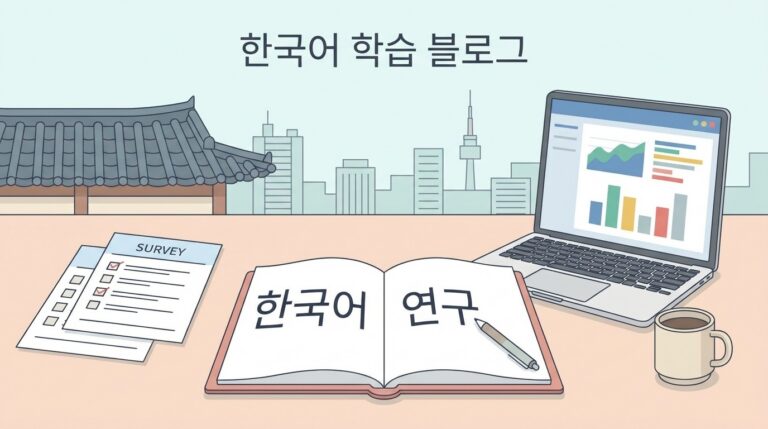
안녕하세요! 매일한글 에디터입니다.
Imagine this scenario: You are sitting in a bustling campus café in Sinchon or at a late-night desk in a university research lab in Daejeon. You’ve spent weeks drafting your survey instrument for your graduate thesis, and you’re preparing your IRB (생명윤리위원회 – Institutional Review Board) documentation. You proudly share your 40-item Likert scale questionnaire with a Korean lab mate, excited to push it live to hundreds of participants. But as they read item number 14, their eyebrows furrow, their head tilts, and they gently ask: “어… 혹시 이 문항이 정확히 어떤 뜻이에요?” (Uh… what exactly does this question mean?)
Translating academic instruments from English or your native tongue into Korean is a notorious minefield. Direct dictionary translations often sound stiff, unnatural, or subtly ambiguous. Before distributing your survey to hundreds of respondents, running a 20-person pilot test (예비 조사) is not just a statistical requirement to verify Cronbach’s alpha (크론바흐 알파)—it’s your cultural safety net. By refining awkward phrasing and measuring internal consistency early on, you prevent catastrophic data loss and win instant respect from your professor (지도교수님) and committee members. Today, let’s unpack the essential intermediate Korean phrases and academic etiquette you need to pilot your study like a seasoned researcher!
1. 본 설문을 배포하기 전에 예비 조사를 실시했어요
- Pronunciation: [Bon seol-mun-eul bae-po-ha-gi jeo-ne ye-bi jo-sa-reul sil-si-hae-sseo-yo] (Tip: Bon sounds like French bon, bae-po rhymes with tempo, and sil-si sounds crisp like silk-see).
- Meaning: “Before distributing the main survey, I conducted a preliminary survey (pilot test).”
- K-Culture Moment: Think of the academic rigor depicted in dramas like Law School or the user-testing chaos in Start-Up (스타트업). Before launching a major app feature or submitting research data to a board, Korean teams always run a structured “예비 조사” (pilot test) to ensure real users comprehend every single prompt without friction.
- Editor’s Insight: “본-” (本) is a formal prefix meaning “the main/primary one” (e.g., 본 설문 = the main survey, 본 연구 = this study). Coupling it with “예비 조사” (preliminary investigation) demonstrates that you understand structured research methodology.
- Situation Spectrum: Casual ⚠️ | Semi-formal ✅ | Formal ✅
- 🤔 Think About It: In English, we often say “I ran a quick pilot.” In Korean academic settings, pairing “본-” with “실시하다” (to conduct/execute) immediately establishes credibility and respect for the scientific process. How does formalizing this step change how your lab peers view your diligence?
2. 모호한 표현을 다듬다
- Pronunciation: [Mo-ho-han pyo-hyeon-eul da-deum-da] (Tip: Mo-ho sounds like “mow-hoe”, and da-deum feels like “dah-deum”).
- Meaning: “To refine / polish ambiguous expressions.”
- K-Culture Moment: In Korean creative and scholarly fields, “다듬다” is an evocative verb originally used for pruning branches, trimming hair, or smoothing rough wood. When an editor or researcher says “문장을 다듬다,” it paints a picture of patiently chiseling away awkward syllables until the thought shines clearly.
- Editor’s Insight: While “수정하다” (to revise/edit) sounds mechanical, “다듬다” carries the nuance of linguistic craftsmanship. It conveys that your initial draft wasn’t necessarily “wrong,” but rather sculpted for smoother comprehension.
- Situation Spectrum: Casual ✅ | Semi-formal ✅ | Formal ✅
- 🤔 Think About It: When you criticize your own draft as “모호하다” (ambiguous) rather than “틀렸다” (incorrect), you open the door to constructive collaboration without sounding defensive. Have you noticed how Korean academics soften self-critique?
3. 문항의 내적 일관성을 확인하다
- Pronunciation: [Mun-hang-ui nae-jeok il-gwan-seong-eul hwa-gin-ha-da] (Tip: Mun-hang rhymes with “moon-hung”, il-gwan-seong flows like “eel-gwan-sung”).
- Meaning: “To verify the internal consistency of the items (questions).”
- K-Culture Moment: In any graduate thesis defense or lab seminar, presenting statistical reliability—specifically Cronbach’s alpha (크론바흐 알파)—is the ultimate badge of honor. Saying this sentence in your lab progress meeting signals that your data isn’t just subjective intuition; it’s backed by robust psychometrics.
- Editor’s Insight: “문항” specifically refers to individual survey/test items, whereas “질문” is a general question you ask someone in conversation. Using “문항” signals that you possess specialized research vocabulary.
- Situation Spectrum: Casual 🚫 | Semi-formal ✅ | Formal ✅
- 🤔 Think About It: Notice the Sino-Korean root “일관” (一貫), which means threaded through by one single thread. Isn’t that a poetic visualization of statistical reliability?
Situation 1: Explaining Survey Item Revisions to Your Sunbae
- 📖 교과서 한국어 (Textbook Korean): 설문지 질문들의 에러를 수정했습니다. (Seolmunji jilmundeur-ui ereoreul sujeonghaesseumnida. – I fixed the errors in the survey questions.)
- 🗣️ 진짜 한국어 (Real Korean): 피드백 반영해서 헷갈리는 문항들을 매끄럽게 다듬었어요. (Pideubaek banyeonghaeseo hetgallineun munhangdeureul maekkeureopge dadeumeosseoyo. – I incorporated the feedback and smoothly polished the confusing items.)
- 💡 왜 다를까?: Native researchers rarely say “에러를 수정하다” (fix errors) regarding phrasing. Instead, using “피드백 반영” (incorporating feedback) and “매끄럽게 다듬다” (smoothly polish) sounds collaborative, humble, and professional.
Situation 2: Announcing Your Pilot Test in Lab Meeting
- 📖 교과서 한국어 (Textbook Korean): 파일럿 테스트를 수행할 예정입니다. (Pailleot teseteureul suhaenghal yejeongimnida. – I am scheduled to execute a pilot test.)
- 🗣️ 진짜 한국어 (Real Korean): 본조사 들어가기 전에, 20명 대상으로 예비 조사 먼저 돌려보려고요. (Bonjosa deureogagi jeone, isim-myeong daesang-euro yebi josa meonjeo dollyeoboryeogoyo. – Before launching the main survey, I’m planning to roll out a pilot test with 20 participants first.)
- 💡 왜 다를까?: In spoken lab communication, “설문을 돌리다” (literally, to spin/run a survey) is the universal idiomatic verb. Pair it with “들어가다” (to enter/launch), and you instantly sound like an insider.
4-1. 눈치 (Nunchi) & Gestures in the Lab
When presenting your pilot survey results to your academic advisor (지도교수님) or senior lab mate (사수 / 선배), non-verbal humility is paramount:
* The Two-Handed Handout: Even if you’re handing over an iPad or a printed pilot summary, hold the document with both hands, thumbs securing the top edges, and give a subtle 15-degree bow.
* Receptive Head Tilt: When a senior colleague points out that an item sounds “어색하다” (awkward), do not immediately explain what you intended to say. Instead, nod slowly, tilt your head slightly downward, and write down their comment immediately in your notebook. In Korean research culture, taking notes during feedback shows immense respect and intellectual maturity.
4-2. The “기프티콘 (Gifticon)” Etiquette for Pilot Testers
In Western universities, a polite “thank you” email might suffice for a 5-minute pilot survey. In Korea, asking 20 peers to scrutinize your survey requires reciprocation! The gold standard is a mobile voucher called a 기프티콘 (Gifticon)—usually a Starbucks Iced Americano (스타벅스 아이스 아메리카노). Sending this via KakaoTalk with a note saying, “바쁘신 와중에 예비 조사 참여해 주셔서 정말 감사합니다! 시원한 커피 한잔 드세요” (Thank you so much for taking part in my pilot survey amidst your busy schedule! Please enjoy a refreshing iced coffee) will ensure enthusiastic and thorough feedback every single time.
- Setting: The human-computer interaction lab at Yonsei University. Late Friday afternoon. Sunlight filters through the blinds, illuminating stacks of IRB forms and half-empty coffee cups.
- Characters: You (Min-su / 민수) (Graduate student preparing a thesis on digital health behaviors) and Ji-won Sunbae (지원 선배) (A meticulous 4th-semester master’s student known for having zero tolerance for sloppy survey methodology).
-
Min-su: 🎭 [Politely approaching Ji-won’s desk with a clipboard and two cold brews] 지원 선배님, 본 설문 배포하기 전에 20명 대상으로 예비 조사 먼저 돌려봤어요. (Jiwon seonbaenim, bon seolmun baepohagi jeone isim-myeong daesang-euro yebi josa meonjeo dollyeobwasseoyo. / Ji-won Sunbae, before distributing the main survey, I ran a pilot test with 20 participants first.)
- Ji-won: 🎭 [Taking off blue-light glasses, intrigued] 오, 민수 씨 벌써 파일럿 돌렸어요? 결과는 어때요? (O, Minsu ssi beolsseo pailleot dollyeosseoyo? Gyeolgwaneun eottaeyo? / Oh, Min-su, you already ran the pilot? How are the results?)
- Min-su: 🎭 [Pointing neatly with a pen at a highlighted table] 응답자들이 몇몇 문항이 모호하다고 해서 표현을 좀 매끄럽게 다듬었어요. (Eungdapjadeuri myeonmyeot munhangi mohohadago haeseo pyohyeoneul jom maekkeureopge dadeumeosseoyo. / Respondents noted that a few items were ambiguous, so I smoothed out and refined the phrasing.)
- Ji-won: 🎭 [Nodding approvingly] 잘했네요. 번역 설문은 한국어 화자가 읽었을 때 자연스러운 게 핵심이니까요. 신뢰도 분석은 해봤어요? (Jalhaenneyo. Beon-yeok seolmuneun hangugeo hwajaga ilgeosseul ttae jayeonseureoun ge haeksim-inikkayo. Sinroedo bunseogeun haebwasseoyo? / Well done. For translated surveys, natural readability for Korean native speakers is key. Did you check the reliability?)
- Min-su: 🎭 [Smiling with quiet confidence, turning the page] 네! 문항 내적 일관성을 확인했는데, 크론바흐 알파 값이 0.84로 양호하게 나왔습니다. (Ne! Munhang naejeok ilgwanseongeul hwaginhaenneunde, keuronbaheu alpa gamsi yeong-jeom-pal-sa-ro yanghohage nawasseumnida. / Yes! I verified the internal consistency of the items, and the Cronbach’s alpha came out favorably at 0.84.)
- Ji-won: 🎭 [Impressed, tapping the desk] 0.84면 훌륭하네! 이대로 IRB 변경 승인 신청서에 파일럿 결과 첨부하면 되겠어요. (Yeong-jeom-pal-sa-myeon hullyunghane! Idaero IRB byeongyeong seung-in sincheongseoe pailleot gyeolgwa cheombuhamyeon doegesseoyo. / 0.84 is fantastic! You can attach these pilot results directly to your IRB amendment request.)
- Min-su: 🎭 [Bowing slightly with genuine gratitude] 꼼꼼히 봐주셔서 감사합니다. 선배님 피드백 덕분에 큰 산 하나 넘었네요! (Kkomkkomhi bwajusyeoseo gamsahamnida. Seonbaenim pideubaek deokbune keun san hana neomeonneyo! / Thank you for checking it so thoroughly. Thanks to your feedback, I’ve cleared a major hurdle!)
- Ji-won: 🎭 [Sipping the iced Americano with a warm smile] 주말에 푹 쉬고, 다음 주에 IRB 서류 마저 마무리해요! (Jumare puk swigo, daeum jue IRB seoryu majeo mamurihaeyo! / Get good rest over the weekend, and let’s wrap up the IRB paperwork next week!)
🔀 Interactive Choice Point: How would you reply if Ji-won asked if the pilot sample included diverse ages?
- Choice A: “아뇨, 그냥 제 동기 20명한테만 부탁했어요.” (No, I just asked 20 of my classmates.)
- 🚫 Feedback (Bad): A homogeneous sample of classmates hurts external validity. In research settings, admitting this bluntly without plans to diversify makes your methodology look fragile.
- Choice B: “IRB 승인 떨어지면 그때 알아서 할게요.” (Once IRB approval drops, I will take care of it then.)
- ⚠️ Feedback (Risk): Sounds dismissive and defensive. In Korean lab culture, hierarchy and mutual consultation are essential.
- Choice C: “우선 가독성 확인용으로 원내 연구원 위주로 돌렸는데, 본조사 때는 연령대를 고르게 표집하겠습니다!” (We first tested with fellow researchers to check readability, but for the main study, we will sample evenly across age cohorts!)
- 🌟 Feedback (Best): Perfect B2 response! It justifies the pilot’s specific goal (가독성 – readability) while promising sound methodological rigor for the main phase.
Practice reading these out loud. Pay close attention to the pause markers (/) and emotional cues!
[🧐 진지하고 학구적으로 / Seriously and academically]
본 설문을 배포하기 전에 / 20명 대상으로 / 예비 조사를 먼저 실시했습니다.
(Bon seolmun-eul baepohagi jeone / isim-myeong daesang-euro / yebi josa-reul meonjeo silsihaetseumnida.)-
[💡 안도하며 차분하게 / With calm relief]
피드백을 바탕으로 / 모호했던 문항 표현들을 / 매끄럽게 다듬었어요.
(Pideubaeg-eul batangeuro / mohohaetteon munhang pyohyeondeureul / maekkeureopge dadeumeosseoyo.) -
[📊 자신감 넘치고 명료하게 / Confidently and clearly]
크론바흐 알파 값이 / 0.8 이상으로 나와서 / 문항 내적 일관성을 확인했습니다!
(Keuronbaheu alpa gamsi / yeong-jeom-pal isang-euro nawaseo / munhang naejeok ilgwanseong-eul hwaginhaetseumnida!)
- 예비 조사 (Ye-bi jo-sa) | Pilot Study / Preliminary Investigation
- Usage: Essential research term used in grant proposals, lab updates, and ethics submissions to describe small-scale trial runs before large data collection.
- IRB 승인 (IRB Seung-in) | Institutional Review Board (Ethics) Approval
- Usage: In Korean universities, submitting your protocol to the 기관생명윤리위원회 (IRB) is mandatory for human subjects research. Phrases like “IRB 심의를 통과하다” (to pass IRB review) are heard daily in graduate life.
- 기프티콘 (Gi-peu-ti-kon) | Mobile Barcode Gift Coupon
- Usage: A blend of “Gift” and “Icon.” In survey methodology, it is the universal modern Korean incentive provided via KakaoTalk or SMS to secure research participation.
- 문항 내적 일관성 (Mun-hang Nae-jeok Il-gwan-seong) | Internal Item Consistency
- Usage: The psychometric property determining whether items measuring the same construct yield similar scores (tested via Cronbach’s alpha).
Survival Phrasing TOP 3
- “혹시 설문 문항 중 이해하기 어려운 부분이 있으셨나요?”
(Hoksi seolmun munhang jung i-haehagi eoryeoun bubun-i isseosyeonnayo?)- Pro Tip: Use this exact phrasing when handing a draft to pilot respondents. It invites gentle, specific critique without putting the reader on the spot.
- “설문 참여해 주셔서 감사합니다. 기프티콘 보내드릴게요!”
(Seolmun cham-yeohae jusyeoseo gamsahamnida. Gipeutikon bonaedeurilgeyo!)- Pro Tip: The quickest way to make friends and foster high return rates in Korean universities!
- “IRB 수정 보고서에 파일럿 분석 결과를 첨부하겠습니다.”
(IRB sujeong bogoseoe pailleot bunseok gyeolgwaneul cheombuhagessumnida.)- Pro Tip: State this when an ethics committee asks how you validated the readability of translated foreign instruments.
Editor’s Travel & Campus Note
If you are conducting fieldwork or distributing surveys in South Korea, bypass traditional printed sheets whenever possible. Modern Koreans rely almost exclusively on mobile links. Set up your questionnaire using Naver Form survey platform or Google Forms formatted cleanly for mobile screens. To distribute thank-you rewards, link your phone number to a Korean banking app (like Toss or KakaoBank) so you can easily purchase and send Starbucks gift coupons directly to participants’ KakaoTalk accounts.
In Western survey design, researchers often prioritize hyper-precise, direct statements (e.g., “I frequently feel isolated”). However, when directly translated into Korean as “나는 자주 고립감을 느낀다”, native speakers may perceive the sentence as uncomfortably blunt or clinical, potentially skewing honest responses due to face-saving tendencies (체면 문화).
Running a pilot test with native Korean speakers allows you to uncover how Korean linguistic culture values subtle relational context. Refining a phrase from a stiff literal translation into natural Korean (“주변 사람들과 단절되어 있다고 느낄 때가 있다”) bridges the gap between cold psychometrics and warm human reality. Language isn’t just an abstract vehicle for data collection; it is an intimate reflection of how a society conceptualizes feelings, boundaries, and social harmony.
💬 Your Turn: Have you ever tried translating a survey or questionnaire from your native language into another tongue? What was the hardest word or emotion to translate accurately? Share your experience in the comments below!
Q: What is the difference between “사전 조사” and “예비 조사”?
A: Both refer to surveys conducted beforehand, but “사전 조사” (pre-survey) is typically used in pre-test/post-test experimental designs (comparing scores before and after an intervention). In contrast, “예비 조사” explicitly refers to a pilot/exploratory trial run aimed at identifying instrument defects before full-scale deployment.
Q: Can I conduct my pilot test before getting final IRB approval in Korea?
A: Under Korean Bioethics and Safety Act guidelines, preliminary pre-testing for feasibility or questionnaire readability among non-vulnerable colleagues (internal lab testing) is often permissible, but collecting data from target research populations requires formal approval or an IRB exemption determination. Always submit your pilot testing protocol within your IRB application!
Q: How do I say “Cronbach’s alpha is high” naturally in Korean?
A: Instead of “크론바흐 알파가 높아요”, Korean researchers say “크론바흐 알파 값이 0.8 이상으로 양호하게 나왔습니다” (The Cronbach’s alpha value came out favorably at 0.8 or higher).
🚨 흔한 실수 (Common Mistakes) Warning Board
- Mistake: Using “틀린 문항을 고쳤어요” (I fixed the wrong items).
- Correct Action: Say “모호한 문항을 다듬었어요” (I refined the ambiguous items). Questions in research aren’t “wrong”; they are ambiguous or in need of calibration.
- Mistake: Offering cash directly to classmates for a short survey.
- Correct Action: Handing cash for minor surveys can feel transactional and awkward. Send a 스타벅스 기프티콘 (Starbucks gifticon) instead—it is culturally recognized as the universally polite campus currency.
- Mistake: Forgetting to attach the IRB approval number on the survey intro page.
- Correct Action: In Korea, respondents look for the IRB approval notice (생명윤리위원회 승인 번호) at the top of the mobile survey to verify legitimacy before clicking “Agree.”
- 🥉 Bronze Mission (Solo Shadowing): Record your voice reciting: “본 설문을 배포하기 전에 20명 대상으로 예비 조사를 먼저 실시했습니다.” Listen back to check if your pronunciation of 실시했습니다 is crisp and confident.
- 🥈 Silver Mission (Community Dialogue): On your study social media or language journal, write down two Korean survey items you created, and ask your language exchange partner: “이 문항 표현이 혹시 모호하거나 어색한가요?”
- 🥇 Gold Mission (Real-world Deployment): Use the phrase “피드백 반영해서 설문 문항을 다듬었어요” during your next meeting with your Korean professor, lab senior, or study group!
🎮 K-Culture Mission: Watch an episode of a Korean workplace or university drama (like Start-Up or Misaeng). Listen carefully for when characters mention “설문” (survey), “피드백” (feedback), or “수정” (revision). Notice how frequently they soften their critique using phrases like “조금 다듬으면 좋겠어요”!
1. Situation Judgment Quiz
Scenario: You are presenting your survey progress to your advisor. You want to explain that you tested the survey on a small group first to eliminate confusing wording. Which sentence is the most natural and professional?
* A) 설문지에 오타가 많아서 다 지워버렸습니다. (Seolmunjie otaga manhaseo da jiwobeoryeotseumnida.)
* B) 본 설문 배포 전에 예비 조사를 실시하여 모호한 표현을 다듬었습니다. (Bon seolmun baepo jeone yebi josareul silsihayeo mohohan pyohyeoneul dadeumeotseumnida.)
* C) 파일럿 테스트를 아무렇게나 돌려봤습니다. (Pailleot teseteureul amureokeona dollyebwasseumnida.)
2. Fill-in-the-Blank Quiz
Complete the sentence using the correct research terminology:
* “설문 문항 간의 내적 ________을 확인하기 위해 크론바흐 알파 분석을 진행했습니다.”
(To verify the internal ________ among survey items, we conducted a Cronbach’s alpha analysis.)
3. True or False Cultural Quiz
- (T/F) In Korea, when sending a pilot survey to graduate colleagues, sending a 4,500 KRW Starbucks coffee gifticon via KakaoTalk is considered an effective and polite incentive etiquette.
👉 Click here to reveal answers & explanations!
- Answer: B
- Explanation: Choice B uses impeccable formal academic phrasing (본 설문 배포 전에, 예비 조사, 모호한 표현을 다듬었습니다). Choice A sounds sloppy, and Choice C implies you conducted the research carelessly (아무렇게나).
- Answer: 일관성 (Ilgwanseong – Consistency)
- Explanation: “내적 일관성” (Internal Consistency) is the standard statistical term paired with Cronbach’s alpha in Korean academia.
- Answer: True (T)
- Explanation: In Korean campus and business culture, the “Starbucks Americano Gifticon” is the ubiquitous social courtesy for small-scale survey participation.
- Explanation: In Korean campus and business culture, the “Starbucks Americano Gifticon” is the ubiquitous social courtesy for small-scale survey participation.







