

Beyond Decluttering: Exploring Inner Freedom and Minimalism in Modern Korea
Phase 1: 공감 (Story-Driven Opening)
안녕하세요! 매일한글 에디터입니다. (Annyeonghaseyo! It’s your Daily Hangul editor.)
Picture this: You step out of Gangnam Station on a rainy Friday evening. Neon signs shimmer in every hue of the rainbow, push notifications flash across your smartphone screen announcing lightning deals, and Coupang vans dart through the bustling alleyways. For years, South Korea has been world-renowned as an ultraconnected hyper-consumerist society, where convenience is measured in sub-second taps and same-day deliveries. Yet, beneath this vibrant, fast-paced rhythm, something profound is shifting among young Koreans.
Have you watched the K-Drama Summer Strike (아무것도 하고 싶지 않아)? The protagonist, suffocated by the endless rat race and corporate noise of Seoul, packs just one single backpack and moves to a quiet coastal town to reclaim her life. This isn’t just television escapism. More and more Koreans in their twenties and thirties are choosing 자발적 고립 (voluntary solitude) and 미닝아웃 (meaning out). They are clearing out crowded wardrobes, deleting social media apps, and questioning whether hyper-productivity is truly the path to happiness.
As advanced (C1) Korean learners, moving beyond basic textbook vocabulary like “청소하다” (to clean) or “물건을 버리다” (to throw things away) is essential. To truly participate in intellectual discussions with educated native speakers, you need the sophisticated, philosophical Korean lexicon of mindful minimalism, digital detox, and personal sovereignty. This lesson was built directly from our senior tutoring sessions with real expatriate professionals in Seoul who wanted to express their deep values without sounding like an elementary school essay. Let’s delve into the language of inner freedom.
Phase 2: 핵심 표현 3선 심층 분석 (Core Expressions)
1. 덜어내는 삶 (Deoleonaeneun sam)
- Pronunciation: [Deo-reo-nae-neun sam] (Sounds like duh-ruh-nae-neun sahm; think of “duh” as in ‘dull’ and “nae” as in ‘nest’)
- Meaning:
- Literal: A life of subtracting or scooping out.
- Nuance: A deliberate, philosophical lifestyle centered on shedding unnecessary burdens, superficial relationships, and consumer noise.
- K-Culture Moment: Seen frequently in thoughtful Korean essays (에세이) and lifestyle vlogs set in Jeju Island or Bukchon Hanok Village, where creators explain why they gave up corporate perks for peace of mind.
- Editor’s Insight: The verb 덜어내다 implies taking out a portion from an overflowing bowl so it does not spill over. When applied to life (삶), it denotes intentional moderation rather than deprivation.
- Situation Spectrum: Casual: ⚠️ | Semi-formal: ✅ | Formal: ✅
- 🤔 Think About It: In English, we often say “minimalist lifestyle,” which emphasizes the aesthetic or the objects. Why do you think Korean uses an active, continuous verb (덜어내는 – subtracting) to describe this philosophy?
2. 본질에 집중하다 (Bonjire jipjunghada)
- Pronunciation: [Bon-ji-re jip-jung-ha-da] (Pronounced bone-jee-reh jeep-joong-hah-dah)
- Meaning:
- Literal: To concentrate on the essence.
- Nuance: Directing one’s emotional and physical bandwidth strictly toward what truly matters, ignoring superficial distractions.
- K-Culture Moment: Often heard in interviews with visionary Korean indie artists, auteur directors like Bong Joon-ho, or startup founders explaining why they removed hierarchical red tape.
- Editor’s Insight: 본질 (essence/nature) is an elevated Hanja root word (本質). Using it instantly elevates your conversational register from basic chit-chat to philosophical discourse.
- Situation Spectrum: Casual: ⚠️ | Semi-formal: ✅ | Formal: ✅
- 🤔 Think About It: What constitutes the “essence” of your daily life? How does shifting your focus to 본질 alter the way you decline social invitations?
3. 갓생 강박을 내려놓다 (Gatsaeng gangbageul naeryeonota)
- Pronunciation: [Gat-saeng gang-ba-geul nae-ryeo-no-ta] (Say gaht-saeng gahng-bah-guhl nae-ryuh-no-tah)
- Meaning:
- Literal: To put down the obsession with living a ‘God-life’.
- Nuance: Freeing oneself from the toxic pressure to be hyper-productive, waking up at 5:00 AM, exercising relentlessly, and commodifying every second of one’s day.
- K-Culture Moment: Featured heavily in contemporary MZ-generation podcasts and YouTube essays critiquing Korea’s relentless self-improvement culture.
- Editor’s Insight: 갓생 (God + 生/life) was praised for years as the ultimate virtue. Now, critically pairing it with 강박 (compulsion/obsession) and 내려놓다 (to set down/surrender) demonstrates high-level socio-cultural awareness.
- Situation Spectrum: Casual: ✅ | Semi-formal: ✅ | Formal: ⚠️
- 🤔 Think About It: Is productivity culture an individual choice or a systemic societal pressure in your home country compared to Korea?
Phase 3: 교과서 한국어 vs 진짜 한국어 (Textbook vs. Real Korean)
Situation 1: Explaining why you are decluttering your apartment and schedule
- 📖 교과서 한국어 (Textbook Korean):
저는 방이 좁아서 필요 없는 물건들을 쓰레기통에 버리고 있어요.
(Jeoneun bang-i job-aseo piryo eomneun mulgeondeureul sseuregitong-e beorigo isseoyo. / Because my room is small, I am throwing unnecessary things into the trash can.) - 🗣️ 진짜 한국어 (Real C1 Korean):
물건뿐만 아니라 인간관계나 일상에서도 불필요한 군더더기를 싹 다 덜어내는 중이에요.
(Mulgeonppunman animyeon ingangwangyena ilsang-eseodo bulpiryohan gundeodeogireul ssak da deoleonaeneun jung-ieyo. / Beyond just physical items, I’m completely stripping away the unnecessary clutter from my relationships and daily routine.) - 💡 왜 다를까? (Why the difference?):
군더더기 refers to superfluous excess or baggage. Advanced native speakers connect physical tidying with emotional and existential decluttering.
Situation 2: Deciding to turn off social media notifications
- 📖 교과서 한국어 (Textbook Korean):
스마트폰 알림이 너무 많이 와서 스트레스를 받기 때문에 껐습니다.
(Seumateupon allim-i neomu mani waseo seuteureseureul batgi ttaemune kkeosseumnida. / Because too many smartphone notifications came and caused stress, I turned them off.) - 🗣️ 진짜 한국어 (Real C1 Korean):
도파민 중독에서 벗어나서 온전히 나만의 고요를 찾으려고 디지털 디톡스 중이에요.
(Dopamin jungdog-eseo beoseonaseo onjeonhi naman-ui goyoreul chajeuryeogo dijiteol ditokseu jung-ieyo. / I’m doing a digital detox to break free from dopamine addiction and fully reclaim my own serenity.) - 💡 왜 다를까? (Why the difference?):
Modern educated Koreans use technical-cultural idioms like 도파민 중독 (dopamine addiction) and poetic philosophical concepts like 온전히 나만의 고요 (fully my own serenity) to express mental boundaries.
Phase 4: K-Culture 딥다이브 & 비언어적 매너 (Deep Dive & Manners)
4-1. 눈치 (Nunchi) & Non-Verbal Manners in Declining Excess
In Korea, social dining (회식 – hoesik) and group activities often revolve around abundance—overflowing banchan, continuous refills of alcohol, and collective spending. When you practice value-driven consumption (가치 소비) or minimalism, outright refusal can sometimes be misread as coldness or anti-social judgment.
* The Mindful Softener: When declining to buy something unnecessary or skipping a second-round drinking party, soften your posture. Place both hands in your lap, tilt your head slightly (approx. 10 degrees), and use an introspective gaze rather than an confrontational stare.
* Tone Modulation: Lower your vocal pitch slightly. Use phrases that direct the limitation onto yourself rather than critiquing the other person’s consumption: “요즘 제 마음을 좀 차분하게 비우는 시간을 갖고 있어서요” (Lately, I’m taking some time to quietly empty my mind).
4-2. Cultural Code Analysis: The Rise of “멍때리기” and Hanok Retreats
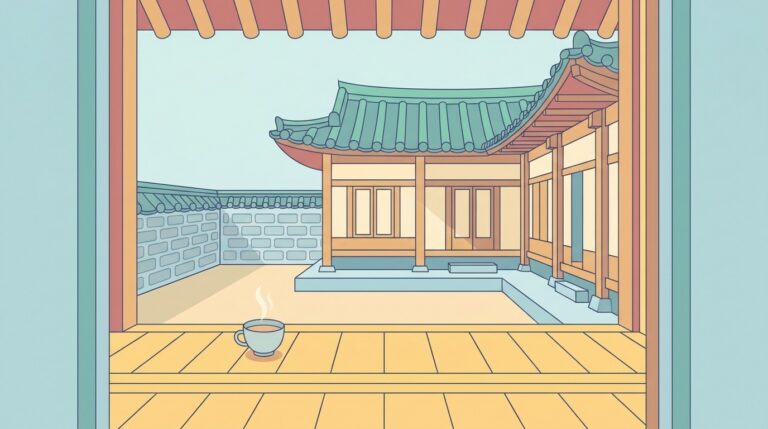
Why has 불멍 (spacing out watching a campfire), 물멍 (spacing out watching moving water), and 숲멍 (spacing out gazing into a forest) become a national wellness phenomenon? In an ultra-dense urban grid like Seoul, silence has become the ultimate luxury good. Traditional Hanok architectures, with their empty courtyards (마당) and deliberately blank walls, embody the Taoist-Confucian aesthetic of 여백의 미 (the beauty of empty margins). Modern Koreans are returning to tea houses in Seochon and mountain temple stays not to consume more experiences, but to experience 무(無)—the liberating presence of nothingness.
Phase 5: 실전 롤플레이 시나리오 (Real-Life Roleplay)
Setting: A serene, minimalist traditional tea salon (전통 찻집) hidden in the quiet backstreets of Seochon, Seoul. Rainfall trickles outside the wooden lattice window.
Characters:
* Min-seo (민서): A high-flying UX design director in Seoul who recently sold half her belongings and deleted her 20,000-follower Instagram account.
* You: An expat professional living in Seoul who is seeking to align your daily life with inner freedom.
Min-seo: 요새 매일 야근에 정보의 홍수 속에 파묻혀 살다 보니까, 영혼이 완전히 탈진하는 기분이 들더라고요.
(Yosae maeil yageun-e jeongbo-ui hongsu sog-e pamuthyeo salda bonikka, yeonghon-i wanjeonhi taljinhaneun gibun-i deuldeoragoyo.)
“These days, living buried under daily overtime and an absolute deluge of information, I felt like my soul was completely depleted.”
🎭 (두 손으로 따뜻한 찻잔을 감싸 쥐며 창밖의 비를 응시한다)
You: 맞아요. 우리는 매일 너무 많은 자극과 소비를 강요당하면서 살고 있는 것 같아요.
(Majayo. Urineun maeil neomu maneun jageukgwa sobireul gang-yodanghamyeonseo salgo inneun geot gat-ayo.)
“That’s so true. I feel like we live our lives constantly coerced into excessive stimulation and relentless consumption.”
🎭 (깊이 공감한다는 듯 천천히 고개를 끄덕인다)
Min-seo: 그래서 결심했어요. 옷장이든 휴대폰이든, 내 에너지를 갉아먹는 군더더기들을 모조리 정리하기로요.
(Geuraeseo gyeolsimhaesseoyo. Otjang-ideun hyudaepon-ideun, nae eneojireul gal-gameongneun gundeodeogideureul mojori jeongnihagiroyo.)
“So I made up my mind. Whether it’s my closet or my smartphone, I decided to purge every bit of clutter that chips away at my energy.”
🎭 (결연하지만 한결 홀가분해진 미소를 지어 보인다)
You: 물건을 정리하는 차원을 넘어서, 삶의 본질과 내면의 자유를 지키려는 철학적 결단이네요.
(Mulgeoneul jeongnihaneun chawoneul neomeoseo, salm-ui bonjilgwa naemyeon-ui jayureul jikiryeoneun cheolhakjeok gyeoldan-ineyo.)
“Beyond just tidying items, that sounds like a philosophical decision to defend your essence of life and inner freedom.”
🎭 (진지한 눈빛으로 민서의 눈을 마주한다)
Min-seo: 정확해요! 처음엔 남들보다 뒤처지면 어쩌나 하는 불안감도 있었지만, 비우고 나니 오히려 시야가 맑아졌어요.
(Jeonghwakhaeyo! Cheo-eumen namdeulboda dwicheojimyeon eojjeona haneun burangamdo isseotjiman, biugo nani ohiryeo siyaga malg-ajyeosseoyo.)
“Precisely! At first I had anxiety that I might fall behind others, but after emptying it all out, my vision became remarkably clear.”
🎭 (가슴에 손을 얹으며 안도의 숨을 쉰다)
You: 외부의 소음을 차단해야 비로소 내가 진짜 원하는 게 뭔지 선명하게 들리니까요.
(Oebu-ui so-eumeul chadanhaeya biroso naega jinjja wonhaneun ge mwonji seonmyeonghage deullinikkayo.)
“Because only when we block out external noise can we clearly hear what we truly desire.”
🎭 (차를 한 모금 음미하며 부드러운 목소리로 말한다)
Min-seo: 혹시 그쪽도 지금 일상에서 꼭 덜어내고 싶은 무언가가 있나요?
(Hoksi geujjokdo jigeum ilsang-eseo kkok deoleonaego sipeun mueon-gaga innayo?)
“By any chance, is there something in your own routine right now that you urgently want to subtract?”
🎭 (호기심 어린 따뜻한 눈빛으로 묻는다)
🔀 Your Interactive Turn! How will you respond to Min-seo?
- Option A: 남들의 기대에 부응하려는 인정 욕구를 내려놓고, 소유보다 온전한 존재 자체에 집중해보고 싶어요. (Namdeur-ui gidae-e bueungharyeoneun injeong yog-gureul naeryeonoko, soyuboda onjeonhan jonjae jache-e jipjunghaebogo sipeoyo. / I want to lay down the craving for validation to meet others’ expectations, and focus on pure being rather than possessing.)
- Feedback (Best! 🌟): Flawless C1 phrasing. Contrasting 소유 (possession) with 존재 (existence/being) resonates deeply with philosophical discourse.
- Option B: 인스타그램 계정을 삭제하고 쇼핑 앱도 다 지워버리려고요. (Inseutageuraem gyejeong-eul sakjeehago syoping aepdo da jiwobeoriryeogoyo. / I’m going to delete my Instagram account and erase all shopping apps.)
- Feedback (Bad ⚠️): Grammatically correct, but stays at an elementary A2/B1 mechanical level. Misses the opportunity to articulate your philosophical rationale.
- Option C: 솔직히 한국 사회는 너무 경쟁적이라서 다들 미쳐있는 것 같아요. (Soljikhi hanguk sahoeneun neomu gyeongjaengjeog-iraseo dadeul michyeoinneun geot gat-ayo. / Honestly, Korean society is so hyper-competitive that I think everyone is crazy.)
- Feedback (Risk 🚫): Culturally inappropriate and unnecessarily aggressive. It breaches Korean conversational etiquette (눈치) and turns a gentle reflective moment into a harsh generalization.
Phase 6: 10초 감정 섀도잉 드릴 (Emotion Shadowing Drill)
Practice reading these out loud. Pay sharp attention to the emotional markers and breathing pauses marked by /.
[🌿 담담하고 평온하게 (Calm and serene)]
소유를 줄일수록 / 내면의 공간은 / 더욱 넓어집니다.
(Soyureul jurilsurok / naemyeon-ui gonggan-eun / deouk neolbeojimnida.)
“The more we reduce possessions / the internal space / expands even wider.”-
[😮💨 깊은 한숨을 쉬며 진심을 털어놓듯 (Sighing deeply, speaking from the heart)]
끝없는 정보의 홍수 속에서 / 잠시 로그아웃할 용기가 / 필요한 때예요.
(Kkeuteomneun jeongbo-ui hongsu sog-eseo / jamsi rogeu-aut-hal yong-giga / piryohan ttae-yeyo.)
“In this deluge of endless information / the courage to temporarily log out / is what we truly need right now.” -
[✨ 확신에 차서 단호하게 (Confident and resolute)]
이건 단순한 정리가 아니라 / 삶의 주도권을 되찾기 위한 / 철학적 선택입니다.
(Igeon dansunhan jeong-riga animyeon / salm-ui judogwoneul doechatgi wihan / cheolhakjeok seontaegimnida.)
“This isn’t mere tidying up / but a philosophical choice / to reclaim sovereignty over my own life.”
Phase 7: K-Culture 미니 사전 (Mini Dictionary)
- 미닝아웃 (Meaning Out | Mi-ning-a-ut): A Korean portmanteau of “Meaning” and “Coming Out.” It describes consumers who boldly express their personal beliefs, ecological ethics, and social values through what they choose to buy—or boycott.
- 여백의 미 (Yeobaek-ui mi): The traditional aesthetic concept praising “the beauty of blank margins.” In painting, poetry, architecture, and now lifestyle design, value is created not by what is added, but by what is purposefully left vacant.
- 도파민 디톡스 (Dopamine Detox | Do-pa-min Di-tok-seu): A buzzword heavily used by young Koreans referring to deliberately disconnecting from short-form reels, instant notifications, and addictive hyper-stimulants to regain deep attention spans.
- 소유보다 존재 (Soyuboda Jonjae): Derived from Erich Fromm’s philosophical thesis To Have or to Be, this phrase is used in intellectual discussions to denote prioritizing living authentically over accumulating assets.
Phase 8: 여행자를 위한 생존 키트 (Traveler’s Survival Kit)
서바이벌 표현 TOP 3 (Survival Phrases)
- “일회용품은 안 주셔도 괜찮아요.” (Ilhoeyongpum-eun an jusyeodo gwaenchannayo.)
- Meaning: “It’s totally fine if you don’t give me disposable plastics/cutlery.”
- Pro Tip: Use this at convenience stores or takeout cafes in Seoul to refuse single-use plastic straws and spoons politely.
- “혹시 이 메뉴에 육류나 유제품이 들어가나요?” (Hoksi i menyu-e yungnyuna yuje-pumi deoreoganayo?)
- Meaning: “By any chance, does this dish contain meat or dairy products?”
- Pro Tip: Essential for vegan/vegetarian travelers navigating Korean menus that use hidden anchovy broth (멸치 육수) or meat bases.
- “조용히 혼자 생각할 수 있는 차분한 공간을 찾고 있어요.” (Joyonghi honja saeng-gak-hal su inneun chabunhan gong-gan-eul chatgo isseoyo.)
- Meaning: “I’m looking for a quiet, tranquil space where I can think alone.”
- Pro Tip: Perfect to ask boutique Hanok guesthouses or traditional tea curators in Insadong and Gangneung.
Editor’s Travel Note
- Essential Navigation Tools: When seeking serene, sustainable spaces in Korea, avoid standard commercial lists. Instead, open the Naver Map application and search using refined keywords like
비건 베이커리(vegan bakery),제로웨이스트 샵(zero-waste store), or조용한 북카페(quiet book cafe). - Eco-Tip: Seoul’s subway and bus transfer system is fully paperless via T-Money or climate-friendly Climate Cards (기후동행카드). Tap your card lightly on the reader and keep your phone in your pocket to practice urban walking meditation!
Phase 9: “한 발 더 깊이” (Thought Essay)
Traditional Korean culture has historically celebrated the collective—the warmth of 정 (Jeong) and sharing meals shoulder-to-shoulder. However, in our current hyper-digitized landscape, where KakaoTalk alerts follow workers past midnight and peer comparison is magnified by social algorithms, this intense collectivism can mutate into emotional claustrophobia. The modern embrace of minimalism among Koreans is not a rejection of their cultural roots, but rather an urgent act of self-preservation. By consciously stripping away excess noise and material validation, Koreans are carving out a private sanctuary—a psychological 여백 (blank margin) in which individual identity and genuine freedom can finally breathe.
💬 Your Turn: What is one digital habit or physical belonging you could let go of today to create more 여백 in your own life? Share your thoughts below in Korean!
Phase 10: FAQ & 흔한 실수 방지 (FAQ & Common Mistakes)
Q: Can I use “덜어내다” when talking about physical objects, or is it only philosophical?
A: You can use it for both! Originally, 덜어내다 was used for scooping out portions of food (e.g., “밥을 조금 덜어내다” – to scoop out some rice). In contemporary advanced Korean, it has successfully transitioned into abstract, emotional, and systemic reduction, such as “업무 부담을 덜어내다” (to reduce work burden) or “잡념을 덜어내다” (to clear wandering thoughts).
Q: What is the exact difference between “미니멀리즘” and “단순한 삶”?
A: 미니멀리즘 (Minimalism) is an adopted loanword that often carries modern aesthetic, design, or lifestyle connotations (clean lines, white rooms, fewer clothes). In contrast, 단순한 삶 (simple life) carries a warmer, more rustic, and existential tone akin to Henry David Thoreau’s philosophy of voluntary simplicity.
Q: Is “비우다” rude if I say I want to “비우다” my schedule when someone invites me out?
A: If you say “일정을 비우다” (to clear one’s schedule), it actually means you are freeing up time for someone! If you wish to decline because you want alone time, say: “죄송하지만 요즘은 스스로를 정리하고 비우는 시간을 조금 가지려고 해요.” (I’m sorry, but lately I’m trying to take a little time to organize and empty my mind).
🚨 외국인 학습자의 흔한 실수 (Common Mistakes TOP 3)
- Using “버리다” (to discard) for everything:
- Wrong: 스트레스를 쓰레기통에 버리고 싶어요.
- Correct Action: Use 비우다 (to empty) or 털어내다 (to shake off): “마음의 짐을 털어내고 머릿속을 비우고 싶어요.”
- Confusing “미닝아웃” with general shopping:
- Wrong: 오늘 백화점에서 예쁜 옷을 미닝아웃 했어요.
- Correct Action: 미닝아웃 must involve an intentional socio-ethical stance (e.g., buying upcycled eco-goods, supporting cruelty-free brands): “업사이클링 브랜드 제품을 구매하면서 미닝아웃을 실천했어요.”
- Overusing dry textbook negation like “필요가 없습니다”:
- Wrong: 이 물건은 이제 제 삶에 필요가 없습니다.
- Correct Action: Express sophisticated indifference with C1 idioms: “더 이상 여기에 연연하지 않기로 했어요.” (I’ve decided not to cling to this any longer.)
Phase 11: 액션 미션 & 참여 유도 (Action Missions)
- 🥉 Bronze Mission (Solo Mastery): Record yourself reading the 3 Emotion Shadowing sentences in Phase 6. Listen closely: Did you sound calm, introspective, and natural?
- 🥈 Silver Mission (Social Engagement): Open your social media notes or Instagram story, upload a minimalist photo (a cup of tea, a clear desk), and write this caption in Korean:
소유보다 온전한 나 자신에게 집중하는 하루. #덜어내는삶 - 🥇 Gold Mission (Real-World Application): Next time you visit a cafe or chat with a Korean friend, gracefully decline an extra item or explain your recent quiet weekend using the expression:
"마음의 군더더기를 덜어내는 중이에요." - 🎮 K-Culture Mission: Watch Episode 1 of the drama Summer Strike (아무것도 하고 싶지 않아). Identify at least two scenes where visual empty space (여백) is used to convey emotional relief.
Phase 12: 인터랙티브 퀴즈 챌린지 (Interactive Quiz)
Test your mastery of advanced philosophical Korean expressions!
1. Situation Judgment (상황 판단)
Your Korean colleague asks why you didn’t buy any items during the massive Black Friday online flash sale. Which response best exhibits an advanced (C1) philosophical reflection?
* (A) 돈이 없어서 아무것도 못 샀어요.
* (B) 세일 품목이 마음에 전혀 안 들었습니다.
* (C) 불필요한 소비를 줄이고, 소유보다는 삶의 본질에 집중하기로 했거든요.
2. Fill-in-the-Blank (빈칸 채우기)
Complete the sentence using the refined word for ‘excess clutter/baggage’:
“마음속에 쌓인 쓸데없는 (____________)를 덜어내고 나니 비로소 자유로워졌어요.”
3. True or False (문화 진위 퀴즈)
In modern Korea, “불멍” and “숲멍” are considered wasteful activities that clash with the cultural virtue of being productive.
* (True / False)
🔍 Click here to reveal the answers and explanations! (정답 및 해설)
- Answer: (C)
- Explanation: Option (C) expresses intentionality and high-level philosophical vocabulary (소유보다는 삶의 본질), whereas (A) sounds destitute and (B) sounds merely critical of the merchandise.
- Answer: 군더더기 (gundeodeogi)
- Explanation: 군더더기 is the exact native Korean term for unneeded excess, clutter, or superfluity in thought, writing, or lifestyle.
- Answer: False
- Explanation: Quite the opposite! “멍때리기” (spacing out), including 불멍 and 숲멍, has been embraced nationwide as an essential therapeutic antidote to Korea’s hyper-stimulated, fast-paced modern life.






