

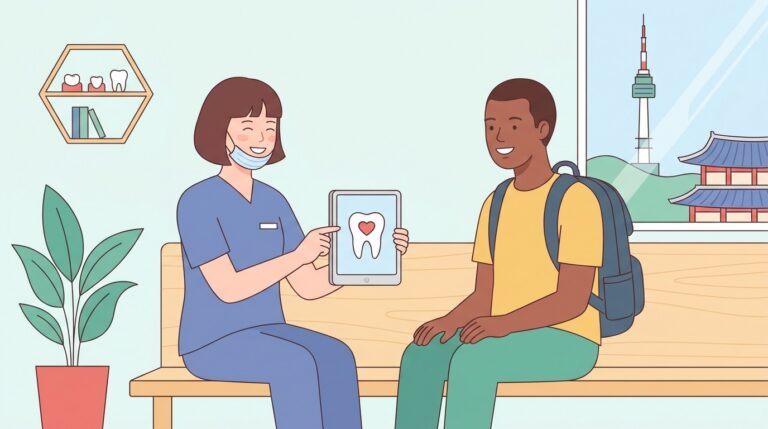
Survived the Dentist in Korea: How to Tackle Root Canals, Quotes, and Non-Covered Costs Like a Local
Phase 1: Empathy (Story-Driven Opening)
안녕하세요! 매일한글 에디터입니다.
Picture this: You are sitting in a trendy cafe in Seongsu-dong, sipping on a freezing iced Americano (얼죽아—iced Americano even if freezing to death, right?). You take a hearty sip, and suddenly—zap! A sharp, electrifying twinge jolts through your lower molar. You freeze, clutching your jaw. Hoping it’s just momentary sensitivity, you brush it off, but a couple of days later, even a sip of chilled barley tea sets off alarm bells.
With a pounding heart, you walk into a spotless Korean dental clinic (치과의원). After a panoramic 3D X-ray and a quick cold test, the dentist looks at you with that gentle, apologetic look every patient dreads: “충치가 신경까지 깊게 진행되어서 신경치료(근관치료)를 하셔야겠어요.” (The decay has progressed deeply into the nerve, so you’ll need a root canal.)
At this moment, two fears collide: physical pain and financial bewilderment. How much will it cost? Is it covered under the National Health Insurance (급여) or is it an out-of-pocket, non-covered cost (비급여)? How do you discuss treatment options without feeling pushed into expensive procedures?
Navigating medical emergencies in Korea can feel intimidating, but speaking clear, intermediate-level Korean gives you immediate agency. Today, we’re diving deep into B2-level medical Korean tailored specifically for dental clinic consultations, understanding itemized quotes, and mastering the cultural etiquette of Korean healthcare.
Phase 2: Core Expressions Deep Dive
1. 차가운 물을 마실 때마다 어금니가 찌릿하게 시려요.
- Pronunciation: [Chagaun muleul masil ttaemada eogeumniga jjirit-hage siryeoyo] (Sound analogy: ‘jjirit’ sounds like the sharp zap of static electricity!)
- Meaning: Literal: “Whenever I drink cold water, my molar is electrically sensitive.” / Actual nuance: “I feel a sharp, shooting pain in my back tooth whenever cold liquid touches it.”
- K-Culture Moment: In K-Dramas, characters inevitably grab their cheek, wince dramatically, and use the onomatopoeia 찌릿 (jjirit) or 시큰 (sikeun) to signal that a painful clinic visit is imminent.
- Editor’s Insight: Standard textbooks teach “치통이 있어요” (I have a toothache), but Korean dentists diagnose based on tactile descriptors. Words like 시리다 (cold/sensitive ache) vs. 아프다 (sore/throbbing pain) tell the doctor whether the pulp is inflamed or dying.
- Situation Spectrum: Casual: ⚠️ (Too descriptive for casual banter unless sharing symptoms with friends) | Semi-formal: ✅ | Formal: ✅
- 🤔 Think About It: English speakers often categorize pain by intensity (sharp, mild, dull), whereas Korean pain descriptions rely heavily on sensory mimetic words (의태어). How does describing pain through texture and sensation change how we experience physical discomfort?
2. 신경치료랑 크라운 씌우는 비용이 비급여인가요?
- Pronunciation: [Singyeong-chiryorang keulaun ssieuneun biyong-i bigeub-yeo-ingayo?]
- Meaning: Literal: “Are the root canal and crown-covering costs non-covered?” / Actual nuance: “Does national insurance cover the root canal, and will I have to pay out-of-pocket for the crown?”
- K-Culture Moment: You will hear savvy Korean consumers on financial podcasts or YouTube consumer vlogs asking this exact breakdown question to prevent unexpected hospital bills.
- Editor’s Insight: In South Korea’s National Health Insurance (NHIS), basic root canal treatments (신경치료/근관치료) are strictly covered (급여 – geub-yeo), meaning you pay only a modest copay per visit (usually 10,000–30,000 KRW). However, capping the tooth with a crown (gold, porcelain, zirconia) is entirely out-of-pocket (비급여 – bigeub-yeo), typically ranging from 400,000 to 600,000+ KRW. Asking this question shows the clinic coordinator that you understand the Korean medical billing system.
- Situation Spectrum: Casual: 🚫 | Semi-formal: ✅ | Formal: ✅
- 🤔 Think About It: In many Western countries, dental insurance is private and separated entirely from general health insurance. How does Korea’s hybrid system (covered root canal + non-covered restorative crown) influence patient decision-making?
3. 혹시 과잉 진료 없이 꼭 필요한 치료만 먼저 진행할 수 있을까요?
- Pronunciation: [Hoksi gwa-ing jinryo eopsi kkok piryohan chiryoman meonjeo jinhaenghal su isseulkkayo?]
- Meaning: Literal: “By any chance, could we proceed first with only the strictly necessary treatment without overtreatment?”
- K-Culture Moment: Featured constantly on consumer investigative journalism programs like Consumer Report or life-tip talk shows where patients seek “양심 치과” (honest, conscientious dental clinics).
- Editor’s Insight: 과잉 진료 (gwa-ing jinryo – overtreatment) is a recognized cultural keyword in Korean medical consumerism. While polite, asking this directly with softening phrases like 혹시 (by any chance) and ~할 수 있을까요? asserts your boundaries courteously without accusing the medical professional of dishonesty.
- Situation Spectrum: Casual: 🚫 | Semi-formal: ⚠️ (Use careful intonation) | Formal: ✅
- 🤔 Think About It: Directly challenging a doctor’s recommendation can be considered taboo in traditional hierarchy-focused societies. Notice how the sentence uses triple softeners to balance assertiveness with politeness.
Phase 3: Textbook Korean vs. Real Korean
Scenario 1: Explaining your specific symptom at the front desk
- 📖 Textbook Korean: 이가 썩어서 아픕니다. 진료를 받고 싶습니다.
(I-ga sseokeoseo apeumnida. Jinryo-reul batgo sipseumnida. / My tooth is rotten and hurts. I want treatment.) - 🗣️ Real Korean: 어금니 쪽이 찬물 마실 때 찌릿하고 씹을 때마다 욱신거려요.
(Eogeumni jjok-i chanmul masil ttae jjirit-hago ssibeul ttaemada uksin-georyeoyo. / My back tooth twinges when drinking cold water, and it throbs every time I chew.) - 💡 Why the difference? Saying “my tooth is rotten” sounds like a primary school health reader. Real adults specify the location (어금니 쪽 – molar area) and pair sensory sensations (찌릿하다 – electric twinge, 욱신거리다 – throbbing ache) to help the staff pre-screen dental priority.
Scenario 2: Requesting an itemized estimate after diagnosis
- 📖 Textbook Korean: 영수증과 가격표를 보여주십시오.
(Yeongsujeung-gwa gagyeokpyo-reul boyeojusipsio. / Please show me the receipt and price list.) - 🗣️ Real Korean: 치료 계획서랑 급여, 비급여 항목 나눈 세부 견적서 좀 뽑아주실 수 있을까요?
(Chiryo gyehoekseo-rang geub-yeo, bigeub-yeo hangmok nanun sebu gyeonjeokseo jom ppobajusil su isseulkkayo? / Could you print out the treatment plan and an itemized quote separated into covered and non-covered items?) - 💡 Why the difference? Asking for a generic “price list” confuses staff because dental care varies by tooth condition. Requesting an itemized estimate (세부 견적서) separates mandatory insurance-subsidized steps from elective restorative materials.
Phase 4: K-Culture Deep Dive & Non-Verbal Manners
4-1. Nunchi & The Dental Chair Protocol
When you sit on the dental chair (진료 의자), communication shifts heavily to non-verbal cues. In Korea, dentists and dental hygienists will say:
“많이 아프시면 왼손을 살짝 들어주세요.”
(Mani apeusimyeon oenson-eul saljjak deureojuseyo. / If it hurts a lot, please raise your left hand slightly.)
- The Left Hand Rule: Always raise your left hand, never your right. The dental team works primarily from your right side, holding delicate, high-speed drills. Raising your right hand or moving suddenly can lead to serious accidents.
- Vocalizing: If your mouth is clamped open with a rubber dam (러버댐), making a short “아—” or gently raising two fingers on your left hand is the golden standard of dental Nunchi.
4-2. Culture Code: “Balpum Palgi” (발품 팔기) and Conscientious Clinics
In Korea, getting a second or third opinion for costly dental treatments is not seen as insulting—it is practically expected. This practice is called 발품 팔기 (balpum palgi – selling foot-effort, meaning doing legwork on foot).
Because non-covered services (비급여) vary wildly between clinics (one clinic in Gangnam might quote 650,000 KRW for a zirconia crown while a local neighborhood clinic in Mapo quotes 450,000 KRW), Korean locals often visit 2 to 3 neighborhood clinics before committing. People deliberately search for a 양심 치과 (yangsim chigwa – a clinic that practices ethical medicine without pressuring patients into early extractions or unnecessary crowns).
Phase 5: Real-Life Roleplay Scenario
Setting: Consultation room at “Barun Dental Clinic” (바른치과의원) in Seoul.
Characters:
* Coordinator Han (실장 한수민): Experienced, efficient dental counselor with a tablet.
* Mark (마크): Intermediate Korean learner who visited due to severe sensitivity in his lower molar.
- [Turn 1] Coordinator Han:
(X-ray 사진을 화면에 띄우며) 마크 님, 아래쪽 어금니 엑스레이 보시면 충치가 신경관 근처까지 깊게 들어갔어요. 찬물 마실 때 많이 시리셨죠?
(X-ray sajineul hwamyeone tti-umyeo) Makeu nim, araejjok eogeumni ekseure-i bosimyeon chungchiga singyeong-gwan geuncheokkaji gipge deureogat-eoyo. Chanmul masil ttae mani sirisyeotjyo?
🎭 (Pointing at the dark gray pocket near the nerve root on the tablet)
“Mark, if you look at the X-ray of your lower molar, the decay has penetrated deeply close to the nerve canal. It must have twinged a lot when you drank cold water, right?” -
[Turn 2] Mark:
네, 맞아요. 찬물 마실 때마다 찌릿하고 밤에는 가끔 욱신거렸어요.
Ne, majayo. Chanmul masil ttaemada jjirit-hago bam-eneun gakkeum uksin-georyeosseoyo.
🎭 (Gently pressing his cheek to show where the pain originates)
“Yes, that’s right. It shoots a sharp pain every time I drink cold water, and sometimes it throbs at night.” -
[Turn 3] Coordinator Han:
단순 충치 치료로는 안 되고요, 신경치료(근관치료)를 3~4회 정도 진행한 다음 치아를 깎아서 크라운을 씌워야 합니다.
Dansun chungchi chiryoloneun an doegoyo, singyeong-chiryo(geun-gwan-chiryo)-reul se-ne-hoe jeongdo jinhaenghan da-eum chia-reul kkak-aseo keulaun-eul ssieowoya hamnida.
🎭 (Speaking calmly while tapping the tooth model)
“A simple cavity filling won’t suffice; we need to perform root canal treatment over 3 to 4 sessions and then place a crown over the reshaped tooth.” -
[Turn 4] Mark:
그렇군요. 혹시 신경치료랑 크라운 씌우는 비용 견적이 어떻게 나올까요?
Geureokunyo. Hoksi singyeong-chiryorang keulaun ssieuneun biyong gyeonjeog-i eotteoke naolkkayo?
🎭 (Holding a notepad and asking with a polite, attentive gaze)
“I see. By any chance, how will the estimated costs for the root canal and crown placement break down?” -
[Turn 5] Coordinator Han:
신경치료는 건강보험 적용이 되는 급여 항목이라 매번 오실 때마다 1~2만 원 안팎으로 나와요. 다만, 치아를 보호하는 크라운은 비급여예요. 지르코니아는 50만 원, 골드(금)는 55만 원입니다.
Singyeong-chiryoneun geon-gangboheom jeok-yong-i doeneun geub-yeo hangmok-ira mae-beon osil ttaemada il-i-man won anpakk-euro nawayo. Daman, chia-reul bohohaneun keulaun-eun bigeub-yeo-yeyo. Jireukonianeun osip-man won, goldeu(geum)-neun osip-o-man won-imnida.
🎭 (Sliding a price sheet comparing tooth-colored zirconia and gold crowns)
“The root canal is an NHI-covered service, so each visit will cost around 10,000 to 20,000 won. However, the crown to protect the tooth is non-covered. Zirconia is 500,000 won, and gold is 550,000 won.” -
[Turn 6] Mark:
비급여 항목 견적서를 서면으로 받아볼 수 있을까요? 실손보험 청구 서류도 같이 확인하고 싶어서요.
Bigeub-yeo hangmok gyeonjeokseo-reul seomyeon-euro badabol su isseulkkayo? Silson-boheom cheong-gu seoryu-do gachi hwaginhago sipeoseoyo.
🎭 (Nodding politely, verifying his private insurance paperwork needs)
“Could I receive a printed quote for the non-covered items? I’d also like to check documents for filing a private indemnity insurance claim.” -
[Turn 7] Coordinator Han:
네, 바로 출력해 드릴게요. 오늘 바로 마취하고 1차 신경치료 들어가실 건가요?
Ne, baro chulryeokhae deurilgeyo. Oneul baro machwihago il-cha singyeong-chiryo deureogasil geon-gayo?
🎭 (Entering data into the computer and pulling out consent forms)
“Certainly, I will print that right out for you. Would you like to get anesthetized and start the first stage of the root canal today?” -
[Turn 8] Mark:
일단 오늘은 통증이 심하니까 급여 치료인 1차 신경치료 먼저 진행하고, 크라운 재료는 다음 예약 때 결정할게요.
Ildan oneul-eun tongjeung-i simhanikka geub-yeo chiryoin il-cha singyeong-chiryo meonjeo jinhaenghago, keulaun jaeryoneun da-eum yeyak ttae gyeoljeonghalgeyo.
🎭 (Giving a confident, friendly bow with an assertive decision)
“Since the pain is severe, I’ll proceed with the covered first-stage root canal today, and I’ll decide on the crown material at my next appointment.”
🔀 Interactive Decision Branch
What should Mark say if Coordinator Han strongly insists on prepaying for an expensive gold crown right now before touching the tooth?
- Option A: “싫어요. 사기 치지 마세요!” (Bad: Overly confrontational and emotionally aggressive; damages the clinic relationship.)
- Option B: “오늘 당장 결정해야 하나요? 일단 1차 신경치료 먼저 받고 집에서 비용을 좀 더 고민해 본 뒤 다음 주에 말씀드릴게요.” (Best: Sets clear personal boundaries, uses polite phrasing, and exercises the right to deliberate non-covered procedures.)
- Option C: “네, 그냥 원하시는 대로 제일 비싼 걸로 지금 다 결제해 주세요.” (Risk: Agrees immediately out of awkwardness; risks severe overtreatment and non-refundable fees.)
Phase 6: 10-Second Emotional Shadowing Drill
Read these sentences out loud following the slash marks (/) for natural cadence, matching the target emotional tone.
[😰 안절부절못하며 긴장된 목소리로]
선생님, / 마취 주사 맞을 때 / 많이 아픈가요? / 겁이 좀 많아서요…
(Seonsaengnim, / machwi jusa majeul ttae / mani apeun-gayo? / Geob-i jom man-aseoyo…)
(Doctor, / when I get the numbing shot, / does it hurt a lot? / I’m rather timid…)-
[🧐 신중하고 당당하게 확인하며]
급여 항목이랑 / 비급여 항목 나눠서 / 세부 견적서 / 한 장만 뽑아주시겠어요?
(Geub-yeo hangmok-irang / bigeub-yeo hangmok nanwo-seo / sebu gyeonjeokseo / han jang-man ppobajusigesseoyo?)
(Could you separate the covered / and non-covered items / and print out / one itemized estimate?) -
[😌 차분하고 확고하게]
오늘은 / 통증 가라앉히는 치료 먼저 받고요, / 보철물은 / 조금 더 고민해 볼게요.
(Oneul-eun / tongjeung garaanjhineun chiryo meonjeo batgoyo, / bocheolmul-eun / jogeum deo gominhae bolgeyo.)
(Today, / I’ll first receive the treatment that calms the pain, / and regarding the prosthesis, / I’ll think it over a little more.)
Phase 7: K-Culture Mini Dictionary
-
신경치료 (Singyeong-chiryo) [Sin-gyeong-chi-ryo]
Translation: Root Canal Treatment (Officially: 근관치료).
Usage: Literally means “nerve treatment.” In Korea, it refers to cleaning out infected pulp inside the root canals to preserve the natural tooth instead of extracting it. -
비급여 (Bigeub-yeo) [Bi-geub-yeo]
Translation: Non-covered medical expenses / Out-of-pocket costs.
Usage: Medical services not covered by the National Health Insurance (NHIS). In dentistry, aesthetic or high-tier materials (e.g., Zirconia crowns, implants, cosmetic veneers) are categorized as 비급여, meaning each clinic sets its own price freely. -
크라운 (Keulaun) [Keu-ra-un]
Translation: Dental Crown.
Usage: A protective “cap” cemented over a weakened tooth after a root canal. Common types in Korea include 지르코니아 (zirconia – natural tooth color) and 골드 (gold crown – durable for back molars). -
발품 팔기 (Balpum palgi) [Bal-pum pal-gi]
Translation: Doing ground legwork / Shopping around in person.
Usage: Idiomatic expression combining 발 (foot) and 품 (labor). In medical contexts, visiting multiple clinics or pharmacies to compare diagnosis transparency, quotes, and friendliness.
Phase 8: Traveler’s Survival Kit
Survival Phrases TOP 3
- 마취 조금만 더 세게 해주실 수 있나요?
(Machwi jogeum-man deo sege haejusil su innayo?)
Pro Tip: Use this if you feel sharp pain despite numbing. Korean dentists can administer booster infiltration anesthesia in seconds. - 진통제랑 항생제 처방전 부탁드립니다.
(Jintongje-rang hangsaengje cheobangjeon butakdeurimnida.)
Pro Tip: Dental pain medication requires an official prescription (처방전) to pick up at the neighboring pharmacy (약국). - 영문 진료의뢰서랑 영수증 발급 가능한가요?
(Yeongmun jinryo-uirweseo-rang yeongsujeung balgeup ganeunghangayo?)
Pro Tip: Crucial for travelers hoping to claim international travel medical insurance back home.
Editor’s Travel Note
- Verify Dental Pricing Online: Did you know you can check standard regional non-covered dental costs beforehand? Open the official Health Insurance Review and Assessment Service (HIRA) Non-Covered Price Portal to benchmark average prices for crowns and wisdom tooth extractions across Seoul.
- Locate Transparent Clinics: When searching on your map apps, search for phrases like
치과의원 과잉진료 없는 곳(clinics without overtreatment) or check reviews mentioning과잉진료 안 하시고 설명이 친절해요(doesn’t push overtreatment and explains kindly).
Phase 9: Step Deeper (Reflection Essay)
In Korean society, medical services occupy a unique intersection between state-managed community welfare and intense private consumer competition. The concept of 양심 (yangsim – conscience/integrity) has become a defining buzzword in Korean medical discourse. Because basic healthcare is remarkably accessible and subsidized by the National Health Insurance, hospitals often depend on non-covered procedures (비급여) for profit margins.
As a response, Korean patients have evolved into exceptionally active, proactive health consumers who inspect itemized receipts, share authentic reviews on community forums, and assertively ask questions before agreeing to major oral reconstructions.
💬 Your Turn: In your home country, how do you handle medical expenses and second opinions? Would you feel comfortable asking a doctor for an itemized estimate separating covered and out-of-pocket costs? Let’s discuss in the comments below!
Phase 10: FAQ & Common Mistakes
Q: Can foreigners without Korean National Health Insurance receive root canal treatments?
A: Yes! Anyone can receive treatment at any Korean dental clinic without an NHIS card. However, you will be billed 100% of the cost as a general uninsured patient (일반 진료). Make sure to request an English medical certificate (진단서), itemized bill (진료비 세부내역서), and receipt (영수증) to submit to your international travel or private insurance.
Q: Why do Korean clinics require multiple visits for a single root canal?
A: Standard Korean root canal therapy (신경치료) typically takes 3 to 4 separate visits spaced 3–7 days apart: 1) Nerve removal and disinfection, 2) Canal shaping and medication change, 3) Gutta-percha canal filling, and 4) Core buildup and impressions for the crown. Doing it over several stages ensures complete sterilization of the deep root system.
Q: What is the average price range for a dental crown in Seoul?
A: As of recent clinic data, non-covered crowns range from approximately 400,000 to 600,000 KRW for ceramic/zirconia, and 500,000 to 700,000 KRW for gold (depending on gold weight/market value).
🚨 Common Mistakes Warning Board
- Mistake 1: Mistaking “신경치료” for a simple surface filling.
Correct Action: Understand that “신경치료” means a full root canal. If you just want a small decay filled, the term is 레진 치료 (resin filling) or 인레이 (inlay). - Mistake 2: Leaving the clinic after root canal therapy without putting on a crown.
Correct Action: Once a nerve is removed, the tooth becomes brittle like a dry branch. Chewing without a crown (크라운) will easily fracture the tooth root, forcing an unexpected implant (임플란트). Never skip the crown phase! - Mistake 3: Waving your right hand when in pain during drilling.
Correct Action: Always signal with your left hand (왼손) to prevent colliding with the dentist’s dominant operating hand.
Phase 11: Action Missions & Community Challenge
- 🥉 Bronze Mission (Solo Shadowing): Stand in front of the mirror, put a hand on your cheek, and practice saying:
"찬물 마실 때마다 찌릿하게 시려요. 세부 견적서 좀 부탁드립니다."out loud 5 times with natural rhythm. - 🥈 Silver Mission (Community Sharing): Share in our community comment section: What is your country’s equivalent term for “비급여” (non-covered medical expense)?
- 🥇 Gold Mission (Real Life Action): If you are currently in Korea, look up a dental clinic on your map app, click on the review section, and find at least one review containing the words 과잉 진료 or 신경치료.
- 🎮 K-Culture Mission: Next time you watch a modern K-Drama or variety show, spot how Koreans express sudden tooth or headache pain—look out for words like 찌릿 (jjirit) and gestures touching the jawline!
Phase 12: Interactive Quiz Challenge
1. Situation Judgment
You received an X-ray, and the dental coordinator says you have deep decay and need root canal treatment. You want to proceed with the insurance-covered pain relief today, but take time to compare crown prices at other clinics. What is the most polite and natural response?
* (A) “비싸니까 그냥 안 할래요. 집에 갈게요.”
* (B) “오늘은 통증 치료 먼저 받고, 비급여 견적서는 서면으로 받아 검토해 볼게요.”
* (C) “신경치료도 비급여니까 지금 다 환불해 주세요.”
👉 Click to view Answer & Explanation
Correct Answer: (B)
Explanation: Option (B) is the most professional B2-level response. It secures the immediate covered treatment to relieve your pain while politely requesting a printed estimate for out-of-pocket costs without making awkward scenes. Option (A) is abrupt, and Option (C) is factually incorrect because root canal treatments under the NHIS are covered (급여), not non-covered.
2. Fill in the Blank
Complete the sentence with the appropriate medical and billing terms:
“이 치료는 건강보험이 적용되는 [ ] 항목이라 저렴하지만, 치아를 씌우는 금관(크라운) 치료는 개인이 전액 부담해야 하는 [ ] 항목입니다.”
👉 Click to view Answer & Explanation
Correct Answer: 급여 (Covered) / 비급여 (Non-covered)
Explanation: 급여 (geub-yeo) refers to items subsidized by national health insurance, whereas 비급여 (bigeub-yeo) denotes elective or out-of-pocket medical services set freely by individual clinics.
3. True / False Cultural Check
- Question: In a Korean dental clinic, if you experience sudden, unbearable pain while the doctor is drilling, you should raise your right hand immediately.
- Answer Choices: [True / False]
👉 Click to view Answer & Explanation
Correct Answer: False
Explanation: Always raise your left hand (왼손)! The medical staff operates on your right side; raising your right hand can bump into instruments and cause severe injury.







