

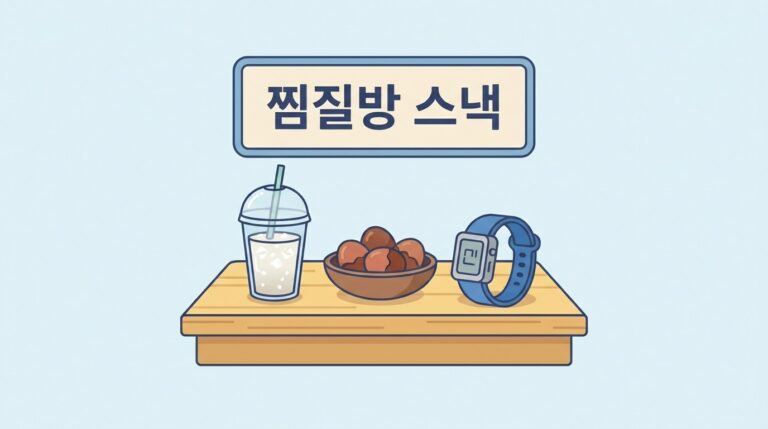
How to Order at a Korean Jjimjilbang Snack Bar Without Cash or Cards
Phase 1: Empathy (Story-Driven Opening)
안녕하세요! (Annyeonghaseyo!) Welcome back to Daily Hangul. I am your local culture navigator and best friend in Korea.
Picture this: You are relaxing in a warm, cozy Korean bathhouse (찜질방, jjimjilbang). You are wearing comfortable cotton sauna clothes (찜질복, jjimjilbok), and you have successfully folded a cute towel sheep-head (양머리, yangmeori) on your head. Suddenly, the delicious aroma of roasted sweet rice drink (sikhye) and baked brown eggs (guun dalgyal) hits you. You walk excitedly to the snack counter (매점, maejeom).
When the auntie behind the counter asks for payment, you panic. You left your wallet, cash, and credit cards deep inside your locker downstairs! You start apologizing and frantically patting your empty pockets. The friendly counter auntie smiles warmly, points to your wrist, and says: “키 찍어 주세요!” (Ki jjigeo juseyo!)
At Korean saunas, you do not need a single coin in your pocket. The digital locker key worn around your wrist is your magic debit card! You tap it at the snack counter, the massage chair, or the arcade, and you settle the entire bill at the exit gate when you leave. In this lesson, we will master the exact words and manners you need to enjoy delicious sauna snacks smoothly like a Seoul local!
Phase 2: 3 Core Expressions Deep-Dive
1. 키로 찍어 주세요. (Ki-ro jjigeo juseyo.)
- Pronunciation: [Ki-ro jji-geo ju-se-yo] (Think: “Key” + “row” + “jjee-guh” + “joo-seh-yo”)
- Meaning: “Please scan it with my wristband key.” (Literal: “Please imprint/press with the key.”)
- K-Culture Moment: In almost every slice-of-life K-drama featuring a sauna scene, characters order towering cups of ice-cold sikhye and simply hold their wrist to the small black terminal box with a cheerful beep! sound.
- Editor’s Insight: The verb 찍다 (jjikda) means to stamp, imprint, or tap an RFID tag. Instead of saying complicated sentences about electronic billing, Koreans simply say “키로 찍어 주세요.”
- Situation Spectrum:
- Casual: 키로 찍을게. (Ki-ro jjigeulge.) – With close friends ⚠️
- Semi-formal / Polite: 키로 찍어 주세요. (Ki-ro jjigeo juseyo.) – At the counter ✅
- Formal: 키로 결제해 주십시오. (Ki-ro gyeoljehae jusipsio.) – Overly formal for a snack stand 🚫
- 🤔 Think About It: In many Western countries, taking items before handing over payment can feel like taking a loan or debt. Why do you think Korean public saunas rely entirely on this deferred wristband tap system?
2. 나갈 때 계산할게요. (Nagal ttae gyesanhalgeyo.)
- Pronunciation: [Na-gal ttae gye-san-hal-ge-yo] (Think: “Nah-gahl” + “teh” + “g-yeh-sahn-hahl-geh-yoh”)
- Meaning: “I will pay when I leave / at check-out.” (Literal: “When leaving, I will calculate.”)
- K-Culture Moment: If an attendant checks if you want to pay with cash or store credits, customers naturally say this phrase to confirm their tab is linked to checkout.
- Editor’s Insight: The grammar pattern
-(으)ㄹ 때means “when [action] happens.”계산하다(gyesanhada) means to calculate or settle a bill. This is an essential phrase across Korea when tab systems exist. - Situation Spectrum:
- Casual: 나갈 때 낼게. (Nagal ttae naelge.) ⚠️
- Semi-formal / Polite: 나갈 때 계산할게요. (Nagal ttae gyesanhalgeyo.) ✅
- Formal: 퇴실 시 정산하겠습니다. (Toesil si jeongtanhagesseumnida.) 🚫
- 🤔 Think About It: How does postponing financial transactions change the psychological feeling of relaxation in a leisure spa?
3. 식혜랑 구운 달걀 세 개 주세요. (Sikhyerang guun dalgyal se gae juseyo.)
- Pronunciation: [Sik-hye-rang gu-un dal-gyal se gae ju-se-yo] (Sound tip: “Sik-hye” sounds like a soft “seek-h-yea” with an airy h)
- Meaning: “Please give me sikhye and three baked eggs.”
- K-Culture Moment: Baked brown eggs are the crown jewel of jjimjilbang dining. Cracking them gently against your friend’s head towel is a legendary K-variety show comedy trope!
- Editor’s Insight:
랑(rang) is the friendly, conversational way to say “and” between nouns.구운(guun) comes from 구운 (roasted/baked), distinguishing these dark, nutty eggs from regular boiled eggs (salmeun dalgyal). - Situation Spectrum:
- Casual: 식혜랑 계란 줘. (Sikhyerang gyeran jwo.) ⚠️
- Semi-formal / Polite: 식혜랑 구운 달걀 세 개 주세요. (Sikhyerang guun dalgyal se gae juseyo.) ✅
- Formal: 식혜와 구운 계란을 부탁드립니다. (Sikhyewa guun gyeraneul butakdeurimnida.) 🚫
- 🤔 Think About It: Why do you think sweet fermented malt rice (sikhye) and high-protein baked eggs became the quintessential post-sweat recharge snack in Korea?
Phase 3: Textbook Korean vs. Real-World Korean
Situation 1: Asking if you can pay with your wristband key
- 📖 교과서 한국어 (Textbook): 이 열쇠에 달린 전자 장치로 비용을 결제할 수 있습니까? (I yeolsoe-e dallin jeonja jangchi-ro biyong-eul gyeoljehal su isseumnikka? / “Is it possible to pay the expenses using the electronic device attached to this key?”)
- 🗣️ 진짜 한국어 (Real-World): 이거 키로 찍으면 돼요? (Igeo ki-ro jjigeumyeon dwaeyo? / “Can I just tap this key?”)
- 💡 Why is it different? Textbook phrases are unnecessarily technical. In daily Korean life, locals replace lengthy descriptions with simple pointer words (igeo = this) and active verbs (jjikda = to tap/scan).
Situation 2: Asking where to pay your final sauna tab
- 📖 교과서 한국어 (Textbook): 모든 이용 금액은 정문 매표소 출구에서 일괄 지불하십시오. (Modeun iyong geumaek-eun jeongmun maepyoso chulgu-eseo ilgwal jibolhasipsio. / “Please pay all usage amounts collectively at the main gate ticketing exit.”)
- 🗣️ 진짜 한국어 (Real-World): 계산은 나갈 때 카운터에서 하시면 돼요. (Gyesan-eun nagal ttae kaunteo-eseo hasimyeon dwaeyo. / “You can just pay at the counter when you head out.”)
- 💡 Why is it different? Attendants speak in friendly
-시면 돼요(-(si)myeon dwaeyo, “you can just…”) structures that sound welcoming rather than rigid or institutional.
Phase 4: K-Culture Deep Dive & Non-Verbal Manners
4-1. Nunchi & Body Gestures
- The Wrist Presentation: When the clerk totals your order, do not pull your locker key completely off your wrist unless requested. Simply raise your forearm and point the plastic disk or barcode toward the tabletop scanner.
- The Two-Handed Tray Reception: Even though you are barefoot and dressed in oversized loungewear, always receive your snack tray with two hands as a polite gesture toward the vendor.
- Egg Cracking Etiquette: Cracking a baked egg on someone’s forehead is only funny in variety shows! In real life, gently tap the egg on the snack table surface or your own palm to avoid making loud thuds on the warm floor.
4-2. Culture Code: The Bathhouse Gastronomy
Korean saunas are not just places to bathe; they are communal urban sanctuaries where people spend 6 to 12 hours relaxing, chatting, and sleeping on heated floors (ondol). Because intense sweating in charcoal or salt rooms depletes minerals and hydration, the snack counter was engineered around instant recovery: icy, sugar-rich sikhye replenishes electrolytes, while slow-cooked brown eggs provide easy digestion without making your stomach feel heavy.
Phase 5: Real-Life Roleplay Scenario
Setting: A bustling Jjimjilbang snack bar on a Saturday afternoon. Warm wooden floors, soft ambient chatter, and the sweet aroma of roasted grains.
Characters:
* You: A traveler craving a refreshing snack after 20 minutes in the hot yellow-clay room (hwangto-bang).
* Imo-nim (이모님): The cheerful, experienced snack counter auntie wearing an apron.
- Turn 1 (You):
안녕하세요! 식혜 하나랑 구운 달걀 세 개 주세요.
(Annyeonghaseyo! Sikhyerang guun dalgyal se gae juseyo.)
“Hello! One sikhye and three baked eggs, please.”
🎭 [Action: Smile pleasantly and look at the menu display] -
Turn 2 (Imo-nim):
네~ 달걀은 세 개에 삼천 원, 식혜는 사천 원이에요.
(Ne~ Dalgyal-eun se gae-e samcheon won, sikhye-neun sacheon won-ieyo.)
“Sure! Eggs are 3,000 won for three, and sikhye is 4,000 won.” -
Turn 3 (You):
저… 지갑이 없는데 키로 찍어도 돼요?
(Jeo… jigap-i eomneunde ki-ro jjigeodo dwaeyo?)
“Um… I don’t have my wallet, can I tap my wristband key?”
🎭 [Action: Lift your arm slightly to show the electronic wristband] -
Turn 4 (Imo-nim):
그럼요! 여기 센서에 키 한번 대 주세요.
(Geureomyo! Yeogi senseo-e ki hanbeon dae juseyo.)
“Of course! Please touch your key to this sensor right here.” -
Turn 5 (You):
(Beep!) 찍었어요! 나갈 때 정산하는 거죠?
(Jjigeosseoyo! Nagal ttae jeongtanhaneun geojyo?)
“Tapped it! I settle this when leaving, right?”
🎭 [Action: Tap the round tag on the reader until it chirps] -
Turn 6 (Imo-nim):
맞아요, 신발 찾기 전에 카운터에서 한꺼번에 내면 돼요.
(Majayo, sinbal chatgi jeone kaunteo-eseo hankkeobeone naemyeon dwaeyo.)
“That’s right, you pay everything at the front counter before collecting your shoes.” -
Turn 7 (You):
감사합니다! 맛있게 먹을게요.
(Gamsahamnida! Masitge meogeulgeyo.)
“Thank you! I will enjoy this.”
🎭 [Action: Receive the small wooden tray with both hands] -
Turn 8 (Imo-nim):
시원하게 마시고 푹 쉬어요!
(Siwonhage masigo puk swieoyo!)
“Drink it refreshingly and have a great rest!”
🔀 Interactive Decision Branch
When the clerk says “여기 센서에 키 한번 대 주세요” (Please tap your key here), what do you do?
* Option A: Pull out a 10,000 won bill from your sock.
Feedback (Bad): In a sauna, wet bills cause inconvenience, and cash registers often do not keep paper money on hand inside the lounge area. Avoid keeping physical cash in your sauna clothes.
* Option B: Gently touch the flat RFID side of your wristband key to the reader until it beeps.
Feedback (Best): Perfect! Smooth, hands-free transaction completed in 1 second.
* Option C: Leave the key on the counter and walk away with the snacks.
Feedback (Risk): The transaction will not register, and the clerk will have to call you back loudly, causing public embarrassment!
Phase 6: 10-Second Emotion Shadowing Drill
Practice these natural rhythm pauses (/) with appropriate emotional inflection:
[😊 Cheerful & Confident]
저기요, / 식혜 하나랑 / 구운 달걀 세 개 주세요!
(Jeogiyo, / sikhye hana-rang / guun dalgyal se gae juseyo!)-
[🤔 Polite Curiosity]
이거 / 팔찌 키로 / 찍으면 되나요?
(Igeo / paljji ki-ro / jjigeumyeon doenayo?) -
[😌 Relieved & Natural]
네! / 나갈 때 / 한꺼번에 계산할게요.
(Ne! / nagal ttae / hankkeobeone gyesanhalgeyo!)
Phase 7: K-Culture Mini Dictionary
-
락카키 (Lakkaki)
Meaning: Locker key / RFID Wristband
Real-World Usage: Refers to the numbered strap worn on wrists or ankles that unlocks your shoe locker, clothes locker, and records your food purchases. -
식혜 (Sikhye)
Meaning: Traditional sweet Korean rice beverage
Real-World Usage: A mildly sweet drink made with fermented malt and cooked rice, served icy cold in large handled plastic containers with oversized straws at bathhouses. -
정산 (Jeongsan)
Meaning: Settlement / Tab clearance
Real-World Usage: The financial step at checkout where the front counter reads your wrist key and presents the total for room fees, drinks, food, and paid massage chairs. -
양머리 (Yangmeori)
Meaning: Towel folded into “Sheep Head” horns
Real-World Usage: Rolling both ends of a standard rectangular bath towel inward to form a cozy cap with two side puffs resembling sheep horns, popular for photos and sauna relaxation.
Phase 8: Traveler’s Survival Kit
Top 3 Survival Expressions
- 영수증 버려주세요. (Yeongsujeung beoryeojuseyo.)
Pro Tip: “Please discard the paper receipt.” Since you pay at the end, snack stands print tiny check slips that you rarely need to carry around. - 빨대 두 개 꽂아주세요. (Ppaldae du gae kkoja-juseyo.)
Pro Tip: “Please put in two straws.” Jjimjilbang sikhye portions are massive; sharing one with a friend is standard! - 신발장이 안 열려요. (Sinbaljang-i an yeollyeoyo.)
Pro Tip: “The shoe locker won’t open.” If you have unpaid snack charges on your key, the automated shoe locker stays electronically locked until settlement.
Editor’s Travel Note
- Navigation Tip: Locate top 24-hour saunas in your neighborhood using our Naver Map search guide. Search for the keyword
찜질방(jjimjilbang). - Checkout Mechanism: Always remember that your shoe locker will not open if your key has an unsettled balance. If the red light flashes at your shoe cubby, walk directly to the main counter and say “정산해 주세요” (Jeongsanhae juseyo / “Please settle my tab”).
Phase 9: “One Step Deeper” (Reflective Question)
In modern cities worldwide, distrust and prepayments dominate commercial customer service. Yet in South Korea, the jjimjilbang ecosystem relies on an extraordinary honor system backed by technological trust. You are trusted to walk freely in light pajamas, eat, sleep, and indulge for hours with nothing more than a plastic bracelet. It reflects the deeply rooted Korean cultural philosophy of Gongdongche (공동체, shared community space) where members share common mutual accountability.
💬 Your Turn: Have you ever experienced a cashless venue like this in your home country? How did you feel relaxing in public without keeping your wallet right next to you? Share your stories below!
Phase 10: FAQ & Common Mistakes
Q: What happens if I accidentally lose my wristband key inside the sauna?
A: Report it immediately to the front desk counter. Keys are tied to your initial shoe locker number. Because anyone picking it up could theoretically purchase snacks under your number, notifying staff right away prevents misuse and helps locate it through security cameras.
Q: Can I pay at the snack bar with Samsung Pay or an Apple Pay phone instead?
A: While some modern snack bars have phone terminals, it is strongly recommended not to carry expensive smartphones into intense dry saunas or steam rooms where extreme heat damages lithium batteries. Rely purely on the wristband key!
Q: Do all Korean bathhouses use digital keys for snacks?
A: Large, multi-story jjimjilbangs use RFID wristband keys. However, tiny neighborhood public bathhouses (mogyoktang) without lounge floors might still request cash for scrub towels or small milks. Look around: if you see a digital scanning pad next to the register, tap away!
🚨 Common Mistakes (흔한 실수)
- Mistake: Trying to hand cash or a credit card to the snack bar clerk while dripping wet or in sauna gear.
Correct Action: Keep cash locked securely in your locker. Tap your wristband key only. - Mistake: Trying to leave the facility immediately after changing into street clothes without visiting the front desk.
Correct Action: Even if you think you bought nothing, always tap your key at the exit gate or front checkout desk to clear your locker record. - Mistake: Cracking baked eggs hard against the floor or tiled wall.
Correct Action: Crack the shell against your own palm or gently on the table tray to keep the peaceful ambiance intact.
Phase 11: Action Mission & Engagement
- 🥉 Bronze Mission (Solo Shadowing): Stand in front of the mirror, extend your wrist, and say out loud three times: “키로 찍어 주세요!”
- 🥈 Silver Mission (Community Share): Take a photo of a sweet rice drink or baked egg at an Asian grocery store or Korean restaurant, fold a towel sheep-head, and tag
@DailyHangulon Instagram with your best Korean sentence! - 🥇 Gold Mission (Real-World Test): On your next visit to a Korean bathhouse, order your sikhye and eggs entirely in Korean using the wrist key without asking in English!
- 🎮 K-Culture Mission: Watch an episode of a classic K-variety show (like Running Man) where the members play games in a sauna. Spot whether they tap their keys or wear yangmeori!
Phase 12: Interactive Quiz Challenge
Quiz 1: Situation Judgment
You just ordered an iced sikhye at the sauna snack bar. The clerk points to a black reader box. What is the most natural sentence to say?
* A) 현금 지금 꼭 내야 해요? (Hyeongeum jigeum kkok naeya haeyo?)
* B) 키로 찍으면 되죠? (Ki-ro jjigeumyeon doejo?)
* C) 신용카드 가지러 옷장에 다녀올게요. (Sinyongkadeu gajireo otjang-e danyeoolgeyo.)
Quiz 2: Fill in the Blank
Complete the sentence to say: “I will pay when I leave.”
* 나갈 때 _______________. (Nagal ttae _______________.)
Quiz 3: True or False (Culture)
Statement: If you bought three eggs and one drink with your wristband key, you can collect your shoes and leave the sauna directly without talking to the front desk clerk.
* True or False?
👉 Click to reveal answers & explanations!
- Quiz 1 Answer: B) 키로 찍으면 되죠? (Can I just tap with the key?)
- Explanation: Option A and C suggest running back to grab wallets or insisting on cash, which disrupts the convenient wristband flow!
- Quiz 2 Answer: 계산할게요 (gyesanhalgeyo) or 정산할게요 (jeongsanhalgeyo).
- Explanation: Nagal ttae gyesanhalgeyo translates naturally to “I will pay when I leave.”
- Quiz 3 Answer: False.
- Explanation: If there is an outstanding balance on your RFID locker key, the electronic shoe locker remains locked until you clear the charges at the front cashier desk.
- Explanation: If there is an outstanding balance on your RFID locker key, the electronic shoe locker remains locked until you clear the charges at the front cashier desk.







