

Phase 1: Empathy & Storytelling Opening
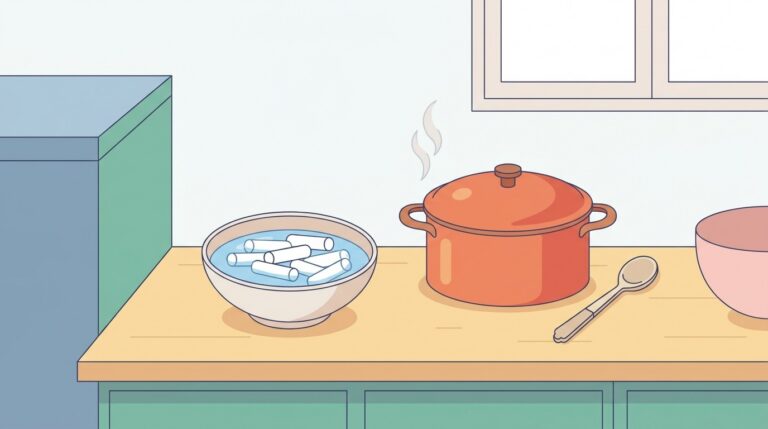
안녕하세요! 매일한글 에디터입니다. (Hello! This is your Daily Hangul editor.) Have you ever watched a cozy K-Drama where the main characters comfort each other over a steaming, glossy plate of crimson tteokbokki late at night, making you want to cook it immediately? You rush to the Asian market, grab a bag of rice cakes, toss them directly into boiling broth, and end up with chewy rocks on the outside that crack into gummy mush! Our A2 learner David messaged me last week: “Editor, why does my tteokbokki split while street stalls in Seoul make it so pillowy soft?” The secret isn’t magic gochujang; it is one simple pre-cooking step: “떡볶이 떡은 요리하기 전에 찬물에 불려 두세요” (Soak tteokbokki rice cakes in cold water before cooking). Today, let’s learn how to explain recipes step-by-step like a true Korean home cook!
Phase 2: 3 Core Expressions In-Depth
1. 찬물에 불려 두세요 (Chan-mure bul-lyeo du-se-yo)
- Pronunciation: Chan-mure bul-lyeo du-se-yo (Sounds like: “Chahn-moo-reh bull-yuh doo-seh-yo” — think of the word “bull” followed by “yuh”).
- Meaning: Literal: “Soak in cold water and leave it.” / Real Nuance: “Please soak them in cold water ahead of time so they hydrate properly.”
- K-Culture Moment: Seen on cooking shows like Baek Jong-won’s Alley Restaurant when chefs give kitchen hacks for rehydrating starch or dried ingredients.
- Editor’s Insight: The grammar
-아/어 두다means performing an action in advance and maintaining that prepared state for a later step. - Situation Spectrum: Casual: 찬물에 불려 둬 (Chan-mure bul-lyeo dwo) ✅ | Semi-formal: 찬물에 불려 두세요 (Chan-mure bul-lyeo du-se-yo) ✅ | Formal: 찬물에 불려 두십시오 (Chan-mure bul-lyeo du-sip-si-o) ✅
- 🤔 Think About It: In English, we often say “Pre-soak the cakes.” Notice how Korean builds anticipation directly into the verb ending
-어 두세요.
2. 요리하기 전에 (Yo-ri-ha-gi jeo-ne)
- Pronunciation: Yo-ri-ha-gi jeo-ne (Sounds like: “Yo-ree-hah-gee juh-neh” — rhythm similar to “Story-telling before bed”).
- Meaning: Literal: “Before the act of cooking.” / Real Nuance: “Before you begin cooking / Prior to cooking.”
- K-Culture Moment: Korean recipe YouTube channels (like Paik’s Cuisine) always highlight this phase when prepping ingredients before firing up the gas stove.
- Editor’s Insight: When you attach
-기 전에to any verb stem, you create the golden sequence marker: “before doing [action]”. - Situation Spectrum: Casual: 요리하기 전에 (Yo-ri-ha-gi jeo-ne) ✅ | Semi-formal: 요리하기 전에 (Yo-ri-ha-gi jeo-ne) ✅ | Formal: 조리하기 전에 (Jo-ri-ha-gi jeo-ne) ✅
- 🤔 Think About It: Korean time markers state the reference action first (요리하기 = cooking) followed by the position (전에 = before). Does your language prioritize the time marker first or the action?
3. 골고루 섞으세요 (Gol-go-ru seok-keu-se-yo)
- Pronunciation: Gol-go-ru seok-keu-se-yo (Sounds like: “Gohl-goh-roo suhk-kuh-seh-yo”).
- Meaning: Literal: “Mix evenly.” / Real Nuance: “Stir it thoroughly so all seasonings blend without clumping.”
- K-Culture Moment: Moms teaching kids how to mix tteokbokki sauce or bibimbap in family K-Dramas.
- Editor’s Insight: “골고루” (gol-go-ru) is a vibrant adverb meaning “evenly, without leaving anything out.” It turns a plain instruction into mouth-watering culinary precision.
- Situation Spectrum: Casual: 골고루 섞어 (Gol-go-ru seok-eo) ✅ | Semi-formal: 골고루 섞으세요 (Gol-go-ru seok-keu-se-yo) ✅ | Formal: 골고루 섞어 주십시오 (Gol-go-ru seok-eo ju-sip-si-o) ✅
- 🤔 Think About It: Korean cuisine values harmony of flavors (조화). Why do you think native speakers emphasize “골고루” rather than just saying “mix it”?
Phase 3: Textbook Korean vs. Real Korean
Situation 1: Telling someone to start the stove
- 📖 교과서 한국어 (Textbook): 가스레인지를 켜고 물을 끓이십시오. (Ga-seu-re-in-ji-reul kyeo-go mur-eul kkeur-i-sip-si-o. / Turn on the gas stove and boil water.)
- 🗣️ 진짜 한국어 (Real-life): 불 켜고 물 먼저 끓여요. (Bul kyeo-go mul meon-jeo kkeur-yeo-yo. / Turn the heat on and boil the water first.)
- 💡 왜 다를까? (Why the difference?): Real Koreans rarely say the 5-syllable word “가스레인지” while cooking at home. We naturally say “불 켜다” (turn on the fire/heat) and use “먼저” (first) to guide the order.
Situation 2: Checking if the rice cake is soft
- 📖 교과서 한국어 (Textbook): 떡이 익었는지 확인해 보십시오. (Tteok-i ig-eon-neun-ji hwag-in-hae bo-sip-si-o. / Please verify if the rice cake is cooked.)
- 🗣️ 진짜 한국어 (Real-life): 떡 말랑말랑해졌는지 한번 봐봐요. (Tteok mal-lang-mal-lang-hae-jyeot-neun-ji han-beon bwa-bwa-yo. / Take a look if the rice cakes turned soft and squishy.)
- 💡 왜 다를까? (Why the difference?): Instead of formal verbs like “확인하다” (to verify), native speakers love vivid sensory words like “말랑말랑” (pillowy/squishy) when talking about texture.
Phase 4: K-Culture Deep Dive & Non-Verbal Manners
4-1. Nunchi (눈치) & Kitchen Gestures
When cooking together in a Korean kitchen, non-verbal respect is key. When passing a kitchen knife or hot ladle to a friend, never point the blade or hot metal toward them—turn the handle toward them with both hands or with your left hand lightly supporting your right wrist. When someone is demonstrating a step (like soaking the tteok), lean in slightly with an appreciative nod and say, “아, 그렇군요!” (Ah, I see!). This demonstrates enthusiastic culinary manners.
4-2. Cultural Code: The Soul of Bunsik (분식)
Tteokbokki is the ultimate Korean comfort food, born out of neighborhood snack shops called “분식집” (bunsik-jip). Soaking rice cakes in cold water before putting them in hot broth is an essential culinary habit in Korea. Because pre-packaged refrigerated or frozen rice cakes have lost surface moisture, throwing them directly into boiling broth causes the outer skin to burst while the core remains chalky. Soaking them is an act of “정성” (sincerity)—giving ingredients time to breathe.
Phase 5: Real-Life Roleplay Scenario
- Setting: A warm kitchen in an Airbnb in Hongdae, Seoul. You and your Korean foodie friend Min-ho (민호) are cooking homemade midnight tteokbokki after exploring Mangwon Market.
-
Turn 1 (Min-ho): 떡 사 왔으니까 바로 냄비에 넣을까요? (Tteok sa wat-seu-ni-kka ba-ro naem-bi-e neo-eul-kka-yo? / “I bought the rice cakes, should we toss them straight into the pot?”) 🎭 Holding a wooden spoon with an eager, hungry smile
- Turn 2 (You): 잠깐만요! 떡볶이 떡은 요리하기 전에 찬물에 불려 두세요. (Jam-kkan-man-yo! Tteokbokki tteok-eun yo-ri-ha-gi jeo-ne chan-mure bul-lyeo du-se-yo. / “Wait a second! Soak tteokbokki rice cakes in cold water before cooking.”) 🎭 Gently raising a palm to pause him while taking out a mixing bowl
- Turn 3 (Min-ho): 오, 요리 좀 해 봤는데요? 찬물에 얼마나 둬요? (O, yo-ri jom hae bwan-neun-de-yo? Chan-mure eol-ma-na dwo-yo? / “Oh, look at you! You know your cooking! How long in cold water?”) 🎭 Eyes widening in pleasant surprise
- Turn 4 (You): 한 10분 정도만 담가 두면 돼요. (Han sip-bun jeong-do-man dam-ga du-myeon dwae-yo. / “Just about 10 minutes will do.”) 🎭 Pouring fresh water over the rice cakes gently
- Turn 5 (Min-ho): 그럼 그 사이에 양념장 먼저 만들까요? (Geu-reom geu sa-i-e yang-nyeom-jang meon-jeo man-deul-kka-yo? / “Then shall we make the sauce base in the meantime?”) 🎭 Reaching for the jar of red pepper paste and soy sauce
- Turn 6 (You): 네, 고추장이랑 설탕을 골고루 섞으세요. (Ne, go-chu-jang-i-rang seol-tang-eul gol-go-ru seok-keu-se-yo. / “Yes, please mix the gochujang and sugar evenly.”) 🎭 Handing him a small whisk with a warm nod
- Turn 7 (Min-ho): 떡이 벌써 말랑말랑해진 것 같아요! (Tteok-i beol-sseo mal-lang-mal-lang-hae-jin geot ga-ta-yo! / “The rice cakes already feel squishy and soft!”) 🎭 Tapping a rice cake gently with chopstick tips
- Turn 8 (You): 이제 끓는 육수에 넣고 약불로 졸여요! (I-je kkeul-neun yuk-su-e neo-ko yak-bul-lo jol-yeo-yo! / “Now let’s put them into the boiling broth and simmer down on low heat!”) 🎭 Adjusting the stove knob with a proud grin
🔀 Interactive Decision Point (At Turn 2)
- Choice A: “떡볶이 떡은 요리하기 전에 찬물에 불려 두세요.” (Soak tteokbokki rice cakes in cold water before cooking.)
- Feedback [Best]: Flawless! Min-ho will admire your culinary savvy, and your rice cakes will be chewy and intact.
- Choice B: “그냥 빨리 냄비에 다 넣고 끓여요!” (Just throw everything in the pot fast and boil!)
- Feedback [Risk]: Your tteokbokki will crack open and dissolve into red starchy soup. Impatience is the enemy of texture!
- Choice C: “떡에 물 닿으면 안 돼요!” (Rice cakes shouldn’t touch water!)
- Feedback [Bad]: Factually wrong! Without water absorption, your tteokbokki will taste tough and dry.
Phase 6: 10-Second Emotion Shadowing Drill
- Sentence 1:
[😊 친절하고 상냥하게 - Kind and gentle]
떡볶이 떡은 / 요리하기 전에 / 찬물에 불려 두세요. (Tteok-bok-ki tteok-eun / yo-ri-ha-gi jeo-ne / chan-mure bul-lyeo du-se-yo.) - Sentence 2:
[💡 똑부러진 꿀팁을 주듯이 - Giving a smart pro-tip]
한 10분 정도만 / 찬물에 / 담가 두면 돼요! (Han sip-bun jeong-do-man / chan-mure / dam-ga du-myeon dwae-yo!) - Sentence 3:
[😋 군침 돌고 신나게 - Mouth watering and excited]
양념을 골고루 섞고 / 약불로 / 졸여 주세요! (Yang-nyeom-eul gol-go-ru seok-ko / yak-bul-lo / jol-yeo ju-se-yo!)
Phase 7: K-Culture Mini Dictionary
- 떡 (Tteok) | Korean traditional rice cake. In street food, it usually comes as cylindrical “garae-tteok” cut into bite-sized tubes.
- 불리다 (Bul-li-da) | To soak / plump up. Used for dry or stiff ingredients like rice, dried seaweed (miyeok), or cold tteok.
- 양념 (Yang-nyeom) | Seasoning / sauce blend. The magical mix of gochujang, gochugaru, soy sauce, and sweetener that creates authentic Korean taste.
- 졸이다 (Jol-i-da) | To simmer down / boil down until the sauce thickens and glazes over the ingredients.
Phase 8: Traveler’s Survival Kit
Top 3 Survival Phrases
- 떡볶이 1인분 포장해 주세요. (Tteok-bok-ki il-in-bun po-jang-hae ju-se-yo. / Please pack one serving of tteokbokki to go.)
- Pro Tip: Use this at any bustling outdoor tent or street cart. “1인분” means one portion.
- 덜 맵게 해 주실 수 있나요? (Deol maep-ge hae ju-sil su in-na-yo? / Could you please make it less spicy?)
- Pro Tip: If bright red sauces make you nervous, this polite phrase will save your stomach!
- 쌀떡이에요, 밀떡이에요? (Ssal-tteog-i-e-yo, mil-tteog-i-e-yo? / Is this rice cake or wheat flour cake?)
- Pro Tip: Koreans passionately debate whether chewy rice tteok (쌀떡) or springy wheat tteok (밀떡) is superior. Asking this proves you are an insider!
Editor’s Travel Note
When hunting for authentic neighborhood tteokbokki in Seoul, skip global search tools and install the 네이버 지도 (Naver Map) 공식 앱. Search for “분식” near any residential subway exit to discover places run by local grandmothers (halmeoni). Bring a 10,000 KRW bill in your pocket—while card payments work almost everywhere, traditional pojangmacha food stalls love cash or local bank transfers.
Phase 9: A Step Deeper (한 발 더 깊이)
In Korean culinary culture, food is never made in a hurry; it is imbued with “정성” (jeongseong)—wholehearted sincerity. The extra five minutes spent soaking hard rice cakes in cold water mirrors the Korean social virtue of “배려” (consideration for others). By gently softening the ingredients before heat touches them, you ensure that anyone sharing your table experiences comfort in every bite. Sharing food cooked with proper steps is how Koreans express affection without saying “I love you.”
💬 Your Turn: What is one essential pre-cooking step from your country’s comfort food that requires patience before turning on the stove? Share your culinary secrets in the comments!
Phase 10: FAQ & Common Mistakes
Q: Can I soak the rice cakes in hot water instead to save time?
A: We recommend cold water! Hot water turns the exterior gelatinous and mushy before the center rehydrates, causing the cakes to fall apart in the boiling sauce. Cold water ensures even, pillowy moisture from edge to core.
Q: What is the grammar difference between ‘-기 전에’ and ‘-은 후에’?
A: They are the ultimate temporal pair! -기 전에 means “before doing [verb]” (e.g., 요리하기 전에 = before cooking). -은 후에 means “after doing [verb]” (e.g., 요리한 후에 = after cooking).
Q: Can I use “불려 두세요” for other Korean recipes?
A: Yes! When making seaweed soup (미역국), say “미역을 찬물에 불려 두세요” (Soak the dried seaweed in cold water). It works for glass noodles (당면) in Japchae, too!
🚨 흔한 실수 (Common Mistakes) Alert
- Mistake: Saying “찬물에 요리하세요” (Cook in cold water).
- Correct Action: Soaking is not cooking! Use “불리다” (to soak) -> “찬물에 불려 두세요.”
- Mistake: Confusing “찬물” (cold water) with “뜨거운 물” (hot water).
- Correct Action: Keep them distinct: “찬물” = cold water, “따뜻한 물” = warm water, “뜨거운 물” = hot/boiling water.
- Mistake: Forgetting the nominalizing
-기before전에(e.g., “요리 전에”).- Correct Action: When using a verb, always attach
-기 전에: “요리하기 전에”, “먹기 전에”.
- Correct Action: When using a verb, always attach
Phase 11: Action Missions
- 🥉 Bronze Mission (Solo Practice): Stand by your kitchen sink and repeat out loud 5 times: “떡볶이 떡은 요리하기 전에 찬물에 불려 두세요!”
- 🥈 Silver Mission (Social Share): Snap a photo of any meal prep or noodle bowl and upload an Instagram Story with the sticker text: “요리하기 전에 찬물에 불리기! 🍲”
- 🥇 Gold Mission (Real-Life Application): Next time you cook with friends or visit an Asian market, explain the golden pre-soak step in Korean: “찬물에 10분만 불려 두세요!”
- 🎮 K-Culture Mission: Watch a tteokbokki street food video or cooking vlog on YouTube and write down every time the chef says “물”, “불”, or “넣으세요”.
Phase 12: Interactive Quiz Challenge
1. Situational Judgment
You are cooking tteokbokki with your Korean roommate. The rice cakes came straight out of the refrigerator and feel rock-hard. What should you instruct your friend to do first?
* (A) 불을 세게 켜고 떡을 바로 구우세요.
* (B) 요리하기 전에 떡을 찬물에 불려 두세요.
* (C) 떡을 전자레인지에 20분 동안 돌리세요.
🔍 Click to reveal the Answer & Explanation
Correct Answer: (B)
Explanation: Hard tteok from the fridge must be soaked in cold water for about 10 minutes to rehydrate and avoid cracking. Cooking immediately on high heat (A) burns the outside, and microwaving for 20 minutes (C) turns them into rubber!
2. Fill in the Blank
Complete the sentence meaning “Please mix the sauce evenly before boiling”:
“끓이기 전에 양념을 _________ 섞으세요.”
🔍 Click to reveal the Answer & Explanation
Correct Answer: 골고루 (gol-go-ru)
Explanation: “골고루” is the native adverb meaning “evenly / thoroughly distributed”, which is paired with “섞으세요” (please mix).
3. True or False Cultural Quiz
Statement: In Korean recipe instructions, it is better to soak pre-packaged tteokbokki rice cakes in boiling water rather than cold water to cook faster.
* [True / False]
🔍 Click to reveal the Answer & Explanation
Correct Answer: False
Explanation: Soaking in boiling water melts the outside while leaving the inside raw. Authentic Korean cooks always recommend cold water (“찬물”) for balanced texture!






