

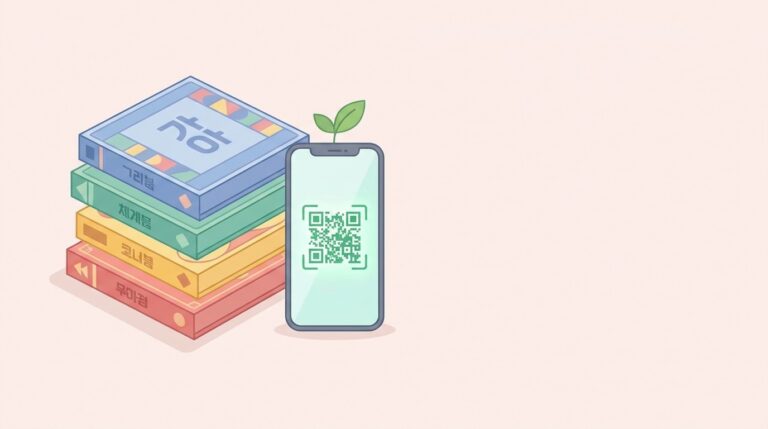
Beyond the Photocard Hype: Navigating K-Pop’s Album Waste Dilemma and Green Reforms in Korean
Phase 1: Empathy (Immersive Story Opening)
안녕하세요! It is your Daily Hangul editor. Imagine this scene: you are sitting inside a bustling idol pop-up cafe in Hongdae on comeback day. The room is filled with ecstatic fans opening glossy packages. Right beside you, a fan has bought thirty copies of the exact same album. With laser focus, they rip open the plastic wrapping, slide out the small 55x85mm random photocard—their beloved bias—and then unceremoniously pile the remaining twenty-nine plastic CD jewel cases into a nearby trash bin on the sidewalk.
It is an open secret in modern K-culture: the fierce battle for first-week sales (초동, chodong), deceptive industry push-selling practices (밀어내기, mil-eo-nae-gi), and the mountains of non-recyclable polycarbonate plastic left behind. Fans love their idols, yet many now grapple with deep moral fatigue over this wasteful cycle. That is why genuine self-reflection and eco-friendly solutions like QR platform albums are shaking up the industry.
As intermediate (B2) learners of Korean, learning to discuss these real socio-cultural issues moves you beyond basic greetings into the heart of modern Korean discourse. Based on genuine student inquiries who wanted to debate these topics without sounding judgmental or clumsy, this guide will equip you with authentic, nuanced Korean vocabulary to talk thoughtfully about fandom, consumerism, and green sustainability.
Phase 2: 3 Key Expressions Deep Dive
1. 초동 판매량을 올리다 (Chodong panmaeryang-eul ollida)
- Pronunciation: [Cho-dong pan-mae-ryang-eul ol-li-da] (Think of ‘cho’ like ‘choke’ without the k, and ‘dong’ like the sound of a resonant bell ding-dong).
- Meaning: Literally “to increase first-week sales volume.” Nuance-wise, it describes the cutthroat race where fandoms mass-purchase albums within the first seven days of release to break records and secure weekly television music show crowns.
- K-Culture Moment: Music news anchors and YouTube commentators dissecting comeback statistics: “이번 신인 그룹이 초동 판매량을 올리기 위해 다양한 이벤트를 진행하고 있습니다.” (Ibeon sin-in geurub-i chodong panmaeryang-eul olligi wihae dayanghan ibenteu-reul jinhaenghago itseumnida. / “This rookie group is running various events to boost their first-week sales.”)
- Editor’s Insight: Chodong (초동) strictly refers to the initial week of sales tracked by certified charts like Hanteo. It represents raw fandom loyalty rather than casual general-public popularity.
- Situation Spectrum: Casual: ⚠️ | Semi-formal: ✅ | Formal: ✅
- 🤔 Think About It: Why does Korean pop music emphasize time-limited first-week data so heavily compared to the long-tail streaming trends in Western music markets?
2. 포카 뽑기 때문에 사재기하다 (Poka ppopgi ttaemune sajaegihada)
- Pronunciation: [Po-ka ppop-gi ttae-mu-ne sa-jae-gi-ha-da] (‘Poka’ sounds like the beginning of ‘polka dot’; ‘ppopgi’ mimics the crunchy candy-carving game popularized by Squid Game).
- Meaning: Literally “to hoard or bulk-buy due to photocard pulling.” In native usage, it describes fans purchasing dozens or hundreds of duplicate albums solely to collect rare, randomized photocards.
- K-Culture Moment: Two fan friends commiserating over credit card bills outside a record shop: “원하는 포카 뽑기 때문에 사재기했는데 중복만 나왔어.” (Wonhaneun poka ppopgi ttaemune sajaegihaenneunde jungbongman nawasseo. / “I bulk-bought albums just to pull the photocard I wanted, but I only got duplicates.”)
- Editor’s Insight: Sajaegi (사재기) traditionally means emergency panic buying or illegal chart-rigging. Used in fandom contexts, it carries an introspective, slightly self-deprecating critique of over-purchasing.
- Situation Spectrum: Casual: ✅ | Semi-formal: ✅ | Formal: ⚠️
- 🤔 Think About It: How does your native language describe blind-box purchases versus intentional music consumption?
3. 친환경 플랫폼 앨범으로 전환하다 (Chinhwangyeong peullaetpom aelbeom-euro jeonhwanhada)
- Pronunciation: [Chin-hwan-gyeong peul-laet-pom ael-beom-eu-ro jeon-hwan-ha-da] (Say ‘Chin’ like the facial feature, and ‘hwan-gyeong’ smoothly like ‘juan-gyung’).
- Meaning: Literally “to transition toward eco-friendly platform albums.” It refers to artists ditching bulky plastic jewel cases and polycarbonate discs in favor of minimalist paper cards with QR codes and digital photo collections.
- K-Culture Moment: Fandom leaders writing open petitions to major entertainment agencies demanding sustainable merchandise choices: “기획사들이 플라스틱 쓰레기를 줄이기 위해 친환경 플랫폼 앨범으로 적극 전환해야 합니다.” (Gihwoeksadeur-i peullaseutik sseuregi-reul jurigi wihae chinhwangyeong peullaetpom aelbeom-euro jeokgeuk jeonhwanhaeya hamnida. / “Entertainment agencies must actively transition to eco-friendly platform albums to reduce plastic waste.”)
- Editor’s Insight: Notice the verb jeonhwanhada (전환하다, to shift/switch policies). At the B2 level, pairing this with chinhwangyeong (친환경, eco-friendly) reflects polished, civic-minded speech.
- Situation Spectrum: Casual: ⚠️ | Semi-formal: ✅ | Formal: ✅
- 🤔 Think About It: Can a digital QR code ever replace the tactile joy of holding a physical CD booklet for you?
Phase 3: Textbook Korean vs Real Korean
Situation 1: Describing the craze of tearing through bulk albums
- 📖 교과서 한국어 (Textbook):
팬들이 포토카드를 얻기 위해 앨범을 여러 장 구매하고 있습니다.
(Faendeur-i potokadeu-reul eotgi wihae aelbeom-eul yeoreo jang gumaehago itseumnida.)
“Fans are purchasing multiple copies of albums to obtain photocards.” - 🗣️ 진짜 한국어 (Real-World):
최애 포카 뽑으려고 앨범깡 하느라 완전 탕진했잖아.
(Choeae poka ppobeuryeogo aelbeom-kkang haneura wanjeon tangjinhaetjana.)
“I went completely broke doing an unboxing spree just to pull my bias’s photocard!” - 💡 왜 다를까? Textbook Korean sounds like an objective sociology paper. Real young Koreans use aelbeom-kkang (앨범깡, mass album unboxing spree derived from tearing opened packages) and tangjinhada (탕진하다, to squander funds humorously).
Situation 2: Criticizing the abandonment of album packaging
- 📖 교과서 한국어 (Textbook):
CD를 버리는 것은 심각한 환경오염 문제를 일으킵니다.
(CD-reul beorineun geos-eun simgakhan hwangyeong-oyeom munje-reul ireukimnida.)
“Discarding CDs causes a serious environmental pollution problem.” - 🗣️ 진짜 한국어 (Real-World):
알맹이인 포카만 쏙 빼고 플라스틱 껍데기는 길거리에 내버려 두니까 문제지.
(Almaeng-i-in poka-man ssok ppaego peullaseutik kkeopdeogi-neun gilgeori-e naebeoryeo dunikka munjeji.)
“The real problem is people snatch out the juicy photocard core and dump the plastic shells right onto the street!” - 💡 왜 다를까? Native speakers use descriptive sensory words like almaeng-i (알맹이, kernel/substance), ssok ppaeda (쏙 빼다, to pluck out neatly), and kkeopdeogi (껍데기, hollow shell) to convey emotional frustration.
Phase 4: K-Culture Deep Dive & Non-verbal Manners
4-1. 눈치 (Nunchi) & Gestures in Album Trading Spaces
When hanging around physical K-pop trading hubs like the underground concourses of Myeongdong or designated fandom cafes, observing non-verbal etiquette (nunchi) is essential:
* The Duplicate Humility: If you open an album and pull an ultra-rare card while someone next to you pulls five duplicates of the same member, do not squeal loudly. Cover your mouth lightly with one hand (입 가리기) to express joyful shock without appearing arrogant.
* Respecting Packaging: If you intend to leave non-card album components behind, never leave them scattered on tables. In Korea, public sorting etiquette (bunri-baechul, 분리배출) is deeply ingrained. Always ask cafe staff: “남은 앨범 기부함이 따로 있나요?” (Nameun aelbeom gibuham-i ttaro innayo? / “Is there a donation box for leftover albums?”).
4-2. Cultural Code Analysis: Fandom Guilt vs. “Mil-eo-nae-gi”
Why do fans buy so many albums if they don’t even own CD players? Two corporate systems drive this:
1. Random Photocards (랜덤 포카): Normalizing gambling-like mechanics where an album contains one random card out of twenty variations.
2. Push-Selling (밀어내기) & Fansign Lotteries (팬사인회 응모): Retailers purchase thousands of albums from agencies on credit, then lure fans into bulk-buying by tying each purchase to a single lottery ticket for a 2-minute in-person fansign event.
Yet Korean Gen Z fans are not passive victims. Activist groups like Kpop4Planet are petitioning the “Big 4” agencies (HYBE, SM, JYP, YG). Their collective critique has led to the adoption of FSC-certified biodegradable packaging and Nemoz/Pocaalbum QR formats, showing how cultural passion can spark institutional reform.
Phase 5: Real-World Roleplay Scenario
Setting: Outside an album retail boutique in Gangnam. Alex (an eco-conscious international fan) meets Minji (a seasoned Korean collector holding two giant shopping bags full of identical albums).
- Minji: 🎭 (Heaving a heavy sigh, looking down at twenty unwrapped albums)
하… 이번에도 우리 최애 포카는 하나도 안 나왔어. 어떡하지?
(Ha… ibeonedo uri choeae poka-neun hanado an nawasseo. Eotteokhaji?)
“Sigh… Not a single card of my ultimate bias came out this time either. What am I going to do?” -
Alex: 🎭 (Gently looking at the plastic mountain with wide eyes)
설마 그 앨범들 다 포카 때문에 사재기한 거야?
(Seolma geu aelbeomdeul da poka ttaemune sajaegihan geoya?)
“Don’t tell me you bulk-bought all those albums just for the photocards?” -
Minji: 🎭 (Nodding sheepishly, biting her lower lip)
응, 팬사인회 응모도 할 겸 샀는데… 솔직히 이 플라스틱 CD들 다 버릴 생각 하니까 죄책감 들어.
(Eung, paensainhoe eungmodo hal gyeom sanneunde… soljikhi i peullaseutik CD-deul da beoril saenggak hanikka joechaekgam deureo.)
“Yeah, I bought them partly to apply for the fansign too… but honestly, thinking about throwing away all these plastic CDs makes me feel so guilty.” -
Alex: 🎭 (Pointing toward the shelf displaying a slim paper sleeve)
저기 보니까 스마트폰으로 듣는 플랫폼 앨범도 있던데, 그건 안 샀어?
(Jeogi bonikka seumateu-pon-euro deunneun peullaetpom aelbeomdo itdeonde, geugeon an sasseo?)
“I saw over there that they also have platform albums you listen to via smartphone—didn’t you buy those?” -
Minji: 🎭 (Shrugging with mixed feelings)
나도 친환경 버전 사고 싶었지! 근데 그건 팬사인회 응모 수량에 포함이 안 된대.
(Nado chinhwangyeong beojeon sago sipeotji! Geunde geugeon paensainhoe eungmo suryang-e poham-i an doendae.)
“I wanted to buy the eco-friendly version too! But they said those aren’t counted toward the fansign lottery quota.” -
Alex: 🎭 (Frowning thoughtfully)
결국 기획사들이 초동 판매량 경쟁 때문에 팬들 심리를 이용하는 거네.
(Gyeolguk gihwoeksadeur-i chodong panmaeryang gyeongjaeng ttaemune paendeul simni-reul iyonghaneun geone.)
“In the end, agencies are just exploiting fans’ devotion for first-week sales competition.” -
Minji: 🎭 (Looking at the overflowing recycling bin nearby)
맞아. 그래서 요즘 국내 팬들 사이에서도 자성의 목소리가 커지고 있어.
(Maja. Geuraeseo yojeum gungnae paendeul saieseodo jaseong-ui moksoriga keojigo isseo.)
“Exactly. That’s why voices of self-reflection are growing louder among domestic fans these days.” -
Alex: 🎭 (Smiling warmly while offering to help carry the bags)
일단 남은 포카는 카페 가서 교환 찾아보고, CD는 필요한 분들께 무료 나눔 해보자!
(Ildan nameun poka-neun kape gaseo gyohwan chajabogo, CD-neun piryohan bundeulkke muryo nanum haeboja!)
“Let’s check for photocard trades at the cafe first, and do a free giveaway for the CDs to people who need them!”
🔀 Interactive Decision Point
How should Alex react next to keep the conversation supportive yet meaningful?
- Option A (Best): “좋아! 다음 컴백 땐 친환경 앨범만 사겠다고 팬클럽 청원 올리면 나도 서명할게.” (Constructive, shows solidarity and actionable community spirit).
- Option B (Bad): “그러니까 애초에 그런 쓸데없는 플라스틱을 왜 그렇게 많이 사? 돈 낭비야.” (Harshly scolds the friend and ignores industry systemic pressures).
- Option C (Risk): “신경 쓰지 마! 1등만 하면 플라스틱 쓰레기가 좀 나와도 어쩔 수 없지.” (Dismisses ecological ethics completely, potentially sounding careless).
Phase 6: 10-Second Emotion Shadowing Drill
Read these aloud while mimicking the emotional punctuation pauses (/):
[🥺 아쉽고 속상하게 - Disappointed & regretful]
최애 포카는 하나도 안 나오고… / 중복만 잔뜩 나와서 / 너무 속상해.
(Choeae poka-neun hanado an naogo… / jungbongman jantteuk nawaseo / neomu soksanghae.)
“Not a single photocard of my bias came out… / only tons of duplicates appeared / I’m so bummed.”-
[🧐 진지하고 단호하게 - Serious & firm]
이제는 무의미한 초동 경쟁 대신 / 환경을 생각하는 플랫폼 앨범으로 / 바뀌어야 해.
(Ijeneun muuimihan chodong gyeongjaeng daesin / hwangyeong-eul saenggakhaneun peullaetpom aelbeom-euro / bakkwieoya hae.)
“Now, instead of meaningless first-week sales races / to eco-friendly platform albums / we must change.” -
[🌱 희망차고 다정하게 - Hopeful & warm]
남은 실물 앨범은 / 필요한 사람들에게 나눔 하고 / 우리도 지속 가능한 덕질을 해보자!
(Nameun silmul aelbeom-eun / piryohan saramdeurege nanum hago / urido jisok ganeunghan deokjireul haeboja!)
“Let’s give away the remaining physical albums / to people who need them / and practice sustainable fandom together!”
Phase 7: K-Culture Mini Dictionary
- 앨범깡 (Aelbeom-kkang) (Noun)
Translation: Album unboxing frenzy.
Usage: Derived from gaming slangs for opening loot boxes. Used whenever someone tears open dozens of wrapped albums on camera or in cafes to reveal photocards. - 밀어내기 (Mil-eo-nae-gi) (Noun)
Translation: Inventory push-selling.
Usage: A controversial B2B business practice where labels pressure wholesale vendors to buy excessive initial inventory, which distributors later liquidate by hosting endless fan-sign events. - 자성의 목소리 (Jaseong-ui moksori) (Noun phrase)
Translation: Voices of self-reflection / introspective critique.
Usage: Highly respected phrase in Korean media and civic discussions when an industry or fandom pauses to critique its own unhealthy habits. - 덕질 (Deok-jil) (Noun)
Translation: Fandom activities / stan life.
Usage: Rooted in the Japanese loanword otaku (오타쿠 → 오덕후 → 덕후), this denotes everything a fan does to love and support their favorite artist.
Phase 8: Traveler’s Survival Kit
Top 3 Survival Phrases
- “혹시 실물 CD 없는 플랫폼 앨범도 있나요?”
(Hoksi silmul CD eomneun peullaetpom aelbeomdo innayo?)
Pro Tip: Use this at music stores when you want photocard inclusions and digital music access without carrying 2kg of heavy plastic back home. - “남은 앨범 무료 나눔 하거나 기부할 곳이 있을까요?”
(Nameun aelbeom muryo nanum hageona gibuhal gosi isseulkkayo?)
Pro Tip: Perfect for asking K-pop event cafe owners if they host public giveaway shelves for surplus unsealed albums. - “중복 포카 교환 구하고 있어요.”
(Jungbok poka gyohwan guhago isseoyo.)
Pro Tip: Say this to fellow fans politely in album cafes when holding duplicate cards face-up in clear binder sleeves.
Editor’s Travel Note
Navigating Seoul’s album spots sustainably is easy if you know where to go. Instead of buying new stacks at department stores, visit secondhand record havens like Aladin Bookstore branches or specialized hobby spots in Hongdae. To find nearby recycling stations and fan-friendly cafes without getting lost, make sure you complete your Naver Map app download before landing, as international map tools often fail to show precise indoor trade spots.
Phase 9: “One Step Deeper” (Critical Thinking)
In South Korea, fandom is rarely an individual pursuit; it is fundamentally a collective endeavor (gongdongche munhwa, 공동체 문화). Helping your favorite singer reach number one on the charts feels like a shared civic victory. Yet this beautiful solidarity can be hijacked by corporate monetization models that turn love into waste. True loyalty to an artist no longer means buying fifty plastic boxes that end up in landfills. Genuine affection is now defined by holding the industry accountable so that our beloved K-pop can thrive sustainably for decades to come.
💬 Your Turn: Have you ever purchased duplicate albums or blind merchandise just to collect your favorite member? How do you balance loving your idol with reducing environmental waste? Let us know in the comments below!
Phase 10: FAQ & Avoiding Misunderstandings
Q: What is the difference between a Nemo album, Pocaalbum, and a regular platform album?
A: They are all branded variants of the same concept: “smart platform albums.” Instead of containing an actual shiny plastic CD, the eco-box includes a mini paper card fitted with a QR code or an NFC chip. When scanned using an app (like Nemoz or MiniRecord), it instantly unlocks high-definition tracks, lyric books, and digital exclusive photo galleries.
Q: Does buying a platform album count toward Korean music charts?
A: Yes! Certified platform albums count toward major tallies like the Circle Chart and Hanteo Chart just like traditional physical CDs. However, ensure that the specific event you are entering (such as a video call lottery) explicitly lists the platform version as an eligible purchase.
Q: Can I just throw away unwanted CDs in general plastic recycling bins in Korea?
A: Actually, no! This is a major misconception. Traditional CD discs are manufactured using layered polycarbonate, aluminum, and protective lacquer. Because these layers cannot be mechanically separated at municipal processing plants, compact discs must be discarded in regular non-recyclable general waste bags (jongnyangje bongtu, 종량제 봉투).
🚨 Common Mistakes Alert
- Calling any bulk-buying “사재기” without context: Saying an idol group did sajaegi implies criminal chart manipulation. When talking about fans buying albums, always specify: “팬들이 앨범을 사재기하다” (fans bulk-bought albums) rather than accusing the artist.
- Confusing ‘포카’ (Poka) with ‘포차’ (Pocha): A poka (포카) is a photocard. A pocha (포차) is an outdoor tent drinking bar! Don’t tell your Korean friend you spent fifty dollars to pull a pocha.
- Using plain form verbs when debating with strangers: When sharing critical views about album waste with fans online, avoid blunt non-polite endings (
-다,-잖아). Use considerate honorific endings like~인 것 같아요(I think it is…) to keep the exchange civil.
Phase 11: Action Mission & Engagement
- 🥉 Bronze Level: Stand before a mirror and pronounce chinhwangyeong peullaetpom aelbeom (친환경 플랫폼 앨범) three times smoothly without pausing.
- 🥈 Silver Level: Check your favorite idol’s latest release. Write a 1-sentence comment on their music video in Korean: “다음 컴백 때는 친환경 플랫폼 앨범도 꼭 내주세요!” (Please make sure to release an eco-friendly platform album for the next comeback too!)
- 🥇 Gold Level: Visit a music store or album trade cafe in Korea (or an online trade forum). Politely negotiate a card trade using the phrase: “혹시 이 포카 교환 가능할까요?” (Excuse me, would it be possible to trade this photocard?)
🎮 K-Culture Mission: Search the hashtag #플라스틱_앨범_그만 (#StopPlasticAlbums) or #Kpop4Planet on social media. Read three Korean fan posts and spot one of our vocabulary words from today!
Phase 12: Interactive Quiz Challenge
Question 1: Situational Judgment
Your Korean friend opens five albums in front of you, gets very frustrated because every photocard is identical, and is about to throw the unopened packaging into an unmonitored street corner. What is the best and most culturally polite response?
* A) “어차피 산 거니까 그냥 길에 버리고 가자.”
* B) “속상하겠다! 껍데기는 분리배출하고 남은 CD는 필요한 분들께 나눔 해볼까?”
* C) “너 환경오염의 주범이야. 왜 그렇게 많이 샀어?”
Question 2: Fill in the Blank
기획사들이 음반 발매 첫 주 동안 기록하는 _______________ 경쟁을 멈추어야 불필요한 플라스틱 폐기물을 줄일 수 있습니다.
(Agencies must stop the competition over _______________ recorded during the first week of album release to reduce unnecessary plastic waste.)
Question 3: Cultural True or False
Physical compact discs (CDs) thrown away in Korea should be placed directly inside blue plastic recycling bins because they melt easily into recycled resin. (True / False)
👉 Click here to reveal answers & explanations!
- Question 1 Answer: B! Option B validates your friend’s disappointment gently while suggesting proper disposal (bunri-baechul) and community sharing (nanum). Option A damages public spaces, and Option C is needlessly aggressive.
- Question 2 Answer: 초동 판매량 (Chodong panmaeryang) — First-week sales volume!
- Question 3 Answer: False! Compact discs are multi-layered polycarbonate composites that cannot be recycled in regular plastic bins. They belong in general incineration waste bags (jongnyangje bongtu), which is precisely why mass album dumping poses such a severe ecological challenge!







