

Phase 1: Empathy & Narrative Opening
안녕하세요! 매일한글 에디터입니다. Have you ever stood before the monumental 21-volume epic Toji (Land) by Park Kyong-ni or Jo Jung-rae’s ten-volume masterpiece Taebaek Sanmaek (The Taebaek Mountains) and felt both awe-struck and utterly terrified? Many advanced learners tell me, “Editor, I’ve passed TOPIK Level 6 and can debate modern economics, but when I open Toji, the dialect is incomprehensible, the social stratum keeps shifting, and every character speaks in raw, polyphonic folklore idioms! Am I actually fluent?”
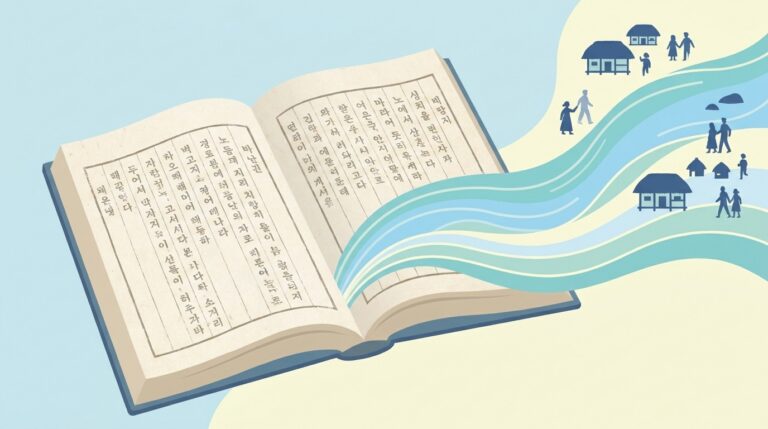
Take a deep breath—you are not failing. You have simply arrived at the pinnacle of the Korean language journey: the realm of modern historical sagas (대하소설). These masterworks do not use sterilized Seoul textbook prose. Instead, they capture the thunderous, agonizing transition from the late Joseon dynasty through colonial occupation and the tragic national division through the vibrant, unvarnished oral vernacular of the minjung (the common people). Today, we will unpack how Korean authors weave grand historical panoramas through polyphonic voices, giving you the high-level critical lexicon and narrative intuition needed to read, analyze, and discuss Korea’s greatest epics like an elite literary scholar.
Phase 2: Core Expressions Deep Dive
1. 직조해 내다 (Jikjohae naeda)
- Pronunciation: [Jik-jo-hae nae-da] (Think: jeek-jo-heh neh-dah, sounding like weaving thread tightly into a loom)
- Meaning: Literal: “To weave together fabric on a loom” | Nuanced: To intricately orchestrate complex narratives, historical threads, or disparate character arcs into a seamless tapestry.
- K-Culture Moment: Used by film critics and literary reviewers when discussing how directors like Bong Joon-ho (Parasite) or authors like Park Kyong-ni braid dozens of subplots into a cohesive, breathtaking climax.
- Editor’s Insight: While standard academic writing uses 구성하다 (to construct), 직조해 내다 evokes the physical craftsmanship of an artisan interlacing distinct, colored threads of human destiny.
- Situation Spectrum: Casual 🚫 | Semi-formal ⚠️ | Formal ✅
- 🤔 Think About It: Why does Korean culture frequently conceptualize collective historical memory through tactile craft metaphors like weaving rather than linear architectural blueprints?
2. 생동하는 입말 (Saengdonghaneun ipmal)
- Pronunciation: [Saeng-dong-ha-neun im-mal] (Pronounce the ‘p’ in ‘ip’ as an ‘m’ before ‘m’: seng-dong-hah-neun eem-mahl)
- Meaning: Literal: “Living mouth-speech” | Nuanced: Visceral, dynamic oral dialect pulsating with the rhythmic vitality, humor, and grit of real human speech.
- K-Culture Moment: Often cited when praising scripts like Our Blues (우리들의 블루스) or Reply 1988, where regional inflections and rustic speech patterns completely outshine formal grammar.
- Editor’s Insight: Unlike 문어체 (written literary style), 생동하는 입말 preserves the raw acoustic energy, phonetic contractions, and emotional exclamations of common folks (minjung).
- Situation Spectrum: Casual ⚠️ | Semi-formal ✅ | Formal ✅
- 🤔 Think About It: How does preserving regional, vernacular syntax protect marginalized cultural identities from being erased by standardized state language?
3. 다성적 인물 군상 (Daseongjeok inmul gunsang)
- Pronunciation: [Da-seong-jeok in-mul gun-sang] (dah-sung-juk een-mool goon-sahng)
- Meaning: Literal: “Polyphonic character constellation/group” | Nuanced: A multi-voiced cast of characters where no single moral perspective or ideological dogma dominates, reflecting Bakhtinian polyphony.
- K-Culture Moment: Frequently invoked in discussions of Taebaek Sanmaek or K-Dramas like Mr. Sunshine, where tenant farmers, Japanese collaborators, nationalist fighters, and aristocrats all voice legitimate human motives.
- Editor’s Insight: If you describe a novel as having 단순한 선악 구도 (a simplistic good-vs-evil dynamic), you dismiss it; calling it a 다성적 인물 군상 elevates your critique to elite academic aesthetic appreciation.
- Situation Spectrum: Casual 🚫 | Semi-formal ⚠️ | Formal ✅
- 🤔 Think About It: How does a society traumatized by ideological polarization benefit from novels that present polyphonic rather than dogmatic moral viewpoints?
Phase 3: Textbook Korean vs. Real Korean
Situation 1: Analyzing Literary Representation of History
- 📖 교과서 한국어: 이 소설은 역사적 사건을 사실적으로 잘 묘사했습니다. (I soseoreun yeoksajeok sageoneul sasiljeog-euro jal myosahaesseumnida. / This novel described historical events very realistically.)
- 🗣️ 진짜 한국어: 격동의 민족사를 박제된 기록이 아니라 생생한 민중의 입말로 직조해 냈어요. (Gyeokdong-ui minjoksareul bakjedoen girog-i anira saengsaenghan minjung-ui immallo jikjohae naesseoyo. / It wove the turbulent national history not as a taxidermied record, but through the vivid spoken idioms of the common people.)
- 💡 왜 다를까? Advanced Korean literary discussion avoids dry clinical descriptions like ‘잘 묘사했다’ and prefers conceptual antonyms such as contrasting ‘박제된 기록’ (stagnant/stuffed record) with ‘생동하는 서사’ (pulsating narrative).
Situation 2: Character Complexity and Moral Ambiguity
- 📖 교과서 한국어: 등장인물들의 성격이 모두 다르고 현실적입니다. (Deungjanginmuldeur-ui seonggyeog-i modu dareugo hyeonsiljeog-imnida. / The characters’ personalities are all different and realistic.)
- 🗣️ 진짜 한국어: 특정 이념에 편향되지 않은 다성적 인물 군상을 밀도 높게 그려냈죠. (Teukjeong inyeome pyeonhyangdoeji aneun daseongjeok inmul gunsangeul mildo nopge geuryeonaetjyo. / It densely depicted a polyphonic array of characters unbiased by any single ideology.)
- 💡 왜 다를까? At the C2 level, nuanced cultural discourse relies on terms like ‘밀도 높게’ (with high density/depth) and ‘다성적’ (polyphonic) to capture literary sophistication.
Phase 4: K-Culture Deep Dive & Non-Verbal Nuance
4-1. Nunchi & Salon Etiquette
When discussing modern Korean history, division literature (분단문학), or class conflicts in a seminar or literary salon, physical posture carries immense ideological weight. Koreans maintain a respectful, contemplative stance: nod slowly with eyes lowered slightly (경청의 시선) while processing conflicting perspectives. Avoid rapid dismissive gestures or aggressive finger-pointing. Use softening discourse markers like “~로 읽어낼 여지가 있지 않을까요?” (Might there be room to interpret it as…?) before offering counterarguments. This honors the historical gravity embedded in these texts.
4-2. The Cultural Matrix: Pansori Orality to Epic Realism
Why are Toji and Taebaek Sanmaek saturated with visceral dialect? Korean epic novels inherit the performance DNA of Pansori (판소리), where a singular storyteller breathes life into emperors and beggars alike through unedited vocal timbres. Just as global hits like Pachinko illustrate the multi-generational immigrant journey across regional dialects, classic Korean epics use vernacular speech to defy imperial erasure and state-sanctioned propaganda. Embracing this oral texture is key to unlocking authentic Korean Han (unresolved sorrow) and Heung (resilient collective joy).
Phase 5: Interactive Role-Play Scenario
Setting: A prestigious graduate seminar room overlooking the pine trees at Paju Book City (파주출판도시).
Characters: You (an advanced foreign researcher of Korean modern literature) and Professor Min (민 교수), an esteemed, warm, yet exacting literary scholar.
- Turn 1:
민 교수: 🎭 안경을 고쳐 쓰며 원고를 내려놓는다.
“이번 발제에서 박경리의 ‘토지’와 조정래의 ‘태백산맥’을 비교하셨는데, 두 작품의 문체적 공통점을 어떻게 규정할 수 있을까요?”
(Ibeon baljee-seo Bak Gyeong-ni-ui ‘Toji’-wa Jo Jeong-rae-ui ‘Taebaek Sanmaek’-eul bigyohasyeonneunde, du jakpum-ui munchejeok gongtongjeomeul eotteoke gyujeonghal su isseulkkayo? / In this presentation, you compared Park Kyong-ni’s ‘Land’ and Jo Jung-rae’s ‘The Taebaek Mountains’; how would you define the stylistic commonality between these two works?) -
Turn 2:
You: 🎭 턱을 가볍게 끄덕이며 진중한 목소리로
“두 작품 모두 역사의 격랑을 단일한 서술자의 시선이 아니라, 민중의 생동하는 입말로 직조해 냈다는 점에 주목했습니다.”
(Du jakpum modu yeoksa-ui gyeongnangeul danilhan seosulja-ui siseon-i anira, minjung-ui saengdonghaneun immallo jikjohae naetdaneun jeome jumokhaesseumnida. / I focused on the fact that both works wove the turbulent waves of history not through a single narrator’s gaze, but through the vibrant oral idioms of the common people.) -
Turn 3:
민 교수: 🎭 흥미롭다는 듯 상체를 앞으로 기울이며
“입말이라… 특히 방언과 비속어의 활용이 두드러지지요. 그것이 역사적 서사에서 갖는 힘은 무엇일까요?”
(Immarira… Teukhi bangeon-gwa bisogeo-ui hwalyong-i dudeureojijiyo. Geugeosi yeoksajeok seosa-eseo ganneun himeun mueosilkkayo? / Oral idioms… Especially the use of regional dialects and vulgarisms is prominent. What power does that hold in historical narrative?) -
Turn 4:
You: 🎭 메모를 짚으며 차분하게 논리를 전개한다.
“표준어로 정제된 기록 문학이 포착하지 못하는 당대 기저 민중의 한과 생명력을 날것 그대로 보존하는 역할을 합니다.”
(Pyojun-eoro jeongjedoen girok munhag-i pochakhaji mot-haneun dangdae gijeo minjung-ui han-gwa saengmyeongnyeogeul nalgeot geudaero bojeonhaneun yeokhareul hamnida. / It serves to preserve in its raw state the grief and vitality of the grass-roots populace, which documentation refined in standard language fails to capture.) -
Turn 5:
민 교수: 🎭 고개를 끄덕이며 미소를 띤다.
“정확한 지적입니다. 그렇다면 인물 형상화의 측면에서는 바흐틴의 다성악적 이론을 어떻게 접목시킬 수 있습니까?”
(Jeonghwakhan jijeog-imnida. Geureotdamyeon inmul hyeongsanghwa-ui cheungmyeon-eseoneun Baheutin-ui daseong-akjeok ironeul eotteoke jeommoksikil su isseumnikka? / An accurate observation. Then, in terms of characterization, how can we graft Bakhtin’s polyphonic theory onto them?) -
Turn 6:
You: 🎭 확신에 찬 어조로 두 손을 모은다.
“이념적 대립기 속에서도 작가가 어느 한 인물의 목소리에 특권을 부여하지 않고, 다성적 인물 군상의 치열한 길항을 그대로 드러냈다고 봅니다.”
(Inyeomjeok daeripgi sog-eseodo jakgaga eoneu han inmul-ui moksorie teukgwoneul buyeohaji anko, daseongjeok inmul gunsang-ui chiyeolhan gilhangeul geudaero deureonaetdago bomnida. / Even in an era of ideological confrontation, the authors did not privilege any single character’s voice, revealing instead the fierce antagonism of a polyphonic cast of characters.) -
Turn 7:
민 교수: 🎭 감탄한 듯 만년필로 책상을 가볍게 두드리며
“훌륭합니다. 단순한 이항대립을 넘어서서 민족사의 입체적 지형도를 포착해 내셨군요.”
(Hullyunghamnida. Dansunhan ihang-daeribeul neomeoseoseo minjoksa-ui ipchejeok jihyeongdoreul pochakhae naesyeotgunyo. / Splendid. You have captured the three-dimensional topography of our national history, transcending simplistic binary oppositions.) -
Turn 8:
You: 🎭 정중하게 고개 숙여 인사하며
“교수님의 통찰 덕분에 텍스트의 심층으로 한 걸음 더 들어갈 수 있었습니다. 감사합니다.”
(Gyosunim-ui tongchal deokbune tekseuteu-ui simcheung-euro han georeum deo deoreogal su isseotseumnida. Gamsahamnida. / Thanks to your insights, Professor, I was able to step one layer deeper into the text. Thank you.)
🔀 Interactive Decision Point
How would you conclude your defense when Professor Min asks about the limits of dialect in modernization literature?
- Choice A (Best): “방언을 단순한 토속적 장치가 아닌, 공식 담론에 맞서는 대항 서사의 주체적 언어로 재해석해야 합니다.” (Reinterpreting dialect not merely as a folkloric device, but as an autonomous language of counter-narrative against official discourse.)
Feedback: Best! Demonstrates peerless post-colonial critical theory mastery combined with sophisticated native phrasing. - Choice B (Risk): “사투리는 읽기 너무 어려워서 외국인 독자에게는 번역의 한계가 명확하다고 생각합니다.” (Dialects are too difficult to read, so I think translation limitations are clear for foreign readers.)
Feedback: Risk. While honest, shifting the focus from literary analysis to subjective translation difficulty lowers the intellectual caliber of an academic symposium. - Choice C (Bad): “그냥 옛날 시골 사람들의 말투일 뿐이라서 큰 의미는 없다고 봅니다.” (I think it’s just old country folks’ speech, so it doesn’t hold big significance.)
Feedback: Bad. Completely disregards the political, social, and aesthetic labor of historical realism.
Phase 6: 10-Second Emotion Shadowing Drill
Practice these high-register cadences by pausing at each / mark.
[🔥 장엄하고 비장하게]
거대한 역사의 격랑 속에서 / 민초들의 삶은 / 파편화되지 않고 끈질기게 이어졌습니다.
(Geodaehan yeoksa-ui gyeongnang sog-eseo / minchodeur-ui sarmeun / papyeonhwadoeji anko kkeonjil-gige ieojyeotseumnida.)
Amid the turbulent waves of grand history, / the lives of the common people / persisted tenaciously without being fragmented.-
[🧐 학구적이고 진지하게]
작가는 이데올로기적 맹점을 탈피하여 / 다성적 인물 군상의 목소리를 / 입체적으로 길항시키고 있죠.
(Jakkaneun ide-ollogijeok maengjeomeul talpihayeo / daseongjeok inmul gunsang-ui moksorireul / ipchejeog-euro gilhangsikigo itjyo.)
Breaking away from ideological blind spots, / the author creates a multidimensional counterpoise / among the voices of a polyphonic cast of characters. -
[🌿 감탄하며 여운을 남기듯]
생동하는 입말이 지닌 힘이란 / 활자 속에 갇힌 역사를 / 비로소 숨 쉬게 만드는 것입니다.
(Saengdonghaneun immari jinin him-iran / hwalja sog-e gachin yeoksareul / biroso sum swige mandeuneun geos-imnida.)
The power embedded in living oral speech / is that it finally breathes life / into history trapped inside print.
Phase 7: K-Culture Mini Dictionary
-
대하소설 (Daehasoseol) | Multi-volume epic saga
Literally meaning “great river novel,” referring to massive, multi-volume sagas that chronicle decades or centuries of socio-historical changes through interconnected generations (e.g., Toji, Taebaek Sanmaek, Arirang). -
판소리적 입말 (Pansori-jeok ipmal) | Rhythmic oral-vernacular idiom
The lively, rhythmically accented linguistic style derived from traditional Pansori performance, characterized by colloquial wordplay, dialect inflections, and auditory resilience. -
민중사 (Minjungsa) | People’s history / Bottom-up history
A historiographical paradigm that views ordinary citizens and marginalized workers as the primary driving agents of historical transformation rather than monarchs, politicians, or military elites. -
길항 (Gilhwang) | Antagonistic balance / Counterpoise
A high-level philosophical and critical term describing two opposing forces, ideologies, or literary voices contending intensely against one another without either collapsing or achieving easy resolution.
Phase 8: Traveler’s Literary Pilgrimage Survival Kit
Literary Traveler Top 3 Phrases
-
“이곳이 소설 속 최참판댁의 실제 모티프가 된 장소인가요?”
(Igosi soseol sok Choi-champan-daeg-ui silje motipeuga doen jangso-ingayo? / Is this the place that served as the real motif for the House of Lord Choi in the novel?)
Pro Tip: Use when visiting the Pyeongsa-ri set in Hadong county to engage local cultural docents. -
“태백산맥 문학관에서 해설사님의 도슨트 투어를 들을 수 있을까요?”
(Taebaeksanmaek munhwagwan-eseo haeseolsanim-ui doseonteu tueoreul deureul su isseulkkayo? / Can I attend the docent tour led by the commentator at the Taebaek Mountains Literary Museum?)
Pro Tip: Boseong’s Beolgyo region offers rich localized explanations of the Yeosu-Suncheon rebellion context. -
“박경리 작가님의 육필 원고가 전시된 공간이 어디인지 여쭤봐도 될까요?”
(Bak Gyeong-ni jakganim-ui yukpil won-goga jeonsidoen gonggani eodiinji yeojjwobwado doelkkayo? / May I ask where the space exhibiting author Park Kyong-ni’s original handwritten manuscripts is located?)
Pro Tip: Essential for your visit to the Park Kyong-ni House and Memorial Hall in Wonju, Gangwon-do.
Editor’s Travel Note
For the ultimate literary odyssey, take the KTX to Suncheon or Jinju and venture into Hadong (하동 평사리) or Beolgyo (벌교). Download and check schedules via the 코레일톡 스마트 기차 예매 서비스 beforehand. Navigate regional bus routes and hidden literary landmarks seamlessly by installing the 네이버 지도 앱 다운로드. Remember that many rural museum docents speak in rich, melodic regional accents—listen carefully; it is live immersion in the very oral language Park Kyong-ni immortalized!
Phase 9: “한 발 더 깊이” (One Step Deeper)
In Western literary traditions, the epic often coalesces around an idealized heroic individual navigating state crises. In contrast, Korean historical epics dismantle the singular hero. Influenced by decades of national division and military authoritarianism, 20th-century Korean literature turned to the collective mass—the minjung—whose endurance through famine, colonial subjugation, and fratricidal warfare constituted the true engine of survival. By weaving dialect and raw oral idioms into legitimate high literature, authors like Park Kyong-ni and Jo Jung-rae democratized Korean letters, establishing that national identity does not reside in royal decrees or standard bureaucratic edicts, but in the irrepressible banter, tears, and shouts of everyday people.
💬 Your Turn: Does your mother tongue possess monumental epics written primarily in regional dialects rather than the standardized literary language? How does hearing localized speech alter your emotional empathy toward historical events? Share your reflections below!
Phase 10: FAQ & Common Mistakes
Q: Why is regional dialect (사투리) so vital in Korean modern historical literature?
A: Because dialect operates as an authentic vessel of social memory and resistance. In works like Taebaek Sanmaek, the Jeolla dialect is not an aesthetic decoration; it embodies the historicized pain, socioeconomic marginalization, and collective communal solidarity of southern tenant farmers fighting for survival.
Q: What is the literary difference between ‘대하소설’ (Daehasoseol) and an episodic novel series?
A: A series often follows independent episodes of a central protagonist (like Sherlock Holmes). A daehasoseol resembles a grand, continuous river: it spans decades or centuries across multi-generational genealogical trees, intertwining hundreds of polyphonic characters against national socio-political upheavals.
Q: How can an advanced learner read these massive novels without getting overwhelmed by archaic terms?
A: Do not look up every single obscure dialect word on your first pass! Focus on the rhythmic cadence of the speech (ipmal) and contextual emotional tone. Modern annotated editions published by Minumsa or Changbi feature specialized glossaries in foot- or end-notes.
🚨 Common Mistakes Warning Board
- Mistake: Pronouncing ‘입말’ literally as [ip-mal].
Correct Action: Apply nasal assimilation (비음화); pronounce it naturally as [임말 / im-mal]. - Mistake: Labeling regional dialects in literature as ‘비표준어이므로 열등한 표현’ (inferior expressions because they are non-standard).
Correct Action: Describe them as ‘생동하는 지역어의 보고’ (a treasury of living regional language) or ‘생동하는 입말’. - Mistake: Confusing 분단문학 (Division Literature) with simple military/war action fiction.
Correct Action: Acknowledge division literature as an examination of existential ideological fracture, divided families, and psychic post-war trauma.
Phase 11: Action Missions
- 🥉 Bronze Mission (Solo Practice): Read the opening scene of Park Kyong-ni’s Toji aloud. Focus on capturing the cadence of harvest festivities and the rhythm of rustic village dialogue.
- 🥈 Silver Mission (Social Share): Pick one powerful quote containing vernacular idiom from a Korean historical novel or period drama (such as Mister Sunshine) and post an analytical micro-review on your social media using the terms
생동하는 입말and직조해 내다. - 🥇 Gold Mission (Real-World Execution): Visit a Korean literary museum (or participate in an online Korean literature book club) and contribute one analytical argument evaluating whether the text achieves a
다성적 인물 군상. - 🎮 K-Culture Mission: Watch an episode of a period K-Drama depicting modern history (such as Jejeon or Pachinko) with Korean subtitles turned on. Transcribe three spoken phrases that end in non-standard dialect sentence endings (e.g., ~했구마잉, ~했소잉, ~하더이다).
Phase 12: Interactive Quiz Challenge
1. Situational Judgment:
You are giving a paper at an academic conference on Korean division literature. Which phrase best demonstrates C2-level literary sophistication when praising the diverse perspectives in a novel?
(a) 주인공이 착해서 감동을 주는 소설입니다.
(b) 한쪽 이념에 치우치지 않고 다성적 인물 군상의 목소리를 생생하게 직조해 냈습니다.
(c) 어려운 사투리를 많이 써서 분량이 아주 깁니다.
2. Fill-in-the-Blank:
“이 대하소설은 박제된 문자 기록에 머물지 않고 민중의 ( )을/를 생생하게 살려냈다.”
[Hint: The two-syllable term meaning ‘living spoken oral language’]
3. True or False:
In modern Korean literary criticism, ‘대하소설’ typically refers to short novellas focusing strictly on modern urban alienation in Seoul during the 1990s. (True / False)
👉 Click to reveal answers & detailed explanations!
-
Answer: (b)
Explanation: Option (b) uses high-register critical vocabulary (다성적 인물 군상,직조해 냈다) appropriate for scholarly discourse, whereas (a) is overly simplistic and (c) treats dialect merely as difficult bulk. -
Answer: 입말 (or 생동하는 입말)
Explanation: ‘입말’ (oral vernacular / spoken idiom) is the defining attribute that gives Korean epic literature its pulsating vitality. -
Answer: False
Explanation: That describes postmodern urban novellas. ‘대하소설’ denotes monumental, multi-volume genealogical epics covering grand historical epochs over vast geographical canvases.






